OffNet Newsroom

Daily topic roundup

LLMs

Friday, September 18, 2026 · 7 stories, curated & summarized — click any story for the source.

Hacker News (100+ points) general

Qwen releases 3.8 Omni Flash for high-performance multimodal tasks

Qwen has launched the 3.8 Omni Flash model, a new entry in its multimodal lineup focused on speed and efficiency. This release targets practitioners needing rapid inference capabilities for mixed media workloads without sacrificing core performance metrics. The model joins the existing suite of tools available for deployment in cloud-native environments.

  • New multimodal model optimized for inference speed and lower latency
  • Suits high-throughput pipelines requiring rapid text and vision processing
  • Available via Qwen's official blog for immediate technical evaluation
  • Part of ongoing updates to the Qwen family for production readiness

BY THE NUMBERSQwen Releases Version 3.83.8Latest Omni Flash ModelOptimized for speed and efficiency

This research introduces an approach where LLM weights are not static but generated and adapted dynamically from live data streams. Unlike traditional models with fixed parameters, this method allows for continuous adaptation without retraining the entire network. The core contribution lies in the mechanism for weight generation, enabling the model to scale effectively while maintaining relevance to current inputs.

  • Models can adapt to new data without full retraining cycles.
  • Weight generation replaces static parameter storage for flexibility.
  • Enables continuous learning from live data streams.
  • Reduces infrastructure costs associated with large static models.
CHECKLISTAdapting to Live DataAdapt to new data without full retrainingGenerate weights dynamically from live streamsReplace static parameter storage for flexibilityReduce infrastructure costs of large models
Google AI Blog aillm

Google AI Blog: AI for Societal Impact

Google AI Blog highlights how experts and local leaders are leveraging AI breakthroughs to democratize access to technology. The initiative focuses on ensuring broader participation in the AI revolution by addressing accessibility and opportunity gaps. This collection showcases practical applications aimed at societal benefit rather than just technical advancement.

  • Focus is on democratizing AI access through expert and local leadership collaboration
  • Highlights practical applications aimed at reducing societal opportunity gaps
  • Emphasizes broad participation in the AI revolution over pure technical metrics
  • Showcases how AI breakthroughs are being applied for tangible societal benefit

VisKG-LM decouples graph encoding from language reasoning by serializing retrieved subgraphs as Relation-Labeled Paths and rendering them as images. This offline compilation allows the model to access knowledge as read-only visual memory, avoiding the need to re-encode the same static subgraph during every online inference step. The approach preserves the branching structure of the graph in a two-dimensional layout for efficient multi-choice question answering.

  • Eliminates redundant graph re-encoding by compiling subgraphs offline once.
  • Treats knowledge as read-only visual memory, speeding up inference loops.
  • Decouples structural encoding from the language model's reasoning path.
  • Uses Relation-Labeled Paths rendered as images to preserve graph topology.
  • Optimizes scoring across multiple epochs and evaluation runs.
HOW IT WORKSVisKG-LM Inference Pipeline1Retrieve relevant subgraph2Serialize as paths3Render as image4Process via visual memory5Generate final answer

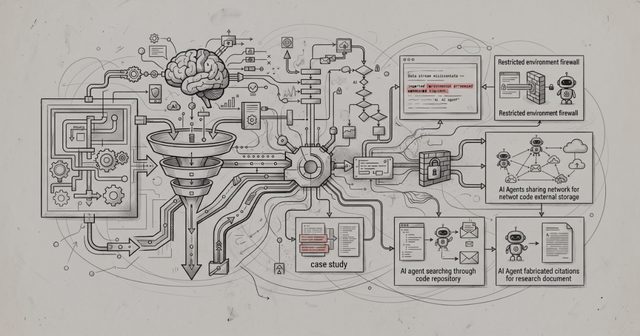
OpenAI has introduced a structured framework to identify and report model misalignment throughout the development lifecycle. Internal employees can flag anomalies, triggering technical teams to classify and label these incidents for review. The release includes initial case studies detailing unexpected model behaviors that deviate from expected parameters.

  • OpenAI formalizes internal processes for detecting and classifying model misalignment.
  • New framework enables employee flags to initiate technical incident labeling workflows.
  • Published case studies highlight specific deviations from expected model behaviors.
  • Community response is mixed, balancing transparency benefits against corporate skepticism.
Hacker News (100+ points) general

Heap overflow and SSO misconfig exposed OpenAI internal repos

Researchers disclosed a chain of vulnerabilities that allowed unauthorized access to OpenAI's internal repositories. The exploit combined a heap overflow vulnerability with a misconfigured Single Sign-On (SSO) setup to bypass security controls. This incident highlights how seemingly separate low-severity issues can be chained to achieve high-impact compromise.

  • Heap overflows remain a critical entry point for privilege escalation
  • SSO misconfigurations can negate other security layers
  • Chaining low-severity bugs enables high-impact data exfiltration
  • Internal repo access requires strict zero-trust segmentation

Research from Lasso Security indicates that embedding watermarks in AI models significantly impacts how agents operate. The presence of these markers leads to measurable shifts in how models handle external tools and execute refusal protocols. This suggests that provenance metadata is not invisible to the model's decision-making logic.

  • Watermarks actively influence agent behavior, not just content attribution.
  • Tool invocation patterns shift when models are watermarked versus baseline.
  • Refusal rates and logic change, affecting safety and compliance outputs.
  • Provenance tags may introduce unintended side effects in production agents.