OffNet Newsroom

Daily topic roundup

AI / ML

Friday, September 18, 2026 · 6 stories, curated & summarized — click any story for the source.

PrismML has released Bonsai 2 27B, a new model variant that significantly reduces memory requirements while maintaining high fidelity. The compression technique reportedly shrinks the model footprint by a factor of nine with minimal accuracy degradation. This advancement targets inference efficiency and deployment costs for large language models.

  • Reduces model size by 9x, lowering hardware and storage costs.
  • Maintains near-lossless accuracy, minimizing performance trade-offs.
  • Enables deployment of 27B models on less powerful infrastructure.
  • May simplify scaling strategies for LLM inference fleets.

ScientistTwo is a fully autonomous multi-agent framework designed to execute problem-driven research. It takes a fundamental challenge from a human expert and independently navigates the scientific landscape to identify theoretical and empirical bottlenecks. The system establishes baselines, formulates novel hypotheses, and coordinates specialized agents to orchestrate an end-to-end discovery cycle.

  • Enables fully autonomous end-to-end scientific discovery cycles without human intervention.
  • Coordinates specialized agents to handle hypothesis formulation and bottleneck identification.
  • Aims to expand the human knowledge frontier by venturing into unexplored scientific territory.
  • Moves beyond assisted research to problem-driven autonomous AI navigation of scientific landscapes.
HOW IT WORKSAutonomous Discovery Cycle1Identify Theoretical Bottlenecks2Formulate Novel Hypotheses3Coordinate Specialized Agents4Execute End-to-End Research

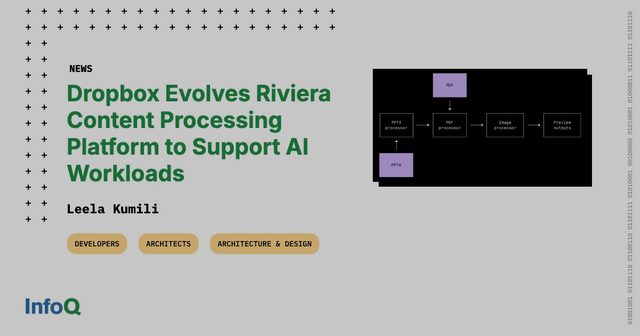
Dropbox has transformed its Riviera service from a simple file preview tool into a universal content processing engine capable of handling over 300 file formats. The platform now executes hundreds of thousands of transformations per second and supports features like Search, Replay, Sign, and Dash. Crucially, its APIs facilitate asynchronous content extraction, enabling robust AI and Retrieval-Augmented Generation (RAG) workflows.

  • Riviera scaled to support 300+ file formats and 100+ transformation types.
  • Throughput now handles hundreds of thousands of transformations per second.
  • New APIs enable asynchronous content extraction for AI and RAG pipelines.
  • Platform now underpins core products: Search, Replay, Sign, and Dash.
AWS What's New awsdatabase ↺ since 09-16

SageMaker AI adds instance preference lists for training and processing jobs

Amazon SageMaker AI now accepts prioritized lists of instance types for training and processing workloads, allowing the scheduler to select from multiple acceptable options rather than a single fixed type. This change eliminates the need for custom retry logic or concurrent job submissions to handle GPU contention during peak demand. The feature automates capacity discovery, reducing wait times and simplifying job configuration for workloads that are flexible across instance sizes.

  • Submit a prioritized list of instance types instead of a single option to increase scheduling flexibility.
  • Avoid complex custom retry logic or concurrent job submissions for GPU availability issues.
  • Reduce job start times during peak periods by allowing SageMaker to pick the first available instance.
  • Ideal for training and processing workloads that perform comparably across multiple instance families.
CHECKLISTOptimize SageMaker Instance SelectionSubmit prioritized instance type listsEliminate custom retry logic complexityReduce job start times during peaksLeverage flexible workload instance families
InfoQ generaldevops ↺ since 09-17

Typed Domain Grounding Reduces LLM Hallucinations in DSL Generation

The article introduces Typed Domain Grounding, a method to minimize LLM hallucinations when generating domain-specific languages by embedding them within mainstream typed languages. By leveraging compiler validation and generate-compile-repair loops, the approach ensures that model-generated DSL output adheres to strict type constraints. Benchmarks using kUML and infrastructure-as-code examples demonstrate improved reliability through this hybrid validation strategy.

  • Embed DSLs in mainstream typed languages to enforce structural correctness at generation time.
  • Use compiler validation as a gatekeeper to catch LLM hallucinations before execution.
  • Implement generate-compile-repair loops to automatically fix type errors in model output.
  • kUML benchmarks and IaC examples validate the approach's effectiveness in reducing errors.
AWS What's New awsdatabase ↺ since 09-16

AWS SageMaker JumpStart adds Granite Speech, Kanana 2, and OpenFold3

Amazon SageMaker JumpStart now hosts models from IBM, Kakao, and the OpenFold Consortium. The update introduces granite-speech-4.1-2b for multilingual AS and AST, kanana-2-30b-a3b-instruct for bilingual agentic tasks, and OpenFold3 for biomolecular structure prediction. These additions expand the available foundation model portfolio for scalable AWS deployments.

  • IBM's granite-speech-4.1-2b handles multilingual ASR and translation for 6 languages.
  • Kakao's kanana-2-30b-a3b-instruct targets bilingual agentic AI workflows.
  • OpenFold3 supports biomolecular structure prediction via SageMaker JumpStart.
  • All three models are now deployable as standard JumpStart foundation models.
BY THE NUMBERSNew IBM Model Versions4.1Granite Speech versionMultilingual ASR and AST support