OffNet Newsroom

Daily topic roundup

Database Technology

Friday, September 18, 2026 · 8 stories, curated & summarized — click any story for the source.

This AWS Database Blog post details a three-tier architecture combining Amazon ElastiCache for Valkey, an exact-match cache, and Amazon Aurora PostgreSQL to create a membership lookup system. The design leverages Bloom filters for initial screening while ensuring zero false-positive risk through subsequent exact-match verification against the relational source of truth. The approach aims to deliver sub-millisecond decision times at peak throughput by minimizing expensive database hits.

  • Eliminates false-positive risk by using exact-match verification after Bloom filter screening.
  • Achieves sub-millisecond latency for membership lookups at high throughput.
  • Combines Valkey for speed with Aurora PostgreSQL as the authoritative data source.
  • Reduces database load by filtering non-existent keys before hitting Aurora.
HOW IT WORKSThree-Tier Lookup Architecture1Bloom filter screening2Exact-match cache check3Aurora PostgreSQL verification

Percona developed a custom harness to evaluate how well large language models handle specialized database administration workloads. The testing focuses on practical systems-administration tasks executed against remote systems rather than theoretical prompts. This approach aims to measure the actual utility of LLMs in operational database environments.

  • Percona built a specific harness to test LLMs on real-world DBA tasks
  • Evaluation targets practical systems-administration rather than abstract queries
  • Tests run against remote systems to simulate actual operational conditions
  • Goal is to determine LLM readiness for specialized database administration
HOW IT WORKSPercona LLM Evaluation Pipeline1Build custom evaluation harness2Select real DBA tasks3Connect to remote systems4Execute practical admin workloads5Measure operational utility

Christophe Pettus explains the introduction of max_notify_queue_pages, a new GUC that enforces a hard limit on the LISTEN/NOTIFY queue size. Previously, this queue, stored as SLRU pages in pg_notify, relied on implicit bounds that ceased to function effectively. This new parameter provides explicit control to prevent unbounded memory consumption in PostgreSQL clusters.

  • Explicitly limits LISTEN/NOTIFY queue memory via pg_notify SLRU pages
  • Fixes broken self-enforcement from versions prior to PostgreSQL 17
  • Prevents runaway memory usage in high-throughput notification scenarios
  • Configurable via GUC for operational tuning and stability
CHECKLISTLimiting Notify Queue MemoryCap queue size with max_notify_queue_pagesFix broken self-enforcement from pre-17 versionsPrevent runaway memory in high-throughput scenariosTune stability via explicit GUC configuration

The pgAdmin 4 development team released version 9.18, addressing four security vulnerabilities (CVE-2026-86861 through CVE-2026-86864) alongside 29 bug fixes. Key features include a toggleable Object Explorer that mimics VS Code's sidebar behavior and persists state across refreshes. The release also hardens default Content-Security-Policy settings and introduces a customizable keyboard shortcut for toggling the explorer.

  • Urgently patch to mitigate four new CVEs affecting pgAdmin 4 installations.
  • Adopt the new toggle_object_explorer preference for faster UI navigation.
  • Review Content-Security-Policy changes to ensure no dependency breakage.
  • Update to v9.18 to resolve 29 assorted bugs and stability issues.
BY THE NUMBERSFour Critical CVEs Patched4Security vulnerabilities fixedUrgently patch to mitigate new CVEs

The fourth alpha release of pgColumnar focuses on improving data layout and query skipping capabilities. It introduces Hilbert curve-based table layout to keep neighboring keys closer together compared to Z-ordering. Additionally, the release enhances star-schema joins by enabling the skipping of fact-table groups during execution.

  • Hilbert curve layout offers better locality than Z-ordering for neighboring keys.
  • Star-schema joins now support skipping fact-table groups for improved performance.
  • This alpha release targets layout efficiency and query execution optimization.
  • pgColumnar continues to evolve as a columnar access method for PostgreSQL.
TRADE-OFFLayout Methods ComparedZ-OrderingLess locality for neighborsStandard baseline approachHilbert CurveBetter locality for neighborsKeeps keys closer togethervs

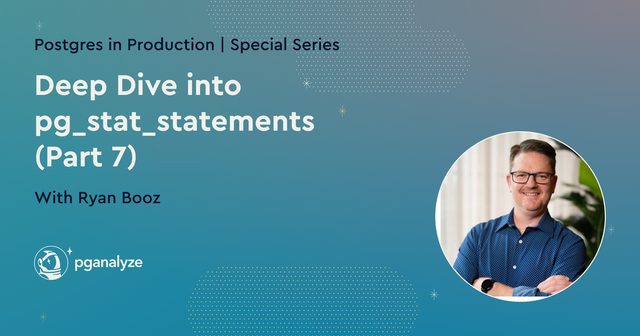
Ryan Booz concludes his Postgres in Production series by demonstrating how to query pg_stat_statements to identify expensive database operations. He emphasizes starting incident response with pg_stat_activity and explains methods like snapshot diffing to derive usable metrics from cumulative counters. The guide also covers column selection for ordering results and criteria for choosing monitoring tools to preserve this history.

  • Prioritize pg_stat_activity over pg_stat_statements during initial incident triage.
  • Use snapshot diffing or reset-and-requery patterns to handle cumulative metric limitations.
  • Order results by cost metrics, not just duration, as slowest isn't always most expensive.
  • Select monitoring tools specifically for their ability to persist and analyze this history.

PostgreSQL 19's release cycle encountered significant delays due to an aggressive pace that saw eight major features land in the five weeks preceding the code freeze. The intense development pressure led to three committers withdrawing their contributions, causing the release process to falter under its own scope. This highlights the risks associated with compressing large-scale feature integration into tight pre-freeze windows.

  • PostgreSQL 19 release is delayed or unstable due to scope creep.
  • Eight major features merged late, destabilizing the freeze period.
  • Three committers withdrew work, indicating burnout or quality concerns.
  • Late-merge risk management is critical for major version stability.
CHECKLISTStabilizing Late IntegrationAvoid merging major features in final weeksPrevent committer burnout through scope controlEnforce strict pre-freeze code freeze rulesPrioritize stability over new feature inclusion

Ryan Booz highlights the paradigm shift for SQL Server DBAs moving to PostgreSQL, where performance tuning relies heavily on log analysis rather than just in-database views. Unlike SQL Server's DMVs and Query Store, Postgres often requires combing through logs to identify query performance issues, as the error log serves as a critical daily instrument. This article serves as an introductory guide to understanding these fundamental differences in observability and debugging strategies.

  • SQL Server DBAs must shift from relying solely on DMVs/Query Store to analyzing logs for performance insights.
  • Postgres error logs are a primary daily instrument for tuning, not just for incident response.
  • Expect a learning curve in locating performance data outside of GUI tools like SSMS equivalents.
  • Understanding log structures is essential for effective query optimization in Postgres.