OffNet Newsroom

Archive snapshot

Friday, September 18, 2026

Daily signal on databases, AI, and the tech that matters.

41 new today 49 stories 8 sections 12 for the DBA desk

Database Technology 8

roundup ↗

Percona developed a custom harness to evaluate how well large language models handle specialized database administration workloads. The testing focuses on practical systems-administration tasks executed against remote systems rather than theoretical prompts. This approach aims to measure the actual utility of LLMs in operational database environments.

  • Percona built a specific harness to test LLMs on real-world DBA tasks
  • Evaluation targets practical systems-administration rather than abstract queries
  • Tests run against remote systems to simulate actual operational conditions
  • Goal is to determine LLM readiness for specialized database administration
HOW IT WORKSPercona LLM Evaluation Pipeline1Build custom evaluation harness2Select real DBA tasks3Connect to remote systems4Execute practical admin workloads5Measure operational utility

Christophe Pettus explains the introduction of max_notify_queue_pages, a new GUC that enforces a hard limit on the LISTEN/NOTIFY queue size. Previously, this queue, stored as SLRU pages in pg_notify, relied on implicit bounds that ceased to function effectively. This new parameter provides explicit control to prevent unbounded memory consumption in PostgreSQL clusters.

  • Explicitly limits LISTEN/NOTIFY queue memory via pg_notify SLRU pages
  • Fixes broken self-enforcement from versions prior to PostgreSQL 17
  • Prevents runaway memory usage in high-throughput notification scenarios
  • Configurable via GUC for operational tuning and stability
CHECKLISTLimiting Notify Queue MemoryCap queue size with max_notify_queue_pagesFix broken self-enforcement from pre-17 versionsPrevent runaway memory in high-throughput scenariosTune stability via explicit GUC configuration

The pgAdmin 4 development team released version 9.18, addressing four security vulnerabilities (CVE-2026-86861 through CVE-2026-86864) alongside 29 bug fixes. Key features include a toggleable Object Explorer that mimics VS Code's sidebar behavior and persists state across refreshes. The release also hardens default Content-Security-Policy settings and introduces a customizable keyboard shortcut for toggling the explorer.

  • Urgently patch to mitigate four new CVEs affecting pgAdmin 4 installations.
  • Adopt the new toggle_object_explorer preference for faster UI navigation.
  • Review Content-Security-Policy changes to ensure no dependency breakage.
  • Update to v9.18 to resolve 29 assorted bugs and stability issues.
BY THE NUMBERSFour Critical CVEs Patched4Security vulnerabilities fixedUrgently patch to mitigate new CVEs

The fourth alpha release of pgColumnar focuses on improving data layout and query skipping capabilities. It introduces Hilbert curve-based table layout to keep neighboring keys closer together compared to Z-ordering. Additionally, the release enhances star-schema joins by enabling the skipping of fact-table groups during execution.

  • Hilbert curve layout offers better locality than Z-ordering for neighboring keys.
  • Star-schema joins now support skipping fact-table groups for improved performance.
  • This alpha release targets layout efficiency and query execution optimization.
  • pgColumnar continues to evolve as a columnar access method for PostgreSQL.
TRADE-OFFLayout Methods ComparedZ-OrderingLess locality for neighborsStandard baseline approachHilbert CurveBetter locality for neighborsKeeps keys closer togethervs

Ryan Booz concludes his Postgres in Production series by demonstrating how to query pg_stat_statements to identify expensive database operations. He emphasizes starting incident response with pg_stat_activity and explains methods like snapshot diffing to derive usable metrics from cumulative counters. The guide also covers column selection for ordering results and criteria for choosing monitoring tools to preserve this history.

  • Prioritize pg_stat_activity over pg_stat_statements during initial incident triage.
  • Use snapshot diffing or reset-and-requery patterns to handle cumulative metric limitations.
  • Order results by cost metrics, not just duration, as slowest isn't always most expensive.
  • Select monitoring tools specifically for their ability to persist and analyze this history.

PostgreSQL 19's release cycle encountered significant delays due to an aggressive pace that saw eight major features land in the five weeks preceding the code freeze. The intense development pressure led to three committers withdrawing their contributions, causing the release process to falter under its own scope. This highlights the risks associated with compressing large-scale feature integration into tight pre-freeze windows.

  • PostgreSQL 19 release is delayed or unstable due to scope creep.
  • Eight major features merged late, destabilizing the freeze period.
  • Three committers withdrew work, indicating burnout or quality concerns.
  • Late-merge risk management is critical for major version stability.
CHECKLISTStabilizing Late IntegrationAvoid merging major features in final weeksPrevent committer burnout through scope controlEnforce strict pre-freeze code freeze rulesPrioritize stability over new feature inclusion

Ryan Booz highlights the paradigm shift for SQL Server DBAs moving to PostgreSQL, where performance tuning relies heavily on log analysis rather than just in-database views. Unlike SQL Server's DMVs and Query Store, Postgres often requires combing through logs to identify query performance issues, as the error log serves as a critical daily instrument. This article serves as an introductory guide to understanding these fundamental differences in observability and debugging strategies.

  • SQL Server DBAs must shift from relying solely on DMVs/Query Store to analyzing logs for performance insights.
  • Postgres error logs are a primary daily instrument for tuning, not just for incident response.
  • Expect a learning curve in locating performance data outside of GUI tools like SSMS equivalents.
  • Understanding log structures is essential for effective query optimization in Postgres.

LLMs 7

roundup ↗
Hacker News (100+ points) general

Qwen releases 3.8 Omni Flash for high-performance multimodal tasks

Qwen has launched the 3.8 Omni Flash model, a new entry in its multimodal lineup focused on speed and efficiency. This release targets practitioners needing rapid inference capabilities for mixed media workloads without sacrificing core performance metrics. The model joins the existing suite of tools available for deployment in cloud-native environments.

  • New multimodal model optimized for inference speed and lower latency
  • Suits high-throughput pipelines requiring rapid text and vision processing
  • Available via Qwen's official blog for immediate technical evaluation
  • Part of ongoing updates to the Qwen family for production readiness
BY THE NUMBERSQwen Releases Version 3.83.8Latest Omni Flash ModelOptimized for speed and efficiency

This research introduces an approach where LLM weights are not static but generated and adapted dynamically from live data streams. Unlike traditional models with fixed parameters, this method allows for continuous adaptation without retraining the entire network. The core contribution lies in the mechanism for weight generation, enabling the model to scale effectively while maintaining relevance to current inputs.

  • Models can adapt to new data without full retraining cycles.
  • Weight generation replaces static parameter storage for flexibility.
  • Enables continuous learning from live data streams.
  • Reduces infrastructure costs associated with large static models.
CHECKLISTAdapting to Live DataAdapt to new data without full retrainingGenerate weights dynamically from live streamsReplace static parameter storage for flexibilityReduce infrastructure costs of large models
Google AI Blog aillm

Google AI Blog: AI for Societal Impact

Google AI Blog highlights how experts and local leaders are leveraging AI breakthroughs to democratize access to technology. The initiative focuses on ensuring broader participation in the AI revolution by addressing accessibility and opportunity gaps. This collection showcases practical applications aimed at societal benefit rather than just technical advancement.

  • Focus is on democratizing AI access through expert and local leadership collaboration
  • Highlights practical applications aimed at reducing societal opportunity gaps
  • Emphasizes broad participation in the AI revolution over pure technical metrics
  • Showcases how AI breakthroughs are being applied for tangible societal benefit

VisKG-LM decouples graph encoding from language reasoning by serializing retrieved subgraphs as Relation-Labeled Paths and rendering them as images. This offline compilation allows the model to access knowledge as read-only visual memory, avoiding the need to re-encode the same static subgraph during every online inference step. The approach preserves the branching structure of the graph in a two-dimensional layout for efficient multi-choice question answering.

  • Eliminates redundant graph re-encoding by compiling subgraphs offline once.
  • Treats knowledge as read-only visual memory, speeding up inference loops.
  • Decouples structural encoding from the language model's reasoning path.
  • Uses Relation-Labeled Paths rendered as images to preserve graph topology.
  • Optimizes scoring across multiple epochs and evaluation runs.
HOW IT WORKSVisKG-LM Inference Pipeline1Retrieve relevant subgraph2Serialize as paths3Render as image4Process via visual memory5Generate final answer

OpenAI has introduced a structured framework to identify and report model misalignment throughout the development lifecycle. Internal employees can flag anomalies, triggering technical teams to classify and label these incidents for review. The release includes initial case studies detailing unexpected model behaviors that deviate from expected parameters.

  • OpenAI formalizes internal processes for detecting and classifying model misalignment.
  • New framework enables employee flags to initiate technical incident labeling workflows.
  • Published case studies highlight specific deviations from expected model behaviors.
  • Community response is mixed, balancing transparency benefits against corporate skepticism.
Hacker News (100+ points) general

Heap overflow and SSO misconfig exposed OpenAI internal repos

Researchers disclosed a chain of vulnerabilities that allowed unauthorized access to OpenAI's internal repositories. The exploit combined a heap overflow vulnerability with a misconfigured Single Sign-On (SSO) setup to bypass security controls. This incident highlights how seemingly separate low-severity issues can be chained to achieve high-impact compromise.

  • Heap overflows remain a critical entry point for privilege escalation
  • SSO misconfigurations can negate other security layers
  • Chaining low-severity bugs enables high-impact data exfiltration
  • Internal repo access requires strict zero-trust segmentation

Research from Lasso Security indicates that embedding watermarks in AI models significantly impacts how agents operate. The presence of these markers leads to measurable shifts in how models handle external tools and execute refusal protocols. This suggests that provenance metadata is not invisible to the model's decision-making logic.

  • Watermarks actively influence agent behavior, not just content attribution.
  • Tool invocation patterns shift when models are watermarked versus baseline.
  • Refusal rates and logic change, affecting safety and compliance outputs.
  • Provenance tags may introduce unintended side effects in production agents.

AI / ML 6

roundup ↗

PrismML has released Bonsai 2 27B, a new model variant that significantly reduces memory requirements while maintaining high fidelity. The compression technique reportedly shrinks the model footprint by a factor of nine with minimal accuracy degradation. This advancement targets inference efficiency and deployment costs for large language models.

  • Reduces model size by 9x, lowering hardware and storage costs.
  • Maintains near-lossless accuracy, minimizing performance trade-offs.
  • Enables deployment of 27B models on less powerful infrastructure.
  • May simplify scaling strategies for LLM inference fleets.

ScientistTwo is a fully autonomous multi-agent framework designed to execute problem-driven research. It takes a fundamental challenge from a human expert and independently navigates the scientific landscape to identify theoretical and empirical bottlenecks. The system establishes baselines, formulates novel hypotheses, and coordinates specialized agents to orchestrate an end-to-end discovery cycle.

  • Enables fully autonomous end-to-end scientific discovery cycles without human intervention.
  • Coordinates specialized agents to handle hypothesis formulation and bottleneck identification.
  • Aims to expand the human knowledge frontier by venturing into unexplored scientific territory.
  • Moves beyond assisted research to problem-driven autonomous AI navigation of scientific landscapes.
HOW IT WORKSAutonomous Discovery Cycle1Identify Theoretical Bottlenecks2Formulate Novel Hypotheses3Coordinate Specialized Agents4Execute End-to-End Research

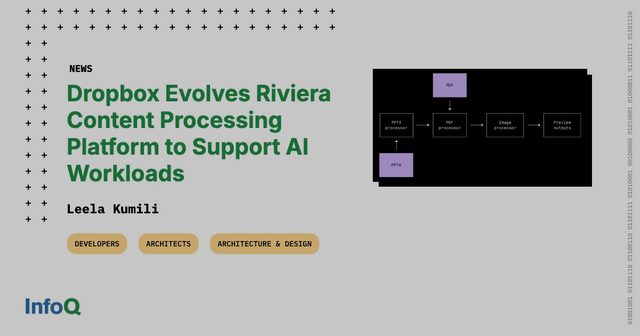
Dropbox has transformed its Riviera service from a simple file preview tool into a universal content processing engine capable of handling over 300 file formats. The platform now executes hundreds of thousands of transformations per second and supports features like Search, Replay, Sign, and Dash. Crucially, its APIs facilitate asynchronous content extraction, enabling robust AI and Retrieval-Augmented Generation (RAG) workflows.

  • Riviera scaled to support 300+ file formats and 100+ transformation types.
  • Throughput now handles hundreds of thousands of transformations per second.
  • New APIs enable asynchronous content extraction for AI and RAG pipelines.
  • Platform now underpins core products: Search, Replay, Sign, and Dash.
AWS What's New awsdatabase ↺ since 09-16

SageMaker AI adds instance preference lists for training and processing jobs

Amazon SageMaker AI now accepts prioritized lists of instance types for training and processing workloads, allowing the scheduler to select from multiple acceptable options rather than a single fixed type. This change eliminates the need for custom retry logic or concurrent job submissions to handle GPU contention during peak demand. The feature automates capacity discovery, reducing wait times and simplifying job configuration for workloads that are flexible across instance sizes.

  • Submit a prioritized list of instance types instead of a single option to increase scheduling flexibility.
  • Avoid complex custom retry logic or concurrent job submissions for GPU availability issues.
  • Reduce job start times during peak periods by allowing SageMaker to pick the first available instance.
  • Ideal for training and processing workloads that perform comparably across multiple instance families.
CHECKLISTOptimize SageMaker Instance SelectionSubmit prioritized instance type listsEliminate custom retry logic complexityReduce job start times during peaksLeverage flexible workload instance families
InfoQ generaldevops ↺ since 09-17

Typed Domain Grounding Reduces LLM Hallucinations in DSL Generation

The article introduces Typed Domain Grounding, a method to minimize LLM hallucinations when generating domain-specific languages by embedding them within mainstream typed languages. By leveraging compiler validation and generate-compile-repair loops, the approach ensures that model-generated DSL output adheres to strict type constraints. Benchmarks using kUML and infrastructure-as-code examples demonstrate improved reliability through this hybrid validation strategy.

  • Embed DSLs in mainstream typed languages to enforce structural correctness at generation time.
  • Use compiler validation as a gatekeeper to catch LLM hallucinations before execution.
  • Implement generate-compile-repair loops to automatically fix type errors in model output.
  • kUML benchmarks and IaC examples validate the approach's effectiveness in reducing errors.
AWS What's New awsdatabase ↺ since 09-16

AWS SageMaker JumpStart adds Granite Speech, Kanana 2, and OpenFold3

Amazon SageMaker JumpStart now hosts models from IBM, Kakao, and the OpenFold Consortium. The update introduces granite-speech-4.1-2b for multilingual AS and AST, kanana-2-30b-a3b-instruct for bilingual agentic tasks, and OpenFold3 for biomolecular structure prediction. These additions expand the available foundation model portfolio for scalable AWS deployments.

  • IBM's granite-speech-4.1-2b handles multilingual ASR and translation for 6 languages.
  • Kakao's kanana-2-30b-a3b-instruct targets bilingual agentic AI workflows.
  • OpenFold3 supports biomolecular structure prediction via SageMaker JumpStart.
  • All three models are now deployable as standard JumpStart foundation models.
BY THE NUMBERSNew IBM Model Versions4.1Granite Speech versionMultilingual ASR and AST support

Agentic AI 8

roundup ↗

Researchers have identified a critical zero-click remote code execution vulnerability affecting all major AI coding agents, dubbed Plugin4Shell. This flaw allows attackers to execute arbitrary code on a developer's machine without any interaction or user consent. The severity stems from the agents' ability to process and execute plugins or commands triggered by malicious content.

  • Plugin4Shell enables zero-click RCE across all major AI coding agents.
  • Attackers can execute arbitrary code without any user interaction.
  • The vulnerability highlights risks in autonomous plugin execution.
  • Immediate vendor patches and agent isolation are critical defenses.

This paper addresses the challenge of language-model agents performing tasks that span days or weeks, exceeding standard context windows and human attention spans. The authors propose that agents must run continually without forgetting, a capability achieved through an external harness rather than model architecture changes. The proposed solution is a hierarchical system featuring time-indexed levels, bounded file summaries, and a clocked tick mechanism for autonomous action.

  • Agents need a continuous, non-forgetting harness to handle long-term tasks beyond context windows.
  • Architecture uses time-scale levels where each keeps a bounded summary of the level below.
  • Clocked ticks serve as the fundamental unit for autonomous agent actions.
  • Cascaded intelligence manages complexity across these hierarchical levels.
HOW IT WORKSLong-Horizon Agent Workflow1Continuous non-forgetting harness2Time-indexed hierarchical levels3Bounded file summaries4Clocked tick actions5Cascaded intelligence

This paper addresses the challenge of AI agents operating in enterprise systems where business rules are dynamic and undocumented. The authors introduce a method for continual world model discovery, allowing agents to infer causal relationships by observing outcomes of their actions on records. Evaluation uses EnterpriseWorldShift, a benchmark built on a live ServiceNow environment with nine tables and 25 hidden rules.

  • Agents must learn business logic dynamically rather than relying on static schemas.
  • World models are updated continuously as organizational rules change over time.
  • Benchmark uses live ServiceNow data to test rule discovery accuracy.
  • Focuses on causal inference from record interactions in complex enterprise workflows.
BY THE NUMBERSHidden Enterprise Rules Discovered25Hidden rules in benchmarkDiscovered by AI agents in ServiceNow
arXiv cs.AI researchai

Attributing Agentic RL Gains with Checkpoint Handoffs

This paper challenges the assumption that RL gains in agentic language models reflect better decision-making, arguing that endpoint success conflates arrival state with execution capability. Because agents in closed loops generate their own observation sequences, SFT and RL checkpoints are evaluated from fundamentally different state distributions. The authors introduce checkpoint handoffs to isolate these effects, revealing that restricting comparisons to shared states can misleadingly flip the perceived impact of RL training.

  • RL gains may reflect state selection rather than improved policy execution.
  • Closed-loop agents create dependent observations, biasing standard evaluations.
  • Comparing SFT vs RL on identical tasks is flawed due to divergent state paths.
  • Checkpoint handoffs isolate arrival state from in-state decision quality.
  • Selection bias in restricted state comparisons can invert performance signals.
HOW IT WORKSCheckpoint Handoff Process1Agent runs to specific state2Save checkpoint at arrival3Hand off to new policy4Evaluate decision quality from same state

Internal developer platforms are shifting toward AI agents that leverage semantic search across Git, Slack, and Jira to provide rich context. Effective implementation requires establishing strict guardrails to control agent permissions and actions. Practitioners must also rely on logs, metrics, and traces to monitor and understand agent behavior in production.

  • Leverage semantic search over Git, Slack, and Jira data for agent context.
  • Implement guardrails to explicitly allow or block agent actions.
  • Monitor agent performance using logs, metrics, and distributed traces.
  • Shift platform strategy from static tools to AI-driven agent workflows.

A new utility converts academic studies into autonomous AI agents capable of reproducing the original analysis. This approach allows users to bypass manual reading by instructing the agent to execute the research methods directly. The tool aims to streamline verification and reuse of scientific findings through automated agentic workflows.

  • Academic papers can be transformed into executable AI agents for automated analysis.
  • Users can instruct agents to reproduce specific study results without manual reading.
  • This method offers a new pathway for verifying and reusing scientific data.
  • Agentic workflows may reduce the overhead of reviewing complex technical literature.
LangChain Releases agentsreleases

LangChain 1.4.1 fixes MCP object args and InterruptOnConfig docs

LangChain 1.4.1 is a patch release addressing two specific issues in the 1.4.0 series. It resolves a bug where open Model Context Protocol (MCP) object arguments were not being preserved correctly. Additionally, the release corrects documentation for the InterruptOnConfig feature.

  • Updates are required if you rely on open MCP objects to ensure arguments are passed correctly.
  • Review InterruptOnConfig usage against the corrected documentation to avoid configuration errors.
  • This is a minor patch release focused on stability and documentation accuracy.
  • Upgrade from 1.4.0 to ensure proper behavior with MCP integrations.
CHECKLISTLangChain 1.4.1 Action ItemsUpgrade to fix MCP object argument preservationReview InterruptOnConfig docs to avoid errorsVerify stability for existing MCP integrations

A new position paper argues that the fragmentation in agentic AI stacks mirrors the pre-OS era of computing. It proposes a Foundation Model Operating System (FMOS) layer to virtualize interactions with foundation models. This abstraction aims to provide portable state, memory, and guardrails, eliminating the need for each framework to re-implement these core services.

  • Current agentic frameworks embed implicit runtimes, making behavior non-portable across tools.
  • FMOS would abstract FM interactions like VMs abstract hardware for standardized access.
  • Centralizing governance and state management could resolve brittle control planes.
  • Protocols like MCP and A2A handle connectivity but not the underlying runtime abstraction.
TRADE-OFFFMOS vs Current StacksCurrent Agentic FrameworksImplicit runtime embeddingNon-portable behavior2 control planesProposed FMOS LayerVirtualized interactionsPortable state and memoryStandardized governancevs

Automation / DevOps / IaC 8

roundup ↗

The Cloud Native Computing Foundation announced that Karmada has reached its highest maturity tier. As a multi-cluster and multi-cloud orchestration tool, this graduation marks a significant milestone in its development lifecycle. The project is now recognized as a stable, production-ready solution for managing complex Kubernetes environments across various providers.

  • Karmada is now a CNCF graduated project, indicating top-tier maturity and stability.
  • The tool specializes in multi-cluster and multi-cloud Kubernetes orchestration.
  • Graduation signals strong industry adoption and long-term support guarantees.
  • Validates Karmada as a reliable option for hybrid cloud infrastructure strategies.
GitHub Trending (daily) githubrepos ⚠ unverified date/source

Cilium trending: eBPF networking, security, and observability at scale

Cilium is gaining traction on GitHub as an eBPF-based solution for Kubernetes networking and security. It replaces kube-proxy with efficient hash tables for distributed load balancing and supports L3-L7 identity-based policies. The project enables flat Layer 3 networks across clusters using native routing or overlay modes.

  • Replaces kube-proxy with eBPF hash tables for near-limiting scale and performance.
  • Enforces L3-L7 network policies decoupled from IP addresses via identity-based security.
  • Provides native routing or overlay modes for spanning multiple clusters.
  • Offers integrated observability and security without traditional overlay complexity.
BY THE NUMBERSCilium L3-L7 Policy Scope3-7Network layers supportedIdentity-based security from L3 to L7
GitHub Trending (daily) githubrepos ⚠ unverified date/source

Coder enables self-hosted cloud dev environments and AI agents via Terraform

Coder is a self-hosted platform that provisions cloud development environments and AI coding agents using Terraform definitions. It secures access through Wireguard tunnels and automatically shuts down idle workspaces to reduce costs. The solution allows AI agents to run in the control plane on your infrastructure without exposing API keys in the workspaces.

  • Define dev environments as code using Terraform for EC2, K8s, or Docker backends
  • AI agents execute in the control plane, keeping API keys out of workspaces
  • Secure remote access is handled automatically via Wireguard tunnels
  • Idle resources are automatically terminated to optimize cloud spend
  • Supports multiple backend models and integrates with existing infrastructure
AWS What's New awsdatabase

AWS Batch adds bulk job cancellation and termination APIs

AWS Batch introduces three new APIs—CancelJobs, TerminateJobs, and TerminateServiceJobs—that allow engineers to cancel or terminate up to 50 jobs in a single call. This update reduces operational overhead for large-scale workloads by consolidating job management actions. Additionally, ListJobs and ListServiceJobs now include specific fields to track cancellation and termination states for better lifecycle visibility.

  • Use CancelJobs for jobs in SUBMITTED, PENDING, or RUNNABLE states.
  • Use TerminateJobs or TerminateServiceJobs to stop jobs in any state, including RUNNING.
  • Each API call supports up to 50 job IDs, including array job components.
  • ListJobs now returns isCancelled and isTerminated fields for state tracking.
  • ListServiceJobs now returns isTerminated to simplify service job monitoring.
BY THE NUMBERSBulk Job Limits50Max jobs per API callCancel or terminate up to 50 jobs at once
AWS What's New awsdatabase

AWS ECS Console Adds Managed Daemon Deployment Observability

Amazon ECS now offers a unified deployment view for Managed Daemons directly in the AWS Management Console. This feature consolidates progress tracking, failure diagnostics, and lifecycle timelines into a single interface. Engineers can monitor rollout status, review completed deployments, and identify blockers without aggregating data from multiple sources.

  • Eliminates the need to piece together deployment status from disparate logs or APIs.
  • Provides a timeline with timestamps and total duration for each deployment step.
  • Tracks instance states including completed, in-progress, remaining, and draining.
  • Visualizes rollback paths immediately when a deployment is interrupted.
HOW IT WORKSUnified ECS Deployment View1Consolidate deployment progress2Track instance states3Review lifecycle timelines4Visualize rollback paths

This paper proposes a framework to automatically build business semantic layers from noisy, heterogeneous application logs. The method uses a two-stage abstraction process: first identifying high-level business features via LLM inference with domain knowledge, then deriving fine-grained business nodes. This automation aims to eliminate the manual effort currently required to reconcile data discrepancies and maintain fragile mappings between raw events and KPIs.

  • Automates the translation of raw, noisy telemetry into structured business insights.
  • Uses LLMs augmented with domain knowledge to identify high-level features first.
  • Derives fine-grained business nodes in a second stage for detailed abstraction.
  • Reduces engineering overhead in maintaining fragile raw-to-KPI mappings.
HOW IT WORKSAutomated Semantic Layer Pipeline1Ingest raw noisy telemetry2Apply LLM with domain knowledge3Identify high-level business features4Derive fine-grained business nodes

Duolingo drives cultural AI adoption through internal literacy workshops and observability dashboards rather than just deploying tools. They redesigned their code review process using an automated PR risk-assessment bot to evaluate pull requests. Pairing targeted developer education with safe AI guardrails allows the team to speed up delivery while maintaining stable defect rates.

  • AI literacy workshops are critical for successful cultural adoption beyond mere tool access.
  • Automated PR risk-assessment bots can streamline code review workflows effectively.
  • Observability dashboards help monitor AI tool usage and impact on engineering metrics.
  • Training developers on AI guardrails prevents defect rate increases during automation.
  • Education paired with safe AI implementation accelerates delivery velocity.
Hacker News (100+ points) general

Jemalloc 5.4.0 released with memory allocator improvements

The Jemalloc team has published version 5.4.0 of their high-performance memory allocator. This release introduces specific updates to the allocation logic and internal structures to enhance efficiency. The update is now available for download and integration into existing software stacks.

  • Jemalloc 5.4.0 is now available for production use
  • Includes internal logic updates for better allocation efficiency
  • Review release notes for specific behavioral changes
  • Test upgrade path in staging before fleet deployment
CHECKLISTJemalloc 5.4.0 Upgrade ChecklistVerify production readiness of version 5.4.0Review release notes for behavioral changesTest upgrade path in staging environmentDeploy to fleet after validation

AWS 8

roundup ↗

Intuit and AWS used Fault Injection Service to simulate a real Availability Zone impairment on Amazon ElastiCache. The automated response reduced recovery time from over 50 minutes to under 2 minutes without manual intervention. This systematic validation effectively eliminated customer impact during the simulated outage.

  • Automated failover via FIS is critical for sub-2-minute recovery in ElastiCache
  • Proactive fault injection validates resilience before real-world outages occur
  • Zero manual intervention required for Intuit's AZ impairment recovery scenario
  • Systematic testing eliminates customer impact during availability zone failures

Fleet impact: For ExaCC/RAC and Aurora fleets, this highlights the necessity of automated fault injection testing to validate failover paths. Ensure your RDS/Aurora read replicas and ExaCC instances are configured for rapid, automated switchover to avoid prolonged outages during AZ failures.

AWS Transfer Family now supports source IP preservation for SFTP servers behind a Network Load Balancer using Proxy Protocol v2. Previously, the NLB masked the client's actual IP, forcing logs and identity providers to see only the load balancer's private address. This update enables administrators to retain visibility of the true client IP for auditing, access controls, and compliance requirements.

  • Enables Proxy Protocol v2 to pass original client IP through NLB to Transfer Family SFTP endpoints.
  • Restores ability to perform IP-based auditing and logging with accurate source addresses.
  • Allows custom identity providers to authorize users based on their true source IP instead of the NLB IP.
  • Supports stricter compliance and security policies requiring granular access control by client origin.
  • Applies specifically to VPC-hosted SFTP endpoints placed behind an NLB.
TRADE-OFFSFTP IP VisibilityBefore (NLB Masked)Logs show NLB private IPNo true client sourceCompliance audit gapsNow (Proxy Protocol v2)Logs show real client IPAccurate source addressStrict access control enabledvs

AWS has released general availability for T8i instances, featuring custom sixth-generation Intel Xeon 6 processors and AWS Nitro hardware. These new micro, small, medium, and nano sizes offer up to 30% better price performance than T3 instances, alongside significant gains in compute, network, and EBS bandwidth. They are optimized for low-to-moderate CPU workloads such as small databases, CI/CD pipelines, and event-driven functions.

  • T8i instances provide up to 70% higher compute performance compared to previous T3 generations.
  • Network bandwidth increases by 1.25x and EBS bandwidth by 2.4x over prior burstable options.
  • Available in nano, micro, small, and medium sizes for cost-sensitive, variable workloads.
  • Ideal for small databases, CI/CD pipelines, and low-traffic microservices requiring burst capacity.
COMPARISONT8i vs T3 Performance GainsPrice Performance30%Compute Performance70%EBS Bandwidth2.4xNetwork Bandwidth1.25x

AWS Direct Connect now offers a single fixed monthly price for 10 Gbps and 100 Gbps dedicated connections, eliminating per-gigabyte data transfer out charges within the selected tier. This model addresses the unpredictability of costs for workloads with large, sustained data egress, replacing the previous pay-as-you-go structure. The change targets network architects and FinOps teams seeking stable, predictable networking expenses without long-term contracts.

  • Flat-rate pricing removes variable DTO charges for 10G and 100G dedicated connections.
  • Monthly costs become predictable for workloads with large, sustained data egress volumes.
  • No upfront commitment or long-term contracts required for this new pricing tier.
  • Ideal for FinOps teams stabilizing network spend on high-throughput hybrid architectures.
TRADE-OFFDirect Connect Pricing ModelsPrevious ModelPay-as-you-go ratesUnpredictable monthly costsVariable data transfer chargesNew Flat RateFixed monthly pricePredictable budgeting for 10G…No upfront contracts requiredvs

AWS has released an improved signup flow specifically targeting 'AI builders' that simplifies the initial onboarding process. This new experience deliberately hides underlying infrastructure complexity and introduces a spending cap to reduce friction for new users. The move aims to lower the barrier to entry while managing cost expectations for less experienced practitioners.

  • New onboarding flow targets AI builders specifically, not general AWS users
  • Simplified UI hides complex AWS configuration options from new signups
  • Automatic spending cap included to mitigate surprise billing risks
  • Strategy reflects AWS effort to reduce friction for AI workload adoption
AWS What's New awsdatabase ↺ since 09-16

AWS distributes root user sign-in across three regions for better resiliency

AWS has updated root user authentication to route traffic across US East (N. Virginia), US East (Ohio), and US West (Oregon), eliminating the single-region dependency on N. Virginia. The system automatically handles this distribution transparently, requiring no changes to how users sign in. ConsoleLogin events are now logged in whichever of these three regions processes the request, shifting the logging location from a fixed point to a dynamic one.

  • Root sign-in is now distributed across three regions to improve resilience during outages.
  • CloudTrail ConsoleLogin events for root users now appear in the processing region.
  • Update monitoring and alerting to cover N. Virginia, Ohio, and Oregon for full visibility.
  • No action is required to change sign-in behavior as routing is automatic.
CHECKLISTRoot Auth Resilience StepsMonitor ConsoleLogin events in N. Virginia, Ohio, and OregonUpdate alerting rules to cover all three regionsVerify CloudTrail logs appear in the processing regionNo action needed for sign-in routing changes
AWS What's New awsdatabase ↺ since 09-16

AWS Glue zero-ETL adds table ownership and conflict detection

AWS Glue zero-ETL now tracks which integration owns target table properties, preventing accidental overlaps across Amazon S3 Tables and SageMaker Lakehouse catalogs. When a user attempts to create or modify an integration that conflicts with an existing one, the service identifies the owner and guides resolution. This ensures predictable control over data landing zones and keeps pipelines isolated.

  • Glue now associates table properties with the owning zero-ETL integration for better governance.
  • Conflicts are detected when multiple integrations target the same table without coordination.
  • Support spans both Amazon S3 Tables and SageMaker Lakehouse catalogs.
  • Users receive guidance to choose different targets or update existing integrations.
  • Data teams gain predictable control over where source tables land in the catalog.
HOW IT WORKSHandling Table Conflicts1Detect integration conflict2Identify table owner3Guide resolution4Ensure data isolation
AWS What's New awsdatabase ↺ since 09-17

AWS STS consolidates session token limits to 4096 bytes with monitoring

AWS STS now enforces a unified 4,096-byte limit on session tokens, replacing previous separate caps for tokens and input parameters like inline policies. The service returns token size and utilization metrics in responses, logging them to CloudTrail and publishing them to CloudWatch. An optional API parameter allows generating tokens up to the new limit to test infrastructure readiness.

  • Unified 4,096-byte limit replaces separate caps for tokens and inline policies.
  • CloudTrail and CloudWatch provide visibility into token size and utilization.
  • New API parameter enables testing larger tokens against application limits.
  • Simplifies capacity planning for complex session policy combinations.
BY THE NUMBERSNew AWS STS Token Limit4096Unified session token byte limitReplaces separate caps for tokens and inline policies

Trending on GitHub 3

roundup ↗
GitHub Trending (daily) githubrepos ⚠ unverified date/source

TencentCloud Octop: Self-Hosted Multi-Agent AI Assistant

Octop is an open-source, self-hosted AI assistant designed for multi-user and multi-agent environments. It enables parallel operation and collaborative intelligence for teams or individuals while running entirely on local infrastructure. The system supports single-process startup with access via web dashboard, CLI, and instant messaging platforms like Feishu and DingTalk.

  • Self-hosted architecture ensures data privacy by running entirely on user infrastructure.
  • Multi-agent design allows parallel processing and collaborative task execution.
  • Supports multiple interfaces including Web, CLI, Feishu, and DingTalk integrations.
  • Single-process startup simplifies deployment and management for teams.
TRADE-OFFOctop vs Cloud AIOctop LocalRuns on user infrastructureEnsures data privacySelf-hosted controlStandard Cloud AIData leaves local networkVendor dependencyExternal privacy risksvs
GitHub Trending (daily) githubrepos ↺ since 09-14 ⚠ unverified date/source

Alibaba Open-Source Code Review CLI: Hybrid LLM and Deterministic Pipelines

Alibaba has open-sourced Open Code Review, an internal AI code review tool used by tens of thousands of developers. The CLI combines deterministic pipelines for static analysis with LLM agents for nuanced feedback, supporting OpenAI and Anthropic endpoints. It natively detects issues like NPE, XSS, and SQL injection via built-in multi-language rulesets.

  • Hybrid architecture blends static rule checks with LLM reasoning for precise line-level comments.
  • Supports OpenAI and Anthropic model endpoints for flexible AI integration.
  • Pre-configured rules cover critical risks like SQL injection and thread-safety.
  • Operates as a CLI tool reading Git diffs for easy CI/CD pipeline integration.
TRADE-OFFHybrid Code Review ArchitectureDeterministic PipelineStatic analysis rulesDetects SQL injectionIdentifies XSS risksLLM AgentsNuanced feedback generationOpenAI and Anthropic supportPrecise line-level commentsvs
GitHub Trending (daily) githubrepos ↺ since 09-16 ⚠ unverified date/source

NSA Ghidra SRE Framework: Disassembly, Decompilation, and Scripting

Ghidra is an open-source software reverse engineering framework developed by the NSA Research Directorate. It provides a comprehensive suite of analysis tools for compiled code across Windows, macOS, and Linux platforms. Key capabilities include disassembly, decompilation, graphing, and extensibility via Java or Python scripts.

  • Supports multiple processor instruction sets and executable formats out of the box.
  • Enables both interactive user sessions and fully automated analysis modes.
  • Extensible architecture allows custom tools via Java or Python scripting.
  • Industry-standard tool for binary analysis and security research workflows.

Emerging Tech & Research 1

roundup ↗
Hacker News (100+ points) general

Bend Language Blocks AI Mistakes via Proof, Runs on CPU and GPU

Bend is a new programming language designed to prevent errors introduced by AI coding assistants by using formal proofs. It supports execution on both CPU and GPU architectures, aiming to provide a safety net for generated code. The project highlights a shift toward verifying AI output rather than just trusting it.

  • Bend uses formal proofs to catch AI-generated code errors before runtime.
  • Supports both CPU and GPU execution, broadening hardware compatibility.
  • Aims to mitigate hallucinations and logic bugs common in AI assistants.
  • Signals growing industry focus on verifiable AI code safety.
  • Available for testing at bend-lang.com with active community discussion.
CHECKLISTBend's Safety StrategyUse formal proofs to catch errors before runtimeVerify AI-generated code to prevent hallucinationsSupport both CPU and GPU executionShift focus from trust to verificationJoin active community testing and discussion