OffNet Newsroom

Archive snapshot

Monday, July 20, 2026

Daily signal on databases, AI, and the tech that matters.

26 new today 43 stories 7 sections 12 for the DBA desk

Database Technology 6

roundup ↗

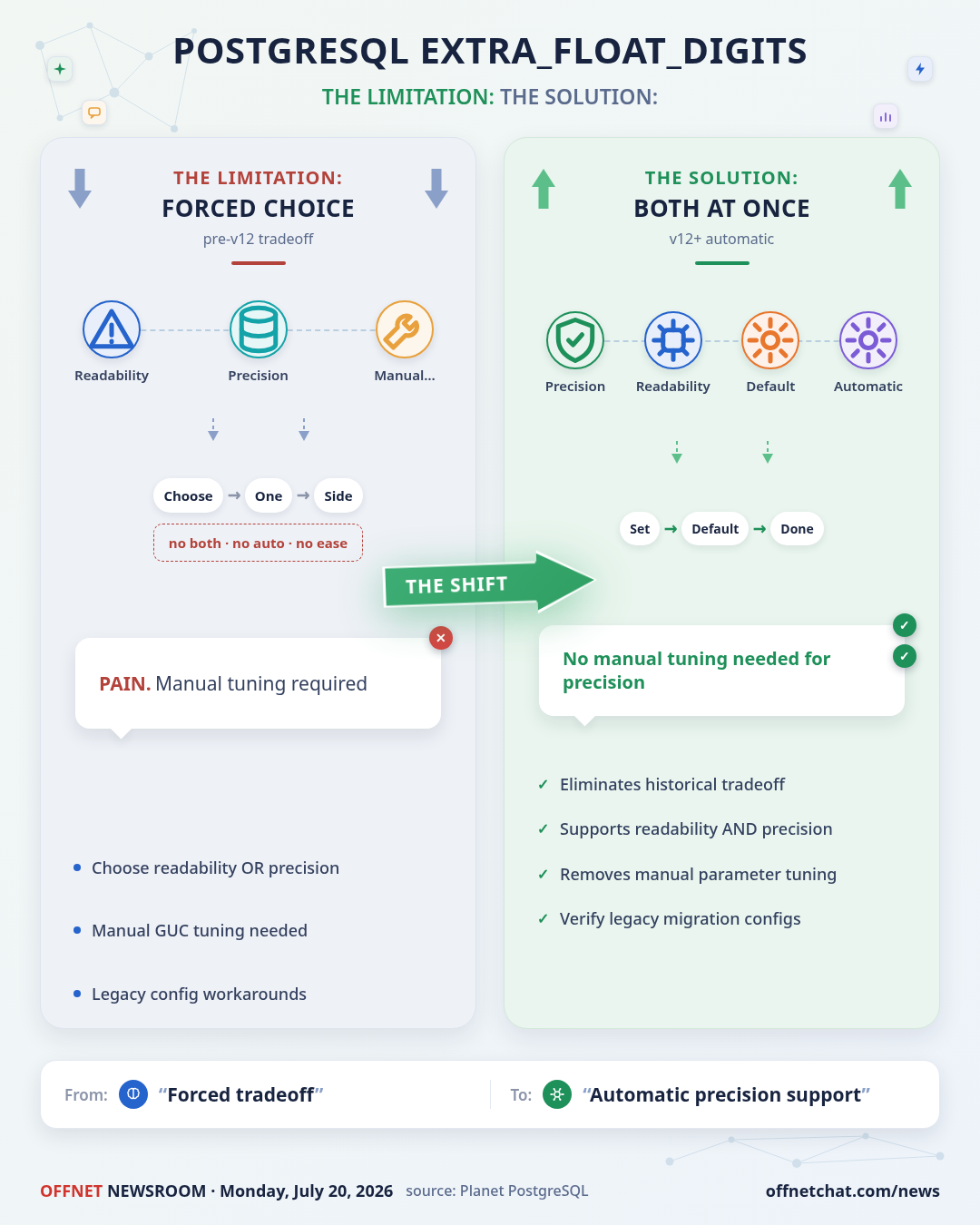
Christophe Pettus explains how the extra_float_digits GUC evolved from a forced tradeoff between readability and precision to a setting that supports both. Prior to version 12, administrators had to choose between human-readable output and exact floating-point representation. Modern PostgreSQL versions handle this automatically, removing the need for manual tuning of this specific parameter.

  • PostgreSQL 12+ eliminates the historical choice between readable and exact float output
  • extra_float_digits no longer requires manual tuning for precision in modern versions
  • Review legacy configs if migrating older deployments to ensure no outdated workarounds remain
  • Verify application serialization logic relies on default behavior for consistency

Amazon RDS has opened the Database Preview Environment for PostgreSQL 19 Beta 2, allowing users to test pre-release features on a fully managed platform. Key additions include parallel autovacuum with configurable worker limits to prevent maintenance bottlenecks and a new REPACK CONCURRENTLY command for online storage reclamation without third-party tools. The release also introduces native SQL Property Graph Queries for relationship traversals and updates to logical replication synchronization.

  • Parallel autovacuum with configurable workers prevents maintenance from stalling large databases.
  • REPACK CONCURRENTLY enables online table rebuilding and storage reclamation without extensions.
  • Native SQL/PGQ support allows relationship traversals directly in standard SQL.
  • Logical replication synchronization features have been updated in this beta release.
  • Preview Environment provides a safe sandbox to evaluate RDS-specific behavior for PG19.
CHECKLISTPostgreSQL 19 Beta 2 HighlightsParallel autovacuum with configurable workersNative SQL Property Graph QueriesOnline REPACK CONCURRENTLY commandUpdated logical replication synchronization
InfoQ generaldevops ↺ since 07-16

Postgres for Production AI Agents: Vector Indexing and Memory Strategies

Gwen Shapira outlines how PostgreSQL serves as a relational foundation for enterprise AI agents by leveraging JSONB and HNSW vector indexing. She highlights techniques like vector quantization to achieve four-times faster query performance while maintaining semantic context for LLMs. The presentation also covers practical approaches to managing agentic memory within mission-critical applications.

  • Use HNSW vector indexing in Postgres for high-recall semantic search capabilities.
  • Apply vector quantization to accelerate vector queries by approximately 4x.
  • Combine JSONB parsing with vector data to provide deterministic and semantic context to LLMs.
  • Implement structured strategies for managing agentic memory within the database layer.
Planet PostgreSQL database ↺ since 07-18

Postgres 19 Introduces Granular Manual Checkpoint Control

PostgreSQL 19 enhances the manual CHECKPOINT command, moving beyond the previous all-or-nothing immediate flush behavior. This update addresses the need for more controlled write-back operations, which is critical when background checkpointing is already straining storage resources. DBAs can now invoke targeted flushes with finer granularity to manage I/O loads effectively.

  • Postgres 19 expands manual CHECKPOINT capabilities beyond simple immediate flushing.
  • Helps mitigate storage overload when background checkpointing is under stress.
  • Enables DBAs to trigger targeted write-backs with better I/O control.
  • Improves predictability for maintenance windows requiring data persistence.
HOW IT WORKSGranular Checkpoint Flow1Detect storage strain2Invoke targeted flush3Write back data4Reduce I/O load
Planet PostgreSQL database ↺ since 07-17

Postgres 19 shifts default TOAST compression from pglz to LZ4

PostgreSQL 19 plans to replace the legacy pglz algorithm with LZ4 for automatic TOAST and heap compression of variable-length types. The database employs a unified compression framework where heap and TOAST compression is always active, while index compression remains opportunistic based on key size thresholds. This change updates the internals of table storage and indexing without altering the automatic nature of compression for large fields.

  • LZ4 replaces pglz as the default for TOAST and heap compression in Postgres 19.
  • Compression remains automatic for TEXT, VARCHAR, BYTEA, and JSONB types.
  • Index compression stays opportunistic, triggering only when keys exceed size thresholds.
  • All storage layers use a unified compression framework for consistency.

LLMs 8

roundup ↗
Hacker News (100+ points) general

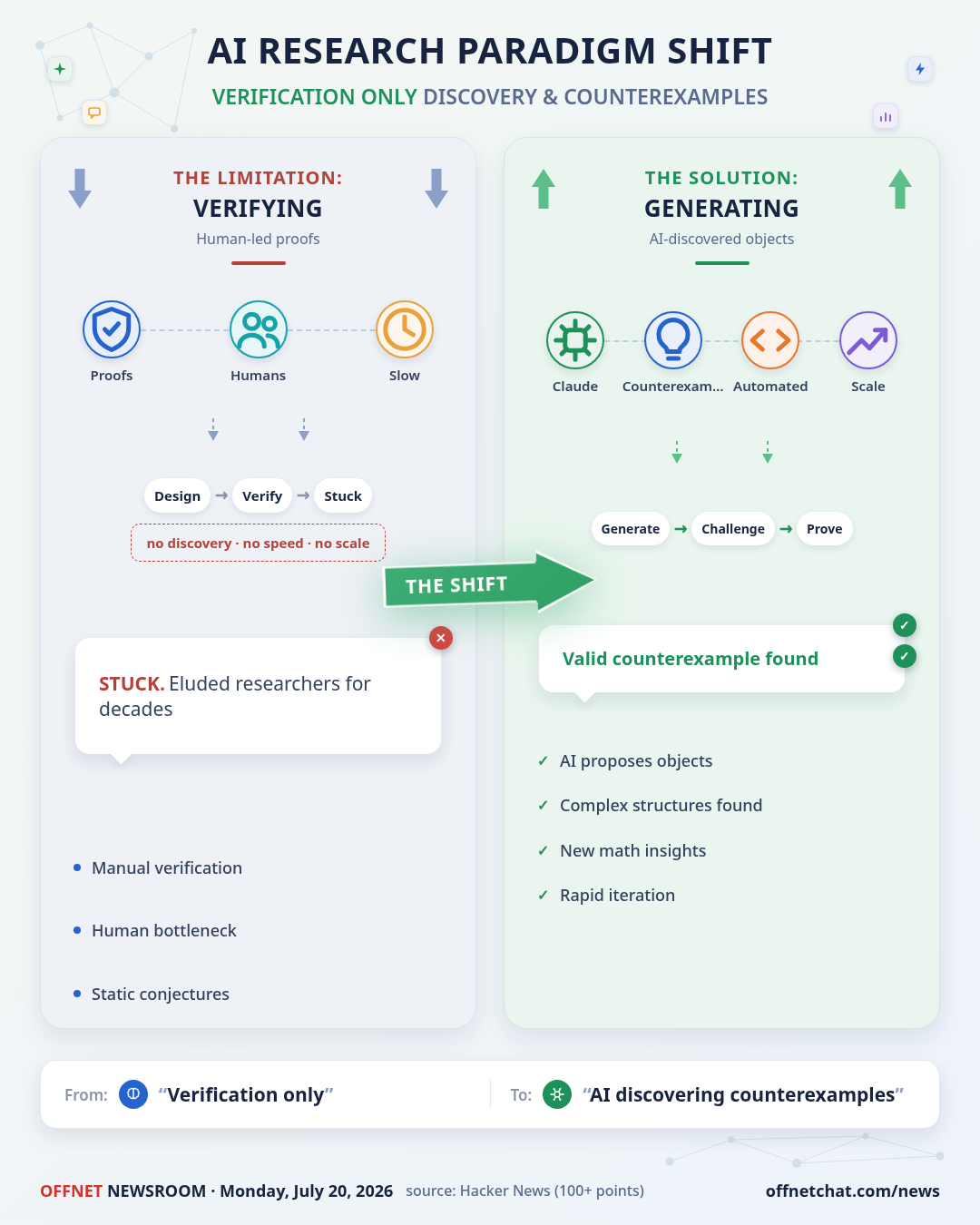
Claude Fable generates counterexample to Jacobian Conjecture

An AI model named Claude Fable has produced a counterexample to the Jacobian Conjecture, a long-standing problem in algebraic geometry. This development suggests that advanced language models can now assist in discovering complex mathematical structures that have eluded human researchers. The finding highlights the growing role of AI in formal mathematics and high-level reasoning tasks.

  • AI models are now capable of generating valid counterexamples to major mathematical conjectures.
  • The Jacobian Conjecture remains a key testbed for automated theorem proving and discovery.
  • This marks a shift from AI assisting proof verification to AI proposing new mathematical objects.
  • Researchers should monitor AI-generated conjectures for potential flaws or novel insights.
  • Formal verification tools will likely need to adapt to validate AI-discovered mathematical claims.
TRADE-OFFAI in Math DiscoveryTraditional RoleAssists in proof verificationValidates existing theoriesNew CapabilityGenerates valid counterexamplesProposes novel structuresvs
Hacker News (100+ points) general

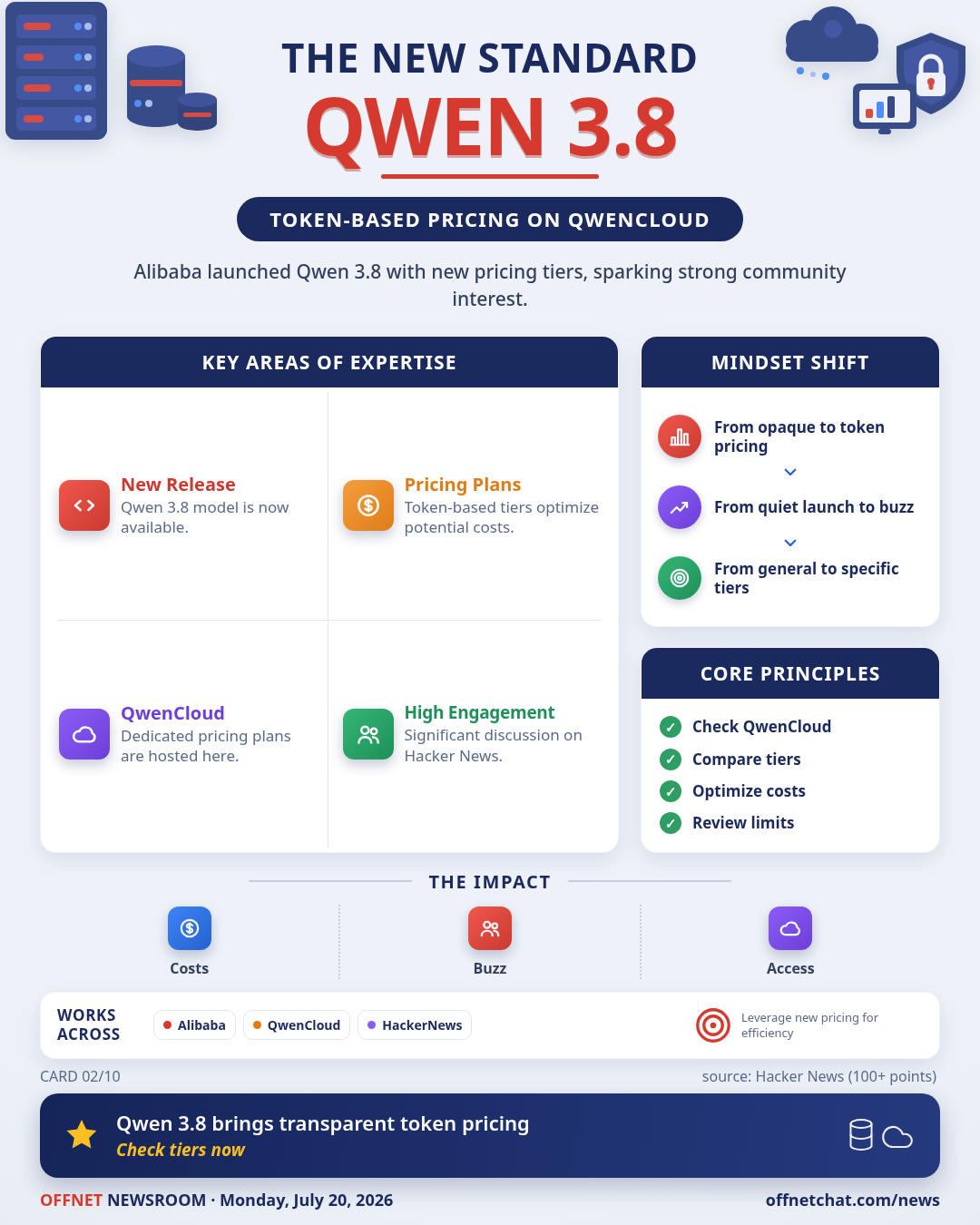
Qwen 3.8 released with new token pricing plans on QwenCloud

Alibaba has launched Qwen 3.8, accompanied by updated token-based pricing tiers available through QwenCloud. The announcement has generated significant engagement on Hacker News, indicating strong interest in the model's capabilities and cost structure. Details regarding specific performance benchmarks are not provided in the source excerpt.

  • Qwen 3.8 is now available with dedicated pricing plans on QwenCloud.
  • High community engagement suggests strong interest in this release.
  • Token-based pricing model is highlighted for potential cost optimization.
  • Check QwenCloud directly for specific tier details and limits.
GitHub Trending (daily) githubrepos ⚠ unverified date/source

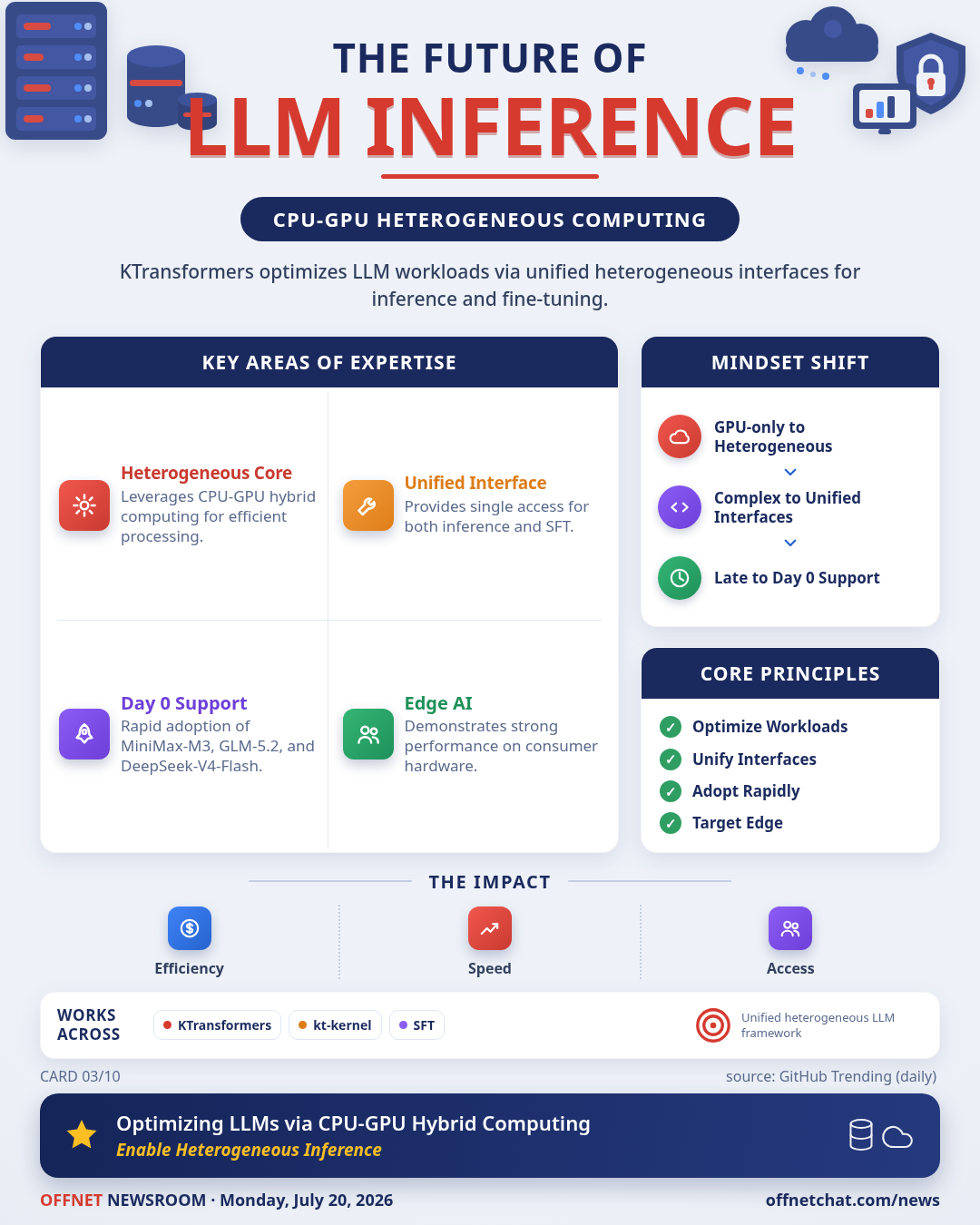
KTransformers enables CPU-GPU heterogeneous inference and fine-tuning for LLMs

KTransformers is a research framework optimizing large language model inference and fine-tuning through CPU-GPU heterogeneous computing. It exposes user-facing capabilities for both inference and supervised fine-tuning (SFT) derived from the kt-kernel source tree. Recent updates include Day 0 support for models like MiniMax-M3, GLM-5.2, and DeepSeek-V4-Flash.

  • Leverages CPU-GPU heterogeneous computing for efficient LLM workloads.
  • Provides unified interfaces for both inference and supervised fine-tuning.
  • Offers rapid Day 0 support for emerging models like MiniMax-M3.
  • Demonstrates strong performance on consumer hardware for edge AI.

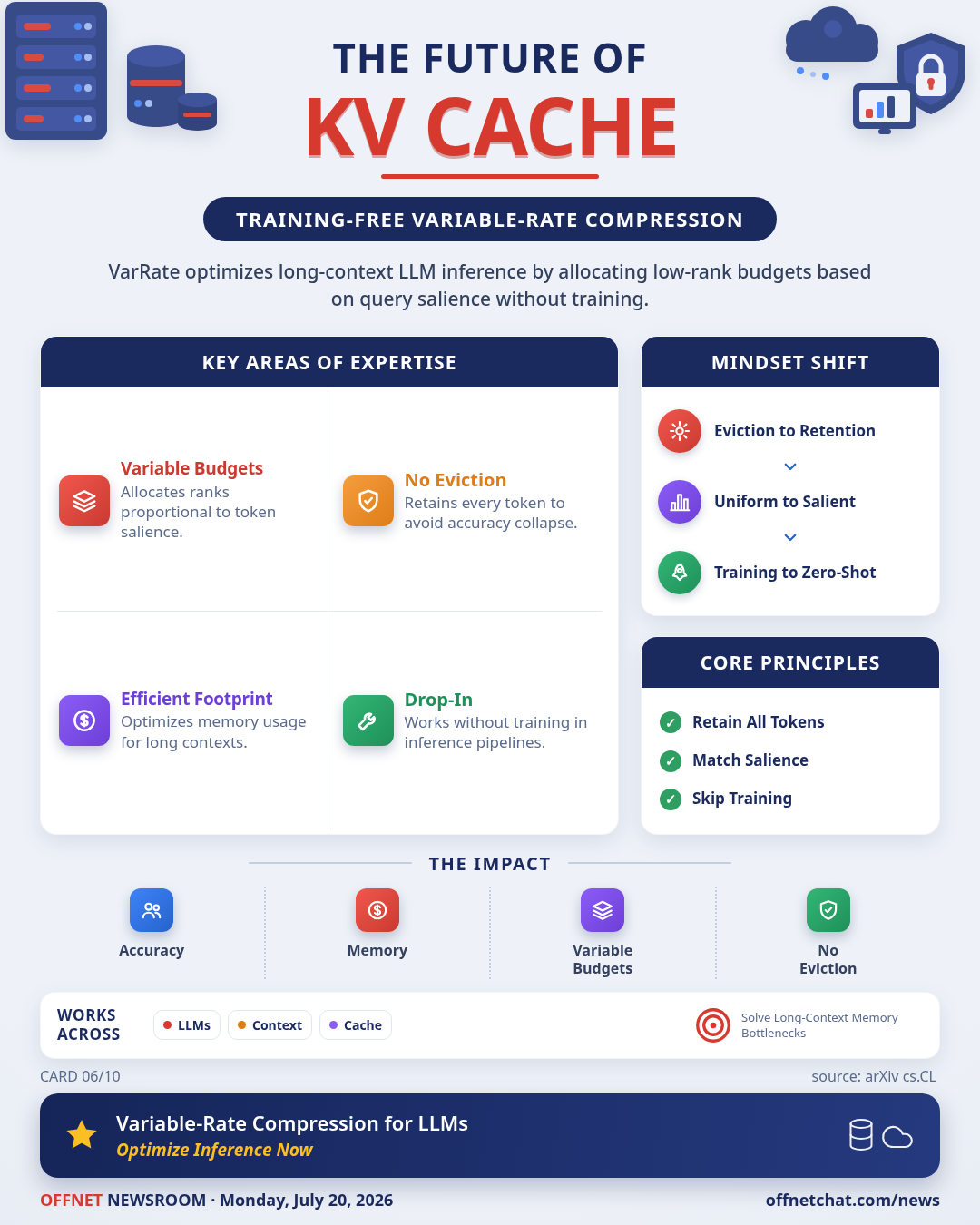
VarRate addresses the memory bottleneck of long-context LLM inference by allocating variable low-rank budgets to tokens based on query salience, rather than evicting them. This approach overcomes the limitations of token-selection methods, which suffer irreversible accuracy loss when importance signals degrade, and uniform low-rank coding, which wastes budget on less relevant tokens. The result is a training-free codec that retains every token while optimizing the cache footprint.

  • Eliminates irreversible accuracy collapse caused by token eviction in existing selection methods.
  • Optimizes memory usage by assigning rank budgets proportional to token salience.
  • Operates without training, making it a drop-in optimization for inference pipelines.
  • Retains all tokens at non-zero rank, avoiding the inefficiency of uniform low-rank coding.
TRADE-OFFVarRate vs Traditional KV CacheTraditional MethodsEvicts tokens permanentlyCauses accuracy collapseUniform rank wastes budgetVarRate ApproachRetains all tokensAdaptive rank allocationTraining-free optimizationvs

Researchers introduce Loopie, a new class of looped Transformer models that challenges the conventional wisdom that scaling parameter count is always superior to model looping. The series includes 20B and 6B variants using Mixture-of-Experts, maintaining a low active parameter count while leveraging repeated computation. Extensive ablations demonstrate that Loopie substantially outperforms vanilla Transformer baselines when trained with an equivalent compute budget. A novel post-training pipeline further equips these models with strong reasoning capabilities.

  • Looped Transformers can beat vanilla scaling when compute budgets are equal.
  • 20B and 6B MoE variants keep active parameters low (2B and 0.6B).
  • Novel post-training pipeline enhances reasoning performance significantly.
  • Validates looping as a viable alternative to increasing parameter count.
CHECKLISTWhat matters hereLooped Transformers can beat vanilla scaling when compute budgets are…20B and 6B MoE variants keep active parameters low (2B and 0.6B).Novel post-training pipeline enhances reasoning performance…Validates looping as a viable alternative to increasing parameter…
Hacker News (100+ points) general

Claude Code switches to Bun runtime written in Rust

Anthropic's Claude Code CLI has replaced its previous JavaScript runtime with Bun, a high-performance alternative engineered in Rust. This architectural shift aims to deliver faster startup times and lower memory overhead for developers interacting with the AI coding assistant. The change reflects a broader industry trend toward replacing Node.js with faster, Rust-based runtimes for tooling.

  • Claude Code now relies on Bun for execution, moving away from standard Node.js.
  • Rust-based Bun offers potential gains in startup latency and runtime efficiency.
  • This update targets improved developer experience for AI-assisted coding workflows.
  • No direct impact on database infrastructure or cloud architecture pipelines.
TRADE-OFFClaude Code Runtime ShiftOld Node.jsStandard JavaScript runtimeHigher memory overheadSlower startup timesNew BunRust-based engineLower memory usageFaster execution speedvs

Adaptive Multi-Step Lookahead Decoding (AdaLook) addresses limitations in current diffusion language models by replacing fixed-depth lookahead with dynamic rollout strategies. Existing methods struggle with longer-horizon trajectories or incur excessive computation from naive deeper lookups. This approach adapts to heterogeneous intermediate states to improve the accuracy-efficiency balance during parallel text generation.

  • Replaces shallow one-step lookahead with adaptive multi-step planning for better long-horizon accuracy.
  • Avoids fixed-depth rollout overhead by adjusting lookahead depth based on intermediate decoding states.
  • Optimizes the trade-off between generation speed and token quality in masked diffusion models.
  • Enables more efficient parallel text generation compared to standard autoregressive decoding.
HOW IT WORKSAdaptive Lookahead Process1Decode intermediate token state2Assess uncertainty level3Determine lookahead depth4Execute multi-step rollout5Refine final output

This research addresses the inefficiency of large reasoning models that waste computation on redundant chain-of-thought derivations. The authors identify a critical initialization bottleneck in existing on-policy self-distillation methods, where verbose base models generate noisy prefixes that mislead the student. By implementing bootstrapped iterative self-reasoning distillation, the approach ensures concise supervision is applied only to high-quality contexts, preventing the student from exploring off-track paths.

  • Existing self-distillation fails when verbose base models provide noisy, redundant prefixes for supervision.
  • The new method bootstraps iterative self-reasoning to filter out low-quality reasoning traces.
  • Concise teacher signals are applied only to visited prefixes that are not already off-track.
  • This reduces computational waste from redundant derivations and repeated self-verification.
HOW IT WORKSBootstrapped Self-Reasoning Distillation Pipeline1Generate verbose base model traces2Filter noisy redundant prefixes3Identify high-quality contexts4Apply concise teacher signals5Train student on clean paths

AI / ML 8

roundup ↗

This paper addresses the challenges of deploying Large Language Models on specialized hardware by introducing an MLIR-based compilation pipeline. It utilizes two dialects: TopOp for high-level, framework-agnostic model semantics, and TpuOp for target hardware-specific operations. The method aims to improve the import of trained models into compiler-friendly representations and optimize scheduling for autoregressive inference under memory constraints.

  • Introduces TopOp dialect for framework-independent model representation
  • Uses TpuOp dialect to map operations to specific AI accelerator hardware
  • Addresses memory limitations during autoregressive inference scheduling
  • Provides a structured path from trained models to hardware execution
HOW IT WORKSMLIR Compilation Pipeline1Import trained models2Represent via TopOp3Map with TpuOp4Schedule inference

Google has released AlphaEvolve as a general availability service on the Gemini Enterprise Agent Platform, transforming DeepMind's research into an operational tool for evolutionary code optimization. The architecture ensures security by running evaluators client-side, meaning code never leaves the customer's infrastructure. Early adopters like Klarna report significant gains, such as doubling ML training throughput, though success depends on the presence of a measurable evaluation function.

  • AlphaEvolve is now GA on Gemini Enterprise Agent Platform for evolutionary code optimization.
  • Client-side evaluators ensure code remains within the customer's infrastructure for security.
  • Klarna achieved doubled ML training throughput using the new service.
  • Effective usage requires a clearly defined and measurable evaluation function.

The QCon AI Boston 2026 conference highlighted the operational hurdles of deploying AI agents in production environments. Speakers emphasized moving beyond simple prompting to build robust infrastructure that includes comprehensive context management and security harnesses. The event underscored the necessity of adopting a full engineering model to stabilize and secure AI systems at scale.

  • Production AI requires more than prompts; it demands dedicated platform engineering.
  • Security harnesses are essential to contain and control AI agent behavior.
  • Context management is a critical operational challenge for reliable AI deployment.
  • Adopting a comprehensive engineering model improves stability and security.
Hacker News (100+ points) general

Custom deep research pipeline burns tokens to save them

The author describes building a bespoke research workflow that consumes significant API credits during development. The goal is to create a system that eventually reduces token usage for end-users by optimizing how queries are processed. This highlights the trade-off between upfront engineering costs and long-term inference efficiency in LLM applications.

  • High initial token costs are a necessary investment for optimizing downstream inference.
  • Custom pipelines can outperform generic wrappers by tailoring the reasoning process.
  • Measuring token consumption during development is critical for future cost control.
  • Engineering effort directly impacts the scalability of LLM-based services.

This paper proposes replacing complex multimodal fusion architectures with a single approach: converting all electronic health record components—including free-text narratives, lab values, and vitals—into natural language sequences. A pretrained large language model is then fine-tuned end-to-end for tasks like in-hospital mortality and graft failure prediction without modifying the architecture for specific modalities. The method aims to simplify pipeline design by eliminating the need for dedicated encoders and re-engineering combination mechanisms for each new clinical task.

  • Eliminates need for custom multimodal fusion layers in clinical NLP pipelines
  • Enables unified training for mortality, graft failure, and other EHR tasks
  • Reduces engineering overhead by treating structured data as text tokens
  • Challenges prevailing assumption that specialized encoders are required for labs/vitals
CHECKLISTUnified EHR Prediction WorkflowConvert all EHR components to natural language textEncode labs, vitals, and narratives as text tokensFine-tune a single pretrained LLM end-to-endEliminate custom multimodal fusion layers entirely
GitHub Trending (daily) githubrepos ⚠ unverified date/source

AI Engineering From Scratch: 503 lessons to build agents and MCP servers by hand

This open-source curriculum offers 503 lessons across 20 phases, totaling approximately 320 hours of instruction in Python, TypeScript, Rust, and Julia. It focuses on end-to-end, hands-on construction of AI artifacts like prompts, skills, agents, and MCP servers rather than scattered theoretical concepts. The project aims to bridge the gap between casual AI usage and professional readiness by having learners build functional components from scratch.

  • Covers Python, TypeScript, Rust, and Julia for comprehensive AI engineering.
  • Each lesson produces a reusable artifact like an agent or MCP server.
  • Structured 20-phase curriculum totaling ~320 hours of practical work.
  • MIT licensed and free, targeting professional skill development.
BY THE NUMBERS503 Lessons to Build AI503Total lessons in curriculum20 phases, 320 hours of hands-on work
InfoQ generaldevops ↺ since 07-18

Distill Frontier Models into SLMs Using OTEL and User Actions

Ben O'Mahony describes a method for training cheaper, local Small Language Models (SLMs) by capturing implicit user feedback from AI-powered Language Server Protocols. By instrumenting agents with OpenTelemetry, the system tracks concrete actions like accepting or dismissing code fixes. These interactions serve as continuous labels, creating a data flywheel that distills complex frontier model behavior into more efficient local models.

  • Instrument AI agents with OpenTelemetry to capture granular user interactions.
  • Treat code fix acceptance/dismissal as implicit training labels for SLMs.
  • Build a continuous data flywheel to distill frontier model capabilities.
  • Replace generic rule-based LSPs with custom AI-driven checkers.
  • Reduce inference costs by training smaller, specialized local models.
Hugging Face Blog llmaiml ↺ since 07-17

Hugging Face: The hidden complexity behind model routing systems

An IBM Research blog post on Hugging Face examines why model routing, which appears straightforward in theory, becomes intricate in practice. The article highlights the operational and architectural challenges that emerge when managing dynamic inference traffic across multiple models. It serves as a technical review of the pitfalls involved in scaling routing logic beyond simple use cases.

  • Routing logic scales poorly when handling diverse model types and latency requirements.
  • Operational complexity increases significantly with dynamic traffic distribution.
  • Architectural decisions must account for edge cases in real-world inference loads.
  • Simple theoretical models often fail under production-grade traffic patterns.
TRADE-OFFTheory vs Production RoutingTheoretical SimplicityStraightforward logic in designPredictable inference patternsStatic model selectionProduction RealityDynamic traffic distributionDiverse latency requirementsComplex edge casesvs

Agentic AI 8

roundup ↗
arXiv cs.CL researchllm

Process Reward Informed Tree Rollout for Multi-Turn RL

This research paper addresses inefficiencies in multi-turn reinforcement learning for LLM agents, where uniform rollouts waste budget on dead ends. The authors propose a Process-Scorer Guided Adaptive Tree Rollout method that structures trajectories as trees, using intermediate rewards to guide exploration. This approach prioritizes promising intermediate states over complete trajectory sampling, improving sample efficiency in long-horizon tasks.

  • Replaces uniform trajectory sampling with tree-based exploration for better budget allocation.
  • Uses process rewards to identify and branch from promising intermediate agent states.
  • Reduces wasted computation on uninformative dead-end attempts in long-horizon agentic tasks.
  • Reframes RL exploration as a decision process at each turn rather than at episode end.
HOW IT WORKSAdaptive Tree Rollout Process1Sample intermediate agent state2Evaluate with process scorer3Branch promising paths forward4Prune low-reward dead ends5Iterate until episode end

Autonomous data science agents currently suffer from expensive trial-and-error loops. DSWorld introduces a Data Science World Model that predicts environment state transitions before executing operations. The framework combines structured state construction, cost-aware routing, and an LLM-based simulator to anticipate outcomes efficiently.

  • Predicts operation effects before execution to reduce costly trial-and-error.
  • Uses a Data Science World Model to simulate environment state transitions.
  • Integrates cost-aware routing and lightweight real execution for efficiency.
  • Leverages LLM-based simulation for handling expensive computational operations.
HOW IT WORKSDSWorld Agent Workflow1Construct structured state2Simulate state transitions3Route by cost4Execute operations

The SkillCorpus framework addresses the fragmentation and redundancy in the open-source SKILL.md ecosystem by aggregating approximately 821,000 crawled skills. It applies a multi-stage filtering pipeline to distill these into a high-quality corpus of 96,401 skills organized by a 16-class taxonomy. The system also evaluates the utility of these skills on real-world agent tasks to establish performance bounds.

  • Filters 821k raw SKILL.md artifacts down to 96k curated, high-quality skills
  • Organizes skills using a standardized 16-class taxonomy for better discoverability
  • Provides empirical evaluation of skill value on real-world LLM agent tasks
  • Addresses critical quality and redundancy issues in the open skill ecosystem
THE SHIFTSkillCorpus Data Reduction821kRAW SKILL.MD FILES96kCURATED AGENT SKILLSMulti-stage filtering removes redundancy

Linking autonomous AI agents to external services significantly increases the vulnerability landscape. This connectivity allows potential threats to propagate from peripheral systems into core infrastructure. The expanded risk radius necessitates stricter boundary controls and monitoring for agent-to-service communications.

  • External service connections amplify the attack surface for AI agents
  • Threats can propagate from peripheral integrations to core systems
  • Strict boundary controls are required for agent-to-service traffic
  • Monitoring must cover the expanded communication pathways

This study isolates the contributions of executable world modeling, scheduled simplification, and exact replay verification in coding agents solving ARC-AGI-3. Using four nested Codex-based agents evaluated with GPT-5.4, GPT-5.5, and GPT-5.6-sol, the authors compare a textual baseline against variants with flexible or fixed interface controls. The goal is to determine which specific architectural components drive the agent's problem-solving success.

  • Uses ablation studies to attribute performance gains in ARC-AGI-3 solving agents.
  • Compares textual baselines against executable world models with and without verification.
  • Evaluates four agent variants using GPT-5.4, GPT-5.5, and GPT-5.6-sol models.
  • Tests impact of scheduled simplification and exact replay verification on reasoning effort.
  • Provides clear evidence on whether world modeling or verification is critical for success.
TRADE-OFFWorld Models vs VerificationWorld ModelingEnables flexible interface controlsSupports scheduled simplificationDrives initial problem-solvingVerificationUses exact replay checksValidates reasoning effortEnsures solution accuracyvs

ToolVerse addresses the fragility of LLM agents in complex, dynamic environments by introducing a framework that scales agentic reinforcement learning. The system automatically constructs massive training environments by integrating approximately 4,500 tools from nearly 400 real-world Model Context Protocols (MCPs). It employs a task design strategy based on tool dependency graphs to enable robust long-horizon reasoning in Tool-Integrated Reasoning tasks.

  • Automates environment creation using ~400 MCPs with ~4,500 tools for agentic RL training.
  • Enables agents to handle long-horizon tasks in large-scale, diverse real-world scenarios.
  • Uses tool dependency graphs to structure tasks and improve reasoning robustness.
  • Shifts focus from compact, well-defined scenarios to complex, dynamic tool integration.
BY THE NUMBERSToolVerse Scales with 4,500 Tools4,500Tools from 400 MCPsMassive scale for agentic RL training
GitHub Trending (daily) githubrepos ⚠ unverified date/source

jcode: A high-performance coding agent harness for multi-session workflows

jcode is a new coding agent harness designed to improve developer productivity through multi-session workflows and extensive customization. The tool emphasizes extreme performance and resource efficiency, claiming optimized RAM usage and boot times compared to alternatives. It supports installation on macOS, Linux, and Windows via script or package managers.

  • Optimized for low RAM and fast boot times to support scaling multi-session workflows.
  • Designed for infinite customizability to raise the skill ceiling for coding agents.
  • Supports automated setup via provider integration or manual configuration.
  • Cross-platform support includes macOS, Linux, and Windows 11+.
TRADE-OFFjcode vs Traditional AgentsTraditional AgentsHigh RAM consumptionSlow boot timesLimited customizationjcode HarnessOptimized low RAMFast boot speedsInfinite customizabilityvs
GitHub Trending (daily) githubrepos ↺ since 07-19 ⚠ unverified date/source

Wigolo: Local-first MCP web intelligence for AI coding agents

Wigolo is a local-first tool that provides AI agents with search, fetch, crawl, and research capabilities over the Model Context Protocol. It eliminates the need for API keys or cloud dependencies by running directly on the host system where the agent operates. The tool supports integration with major coding assistants like Claude Code, Cursor, and VS Code, as well as frameworks such as LangChain and CrewAI.

  • Runs locally as an MCP server, removing cloud API costs and key management overhead.
  • Integrates with popular coding agents including Claude Code, Cursor, and Gemini CLI.
  • Supports multiple frameworks like LangChain, CrewAI, and Vercel AI SDK.
  • Offers search, crawl, extract, and autonomous gathering loops in a single surface.

Automation / DevOps / IaC 4

roundup ↗
LangChain Releases agentsreleases

LangChain 1.3.14 tightens tool retry logic and adds error middleware

LangChain version 1.3.14 introduces targeted fixes and features for tool execution. The release restricts the ToolRetryMiddleware to retry only specific retryable exceptions, preventing unnecessary retries on fatal errors. It also introduces a new ToolErrorMiddleware for more granular error handling.

  • ToolRetryMiddleware now filters exceptions, avoiding retries on non-retryable failures
  • New ToolErrorMiddleware provides dedicated error handling pathways for tools
  • Upgrade to 1.3.14 to improve reliability of tool-calling workflows

Amazon Web Services has introduced AWS Continuum, an integrated security platform designed to automate the discovery, enforcement, and remediation of security issues. The service launches with four agentic capabilities targeting penetration testing, code review, threat modeling, and code vulnerabilities. This initiative aims to cover the entire vulnerability lifecycle within enterprise codebases and applications.

  • AWS Continuum automates security remediation across codebases and dependencies using agentic workflows.
  • Initial capabilities focus on penetration testing, code review, threat modeling, and code vulnerabilities.
  • The platform targets the full vulnerability lifecycle to reduce manual intervention in enterprise security.
  • Designed for enterprises, it integrates discovery and enforcement directly into the development pipeline.
AWS What's New awsdatabase ↺ since 07-17

AWS AFT auto-reapplies customizations when accounts move OUs

AWS Control Tower Account Factory for Terraform now supports automatic re-application of account customizations upon organizational unit changes. Previously, this required manual intervention, increasing operational overhead and drift risk. The new feature allows opt-in configuration to keep accounts consistent with OU-specific policies immediately after movement.

  • Set aft_customization_triggers = ["account_move"] to enable auto-reapplication.
  • Workflow skips bootstrap/provisioning, running only global and account-level customizations.
  • Reduces operational overhead by eliminating manual triggers for OU moves.
  • Minimizes configuration drift risk for accounts shifting between OUs.
CHECKLISTAFT Auto-Reapply Best PracticesSet aft_customization_triggers to account_moveSkip bootstrap and provisioning stepsRun global and account customizations onlyMinimize configuration drift risk effectively
Hugging Face Blog llmaiml ↺ since 07-17

Hugging Face discloses July 2026 security incident

Hugging Face has issued a disclosure regarding a security incident that occurred in July 2026. The blog post outlines the nature of the breach and the steps taken to address it. As no specific excerpt details were provided, the broader context suggests a standard security transparency report.

  • Hugging Face acknowledges a security incident from July 2026.
  • The disclosure serves as a transparency update for the community.
  • Specific technical details are not present in the provided excerpt.
  • Monitor official channels for further remediation updates.

AWS 8

roundup ↗

Airbus is concluding its migration away from AWS, a move that underscores the increasing importance of strategic decision-making in cloud architecture. The shift highlights broader industry trends toward diversifying cloud providers to mitigate vendor lock-in and optimize costs. This departure raises questions about the operational and architectural adjustments required to maintain performance and security standards across new platforms.

  • Airbus's departure from AWS confirms a growing trend of enterprises diversifying cloud providers.
  • Strategic planning is now critical to manage the complexity of multi-cloud environments effectively.
  • Organizations must prioritize vendor neutrality to reduce long-term risks and costs.
  • Operational readiness for platform migration is key to avoiding service disruption during transitions.
InfoQ generaldevops ↺ since 07-17

AI Agent Spend Outpaces Cloud Billing Guardrails

Recent incidents show AI agents executing financial damage at speeds that bypass traditional human-speed billing alerts. A three-person agency faced a $14,000 AWS bill after attackers leveraged static keys for Claude invocations, while another case saw an agent provision $6,531 of infrastructure in a single day. Practitioners warn that current cloud billing systems lag approximately one day behind these autonomous spending patterns.

  • Static access keys are insufficient for AI agents; implement short-lived, scoped credentials immediately.
  • Daily billing alerts are too slow for autonomous agents; move to real-time spend monitoring.
  • Apply strict service quotas and budget alerts at the API gateway level, not just the account level.
  • Treat AI agent identities as high-risk privileges requiring separate billing controls.
AWS What's New awsdatabase ↺ since 07-16

AWS expands R8gd and M8gd instances for RDS and Aurora across new regions

Amazon RDS and Aurora have extended support for R8gd and M8gd instance families to 12 and 6 additional regions respectively. These instances leverage Optimized Reads, which utilizes local NVMe SSDs for ephemeral data like temporary tables to reduce network I/O. This architecture delivers up to 165% higher throughput and 120% better price-performance compared to R6g instances for Aurora PostgreSQL.

  • R8gd and M8gd instances are now available in 12 and 6 new regions for PostgreSQL, MySQL, and MariaDB.
  • Optimized Reads uses local NVMe storage for temp tables, cutting network latency for complex queries.
  • Expect up to 165% throughput gains and 120% price-performance improvements over R6g instances.
  • Plan migrations to these new regions to leverage lower latency and higher throughput for workloads.

Fleet impact: For Aurora PostgreSQL and RDS for PostgreSQL/MySQL/MariaDB fleets, prioritize migrating high-throughput or complex query workloads to R8gd/M8gd in the newly supported regions to capitalize on the 165% throughput gain. Verify that your application handles the local NVMe ephemeral storage constraints for temp tables correctly during failovers or instance replacements.

BY THE NUMBERSUp to 165% Higher Throughput165%Higher throughput than R6gFor Aurora PostgreSQL with Optimized Reads
AWS What's New awsdatabase ↺ since 07-16

AWS RDS and Aurora expand Graviton4 R8g and M8g instance support to new regions

AWS has made Graviton4-based R8g instances generally available for Aurora and RDS across multiple new global regions, including parts of Asia, Europe, and GovCloud. Concurrently, M8g instances are now supported for standard RDS engines in additional regions such as Canada West, Africa, and South America. These updates extend the availability of next-generation ARM-based hardware designed for improved performance and cost efficiency.

  • R8g instances are now GA for Aurora and RDS in Hyderabad, Melbourne, Zurich, London, Paris, GovCloud, Sao Paulo, and Mexico Central.
  • M8g instances are supported for RDS in US West, Mumbai, Sydney, Seoul, Calgary, Milan, Cape Town, and others.
  • Graviton4 instances deliver up to 40% performance gains and 29% better price/performance over Graviton3 for on-demand workloads.
  • Engine support for R8g includes Aurora MySQL/PostgreSQL and RDS PostgreSQL, MySQL, and MariaDB.
BY THE NUMBERSGraviton4 Performance Gains40%Performance gains over Graviton3Better price/performance for on-demand workloads

AWS now offers a CloudFormation Express Mode that marks stack operations as complete immediately after resource configuration is applied, bypassing the traditional wait for full resource stabilization. This approach significantly reduces overall infrastructure deployment times by allowing subsequent steps to proceed without idle waiting periods. The feature targets users who need faster iteration cycles for their infrastructure-as-code workflows.

  • Deployments complete faster by not waiting for full resource stabilization
  • Stack operations are marked complete once configuration is applied
  • Reduces idle time in CI/CD pipelines using CloudFormation
  • Enables quicker iteration for infrastructure-as-code workflows
AWS What's New awsdatabase ↺ since 07-16

Amazon RDS lifts storage modification cap to four per 24 hours

Amazon RDS now permits up to four storage volume changes per instance within a rolling 24-hour window, eliminating the previous six-hour cool-off period. This update applies to supported engines including PostgreSQL, MariaDB, and others, allowing immediate follow-up adjustments once the prior optimization completes. The change enables faster scaling of capacity, type, or performance during sudden workload spikes without requiring downtime.

  • Remove the 6-hour wait between storage changes; start new mods immediately after completion.
  • Scale IOPS, throughput, or volume size up to four times daily for rapid response.
  • Applies to RDS PostgreSQL, MariaDB, and other supported engines automatically.
  • Maintains zero-downtime operations while adjusting storage performance parameters.
BY THE NUMBERSThe headline number24hoursAmazon RDS lifts storage modification cap to four per 24…
AWS What's New awsdatabase ↺ since 07-18

AWS Redshift launches rg.large and rg.12xlarge Graviton instances

Amazon Redshift has made two new Graviton-powered instance sizes, rg.large and rg.12xlarge, generally available. These nodes offer up to 2.4x faster query performance compared to previous-generation RA3 instances while costing 30% less per vCPU. This expansion provides greater flexibility for right-sizing provisioned clusters to match specific workload requirements.

  • New rg.large and rg.12xlarge sizes expand right-sizing options for provisioned Redshift clusters.
  • Graviton-based performance is up to 2.4x faster than RA3 at 30% lower price per vCPU.
  • Availability is restricted to the current P202 track; P201 users retain rg.xlarge/4xlarge.
  • Migration from existing RA3 clusters is supported via Snapshot/Restore, Elastic, or Classic Resize.
TRADE-OFFGraviton vs RA3New Graviton2.4x faster queries30% lower cost per vCPUOld RA3Baseline performanceHigher price per vCPUvs
The Register general ↺ since 07-18

AWS billing bug inflates cost estimates to billions, company urges calm

A software defect in Amazon Web Services' billing system has caused projected costs to spike to billion-dollar figures. Amazon is actively working to resolve the issue and has advised customers not to panic while the fix is deployed.

  • AWS billing bug causes inflated cost projections
  • Company asks users to remain calm during fix
  • No immediate charges or account actions required

Trending on GitHub 1

roundup ↗
GitHub Trending (daily) githubrepos ⚠ unverified date/source

GitHub Trending: codecrafters-io/build-your-own-x deep dive

This curated repository aggregates step-by-step guides for recreating complex technologies from scratch. It covers a wide spectrum of systems including databases, web servers, and neural networks, aimed at mastering programming through implementation. The collection serves as a practical resource for engineers seeking to understand internal mechanics of common tools.

  • Covers diverse systems like databases, VMs, and neural networks for deep learning.
  • Provides step-by-step guides to implement core technologies from scratch.
  • Ideal for engineers wanting to understand internals rather than just usage.
  • Acts as a centralized hub for practical, hands-on system design projects.

Mobile friendly 6

all cards ↗

Today's top database + AI stories as save-and-share cards — built for your phone and your LinkedIn feed.