OffNet Newsroom

Archive snapshot

Thursday, July 16, 2026

Daily signal on databases, AI, and the tech that matters.

36 new today 51 stories 8 sections 15 for the DBA desk

Database Technology 8

roundup ↗
AWS Database Blog awsdatabase ↺ since 07-14

Aurora PostgreSQL Rebuild Large Indexes Using Blue/Green Deployments

AWS demonstrates rebuilding large indexes on Aurora PostgreSQL by leveraging Blue/Green Deployments alongside Aurora Optimized Reads. The process executes the reindex on the green staging environment using NVMe-backed instance classes to utilize fast local storage for the sort phase. This approach prevents production workload impact by avoiding network-bound EBS I/O during the intensive reindex operation.

  • Use Blue/Green Deployments to isolate heavy index maintenance from production traffic
  • Select NVMe-backed instance classes to enable local storage for the sort phase
  • Leverage Aurora Optimized Reads to reduce network I/O contention during rebuilds
  • Perform reindexing on the green environment to ensure zero production impact

Fleet impact: For Aurora PostgreSQL fleets, use Blue/Green Deployments with NVMe-backed instances to rebuild large indexes without blocking production queries. Monitor the green environment's storage performance during the sort phase to ensure optimal rebuild times before promoting to production.

PostgreSQL Releases databasereleases ↺ since 07-15

PostgreSQL 19 Beta 2 Released

PostgreSQL has released the second beta for version 19. This release represents a significant milestone in the development cycle for the upcoming major feature set. It includes various bug fixes and stability improvements leading up to the final release candidate.

  • PostgreSQL 19 Beta 2 is now available for testing.
  • Review release notes for new features and breaking changes.
  • Validate application compatibility with current beta builds.

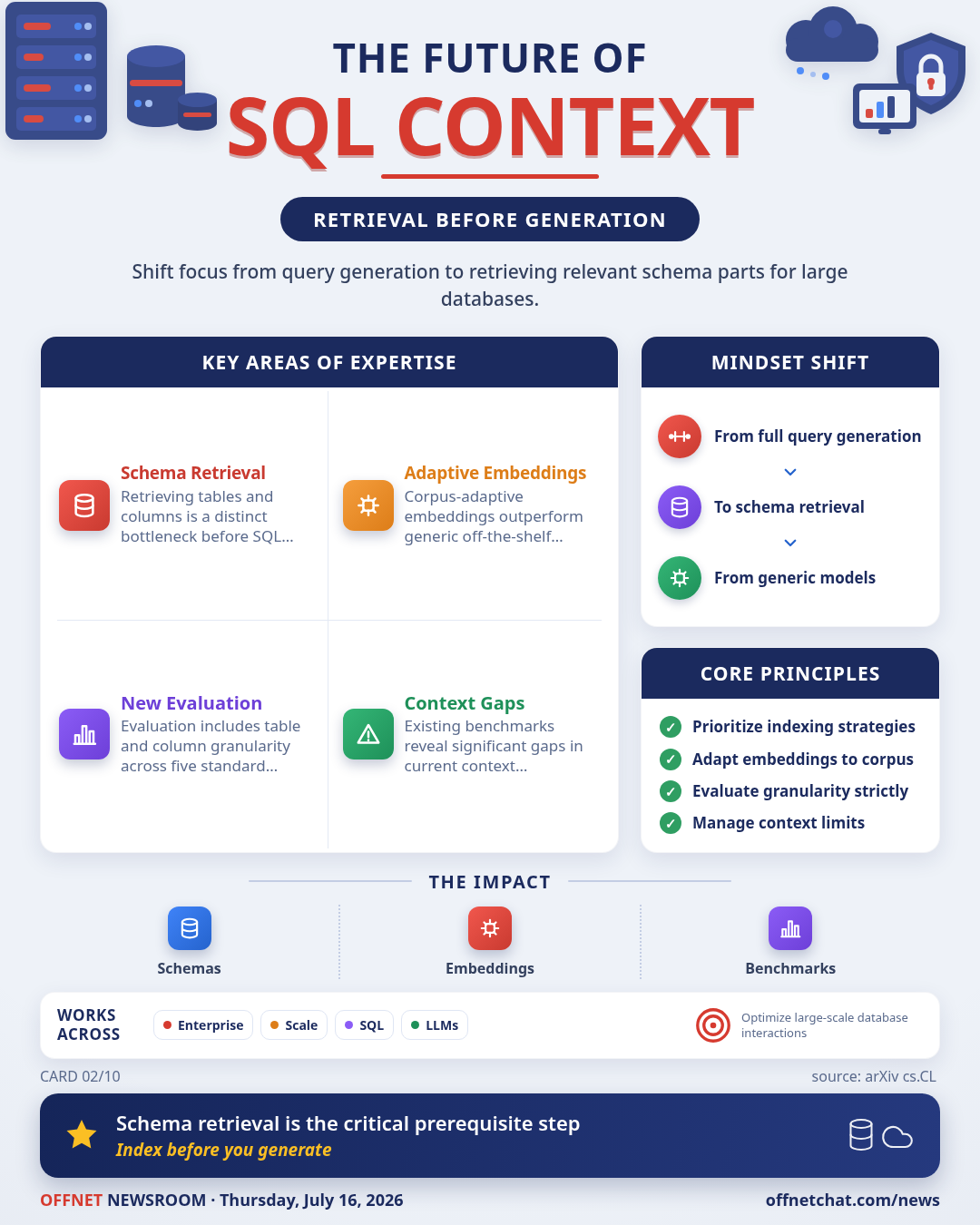
This research shifts focus from full query generation to the prerequisite step of retrieving relevant tables and columns from massive schemas that exceed model context windows. The authors introduce a corpus-adaptive embedding approach and recast five major text-to-SQL datasets into retrieval tasks across diverse enterprise-scale structures. Initial results indicate that standard embedding models struggle with this granularity, highlighting a critical gap in current LLM pipelines for handling large database schemas.

  • Schema retrieval is a distinct bottleneck before SQL generation in large-scale DBs.
  • Corpus-adaptive embeddings outperform generic off-the-shelf models for this task.
  • Evaluation now includes table and column granularity across five standard datasets.
  • Existing text-to-SQL benchmarks reveal significant gaps in context management.
  • Practitioners should prioritize schema indexing strategies over raw query generation.
HOW IT WORKSSchema Retrieval Pipeline1Retrieve relevant tables2Select specific columns3Adapt embeddings to corpus4Generate SQL query

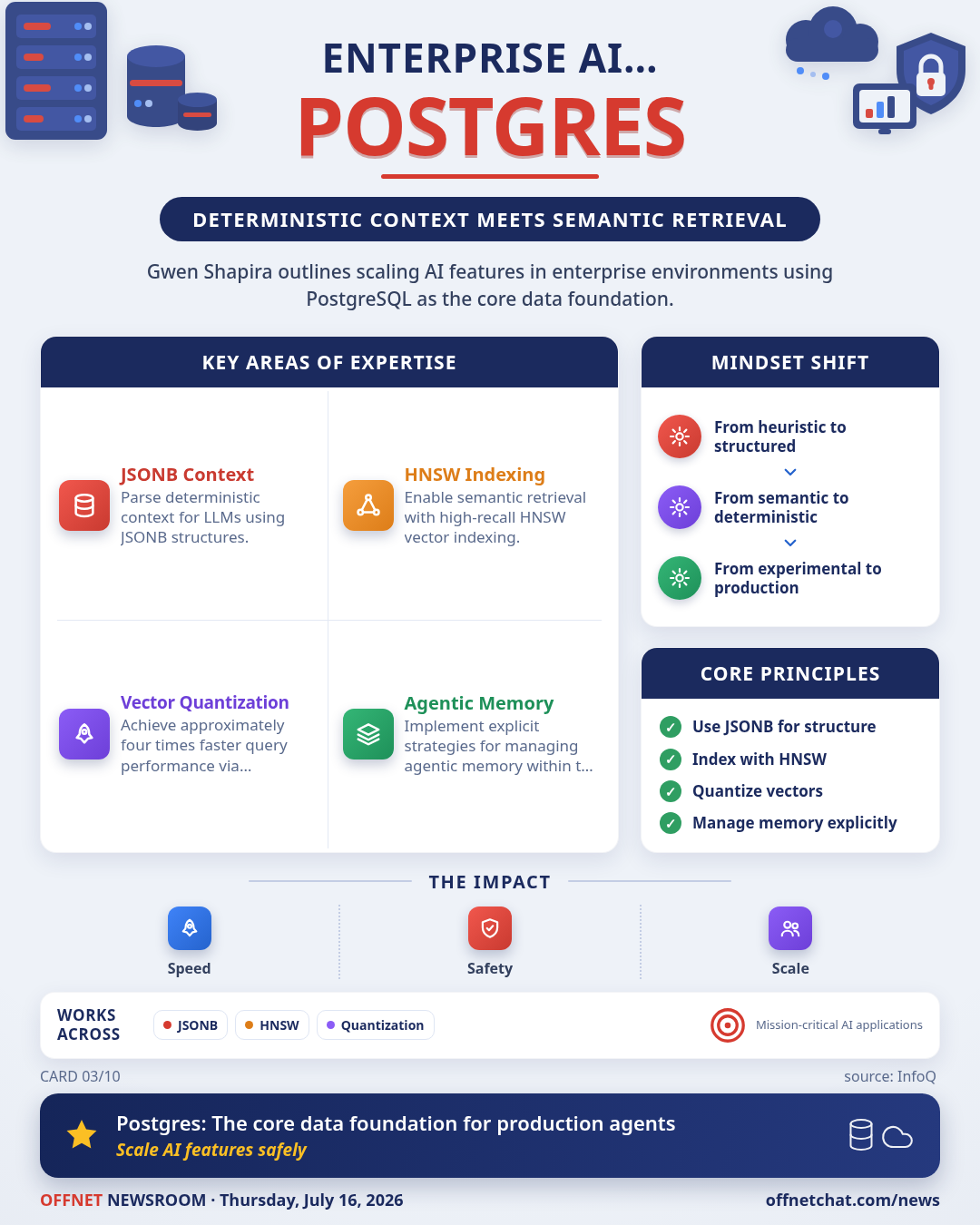
Gwen Shapira outlines strategies for scaling AI features in enterprise environments using PostgreSQL as the core data foundation. The approach combines deterministic context via JSONB parsing with semantic retrieval using high-recall HNSW vector indexing. Key optimizations include applying vector quantization to accelerate queries by four times and implementing structured methods for managing agentic memory.

  • Use JSONB and HNSW indexing to provide both deterministic and semantic context to LLMs.
  • Apply vector quantization to achieve approximately 4x faster query performance.
  • Implement explicit strategies for managing agentic memory within the database layer.
  • Leverage Postgres multi-modal capabilities to support mission-critical AI applications.
Hacker News (100+ points) general

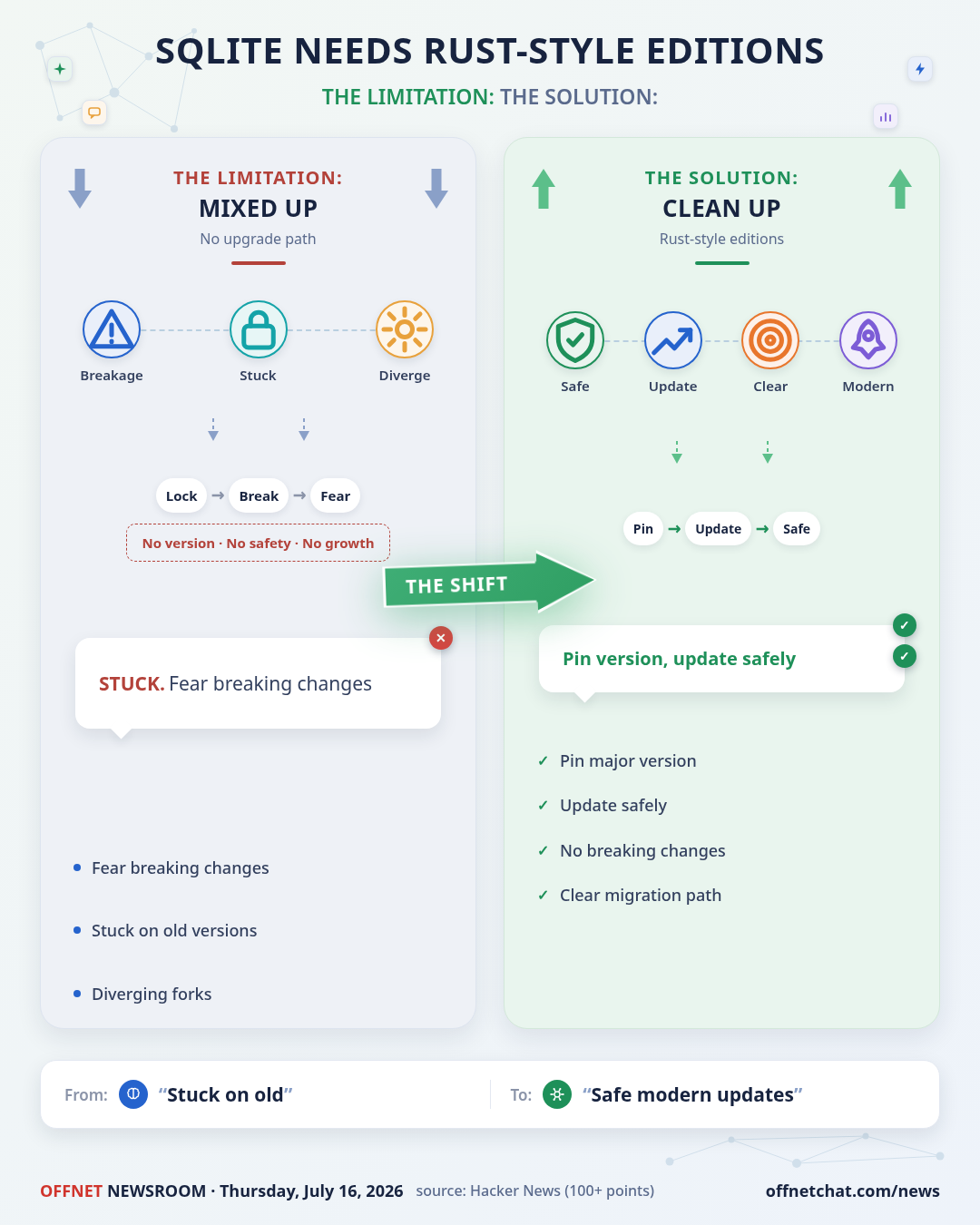
SQLite should have (Rust-style) editions

Article URL: https://mort.coffee/home/sqlite-editions/ Comments URL: https://news.ycombinator.com/item?id=48928135 Points: 266 # Comments: 106

  • Read the full item at Hacker News (100+ points).
BY THE NUMBERSHacker News Engagement266Upvotes for SQLite edition proposalHigh interest in Rust-style versioning
Planet PostgreSQL database

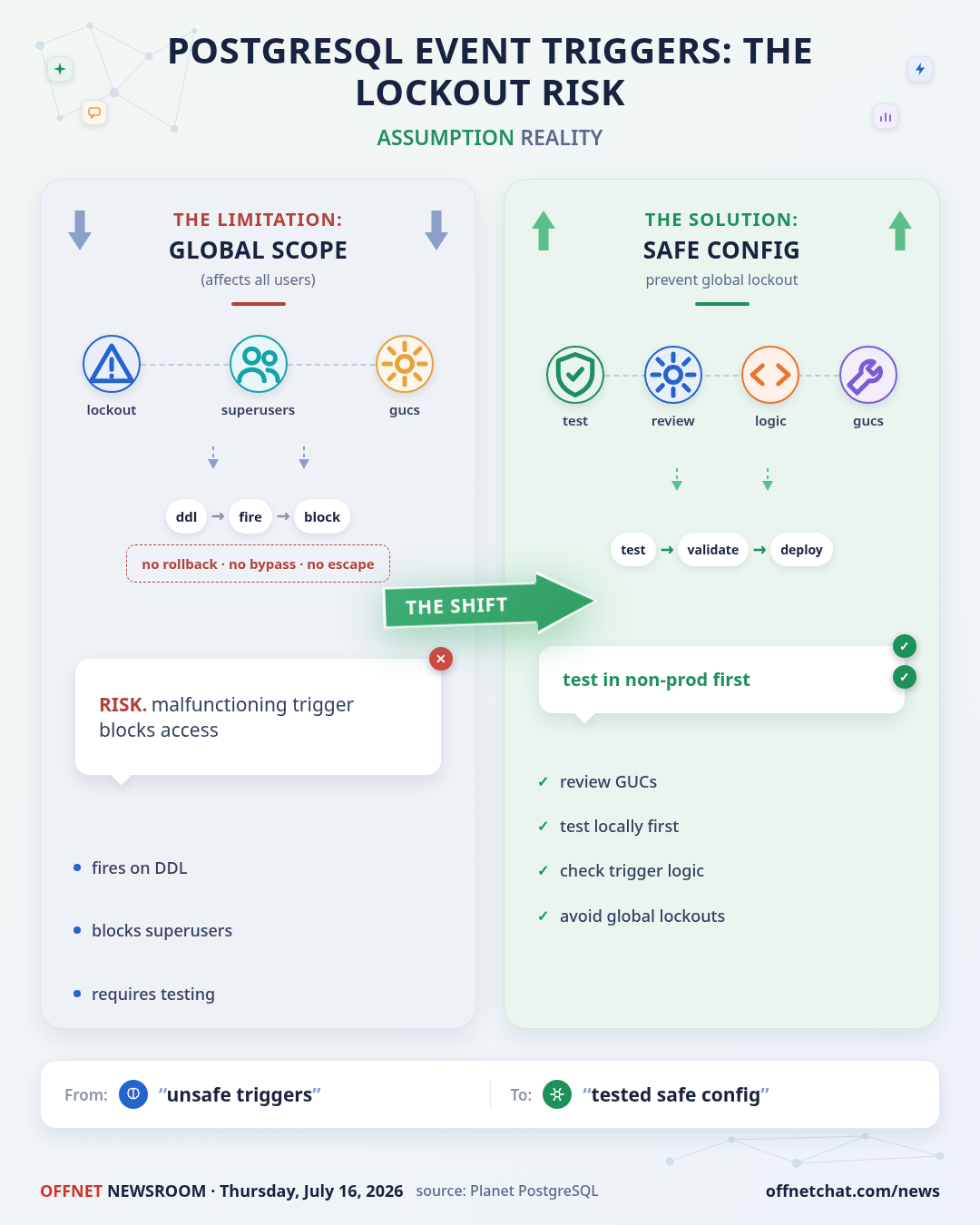
PostgreSQL Event Triggers: DDL Lockout Risks and GUC Scope

Christophe Pettus clarifies that event triggers respond to DDL and login activities rather than row-level changes. A critical vulnerability exists where a malfunctioning trigger can lock out all users, including superusers. This highlights the need for careful configuration and testing of global event triggers.

  • Event triggers fire on DDL and login events, not row operations.
  • Buggy triggers can block all users, even superusers.
  • Review GUCs and trigger logic to prevent global lockouts.
  • Test event triggers in non-production environments first.

PostgreSQL's psql client includes a suite of meta commands that operate outside standard SQL syntax, lacking semicolons and SQL structure. These tools are essential for experienced DBAs to manage daily database interactions and streamline administrative tasks. The article highlights how these specific commands significantly reduce friction in routine operational workflows.

  • psql meta commands differ from SQL by not requiring semicolons or standard query syntax.
  • These commands are designed to accelerate daily administrative tasks for seasoned DBAs.
  • Mastering psql internals improves operational efficiency beyond standard SQL knowledge.
  • Meta commands provide direct access to client-side utilities without server round-trips.
  • Adopting these tools is a key differentiator between junior and senior database practitioners.

LLMs 8

roundup ↗

Researchers introduce interventional grounding audits to test whether LLM chain-of-thought steps genuinely depend on stated premises. The black-box technique substitutes a target predicate in a single premise and checks if the model's normalized conclusion changes. Evaluated on ProntoQA with GPT-4o, the method achieved an F1 score of 0.806 in detecting proof-tree dependencies.

  • Proves CoT reasoning may appear logical without true premise dependency.
  • Uses black-box predicate substitution to isolate step-level causal links.
  • Validated on ProntoQA with GPT-4o showing 0.806 F1 for dependency detection.
  • Offers a concrete metric for auditing LLM logical grounding capabilities.
WORTH QUOTINGThe gistResearchers introduce interventional grounding audits totest whether LLM chain-of-thought steps genuinely depend onstated— arXiv cs.AI

Research into attention-based KV cache eviction reveals that non-stationary filtering disproportionately retains structural noise over content. In schema-dense inputs like nested JSON, delimiters and whitespace carry significantly more attention energy than actual data values. This structural-role bias causes exact-match accuracy to collapse from 88% to 0% at a 5% compression budget due to signal degradation.

  • Attention mass is a flawed metric for content retention in structured data contexts.
  • Structural tokens like delimiters dominate KV cache, starving content tokens of space.
  • Aggressive KV eviction (5% budget) can cause total accuracy failure on JSON schemas.
  • Current eviction algorithms need structural-aware weighting to preserve signal integrity.
THE SHIFTAccuracy Collapse at Low Compression88%FULL ACCURACY0%5% BUDGETStructural tokens drown out content
Hacker News (100+ points) general

xAI releases Grok build process as open source

xAI has open-sourced the Grok build repository on GitHub, providing the scripts and configuration used to construct the model. This release exposes the infrastructure and training pipeline details previously kept proprietary. The move allows the community to inspect the engineering choices behind Grok's architecture and deployment.

  • Inspect xAI's infrastructure and training scripts directly from their GitHub repo.
  • Opportunity to benchmark open-source build practices against proprietary LLM pipelines.
  • No immediate database or fleet impact for internal operations.
  • Potential for community-driven improvements or forks of the build process.
Hacker News (100+ points) general

Thinking Machines releases Inkling, an open-weights AI model

Thinking Machines has introduced Inkling, a new large language model with open weights. The release provides access to the model's architecture and parameters for public use. This move aims to foster broader research and development within the AI community.

  • Inkling weights are now publicly available for download and inspection.
  • The release supports open-source AI research and commercial adaptation.
  • Thinking Machines positions itself as a contributor to open-weight ecosystems.

OpenAI has released GPT-Red, an automated red teaming framework designed to stress-test AI systems through self-play. The system iteratively generates adversarial prompts to identify vulnerabilities in alignment and safety. This approach aims to enhance robustness against prompt injection attacks by allowing models to critique and improve their own defenses autonomously.

  • Automates adversarial testing via self-play, reducing manual red team overhead.
  • Focuses on improving robustness against prompt injection and alignment failures.
  • Enables continuous safety validation without external human-in-the-loop constraints.
  • Signals a shift toward autonomous model hardening in production pipelines.

OriginBlame introduces a system that tracks author identity through data processing pipelines at the record and token level, addressing the gap in locating specific training data for removal requests. Unlike existing tools that operate at the file or dataset level and force over-deletion, this approach resolves revocation requests into precise forget sets via deterministic queries. Evaluation on nearly 220,000 Wikipedia pages shows it reduces dataset-level over-deletion from 101x down to 1.3x, with integration overheads ranging from 1.3% to 19% depending on the pipeline.

  • Eliminates catastrophic over-deletion by pinpointing exact records for unlearning requests.
  • Propagates author identity through pipelines to create deterministic forget sets.
  • Adds 1.3-4.0% throughput overhead on HuggingFace and up to 19% on Datatrove.
  • Addresses practical gaps in data contributor removal compliance for model trainers.
THE SHIFTOriginBlame Over-Deletion Reduction101xPREVIOUS OVER-DELETION1.3xNEW OVER-DELETIONPinpoints exact records for unlearning

This paper addresses the engineering instability of scaling Generative Flow Networks to large language models, where learned prompt-conditional partition functions often cause gradient issues. The authors demonstrate that this partition function, previously considered essential for normalization, can be safely removed. This simplification reduces overhead and improves stability in post-training pipelines for reasoning models.

  • Learned partition functions in GFlowNets cause gradient instability at scale, adding unnecessary engineering overhead.
  • Replacing the partition function with a simpler alternative stabilizes training for large reasoning models.
  • Distribution-matching RL remains viable for LLMs if the normalization component is decoupled from prompt conditioning.
  • Simplifying the GFlowNet architecture enables better scaling for math and code generation tasks.
TRADE-OFFGFlowNet Partition FunctionTraditional ApproachLearned prompt-conditional…Causes gradient instability at scaleAdds unnecessary…Proposed SimplificationPartition function safely removedStabilizes training for LLMsReduces overhead significantlyvs

This paper analyzes on-policy distillation (OPD) in LLM post-training, identifying it primarily as an exploration catalyst that steers students toward correct reasoning paths via dense token-level guidance. The study reveals that prompt diversity outweighs per-problem sampling counts and that OPD effectiveness depends entirely on guiding signal quality. A critical Student-Teacher Mismatch pathology emerges when large distributional gaps between teacher and student models derail this exploration process.

  • OPD acts as an exploration catalyst, not a capability ceiling expander.
  • Prompt diversity is more critical than high per-problem sampling rates.
  • Guiding signal quality is the single most important factor for success.
  • Large teacher-student distribution gaps cause Student-Teacher Mismatch pathologies.
  • Monitor distributional gaps to prevent exploration derailment during training.
HOW IT WORKSOPD Training Pipeline1Generate diverse prompts2Teacher provides dense guidance3Student explores reasoning paths4Monitor distributional gaps

AI / ML 7

roundup ↗
AWS What's New awsdatabase ↺ since 07-15

GuardDuty expands to detect AI-specific threats in Bedrock and SageMaker

Amazon GuardDuty now includes AI Protection to monitor AWS AI services like Bedrock and SageMaker for targeted threats. The feature analyzes CloudTrail events to identify risks such as prompt injection, anomalous model invocations, and cost harvesting attacks. This provides automatic visibility into AI workload security without requiring custom tooling or manual configuration.

  • GuardDuty now covers Bedrock and SageMaker for AI-specific threat detection.
  • Automated monitoring detects prompt injection and anomalous invocation patterns.
  • Cost harvesting attacks via excessive GPU and token consumption are flagged.
  • No custom tooling or manual configuration is required for setup.
CHECKLISTGuardDuty AI Protection TakeawaysCovers Bedrock and SageMaker servicesDetects prompt injection risksFlags anomalous model invocationsIdentifies cost harvesting attacksRequires no custom tooling
AWS Database Blog awsdatabase ↺ since 07-15

AWS details semantic ontology for AI assistants via property graphs and vector search

AWS outlines a method for building semantic ontologies that ground AI assistants in enterprise data. The approach structures property graph stores for relationships and sets up vector indexing for semantic search. An automated fact-learning layer improves utility by building abstractions from observed data patterns rather than theoretical models.

  • Structure property graphs to map explicit data relationships for AI navigation
  • Implement vector indexing to enable semantic search capabilities
  • Use automated fact-learning to refine ontology from observed patterns
  • Adopt a bottom-up approach ensuring abstractions are data-grounded
AWS What's New awsdatabase ↺ since 07-15

AWS Security Hub adds AI inventory for org-wide asset visibility

AWS Security Hub now automatically discovers and catalogs AI workloads across the organization to address visibility gaps. It leverages AWS Config resources to inventory assets from managed services like Amazon Bedrock, Bedrock AgentCore, and Amazon SageMaker without requiring extra configuration. This central view helps security teams connect AI assets to active threats and misconfigurations.

  • Security Hub now provides a continuously updated, organization-wide view of AI assets.
  • Automatically discovers AI workloads using AWS Config resources from managed services.
  • Covers Amazon Bedrock, Bedrock AgentCore, and Amazon SageMaker out of the box.
  • Requires no additional configuration for inventorying these specific managed AI services.
  • Enables security teams to identify and secure AI assets they previously could not see.
HOW IT WORKSAI Asset Discovery Pipeline1AWS Config monitors resources2Security Hub ingests data3AI assets cataloged automatically4Threats linked to inventory
AWS What's New awsdatabase ↺ since 07-14

Gemma-4-E2B-it now in SageMaker JumpStart for efficient multimodal AI

Google DeepMind's Gemma-4-E2B-it is available in Amazon SageMaker JumpStart, offering a multimodal model optimized for local execution. It processes text, image, and audio inputs to generate text, featuring a built-in step-by-step reasoning mode. Key capabilities include object detection, document parsing, video understanding, native function calling, and code generation across multiple languages.

  • Gemma-4-E2B-it is now accessible via SageMaker JumpStart for AWS customers.
  • Model supports multimodal inputs: text, image, and audio with text output.
  • Includes native function calling for agentic workflows and step-by-step reasoning.
  • Optimized for efficient local execution on AWS infrastructure.
  • Handles OCR, chart comprehension, and code correction with multilingual support.
TRADE-OFFGemma-4 vs General ModelsGemma-4 EfficiencyOptimized for local executionEfficient resource usageBuilt-in reasoning modeGeneral MultimodalHigh cloud compute costsComplex deployment stepsStandard processing onlyvs
AWS What's New awsdatabase ↺ since 07-14

OpenAI privacy-filter for PII detection and masking arrives in SageMaker JumpStart

AWS has added OpenAI's privacy-filter to SageMaker JumpStart, introducing a bidirectional token-classification model for PII detection and masking. This tool enables high-throughput data sanitization by labeling input sequences in a single forward pass to identify entities like emails, names, and account numbers. The model is designed for context-aware processing and can be deployed with minimal effort to support secure data workflows on AWS infrastructure.

  • OpenAI's privacy-filter is now available in SageMaker JumpStart for PII detection and masking.
  • Model uses bidirectional token classification to label PII spans in a single forward pass.
  • Supports detection of emails, names, account numbers, dates, URLs, and secrets.
  • Designed for high-throughput sanitization workflows that can run on-premises or on AWS.
  • Deployable with few clicks via SageMaker JumpStart for rapid integration.
HOW IT WORKSPII Sanitization Pipeline1Input raw data sequences2Bidirectional token classification3Identify PII spans4Mask sensitive entities5Output sanitized text
AWS What's New awsdatabase ↺ since 07-14

Qwen3 Embedding and Reranker Models Now in SageMaker JumpStart

AWS has added Qwen3-VL-Embedding-2B and Qwen3-Reranker-4B to SageMaker JumpStart for building search pipelines. The embedding model handles initial recall across text, images, and video, while the reranker refines results. These models work in tandem to support cross-modal retrieval tasks on AWS infrastructure.

  • Qwen3-VL-Embedding-2B supports mixed modalities including text, images, screenshots, and video.
  • Qwen3-Reranker-4B provides precise re-ranking after the initial embedding-based recall stage.
  • Both models are now available via SageMaker JumpStart for immediate deployment.
  • Designed for comprehensive search pipelines leveraging AWS foundation model infrastructure.
HOW IT WORKSQwen3 Search Pipeline Steps1Ingest mixed media2Embed with Qwen33Recall initial results4Rerank with Qwen35Deliver final output

Small language models struggle with structural blindness when predicting molecular properties from SMILES strings. This research introduces a Context-Augmented Prompting framework that integrates graph neural networks at inference time to provide predictive hints and explanatory subgraphs. Evaluations on MUTAG and Tox21 datasets show that enriching prompts with these graph-based tools significantly improves performance across multiple prompting configurations.

  • SLMs often miss graph-topological cues when relying solely on SMILES sequences.
  • The new framework enables agentic tool use by invoking a GNN expert at inference.
  • GNNs provide both predictive hints with confidence and instance-specific subgraphs.
  • Performance gains were confirmed on MUTAG and Tox21 across five prompting setups.
HOW IT WORKSGraph-Augmented Inference Pipeline1Ingest SMILES sequence2Invoke GNN expert3Extract subgraphs4Augment prompt5Generate prediction

Agentic AI 8

roundup ↗

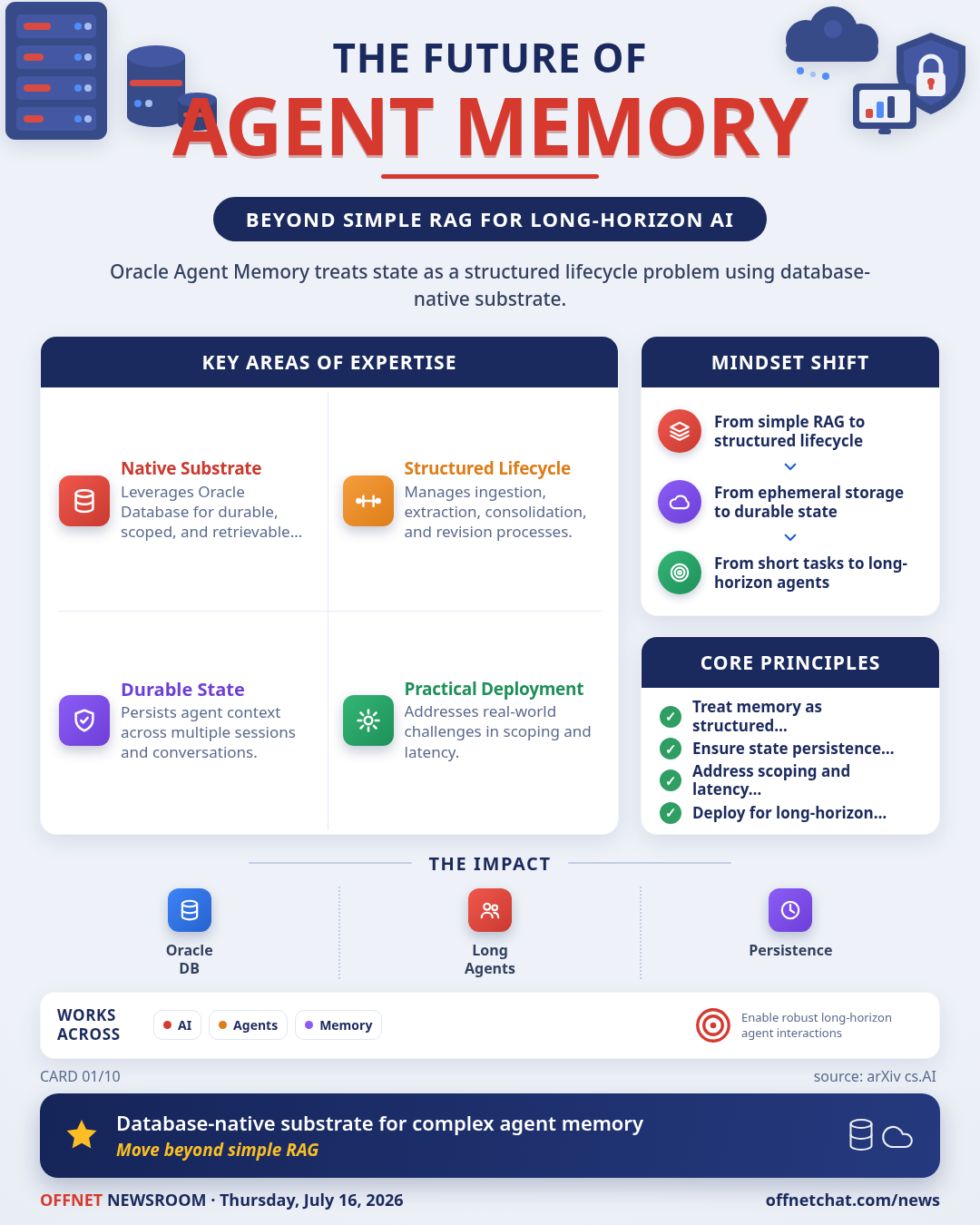
This arXiv paper introduces Oracle Agent Memory, a system designed to handle the complexity of retaining and managing state for long-horizon AI agents. Rather than relying solely on document retrieval, the architecture treats memory as a lifecycle involving ingestion, extraction, consolidation, and revision. It leverages Oracle Database to provide durable, scoped, and retrievable state that persists across sessions and conversations.

  • Moves beyond simple RAG by treating agent memory as a structured, durable lifecycle problem.
  • Uses Oracle Database as the native substrate for state retention and retrieval.
  • Addresses key challenges in scoping, latency, and the revision of accumulated knowledge.
  • Focuses on practical deployment needs for long-horizon agent interactions.
HOW IT WORKSOracle Agent Memory Lifecycle1Ingest raw data2Extract key entities3Consolidate memory state4Revise outdated facts

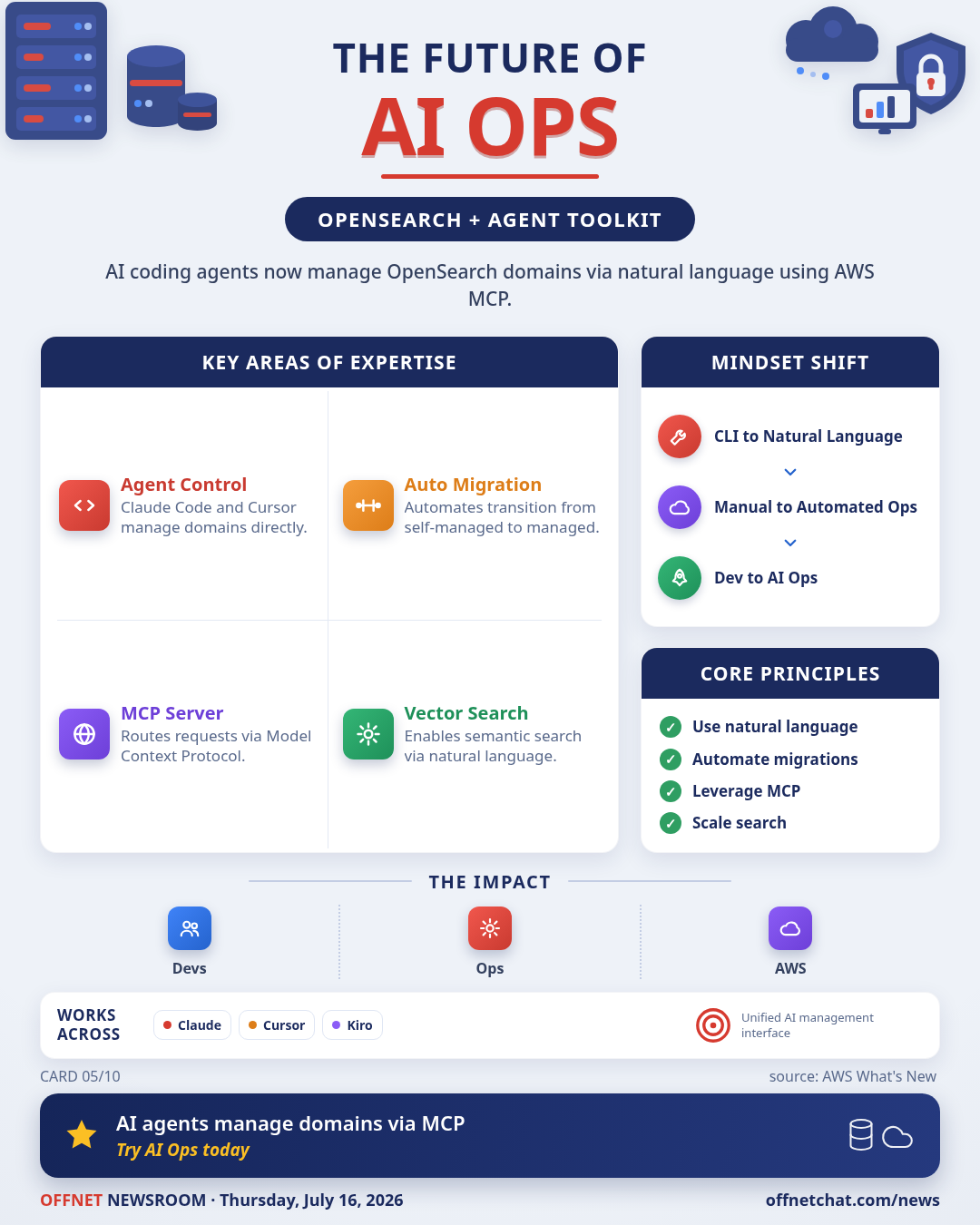
Amazon OpenSearch Service now supports the Agent Toolkit for AWS, allowing AI coding agents like Claude Code and Cursor to manage domains and Serverless collections via natural language. This integration leverages the AWS Model Context Protocol (MCP) server to execute API calls automatically. A curated skill routes requests across migration, operations, and search capabilities.

  • AI agents can now provision and manage OpenSearch domains and Serverless collections directly.
  • Integration uses AWS MCP server to handle API calls based on natural language prompts.
  • Supported agents include Claude Code, Kiro, and Cursor for development workflows.
  • Automates migration from self-managed to fully managed OpenSearch environments.
  • Enables semantic and vector search operations through natural language instructions.
CHECKLISTAI Agent Integration StepsProvision domains via natural language promptsUse MCP server for API executionRoute requests across migration and opsAutomate self-managed to fully managed migrationEnable semantic search through instructions

This survey examines how autonomous agents evolve capabilities through experience with minimal human intervention. It introduces a system-level framework viewing agents as configurations of foundation models paired with operational scaffolds like prompts, memory, and tools. Self-improvement is formalized as a self-induced update operator that commits changes to either model parameters or these scaffold components. The work categorizes existing research by what is updated and the signals driving those updates.

  • Self-improving agents are transitioning from research to production environments.
  • Framework treats agents as config of foundation model plus operational scaffold.
  • Improvement is formalized as self-induced updates to parameters or scaffolds.
  • Prior work organized by update target and driving signals.
HOW IT WORKSSelf-Improving Agent Framework1Foundation model configuration2Operational scaffold integration3Self-induced update operator4Parameter or scaffold commit5Capability evolution via experience

Google has released a preview of the Genkit Agents API for TypeScript and Go, consolidating message history, tool loops, streaming, and state persistence into a single chat() interface. The update introduces detached turns, allowing agents to continue processing after the client disconnects. It also supports interruptible tools for human-in-the-loop workflows, featuring anti-forgery validation to secure resumption.

  • Agents can now operate asynchronously via detached turns even after client disconnection.
  • Human-in-the-loop is enabled through interruptible tools with anti-forgery resume validation.
  • TypeScript and Go developers get a unified chat() interface for AI agent state and streaming.
  • The API is currently in preview, signaling early access for framework integration testing.

Hugging Face and Allen AI share insights from developing Shippy, an autonomous agent system. The blog post details the architectural decisions and engineering challenges encountered during the build process. It highlights key takeaways for creating robust AI agents in production environments.

  • Shippy demonstrates practical approaches to agent architecture from Hugging Face and Allen AI.
  • The team shares specific engineering lessons learned during the development lifecycle.
  • Focus is placed on reliability and structure when building autonomous AI systems.
  • Provides technical context for practitioners interested in agent-based workflows.

This paper addresses the challenge of modifying AI agent harnesses, which coordinate prompts, state, and tools. As systems evolve, developers struggle to map behavioral requirements to distributed, tightly coupled code. The work proposes methods to make these harnesses readable and editable for both human engineers and coding agents.

  • AI agent harnesses are critical infrastructure often overlooked compared to the foundation model.
  • Behavioral requirements are hard to map to code in large, distributed, and coupled repositories.
  • Standard code search and indexing are insufficient for understanding behavioral intent.
  • Improved navigability is essential for both human developers and autonomous coding agents.
  • The work focuses on making harnesses editable as models and APIs continuously change.
TRADE-OFFBeyond Standard Code SearchStandard ToolsInsufficient for behavioral intentMisses distributed couplingFails with evolving APIsHarness MethodsMaps requirements to codeSupports human and AIEnables editable infrastructurevs
arXiv cs.AI researchai

Safety Sentry: Three-Way Routing for LLM Agent Actions

This paper introduces Safety Sentry, a guard model that replaces binary safe/unsafe classification with a three-way EXECUTE-ASK-REFUSE routing decision. By evaluating actions at the instance level rather than the category level, it distinguishes between inherent harm and contextual appropriateness. The approach aims to reduce unnecessary interruptions while ensuring critical safety checks are enforced where needed.

  • Replaces binary guardrails with EXECUTE, ASK, or REFUSE routing for finer control.
  • Evaluates safety at the individual action instance level, not just the category.
  • Separates inherent harm from contextual appropriateness to reduce false positives.
  • Uses a lightweight guard model to minimize inference overhead for real-time agents.
HOW IT WORKSSafety Sentry Decision Pipeline1Evaluate action instance2Check inherent harm3Assess context4Route: Execute, Ask, or Refuse

MyAG introduces a graph-based architecture that decouples LLM agent construction into component, workflow, and search graphs. This separation enables flexible reuse of modules across different execution strategies and supports hierarchical composition via recursive nodes. The framework includes monitoring and visualization tools to help practitioners analyze performance and efficiency tradeoffs in agent deployments.

  • Decouples agent logic, execution flow, and search strategies into distinct graph layers.
  • Enables modular reuse of components across varying execution contexts.
  • Supports hierarchical system design through recursive node definitions.
  • Provides built-in monitoring and visualization for runtime analysis.
HOW IT WORKSMyAG Graph Layers1Component Graph2Workflow Graph3Search Graph4Monitoring & Visualization

Automation / DevOps / IaC 8

roundup ↗

FixItFlow uses LLMs to automate the creation of troubleshooting guides by extracting diagnostic patterns from historical cloud incidents. The system synthesizes structured guides with verified commands and applies strict validation to prevent hallucinations. Evaluation with 26 engineers showed 61.5% clarity ratings and a 2.3x reduction in mitigation time.

  • Automates guide creation from historical incident data, reducing manual effort.
  • Extracts diagnostic patterns from engineer actions to build structured content.
  • Enforces strict validation to ensure commands are verified and accurate.
  • Reduces incident mitigation time by 2.3x in practitioner evaluations.
BY THE NUMBERS2.3x Faster Mitigation2.3xReduction in mitigation timeBased on evaluation with 26 engineers

Existing classical and LLM-based methods struggle to identify root causes in the large-scale, multimodal OpenRCA dataset due to its lack of detailed domain knowledge. The authors introduce a Structured Multi-Agent RCA pipeline that significantly improves accuracy over prior baselines. This new approach is designed to function effectively in both domain-knowledge and knowledge-free operating modes.

  • Classical causal discovery and existing LLM multi-agents fail reliably on the OpenRCA benchmark.
  • OpenRCA's lack of domain knowledge makes root cause identification particularly challenging.
  • New Structured Multi-Agent RCA pipeline shows substantial performance gains.
  • Solution supports both domain-knowledge and knowledge-free operational contexts.
HOW IT WORKSStructured Multi-Agent RCA Pipeline1Ingest multimodal telemetry data2Identify candidate root causes3Validate hypotheses via agents4Output structured diagnosis
AWS What's New awsdatabase ↺ since 07-15

AWS Lambda Console Adds One-Click Setup for Coding Agents

AWS Lambda now offers a one-click prompt in the console to configure coding agents with AWS Serverless skills and the Serverless Model Context Protocol. This automation embeds serverless best practices directly into the agent's workflow, replacing the previous need to manually search documentation for configuration details. The feature is accessible to developers at any stage of their Lambda journey, from initial exploration to function creation.

  • Eliminates manual configuration steps for coding agents in the Lambda console
  • Automatically installs AWS Serverless skills and Serverless MCP server
  • Embeds serverless best practices into agent workflows from the start
  • Available across all Lambda entry points for consistent developer experience
HOW IT WORKSOne-Click Agent Setup1Click Lambda agent prompt2Auto-install Serverless skills3Configure MCP server4Embed best practices
AWS What's New awsdatabase

AWS Lambda supports self-managed S3 code storage

AWS Lambda now allows referencing source code directly from customer-managed S3 buckets, eliminating the need for intermediate copies in Lambda-managed storage. This change removes the previous 75GB per-region storage limit and reduces function activation time by skipping the copy step during creation and updates. The feature specifically benefits workloads with numerous functions and layers that previously required quota increase tickets.

  • Bypass the 75GB per-region storage limit by storing code in your own S3 buckets
  • Reduce cold start and update latency by eliminating the intermediate copy step
  • No longer need to submit support tickets for storage quota increases
  • Simplifies deployment pipelines by removing Lambda-managed storage management
THE SHIFTLambda Storage Limit Removed75GBPER-REGION LIMIT3S3 BUCKETSNo more intermediate copies or quota tickets
AWS What's New awsdatabase ↺ since 07-15

AWS Flink AI Agent Skills streamline app development and ops

Amazon Managed Service for Apache Flink now integrates AI Agent Skills to guide developers through common tasks like creation, troubleshooting, and scaling. These skills provide expert, up-to-date guidance to help teams accelerate development and maintain application health without deep specialized knowledge. The feature supports integration with existing AI coding agents such as Kiro to assist with version upgrades and cost optimization.

  • AI Agent Skills automate guidance for Flink app creation, scaling, and monitoring.
  • Reduces dependency on specialized Flink expertise for routine operational tasks.
  • Integrates with existing tools like Kiro to streamline the developer workflow.
  • Simplifies upgrades to new Flink versions, such as 2.2, with guided assistance.
CHECKLISTMastering Flink AI SkillsAutomate app creation and scaling tasksReduce reliance on deep Flink expertiseIntegrate with tools like KiroSimplify upgrades to version 2.2
AWS Database Blog awsdatabase ↺ since 07-14

AWS adds CloudFormation support for DMS Schema Conversion provisioning

AWS Database Migration Service now allows Schema Conversion tasks to be provisioned via AWS CloudFormation templates. This update integrates generative AI capabilities to enhance the code conversion experience for heterogeneous migrations. The feature supports converting database objects between systems such as Oracle, SQL Server, PostgreSQL, and MySQL.

  • Automate DMS Schema Conversion setup using Infrastructure as Code workflows.
  • Leverage built-in generative AI to improve heterogeneous code conversion quality.
  • Simplify migration pipelines for Oracle/SQL Server to PostgreSQL/MySQL targets.
  • Eliminate manual console steps for schema conversion task provisioning.
CHECKLISTDMS Schema Conversion TakeawaysAutomate setup using Infrastructure as CodeLeverage generative AI for conversion qualitySimplify Oracle to PostgreSQL migrationsEliminate manual console provisioning steps

The Linkerd community has released version 2.20, bringing significant improvements in performance, observability, and traffic management capabilities. This update reinforces the project's status as a lightweight, CNCF-graduated alternative for Kubernetes networking. The enhancements aim to provide greater efficiency gains for clusters adopting service mesh architectures.

  • Linkerd 2.20 introduces refined traffic management controls for Kubernetes workloads.
  • Performance and observability metrics are enhanced to support deeper operational insight.
  • The release solidifies Linkerd's position as a high-efficiency, lightweight service mesh option.
  • CNCF-graduated status confirms stability and community adoption for production environments.
Hacker News (100+ points) general

clig.dev: New Command Line Interface Guidelines for CLI Design

clig.dev is a curated resource offering comprehensive guidelines for designing command-line interfaces. It covers essential aspects such as argument parsing, help text, error handling, and consistency across different tools. The site aims to standardize CLI behavior to improve usability for developers and operators.

  • Standardize CLI argument parsing and help text for better usability
  • Ensure consistency in error handling and exit codes across tools
  • Follow established patterns to reduce cognitive load for users
  • Reference clig.dev for practical examples and design principles

AWS 8

roundup ↗

AWS has extended support for Graviton4-based R8g and M8g database instances to numerous new regions, including Europe, Asia Pacific, and South America. R8g is now generally available for Aurora and RDS engines, delivering up to 40% performance gains and 29% better price-performance compared to Graviton3. M8g support for RDS engines has also widened to additional locations across North America, Europe, and Asia.

  • R8g Graviton4 instances are now GA in 10+ new regions for Aurora and RDS.
  • M8g instances see expanded regional availability for RDS PostgreSQL, MySQL, and MariaDB.
  • Expect up to 40% performance improvement and 29% cost efficiency over Graviton3.
  • Review regional quotas and capacity plans for new Graviton4 instance types.
BY THE NUMBERSGraviton4 Performance Gains40%Performance increase over Graviton3New R8g instances deliver faster speed

Amazon RDS and Aurora now offer R8gd and M8gd instances in additional regions, bringing Optimized Reads capabilities to PostgreSQL, MySQL, and MariaDB. These instances leverage local NVMe storage for ephemeral data like temporary tables, significantly reducing network I/O. This architecture delivers up to 165% better throughput and 120% improved price-performance compared to R6g instances for Aurora PostgreSQL.

  • R8gd and M8gd instances are now available in 12 and 6 additional regions respectively.
  • Local NVMe storage handles ephemeral data, lowering query latency for complex operations.
  • Aurora PostgreSQL sees up to 165% throughput gains and 120% price-performance improvements.
  • Optimized Reads support extends to RDS for MySQL and MariaDB alongside PostgreSQL.
BY THE NUMBERS165% Throughput Gain for Aurora165%Better throughput for Aurora PostgreSQLCompared to R6g instances using local NVMe storage

AWS and Anthropic have released the Claude Apps Gateway for AWS, a self-hosted control plane designed to manage Claude Code and Claude Desktop. This stateless container centralizes identity, policy, telemetry, routing, and spend caps while directing inference traffic to Amazon Bedrock or the Claude Platform on AWS.

  • Self-hosted control plane simplifies governance for Claude Code and Desktop across the fleet.
  • Centralizes identity, policy, and spend caps in a single stateless container.
  • Routes inference requests to Amazon Bedrock or Claude Platform on AWS.
  • Enables unified telemetry and routing for enterprise AI usage.
AWS What's New awsdatabase

AWS Expands G7e Instances to Europe and Asia Pacific

Amazon EC2 G7e instances, powered by NVIDIA RTX PRO 6000 Blackwell Server Edition GPUs, are now live in Frankfurt, Stockholm, and Mumbai. These instances deliver up to 2.3x inference performance over G6e and support up to 8 GPUs with 96 GB memory each. They are optimized for LLMs, agentic AI, spatial computing, and hybrid graphics-AI workloads.

  • G7e instances launched in EU (Frankfurt, Stockholm) and APAC (Mumbai) regions
  • Up to 2.3x inference performance improvement compared to G6e instances
  • Features 8x NVIDIA RTX PRO 6000 Blackwell GPUs with 96 GB memory each
  • Optimized for LLMs, multimodal AI, spatial computing, and physical AI workloads
  • Powered by 5th Gen Intel Xeon processors supporting up to 192 vCPUs
BY THE NUMBERSG7e Inference Speed Boost2.3xPerformance over G6e instancesPowered by 8x RTX PRO 6000 GPUs

Amazon RDS now permits up to four storage modifications per database instance within a rolling 24-hour window. This change eliminates the previous six-hour cool-off period, allowing operators to initiate new adjustments immediately after the prior optimization completes. The update supports increasing volume size, changing storage types, and adjusting performance without downtime across PostgreSQL, MariaDB, and other supported engines.

  • Removes the six-hour cool-off period between storage modifications for faster operational agility.
  • Allows up to four storage changes (size, type, performance) per instance in a 24-hour window.
  • Modifications are non-disruptive, keeping applications running with minimal performance impact.
  • Improves responsiveness to sudden data growth or unexpected workload spikes.
  • Available on Amazon RDS for PostgreSQL, MariaDB, and other supported engines.
BY THE NUMBERSThe headline number24hoursAWS RDS allows four storage modifications in 24 hours…

AWS Elastic Disaster Recovery now accelerates failover for workloads already hosted on Amazon EC2 by bypassing unnecessary preparation steps. This optimization reduces recovery time by up to 65% for Windows instances and 40% for Linux. The service automatically handles networking, drivers, and licensing while allowing administrators to toggle this faster mode per account or server.

  • Skip prep steps for AWS-hosted source servers to cut RTO significantly.
  • Up to 65% faster recovery for Windows and 40% for Linux workloads.
  • Networking, drivers, and licensing are applied automatically during failover.
  • Control granularity allows enabling faster recovery per account or individual server.
COMPARISONRecovery Time Saved by OSWindows65%Linux40%

AWS has introduced an open-source Bulk Executor tool designed to streamline large-scale operations on Amazon DynamoDB tables. The utility supports bulk commands such as count, find, update, and delete without requiring custom code. This release aims to simplify tasks that previously demanded significant engineering effort to implement at scale.

  • Eliminates need for custom coding for bulk DynamoDB operations
  • Supports count, find, update, and delete commands out of the box
  • Optimized for performance at large scale across full tables
  • Available as open-source tool for immediate integration

Amazon CloudWatch now supports a lookup processor that enriches log events by matching fields against uploaded CSV reference tables within the pipeline. This feature allows engineers to append metadata, such as mapping IP addresses to application teams or user IDs to details, directly during ingestion. The processor executes these matches in real-time, eliminating the need for external services to perform data enrichment.

  • Upload CSV lookup tables directly in the CloudWatch Pipeline config for immediate use.
  • Enrich logs with external context like team ownership or user details at ingestion time.
  • Matches log fields against table keys to append specified metadata columns to events.
  • Simplifies workflows by removing the need for separate enrichment microservices.
HOW IT WORKSReal-time Log Enrichment Flow1Upload CSV reference tables2Ingest raw log events3Match fields against keys4Append metadata to events

Oracle Ecosystem 1

roundup ↗

A recent EU competition decision has shifted the balance of power, giving SAP customers greater leverage during maintenance fee negotiations. While this provides a strategic advantage for organizations still on ECC, the ruling does not necessarily trigger a mass exodus to third-party support vendors. The truce over fees is now primarily a bargaining chip rather than a guaranteed pathway to cheaper alternatives.

  • EU decision strengthens customer position in maintenance fee talks with SAP.
  • ECC holdouts can use this ruling as leverage in current contract discussions.
  • Do not assume a widespread migration to third-party support will follow.
  • Focus on negotiation tactics rather than expecting immediate market shifts.

Trending on GitHub 3

roundup ↗
GitHub Trending (daily) githubrepos ⚠ unverified date/source

Open Interpreter: CLI coding agent for low-cost models with harness emulation

Open Interpreter is a terminal-based coding agent designed to maximize performance from affordable LLMs by emulating high-end agent harnesses. It supports multiple execution modes via the /harness command, allowing users to switch between native, Claude Code, and other specialized agents. The tool also includes capabilities for computer use, enabling models to interact with and test graphical interfaces directly.

  • Optimizes low-cost models using specific agent harnesses like claude-code and swe-agent.
  • Installable via one-liner scripts for macOS, Linux, and Windows.
  • Supports computer use skills for GUI interaction and interface testing.
  • Provides a flexible CLI environment for iterative coding tasks.
GitHub Trending (daily) githubrepos ↺ since 07-13 ⚠ unverified date/source

GitHub: dcg blocks destructive git/shell commands for AI coding agents

Destructive Command Guard acts as a high-performance hook to intercept and block dangerous git and shell commands before they execute. It supports a wide range of AI coding tools including Claude Code, Codex CLI, Gemini CLI, and Cursor, preventing accidental file deletions. The tool integrates via native hooks or compatibility layers to protect developer workflows across multiple environments.

  • Blocks destructive commands across major AI coding agents like Claude, Gemini, and Cursor.
  • Prevents accidental deletion of work by intercepting git and shell operations.
  • Supports native hooks for Grok and Antigravity, plus compatibility layers for others.
  • A practical safety net for teams using autonomous AI coding assistants.
GitHub Trending (daily) githubrepos ↺ since 07-14 ⚠ unverified date/source

Shubhamsaboo/awesome-llm-apps: 100+ Open-Source Agent & RAG Templates

This repository provides over 100 hand-built, end-to-end tested open-source applications for AI agents and Retrieval-Augmented Generation. It supports major models including Claude, Gemini, GPT, and various open-source options like Llama and Qwen under the Apache-2.0 license. The collection includes practical examples like fraud investigation agents and home renovation assistants, designed for easy cloning and customization.

  • Apache-2.0 licensed 100+ tested LLM apps for cloning and immediate use.
  • Compatible with Claude, GPT, Gemini, Llama, Qwen, and DeepSeek models.
  • Includes specialized agents for fraud, insurance, and project management.
  • Integrates with coding agents via npx skills add for rapid skill injection.
  • Provides step-by-step tutorials and quick start guides for deployment.

Mobile friendly 6

all cards ↗

Today's top database + AI stories as save-and-share cards — built for your phone and your LinkedIn feed.