OffNet Newsroom

Archive snapshot

Tuesday, July 14, 2026

Daily signal on databases, AI, and the tech that matters.

41 new today 50 stories 8 sections 17 for the DBA desk

Database Technology 8

roundup ↗

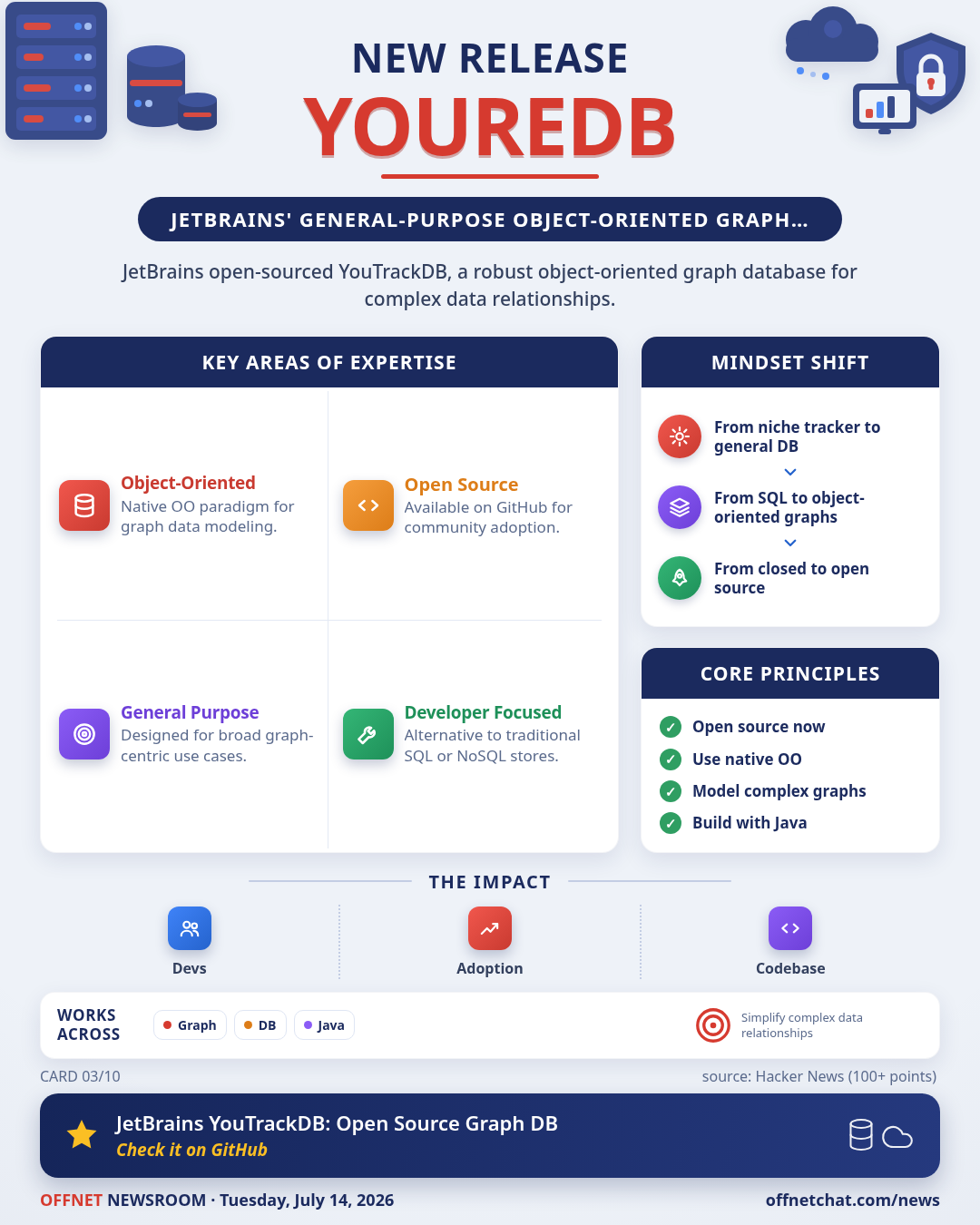
JetBrains has open-sourced YouTrackDB, positioning it as a general-purpose object-oriented graph database rather than a niche tracking tool. The project aims to provide a robust backend for complex data relationships using an object-oriented paradigm. This release offers developers an alternative to traditional relational or document stores for graph-centric use cases.

  • YouTrackDB is an object-oriented graph database from JetBrains, not just a tracker.
  • Open-sourced on GitHub, suitable for general-use graph data models.
  • Targets developers needing native OO graph capabilities over SQL/NoSQL.
  • Initial release suggests early-stage adoption for new projects.

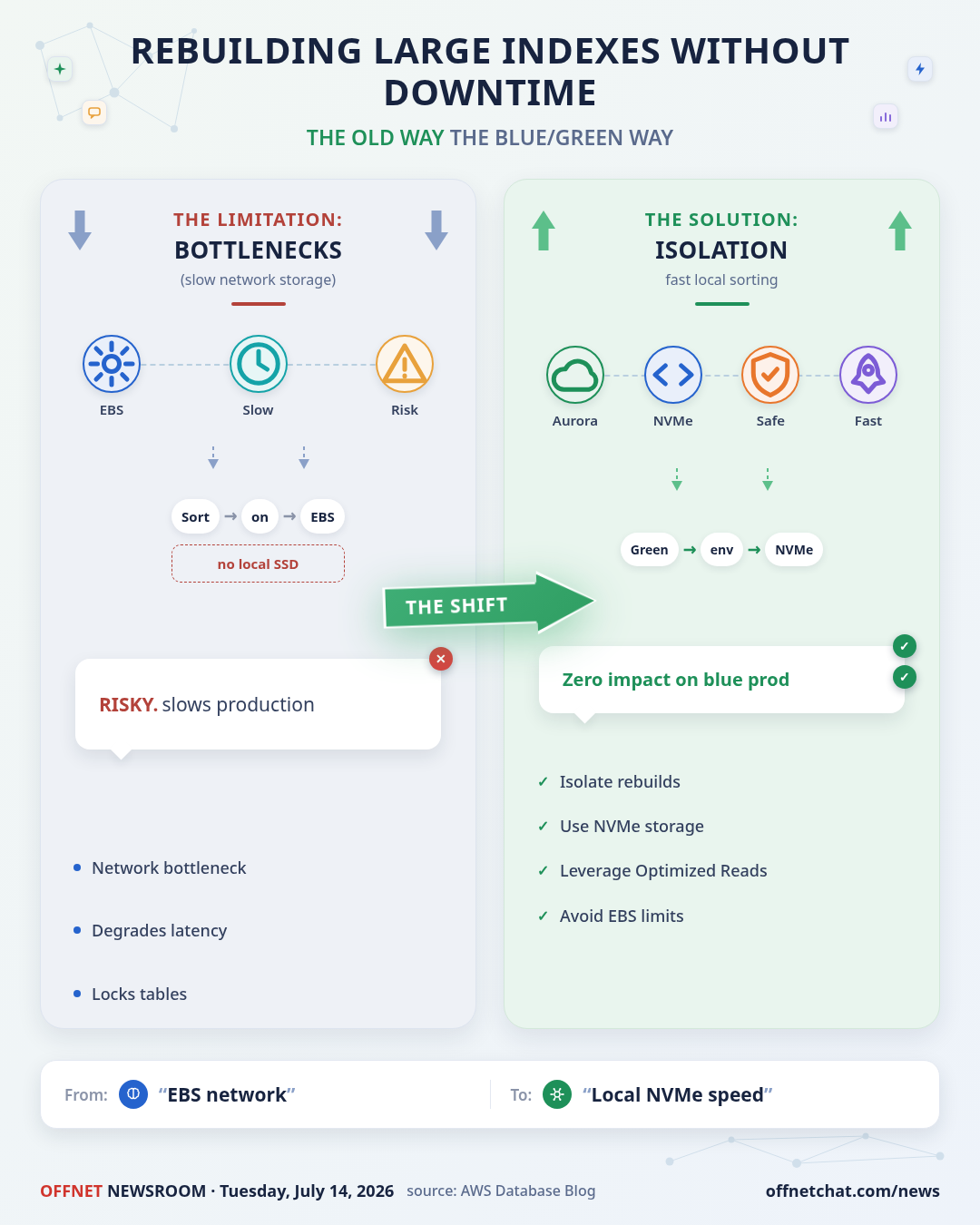
AWS outlines a method for rebuilding large indexes on Aurora PostgreSQL by leveraging Blue/Green Deployments and Optimized Reads. The process executes the reindex on the green staging environment using NVMe-backed instances, allowing the sort phase to utilize fast local storage rather than networked EBS. This approach isolates the resource-intensive operation, preventing performance degradation for production workloads running on the blue environment.

  • Use Blue/Green Deployments to isolate index rebuilds from production traffic.
  • NVMe-backed instances enable local storage sorting, significantly speeding up the process.
  • Aurora Optimized Reads enhances performance during the staging phase operations.
  • Avoids EBS network bottlenecks by leveraging local SSD storage for heavy sorts.

Fleet impact: For Aurora PostgreSQL fleets, this offers a low-risk strategy to maintain index health without locking production tables or degrading query latency. Plan maintenance windows around the deployment switch, ensuring the green environment has sufficient NVMe storage capacity for the sort operations before initiating the cutover.

Amazon DocumentDB version 8.0.1 introduces support for 46 additional MongoDB aggregation operators and cursor methods. This update covers seven functional categories including accumulators, trigonometry, bitwise operations, arithmetic, and data size checks. The enhancement aims to improve query API compatibility, facilitating smoother migration of MongoDB workloads without requiring application code modifications.

  • Version 8.0.1 adds 46 new aggregation operators to Amazon DocumentDB
  • New features span accumulators, trigonometry, bitwise, arithmetic, and type checks
  • Improved API compatibility reduces friction for migrating MongoDB workloads
  • Many migrations can proceed without application code changes
  • Operators include $top, $sin, $bitAnd, $round, and $binarySize
BY THE NUMBERSNew Aggregation Operators in 8.0.146New MongoDB aggregation operators addedSpanning accumulators, trigonometry, bitwise, and more

AWS has enabled Infrastructure as Code support for Database Migration Service Schema Conversion tasks through AWS CloudFormation. This update allows engineers to automate the provisioning of schema conversion jobs for heterogeneous migrations, such as moving from Oracle or SQL Server to PostgreSQL or MySQL. The solution integrates generative AI capabilities to enhance the quality and efficiency of the code conversion process during these cross-database migrations.

  • Automate DMS Schema Conversion task creation using CloudFormation templates for consistent deployments.
  • Supports heterogeneous migrations from Oracle/SQL Server to PostgreSQL/MySQL targets.
  • Leverages generative AI to improve the accuracy and speed of schema translation.
  • Enables repeatable, version-controlled migration workflows for database modernization projects.

Christophe Pettus examines the escape_string_warning GUC, a warning mechanism present in PostgreSQL for two decades. The system typically remains silent on this setting until it detects a genuine configuration problem within the connection parameters. This behavior highlights how modern PostgreSQL handles legacy warnings by suppressing them unless they indicate an actual error.

  • escape_string_warning is a long-standing GUC that often goes unnoticed by users.
  • PostgreSQL suppresses this warning by default to reduce noise in modern versions.
  • The warning only activates when a real problem is detected in connection settings.
  • Review connection configurations if you need strict validation of escape sequences.

Hans-Juergen Schoenig explains that pg_hardstorage operates by connecting to PostgreSQL exactly like a streaming replica, using the standard libpq client with the replication attribute. The agent retrieves data via START_REPLICATION SLOT on a physical slot and BASE_BACKUP, eliminating the need for archive_command, SSH access, or shared filesystems. This architecture allows the tool to function effectively against managed PostgreSQL services where host-level access is restricted.

  • Uses standard libpq replication protocol, avoiding host-level dependencies like SSH or shared storage.
  • Reads WAL via START_REPLICATION SLOT and uses BASE_BACKUP for initial data sync.
  • Works against managed PostgreSQL by treating the replication endpoint as the sole interface.
  • No archive_command or archive_library required, simplifying deployment and configuration.

Andrew Dunstan has released version 21 of the PostgreSQL Buildfarm Client, introducing two new modules to enhance testing capabilities. The PatchStack module allows non-standard buildfarms to test stacks of patches on top of a specific branch, while the ABI check module utilizes abidw to detect changes in installed headers. These updates aim to improve the rigor and flexibility of the PostgreSQL development testing infrastructure.

  • PatchStack module enables testing patch stacks on branches, isolated from the main community Buildfarm.
  • New ABI check module uses abidw to detect header changes, ensuring binary compatibility.
  • PatchStack submissions to the regular community server will be detected and rejected.
  • Buildfarm Client v21 is now available for contributors managing custom build environments.
TRADE-OFFPatchStack New CapabilitiesStandard FarmTests single patches onlyCommunity controlled serverLimited flexibilityPatchStack ModuleTests patch stacksCustom buildfarmsIsolated testingvs

LLMs 8

roundup ↗
AWS What's New awsdatabase

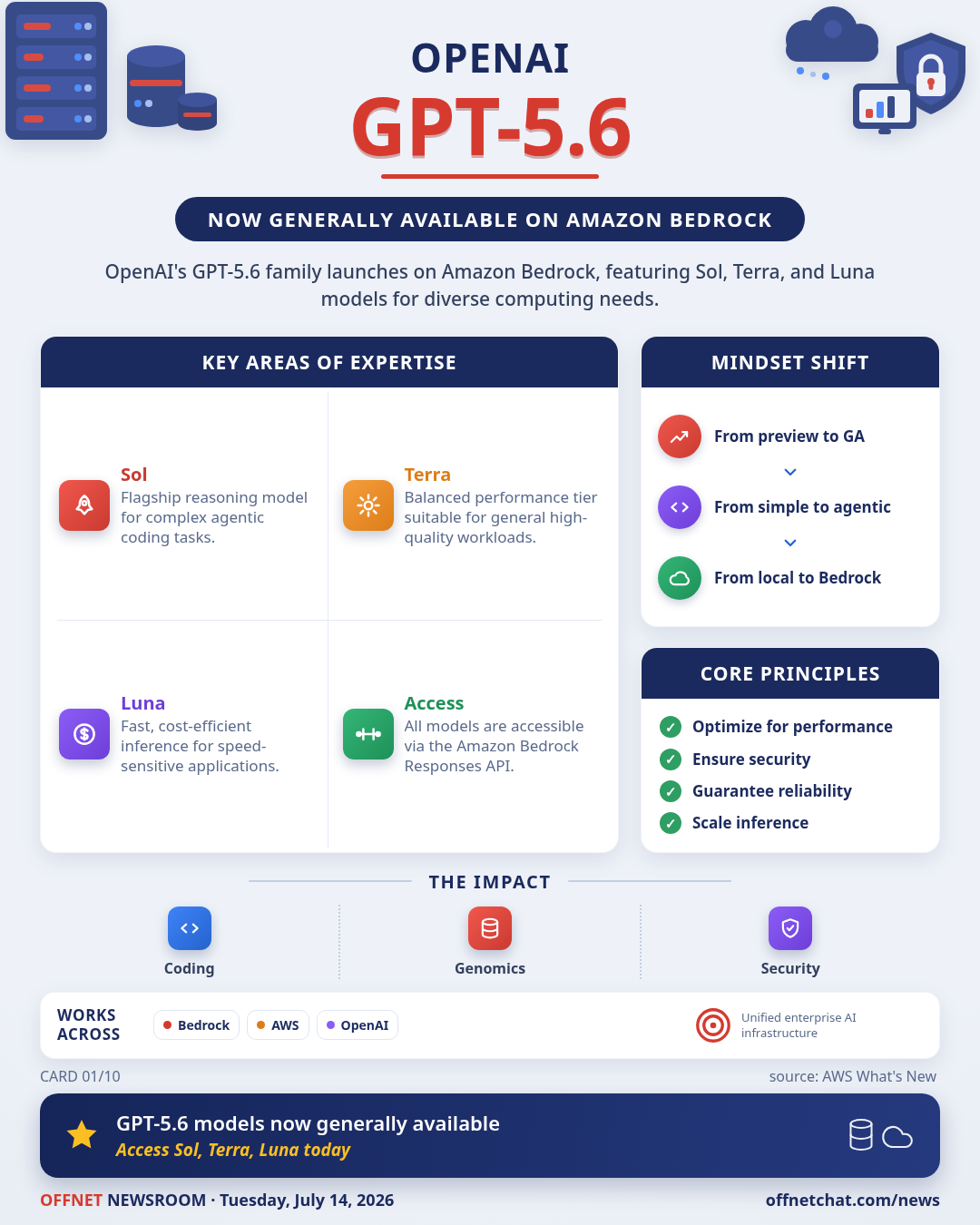
OpenAI GPT-5.6 Sol, Terra, Luna now GA on Amazon Bedrock

Amazon Bedrock has made the OpenAI GPT-5.6 model family generally available, integrating it into the provider's next-generation inference engine. The lineup includes Sol for flagship reasoning, Terra for balanced performance, and Luna for cost-efficient speed, all accessible via the Responses API. These models are optimized for high-performance, security, and reliability to handle complex tasks like autonomous coding and genomics analysis.

  • GPT-5.6 Sol targets flagship reasoning with state-of-the-art agentic coding benchmark results.
  • Terra offers a balanced tier for performance, while Luna provides fast, cost-efficient inference.
  • All models are accessible through the Responses API on Amazon Bedrock.
  • Use cases include autonomous coding agents, long-horizon genomics, and cybersecurity research.
  • The underlying inference engine emphasizes high performance, security, and reliability.
TRADE-OFFGPT-5.6 Model TiersSol & TerraFlagship reasoning powerBalanced performance tierLunaCost-efficient speedFast inference focusvs

This research addresses on-device English-to-Traditional-Chinese subtitle translation with strict latency and privacy constraints. Profiling reveals that after GGUF quantization reduces Transformer block costs, vocabulary projection becomes the primary decode-time bottleneck. The authors replace the original 151k-token vocabulary with a 64k-token subtitle-domain tokenizer and adapt the model via embedding calibration and full supervised fine-tuning.

  • GGUF quantization shifts the bottleneck from Transformer blocks to vocabulary projection.
  • Shrinking vocab from 151k to 64k tokens reduces compute for on-device inference.
  • Embedding calibration is required before full supervised fine-tuning to maintain accuracy.
  • Standard long-context optimizations are ineffective for short-input, batch-size-one workloads.
THE SHIFTVocabulary Size Reduction151kORIGINAL TOKENS64kOPTIMIZED TOKENSShrinking vocab reduces on-device compute

Focusing solely on token costs for AI workloads creates a false economy, as cheap tokens can lead to expensive failures if tasks do not complete successfully. The argument emphasizes that total cost of ownership must account for retry rates and the operational overhead of handling failed generations. Ignoring success metrics distorts budgeting and obscures the true efficiency of LLM deployments.

  • Token price is insufficient for accurate AI budgeting without success metrics
  • Failed tasks incur hidden costs through retries and wasted compute cycles
  • Engineering teams must track completion rates alongside inference spend
  • Optimizing for lowest token cost may degrade reliability and increase total cost
AWS What's New awsdatabase

Gemma-4-E2B-it available in SageMaker JumpStart

Google DeepMind’s Gemma-4-E2B-it model is now accessible via Amazon SageMaker JumpStart, offering a multimodal, instruction-tuned option optimized for efficient local execution. The model supports text, image, and audio inputs with text output, including a built-in reasoning mode for step-by-step problem solving. Key capabilities include object detection, document parsing, native function calling for agentic workflows, and code generation.

  • Gemma-4-E2B-it is now live in SageMaker JumpStart for easy deployment.
  • Model is optimized for efficient local execution on AWS infrastructure.
  • Supports text, image, and audio inputs with step-by-step reasoning mode.
  • Enables agentic workflows via native function calling capabilities.
  • Includes code generation, completion, and correction features.
TRADE-OFFGemma-4-E2B-it CapabilitiesInput ModalitiesText inputs supportedImage inputs supportedAudio inputs supportedOutput FeaturesReasoning mode enabledNative function callingCode generation includedvs

A new study introduces the Format Sensitivity Index (FSI) and Parseability Sensitivity Index (PSI) to quantify how minor prompt wrapper changes impact LLM performance. Analyzing 140,000 generations across seven models, the research finds that FSI varies by over 30x depending on the model, driven primarily by compliance failures. The data confirms that answer parseability remains a strong predictor of accuracy, even when controlling for task complexity.

  • FSI and PSI provide standardized metrics for benchmarking prompt wrapper robustness.
  • Formatting choices can significantly alter leaderboard rankings and model comparisons.
  • Compliance failures are the primary driver of high format sensitivity variance.
  • Parseability is a reliable predictor of final accuracy across diverse instruct models.
BY THE NUMBERSFSI Variance Across Models30xFSI variation across modelsDriven by compliance failures in 140k generations

Anthropic's unusually granular tokenizer makes token counts a poor proxy for actual resource consumption, complicating cost estimation. While the high resolution improves model performance, it obscures the relationship between input length and billing. Practitioners must look beyond simple token tallies to understand true operational expenses.

  • Token counts no longer reliably predict Anthropic API costs due to granularity
  • Granular tokenization improves model precision but hides true resource usage
  • Budgeting requires analyzing actual consumption, not just input string length
  • Monitor billable units closely to avoid unexpected spend spikes

Satya Nadella has issued a stark warning for companies to aggressively protect their intellectual property from frontier AI labs. This stance marks a notable shift in tone, appearing to contradict Microsoft's previous multi-billion dollar investments in organizations like OpenAI. The guidance signals a move toward greater caution regarding data usage and IP ownership in partnerships with top-tier AI developers.

  • Microsoft leadership is shifting rhetoric to prioritize IP protection over open collaboration.
  • Companies should audit data sharing agreements with frontier AI labs immediately.
  • Historical investments in OpenAI suggest a strategic pivot in Microsoft's AI ecosystem policy.
  • Practitioners must verify contract terms regarding training data ownership and usage rights.
  • Expect increased scrutiny on how third-party AI models ingest proprietary corporate data.

AWS has added Mistral AI's Voxtral-Mini-4B-Realtime model to SageMaker JumpStart, enabling rapid deployment of real-time speech-to-text applications. The model features a natively streaming architecture that supports high-quality transcription across 13 languages with configurable latency settings. This integration allows engineers to balance speed and accuracy directly within the AWS infrastructure without complex setup.

  • Deploy Mistral AI's 4B parameter model instantly via SageMaker JumpStart one-click interface.
  • Supports real-time streaming transcription for 13 languages with native low-latency architecture.
  • Configurable transcription delays allow tuning the trade-off between latency and accuracy.
  • Ideal for building live audio processing pipelines on AWS without managing underlying infrastructure.
BY THE NUMBERSVoxtral Supports 13 Languages13Supported languages for transcriptionNative streaming architecture for low-latency multilingual speech-to-text

AI / ML 5

roundup ↗

AWS has added OpenAI's privacy-filter to SageMaker JumpStart, offering a bidirectional token-classification model for PII detection and masking. The model identifies sensitive data spans including names, emails, and secrets in a single forward pass, enabling high-throughput data sanitization workflows on AWS infrastructure. It is designed to be context-aware, tunable, and deployable with minimal effort for teams needing robust data privacy controls.

  • Deploy OpenAI's PII detection model directly via SageMaker JumpStart with few clicks
  • Single forward pass identifies spans like emails, names, and secrets for efficient masking
  • Model is context-aware and tunable for high-throughput sanitization workflows
  • Supports on-premises or AWS infrastructure deployment for flexible data governance
CHECKLISTDeploying OpenAI PII FilterDeploy via SageMaker JumpStart with few clicksIdentify sensitive spans in single forward passTune model for context-aware high-throughput maskingSupports on-premises or AWS infrastructure deployment

AWS has added Qwen3-VL-Embedding-2B and Qwen3-Reranker-4B to SageMaker JumpStart for retrieval-augmented generation pipelines. The embedding model handles multimodal inputs like text, images, and video to perform initial recall. The reranker then refines these results to improve precision in subsequent stages.

  • Deploy specialized retrieval models via SageMaker JumpStart without custom infrastructure setup.
  • Qwen3-VL-Embedding-2B supports mixed modalities including text, images, screenshots, and video.
  • Use the two models in tandem: embedding for recall, reranker for precision refinement.
  • Enables building comprehensive search pipelines directly on AWS infrastructure.
HOW IT WORKSQwen3 Retrieval Pipeline1Multimodal input ingestion2Initial recall via embedding3Precision refinement via reranking4Final result delivery

Amazon SageMaker HyperPod now supports deep health checks for Slurm-orchestrated clusters, specifically those using continuous provisioning. This feature allows engineers to proactively verify GPU accelerator health and run comprehensive hardware stress tests on running instances before committing them to training jobs. By validating nodes as they come online, the service helps prevent single unhealthy instances from wasting compute hours or delaying critical workloads.

  • Target entire instance groups or specific nodes for hardware stress and connectivity tests before job start.
  • Continuous provisioning enables asynchronous scaling, now paired with comprehensive hardware validation.
  • Deep health checks prevent wasted compute time caused by single unhealthy GPU nodes.
  • Proactive verification ensures reliable training jobs without all-or-nothing provisioning failures.
HOW IT WORKSDeep Health Check Workflow1Continuous provisioning scales nodes2Verify GPU accelerator health3Run hardware stress tests4Validate connectivity before job
Hugging Face Blog llmaiml ↺ since 07-10

Hugging Face: Profiling Attention Mechanisms in PyTorch

Hugging Face releases the third installment of its PyTorch profiling series, focusing specifically on attention mechanisms. The guide details how to profile attention layers to identify bottlenecks in transformer architectures. It provides practical insights for engineers optimizing large language model performance.

  • Focuses on profiling attention layers, a critical component of transformer models.
  • Part of a three-part series dedicated to PyTorch performance tuning.
  • Helps identify computational bottlenecks in large language model inference.
  • Provides actionable techniques for optimizing attention mechanism efficiency.
AWS What's New awsdatabase ↺ since 07-10

SageMaker Feature Store adds batch writes, record listing, and custom offline tables

Amazon SageMaker Feature Store now supports high-throughput ingestion via BatchWriteRecord, allowing multiple records across feature groups in a single API call. The update introduces ListRecords to discover stored data without prior knowledge of identifiers, and enables creation of named databases and tables in the offline store. These changes reduce API overhead and improve latency for large-scale feature engineering workflows.

  • Use BatchWriteRecord to ingest features at scale with fewer API calls and lower latency.
  • ListRecords enables discovery of stored data without needing specific record identifiers.
  • Custom database and table names in the offline store improve data organization and cataloging.
CHECKLISTOptimize SageMaker Feature IngestionUse BatchWriteRecord for high-throughput ingestionDiscover data with ListRecords APICreate custom offline database tablesReduce API overhead and latency

Agentic AI 8

roundup ↗

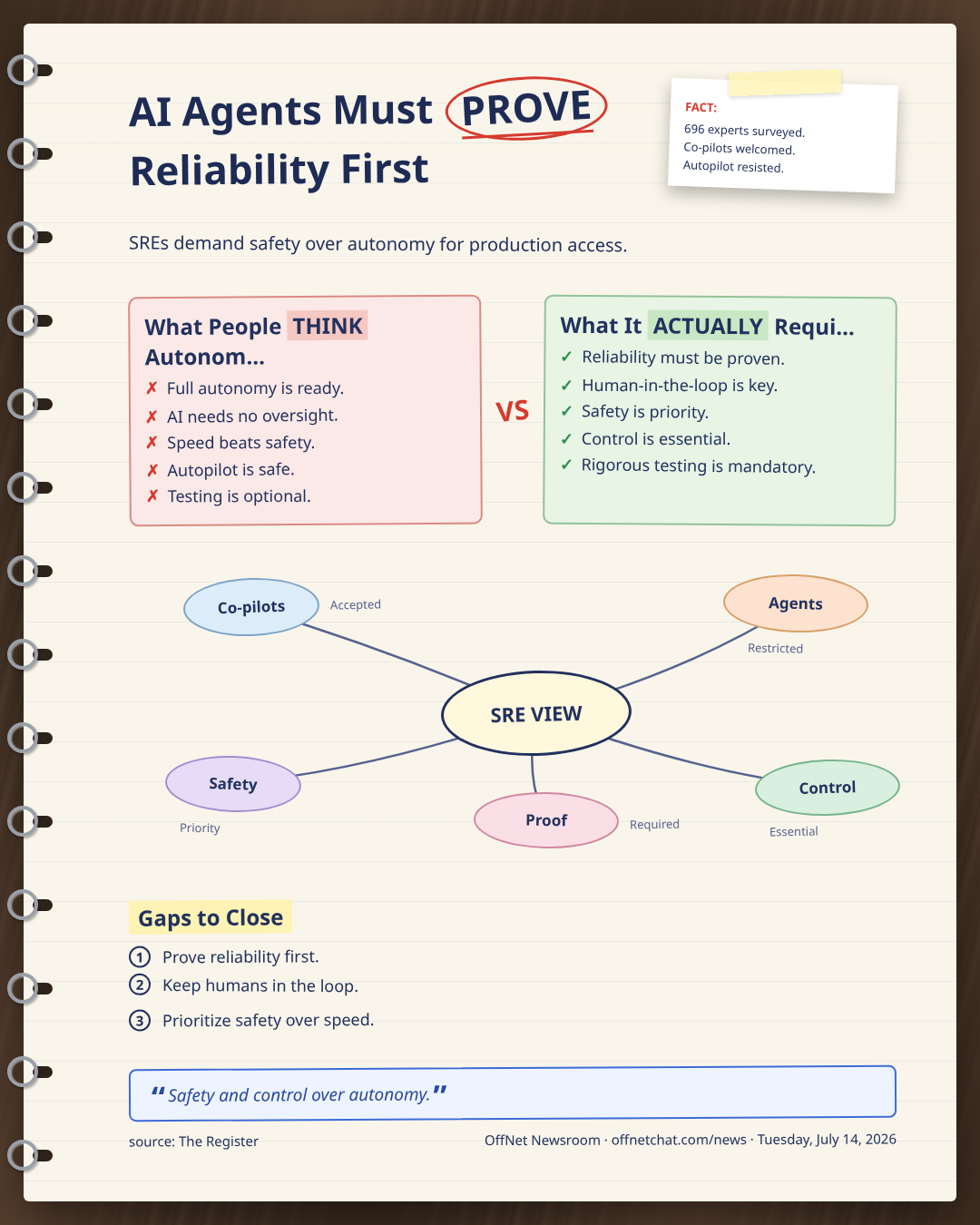
A survey of 696 experts reveals a clear divide in how teams view AI integration: while AI co-pilots are widely welcomed, autonomous autopilot modes are met with significant resistance. The consensus suggests that AI agents must demonstrate reliability and safety through rigorous testing before being granted direct access to production environments. This feedback highlights a pragmatic approach to adopting AI tools in critical infrastructure workflows.

  • Co-pilots are accepted as assistive tools, but full autonomy is rejected.
  • AI agents need to prove reliability before accessing production systems.
  • SREs prioritize safety and control over fully autonomous AI operations.
  • Expert consensus favors human-in-the-loop AI for critical tasks.

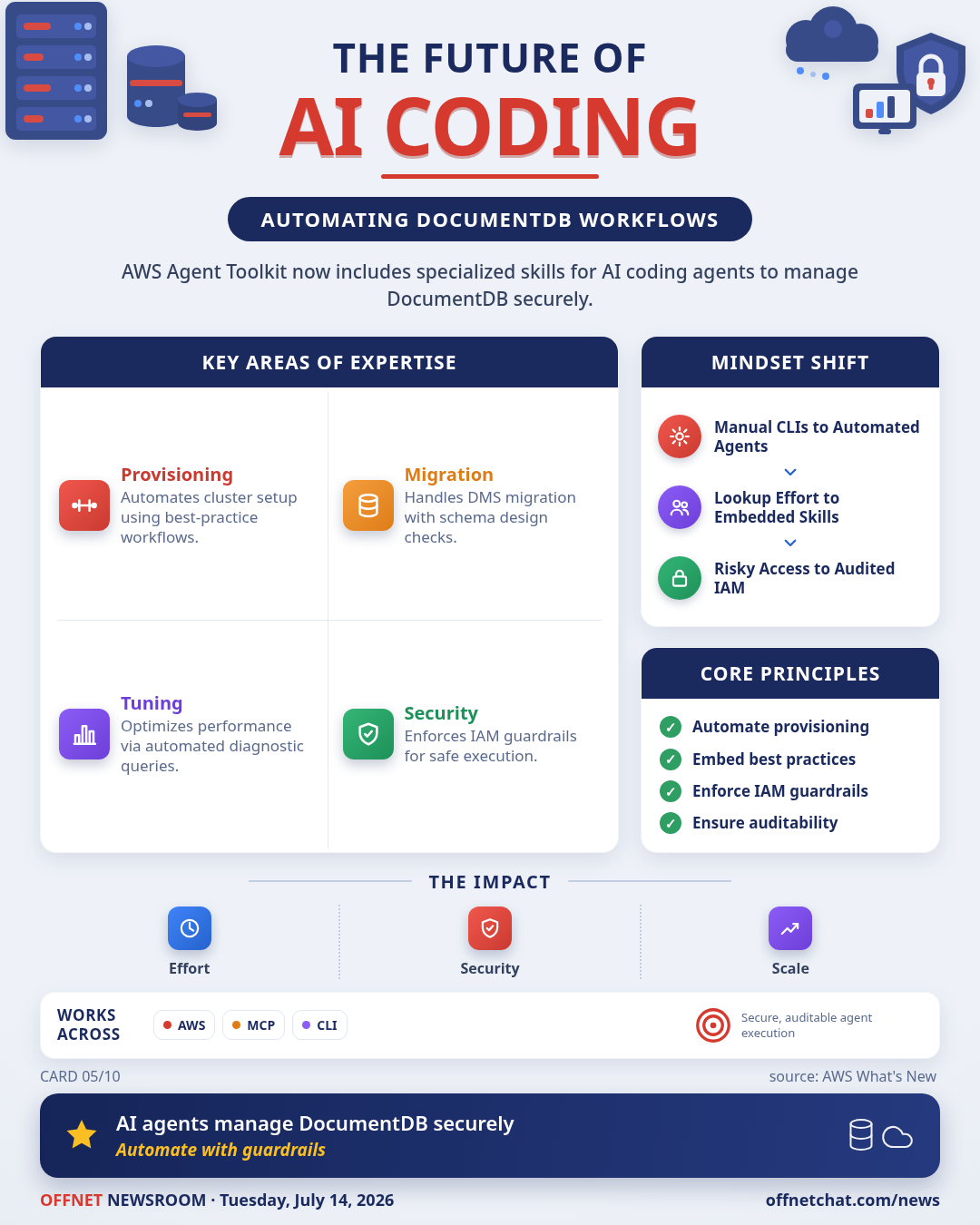
AWS has added a specialized skill for Amazon DocumentDB to the Agent Toolkit, enabling AI coding agents to automate cluster management tasks. The skill supports seven key workflows including provisioning, schema design, DMS migration, and performance tuning. It integrates with the AWS MCP Server to execute CLI commands and diagnostic queries under IAM guardrails.

  • Agents can automate DocumentDB provisioning, migration, and upgrades via best-practice workflows
  • Reduces manual lookup effort by embedding MongoDB compatibility and well-architected checks
  • Integration with AWS MCP Server allows agents to run CLI commands and diagnostics
  • IAM guardrails and CloudTrail ensure secure, auditable agent execution
HOW IT WORKSDocumentDB Automation Flow1Integrate AWS MCP Server2Invoke specialized skill3Execute CLI commands4Apply IAM guardrails5Log via CloudTrail

Researchers argue that least privilege is insufficient for agentic AI because these systems combine, approve, and amplify permissions across workflows. They propose least autonomy as a formal generalization to constrain this amplified agency. The framework introduces a compositional blast radius metric using ultrametric trees and lattice-valued labels to measure structural separation between actions. It also defines a directed agent influence graph to track how actions propagate through enterprise hierarchies.

  • Least privilege fails for agents that chain actions and amplify permissions.
  • Least autonomy provides a formal theoretical basis for constraining AI agency.
  • Blast radius metric uses ultrametric trees and lattice labels to quantify risk.
  • Directed influence graphs map how agent actions propagate through systems.
  • Offers a structured approach to auditing autonomous agent workflows.
TRADE-OFFLeast Privilege vs AutonomyLeast PrivilegeFails for chained agent actionsInsufficient for…Static access control modelLeast AutonomyFormal constraint on agencyMeasures compositional blast radiusMaps influence propagation graphsvs

EvoCUA-1.5 shifts computer-use agents from static imitation learning to online reinforcement learning, allowing policies to improve through direct interaction with sandboxed desktop environments. The paper addresses the challenge that single-turn RL methods fail in multi-turn scenarios due to context management and dynamic state changes. By leveraging verifiable task outcomes, the agent evolves its behavior based on causal feedback loops inherent in real-world computer usage.

  • Moves beyond offline imitation learning to online RL for better adaptability in dynamic environments.
  • Agents interact with executable sandboxes, enabling safe trial-and-error learning.
  • Addresses context management challenges specific to multi-turn, long-horizon tasks.
  • Uses verifiable outcomes to drive policy improvement rather than static trajectory refinement.
HOW IT WORKSEvoCUA Online RL Loop1Interact with sandbox2Observe state change3Verify task outcome4Update policy via feedback

This paper investigates how message formatting affects information fidelity when LLM agents pass data across multiple hops, a scenario distinct from single-turn generation. Using a controlled testbed, the authors re-encode atomic facts across five formats over six hops, scoring against ground truth. Findings reveal that format effects are tier-dependent, challenging prior work that only measured one-shot generation accuracy.

  • Multi-hop relay fidelity differs from one-shot generation; copy accuracy is the primary metric.
  • Format impact is tier-dependent, varying by the cognitive load capabilities of the agents.
  • Structured formats (JSON, triples) do not universally outperform natural language in multi-hop chains.
  • Prior format-optimization research may be incomplete as it ignores multi-hop degradation.
  • Agent tier classification is critical for predicting whether structure helps or hurts relay performance.
BY THE NUMBERSTriples Triple Fidelity3xTriples boost copy accuracyStructured triples improve multi-hop relay fidelity by three times
arXiv cs.AI researchai

Epistemic State Replication for Stochastic AI Agents

This paper challenges the classical State Machine Replication model, which relies on deterministic, bitwise identical states, by introducing Epistemic State Replication for agentic systems. It argues that forcing bitwise agreement on stochastic, model-driven agents degrades flexibility and causes context amnesia. Instead, the authors propose allowing replicas to diverge in reasoning paths and token boundaries while maintaining semantic equivalence and correct operational decisions.

  • Bitwise replication is insufficient for stochastic, generative AI agents in distributed infrastructures.
  • Forcing deterministic state equality degrades execution flexibility and performance.
  • Semantic equivalence allows divergent reasoning paths while ensuring correct outcomes.
  • New replication model prevents context amnesia in model-driven autonomous systems.
TRADE-OFFClassical vs Epistemic ReplicationClassical State MachineRequires bitwise identical statesDegrades flexibility for AICauses context amnesiaEpistemic State ModelAllows divergent reasoning pathsEnsures semantic equivalenceMaintains correct outcomesvs

This research addresses the verification gap for adaptive AI agents in production, where non-determinism and weak observability hinder reliability. The authors propose a bounded verification protocol that models controllers using finite symbolic rules, diagnostic predicates, and explanation logs. This approach aims to detect specific classes of controller failures through held-out re-evaluation.

  • Adopts a bounded verification protocol for adaptive agentic controllers.
  • Models agents using finite symbolic rules and explicit diagnostic predicates.
  • Leverages explanation logs for structured analysis and debugging.
  • Uses held-out re-evaluation to detect specific failure classes.
  • Targets the gap between prototype capability and production deployment.
HOW IT WORKSVerification Protocol Pipeline1Model controllers via finite symbolic rules2Apply diagnostic predicates for analysis3Generate structured explanation logs4Detect failures through held-out…

This research paper reframes commercial search APIs not just as accuracy engines, but as decision surfaces that dictate agent behavior. It highlights that traditional evaluation metrics often ignore the token costs associated with progressive disclosure, where agents choose between reading snippets or fetching full pages. By treating search results as a strategic interface, the study demonstrates that API design directly influences whether an agent answers immediately or incurs additional token consumption.

  • Move beyond accuracy metrics; evaluate search APIs by their ability to guide efficient agent decisions.
  • Progressive disclosure architectures are token-sensitive; snippet quality directly impacts cost.
  • Search APIs function as decision surfaces that determine if agents fetch full pages or stop early.
  • Optimizing for decision quality can reduce unnecessary token spend in tool-using agents.
CHECKLISTOptimize Search API DesignEvaluate APIs by decision efficiency, not just accuracyDesign snippet quality to minimize token costsTreat search results as strategic decision surfacesOptimize for decision quality to reduce token spend

Automation / DevOps / IaC 8

roundup ↗

Amazon SageMaker HyperPod now allows users to provision Slurm-orchestrated clusters using custom Amazon Machine Images. This feature enables the integration of pre-configured security agents, compliance tools, and proprietary libraries directly into the base image. By baking these configurations into the AMI, teams can bypass complex lifecycle scripts and ensure consistent, hardened environments across nodes.

  • Eliminates reliance on slow, error-prone lifecycle configuration scripts during cluster startup.
  • Ensures strict security and compliance standards are baked into every node image.
  • Maintains fast cluster deployment times by pre-installing specialized drivers and libraries.
  • Provides consistency across all cluster nodes by using a single, validated custom AMI.
CHECKLISTBenefits of Custom AMIsEliminate slow lifecycle scriptsEnforce strict security standardsEnsure consistent node imagesPre-install specialized drivers

MyDumper has introduced a new SAFE_NO_LOCK option as part of its ongoing effort to streamline locking mechanisms. This update follows the earlier adoption of the --sync-thread-lock-mode flag, aiming to replace rigid, legacy flags with a more flexible execution model. The change standardizes how the tool handles table locks during backup operations.

  • MyDumper is consolidating locking logic under the --sync-thread-lock-mode umbrella.
  • SAFE_NO_LOCK offers a cleaner alternative to older, complex locking flags.
  • The update reduces configuration rigidity for standard backup workflows.
  • Review --sync-thread-lock-mode docs to map existing custom scripts to new modes.
CHECKLISTMyDumper Locking UpdatesConsolidate locking under --sync-thread-lock-modeUse SAFE_NO_LOCK for cleaner backupsReduce configuration rigidity in workflowsMap scripts to new locking modes

CAFE is an open-source platform that applies design of experiments principles to evaluate compound AI systems by treating interchangeable components like retrievers or models as factors. It allows practitioners to build factorial designs, run configurations, and score outputs using configurable LLM judges and human raters. The framework then uses mixed-effects models to attribute answer-quality variance to specific components and their interactions, reporting effect sizes to guide optimization.

  • Use factorial design to systematically test swappable components like retrievers and prompts in AI pipelines.
  • Attribute answer-quality variance to specific components and their interactions using mixed-effects models.
  • Leverage configurable LLM judges alongside human raters for consistent scoring on shared rubrics.
  • Report effect sizes to determine which pipeline changes actually impact performance.
HOW IT WORKSCAFE Evaluation Pipeline1Build factorial designs2Run configurations3Score outputs4Attribute variance5Report effect sizes
AWS What's New awsdatabase ↺ since 07-11

Amazon EMR on EKS adds AI troubleshooting agent for Spark jobs

AWS has extended its Apache Spark troubleshooting agent to Amazon EMR on EKS, enabling natural language diagnostics for job failures. The tool automatically analyzes Spark History Server data, executor logs, and cluster configurations to identify root causes like memory errors or data skew. It provides PySpark code recommendations directly from the console, eliminating the need for manual log navigation.

  • Spark troubleshooting agent now covers EMR on EKS, EC2, and Serverless
  • Diagnose failures via natural language queries in the EMR console
  • Agent analyzes history data, logs, and configs for root cause analysis
  • Receives automated PySpark code recommendations to fix issues
  • Covers common problems like memory errors, skew, and contention
TRADE-OFFEMR Troubleshooting: Before vs AfterTraditional DebuggingManual log navigation requiredComplex syntax errors hard to findTime-consuming root cause analysisAI Agent AssistNatural language diagnostics…Automated root cause identificationDirect PySpark code recommendationsvs

Amazon EKS Auto Mode now integrates with Application Recovery Controller to support zonal shift and autoshift capabilities. This feature automatically reroutes in-cluster network traffic away from impaired Availability Zones to maintain application availability. The integration requires no additional configuration, permission grants, or Karpenter version management, handling compute protection seamlessly.

  • EKS Auto Mode provides native zonal shift support via ARC without extra setup or cost.
  • Traffic is automatically shifted away from impaired AZs to preserve Kubernetes availability.
  • No manual configuration, permission grants, or Karpenter version management is required.
CHECKLISTZero-Config Zonal Shift SetupIntegrates natively with ARC for recoveryAutomatically reroutes traffic from impaired zonesRequires no manual configuration or permissionsHandles Karpenter updates seamlessly
Hacker News (100+ points) general

Practical guide to navigating git history efficiently

A new article explores advanced techniques for viewing and analyzing git history beyond basic log commands. It focuses on strategies to understand code evolution and trace changes effectively. The post aims to help developers navigate complex repositories with greater precision.

  • Move beyond default git log to see meaningful change patterns
  • Learn techniques to trace specific code evolution over time
  • Improve debugging by understanding historical context of changes
HOW IT WORKSNavigating Git History1Move beyond default log2Analyze change patterns3Trace code evolution4Debug with context
GitHub Trending (daily) githubrepos ⚠ unverified date/source

GitHub releases Spec-Kit for Spec-Driven Development workflows

GitHub has launched Spec-Kit, an open-source toolkit designed to facilitate Spec-Driven Development. This framework shifts focus from writing code line-by-line to defining product scenarios and predictable outcomes through specifications. It supports integration with AI coding agents to accelerate the build process while ensuring alignment with initial requirements.

  • Introduces Spec-Driven Development as an alternative to traditional coding-first approaches.
  • Toolkit helps teams focus on scenarios and outcomes rather than manual implementation.
  • Supports multiple AI coding agent integrations for automated specification execution.
  • Provides CLI reference, extensions, and role-based bundles for flexible adoption.
TRADE-OFFSpec-Driven vs Traditional DevTraditional CodingWrite code line-by-lineManual implementation focusRisk of misalignmentSpec-Driven DevDefine scenarios firstFocus on outcomesAI agent integrationvs

While AI accelerates initial coding, it often obscures growing architectural complexity until systems become unstable. This article argues for shifting focus from raw development throughput to systemic comprehension by maintaining a repo-bound Context Store. By integrating spec-anchored SDD, TDD, and automated fitness functions, teams can ensure both AI agents and human engineers evolve code safely and coherently.

  • AI speeds up the first 80% of coding but risks hiding long-term architectural debt.
  • Shift focus from velocity to systemic comprehension to prevent instability.
  • Use a repo-bound Context Store to unify SDD, TDD, and fitness functions.
  • Ensure AI agents and human reviewers operate within a shared architectural context.
  • Spec-anchored design prevents drift as systems evolve under AI assistance.

AWS 6

roundup ↗

Davide de Paolis outlines a strategy for implementing 'minimum viable governance' on AWS without alienating internal users. The approach emphasizes shifting from rigid enforcement to high-empathy, data-driven collaboration. Key tactics include using event-driven Slack alerting to automate policy feedback loops.

  • Adopt 'minimum viable governance' to reduce friction during cloud infrastructure rollout.
  • Use event-driven Slack alerts to provide immediate, automated policy feedback to developers.
  • Prioritize high-empathy collaboration over rigid enforcement to maintain team relations.
  • Leverage data-driven insights to guide compliance decisions rather than arbitrary rules.

Regional outages exposed a pre-flight discovery call embedded in every client session, creating a latency bottleneck for global failover. The engineering team refactored the architecture to eliminate this mandatory round trip. The article details the implementation steps and the operational cost required to roll out this change.

  • Legacy discovery calls can silently block effective multi-region failover strategies.
  • Refactoring client sessions requires careful rollout planning to manage operational costs.
  • Proactive latency audits are essential for maintaining global API performance.
AWS What's New awsdatabase ↺ since 07-10

Timestream for InfluxDB emits EventBridge state change events

Amazon Timestream for InfluxDB now publishes database lifecycle events to Amazon EventBridge, covering creation, deletion, scaling, maintenance, and reboot operations. These events capture both successful completions and failures, eliminating the need for API polling. Teams can route these signals to trigger automation workflows, alerting systems, or audit logging pipelines.

  • Eliminates polling by pushing state changes directly to EventBridge
  • Covers full lifecycle including scaling, maintenance, and failures
  • Enables automated workflows triggered by specific database events
  • Supports compliance via persistent logging to CloudWatch or S3
HOW IT WORKSInfluxDB Event Pipeline1Database lifecycle change occurs2Timestream emits state event3EventBridge routes signal4Trigger automation or logging

AWS has launched Amazon Managed Service for Prometheus in the Asia Pacific (New Zealand) region. This fully managed, Prometheus-compatible service enables scalable monitoring and alerting for operational metrics. Each workspace supports up to 1 billion active metric series, allowing teams to store and query data efficiently across multiple workspaces per account.

  • Prometheus monitoring is now available in the New Zealand region for lower latency.
  • Workspaces support up to 1 billion active metric series for high-scale observability.
  • Fully managed service eliminates operational overhead of self-hosted Prometheus stacks.
  • Multiple workspaces can be created per account to logically separate metric data.
BY THE NUMBERSMax Metrics Per Workspace1 billionActive metric series capacityEach workspace can store and query this volume
AWS What's New awsdatabase ↺ since 07-10

AWS MCP Server adds OAuth for direct AI agent authentication

The AWS MCP Server now supports OAuth via AWS Sign-In, allowing AI agents to connect using industry-standard protocols without extra middleware. This update leverages existing IAM permissions and governance controls while enabling both interactive and headless authorization flows. Administrators gain enhanced oversight through new CloudTrail audit events, token introspection, and dynamic client registration capabilities.

  • AI agents authenticate via OAuth using existing AWS identities and IAM policies.
  • Supports both interactive browser-based and programmatic headless authorization flows.
  • New governance features include token introspection, revocation APIs, and dynamic client registration.
  • Access is fully auditable through new CloudTrail events and global condition keys.
HOW IT WORKSAWS MCP OAuth Flow1Agent initiates authentication2User signs in via AWS3IAM validates permissions4Token issued securely5Access granted to resources
AWS What's New awsdatabase ↺ since 07-10

Amazon MSK Replicator now supports external Kafka to MSK Standard brokers

AWS has expanded Amazon MSK Replicator to allow data replication from external Apache Kafka clusters—including on-premises, self-managed, or third-party cloud environments—to MSK Standard brokers. This update extends prior support that was limited to MSK Express brokers, enabling broader adoption of the managed replication service. The feature automates data movement, removing the need for custom infrastructure or open-source tooling.

  • External Kafka clusters can now replicate directly to MSK Standard brokers.
  • Supports hybrid and multi-cloud disaster recovery and backup scenarios.
  • Eliminates the need for custom replication code or open-source tools.
  • Simplifies workload migration from on-prem or other cloud Kafka providers.
CHECKLISTKey Benefits of MSK ReplicatorReplicate from external Kafka to MSK StandardEnable hybrid and multi-cloud disaster recoveryEliminate custom replication code needsSimplify workload migrations from on-prem

Oracle Ecosystem 2

roundup ↗
AWS Database Blog awsdatabase ↺ since 07-10

Diagnose RDS Oracle Replica Lag: Wait Events and CloudWatch Metrics

This second part of a series on Amazon RDS for Oracle Read Replicas details methods to monitor and resolve replication lag. It covers using CloudWatch metrics and database views to track performance, alongside wait event analysis to pinpoint root causes. The guide provides actionable troubleshooting steps to address specific performance bottlenecks slowing down the replication process.

  • Monitor replica lag using specific CloudWatch metrics and internal database views for real-time visibility.
  • Analyze wait events to identify the precise root causes of replication delays and performance degradation.
  • Apply targeted troubleshooting steps based on wait event data to resolve lag issues effectively.
  • Leverage insights from this follow-up to complement Part 1's configuration and redo compression optimizations.

Fleet impact: For DBAs managing Oracle ExaCC/RAC or RDS for Oracle, use wait event analysis to distinguish between I/O contention and CPU bottlenecks during peak replication windows. Prioritize tuning the redo transport mechanism and check for long-running transactions blocking apply processes to maintain data freshness SLAs.

AWS Database Blog awsdatabase ↺ since 07-10

AWS RDS for Oracle uses redo compression to cut replication lag

AWS introduces redo compression for Amazon RDS for Oracle read replicas to reduce network bandwidth consumption during data transfer. This optimization directly targets replication lag by shrinking the size of redo logs transmitted between the primary and replica instances. The blog series outlines how this feature works, with a second part dedicated to monitoring and troubleshooting ongoing lag issues.

  • Redo compression reduces network bandwidth usage for RDS for Oracle replicas.
  • Smaller redo logs help minimize replication lag between primary and standby instances.
  • Part 2 of the series covers monitoring, troubleshooting, and resolving lag scenarios.
  • This feature is specific to Amazon RDS for Oracle engine family.

Fleet impact: For Oracle ExaCC/RAC fleets, this confirms AWS is addressing network-bound replication bottlenecks via compression rather than just compute scaling. Plan to test redo compression settings in non-prod RDS Oracle instances to measure lag reduction before enabling in production, ensuring network egress costs are weighed against latency gains.

Trending on GitHub 5

roundup ↗
GitHub Trending (daily) githubrepos ⚠ unverified date/source

Graphify turns codebases into queryable knowledge graphs for AI assistants

Graphify is an AI coding assistant skill that ingests project artifacts like code, SQL schemas, and infrastructure docs to build a unified knowledge graph. It integrates with tools such as Claude Code, Cursor, and Gemini CLI, allowing users to type /graphify to map and query their entire project context. This approach consolidates application logic, database structures, and operational documentation into a single searchable structure.

  • Supports major AI coding tools including Claude Code, Cursor, and Gemini CLI.
  • Ingests diverse inputs: code, SQL schemas, R scripts, shell scripts, and docs.
  • Unifies app code, database schema, and infrastructure into one graph.
  • Enables natural language querying of the entire project structure.
GitHub Trending (daily) githubrepos ⚠ unverified date/source

Hallmark: Anti-AI-slop design skill for coding agents

Nutlope/hallmark is a design skill for Claude Code, Cursor, and Codex that enforces original UI generation by rejecting standard LLM defaults. It selects a macrostructure, applies one of twenty themes, and runs fifty-seven anti-pattern gates before emitting code. The tool includes a 'hallmark audit' command to score existing code against these anti-patterns without making edits.

  • Integrates with Claude Code, Cursor, and Codex to enforce original design patterns.
  • Uses 57 'slop-test' gates and self-critique to avoid generic AI-generated looks.
  • Provides a 'hallmark audit' command to score existing code against anti-patterns.
  • Supports 20 distinct themes and four core verbs for structured UI generation.
GitHub Trending (daily) githubrepos ⚠ unverified date/source

Shubhamsaboo/awesome-llm-apps: 100+ RAG and Agent templates for production

This GitHub repository curates over 100 ready-to-run templates for building LLM applications, focusing on AI agents, RAG pipelines, and voice integrations. It supports major providers like Claude, Gemini, OpenAI, and Llama, offering starter code that engineers can fork and customize. The collection aims to eliminate the need to rebuild common architectural patterns from scratch for new projects.

  • Provides forkable starter code for complex patterns like multi-agent teams and MCP integrations
  • Covers diverse modalities including voice agents, fine-tuning workflows, and always-on agents
  • Supports a broad vendor stack including OpenAI, xAI, Qwen, and Llama out of the box
  • Includes step-by-step tutorials to accelerate development and reduce initial setup friction

Andrew Kelley, creator of Zig, criticized a recent port of his language to Bun, which was executed by an AI using Claude and Rust. He labeled the resulting code as 'unreviewed slop,' highlighting the speed and low cost of the 11-day, $165,000 API-driven effort. The comment underscores skepticism around AI-generated code quality when human review is bypassed.

  • AI-driven ports can be delivered in days but may lack rigorous code review.
  • High API costs ($165k) do not guarantee engineering quality or maintainability.
  • Language creators may reject AI-generated ports that skip human oversight.
  • Rust rewrites via LLMs require strict validation before integration.
GitHub Trending (daily) githubrepos ⚠ unverified date/source

OpenCut: Rust-Core Video Editor with MCP and Plugin-First Architecture

OpenCut is an open-source video editor being rewritten from scratch using a Rust core to support web, desktop, and mobile platforms from a single codebase. The new architecture prioritizes an Editor API and first-class third-party plugins, enabling a plugin-first design. Key upcoming features include an MCP server for AI agent integration, headless mode for automation, and a built-in scripting tab.

  • Rust core enables cross-platform consistency across web, desktop, and mobile.
  • MCP server support allows direct integration with AI agents for automation.
  • Plugin-first architecture and Editor API facilitate robust third-party extensions.
  • Headless mode and scripting tab support batch rendering and CI/CD workflows.
  • Classic version remains available; rewrite is currently in beta at new.opencut.app.

Mobile friendly 6

all cards ↗

Today's top database + AI stories as save-and-share cards — built for your phone and your LinkedIn feed.