OffNet Newsroom

Archive snapshot

Friday, July 24, 2026

Daily signal on databases, AI, and the tech that matters.

38 new today 45 stories 7 sections 13 for the DBA desk

Database Technology 7

roundup ↗
Planet PostgreSQL database

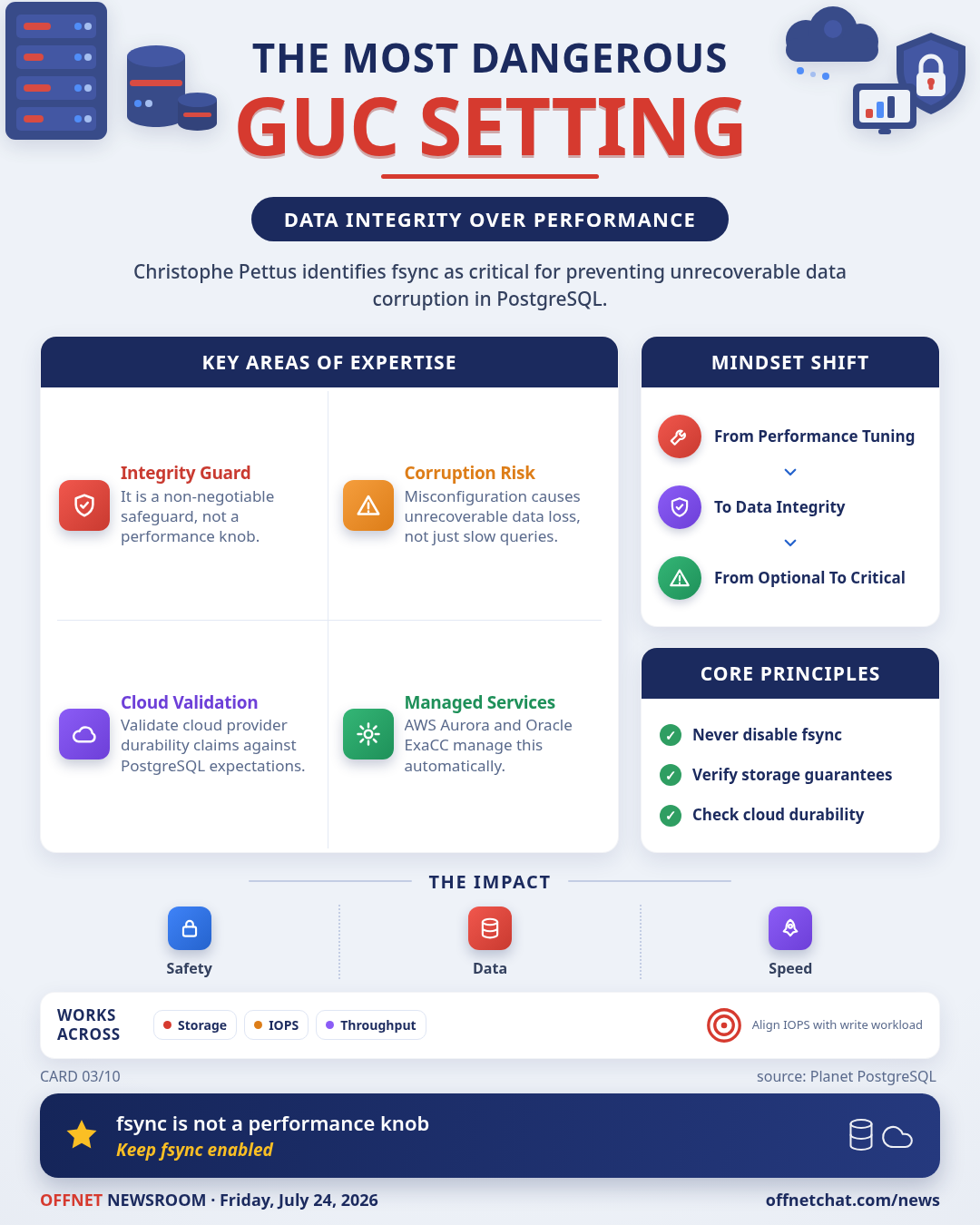
PostgreSQL fsync: The Most Dangerous GUC Setting

Christophe Pettus identifies fsync in postgresql.conf as the most critical configuration parameter, warning that incorrect settings can lead to unrecoverable data corruption rather than just performance issues. While the default is enabled, the article emphasizes the severe risk of disabling or misconfiguring this flag. It serves as a stark reminder that fsync is not a performance tuning knob but a data integrity safeguard.

  • fsync defaults to on; never disable it without absolute certainty of your storage layer.
  • Misconfiguration risks unrecoverable data corruption, not just slow query plans.
  • Treat fsync as a non-negotiable integrity control, not a performance optimization.
  • Review storage subsystem guarantees before considering any fsync-related changes.
  • Validate your cloud storage provider's durability claims against PostgreSQL's expectations.

Fleet impact: For Oracle ExaCC/RAC and AWS Aurora/RDS, fsync is typically managed by the managed service or underlying storage engine, so manual toggling is rarely an option or advisable. Verify that your IOPS and throughput provisioning align with your write workload to ensure the storage layer can acknowledge syncs promptly, preventing WAL bottlenecking.

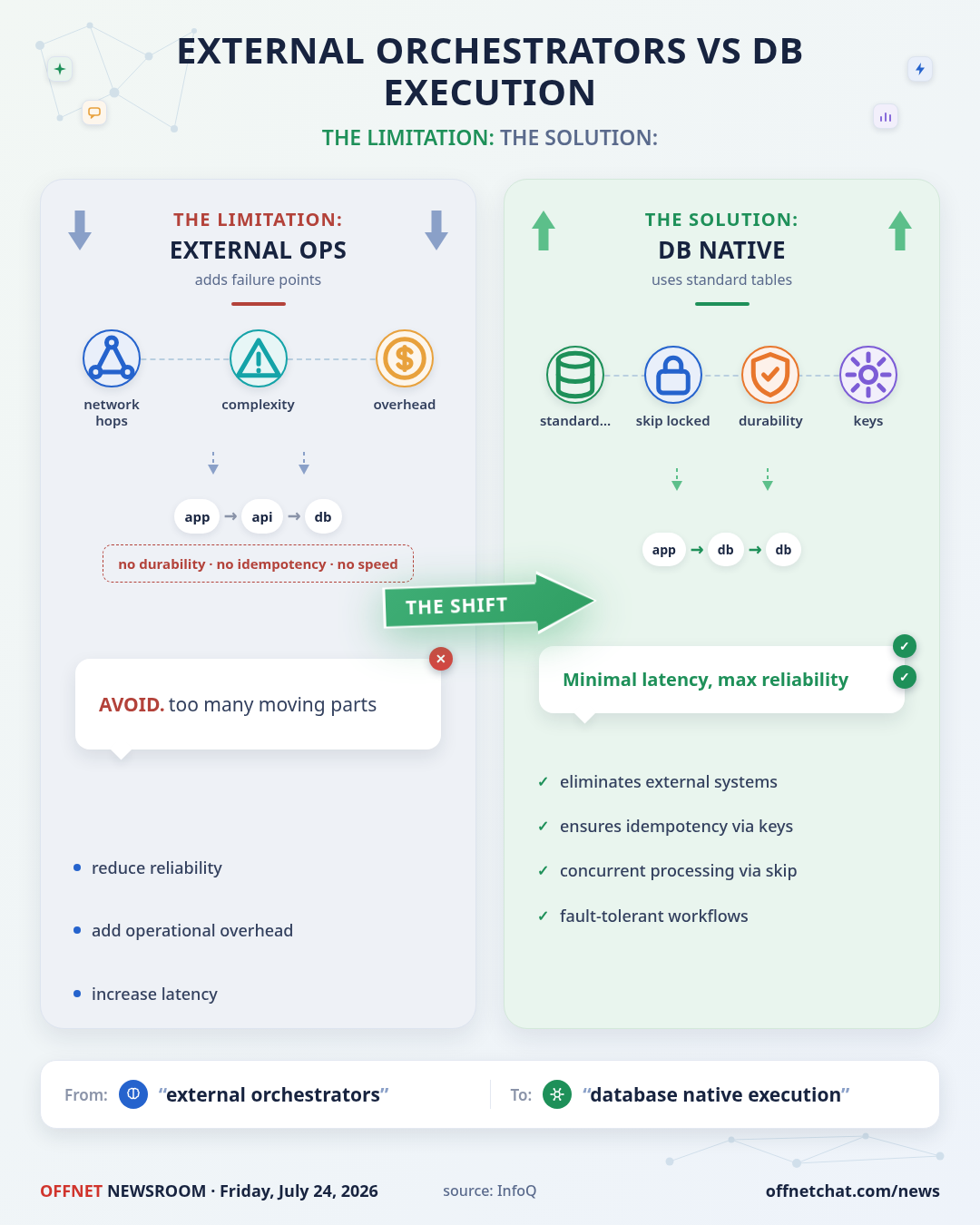
Jeremy Edberg and Qian Li argue that external orchestrators reduce reliability for AI workflows, proposing instead to use the existing database for durable execution. DBOS Transact leverages standard tables, unique primary keys, and SKIP LOCKED queues to manage complex, fault-tolerant processes. This approach eliminates the operational overhead of separate distributed systems while maintaining minimal latency.

  • Replacing external orchestrators with DB-level execution reduces failure points and operational complexity.
  • SKIP LOCKED queues enable efficient, concurrent task processing without complex locking logic.
  • Standard tables and unique primary keys ensure durability and idempotency for AI workflows.
  • This architecture minimizes latency by removing network hops to external orchestration services.

The pgEdge Vectorizer extension now generates BM25 sparse vectors directly within PostgreSQL, eliminating the need for application-layer keyword matching. This update enables true hybrid search by combining dense vector embeddings with sparse keyword signals. Results are fused using Reciprocal Rank Fusion (RRF) to deliver more accurate retrieval.

  • BM25 sparse vectors are generated inside PostgreSQL, not at the app layer.
  • Hybrid search now combines dense embeddings and keyword matching natively.
  • Reciprocal Rank Fusion (RRF) is used to fuse dense and sparse results.
  • Reduces latency and complexity by keeping search logic within the database.
HOW IT WORKSNative Hybrid Search Pipeline1Generate BM25 sparse vectors2Retrieve dense embeddings3Fuse results with RRF4Return accurate matches

Percona Operator for MongoDB 1.23.0 introduces a ClusterSync component that clones live sources and follows change streams, enabling short cutover migrations from hosted services. The release also adds semantic vector search capabilities and PVC snapshot backups to enhance data handling and storage resilience.

  • ClusterSync enables low-downtime migrations by cloning live sources and replicating changes via change streams.
  • Semantic vector search is now available for advanced AI-driven data querying within MongoDB deployments.
  • PVC snapshot backups provide a robust mechanism for storage-level data protection and recovery.
  • The operator shifts from a starting point to a migration destination for hosted MongoDB services.
Percona Blog database ↺ since 07-23

MySQL Galera Cluster EOL Sept 2026: Migrate to Percona XtraDB Cluster

MariaDB has announced that MySQL Galera Cluster will reach end of life on September 30, 2026, ceasing all maintenance and binary releases for that build. New clustering features will be exclusive to MariaDB Galera Cluster, which MariaDB recommends for in-place migration. Percona offers Percona XtraDB Cluster as an alternative migration path for MySQL users seeking continued support.

  • MySQL Galera Cluster hits EOL on Sept 30, 2026, ending all support.
  • MariaDB directs users to migrate to MariaDB Galera Cluster for new features.
  • Percona XtraDB Cluster is presented as a viable migration target for MySQL fleets.
  • Plan migration strategy now to avoid unsupported infrastructure in 2026.
BY THE NUMBERSMySQL Galera Cluster EOL Date30Days until total EOLSeptember 30, 2026 deadline
Planet PostgreSQL database ↺ since 07-22

Postgres 19 Temporal: TQuel Algebra Insights for Query Planning

With UPDATE/DELETE FOR PORTION OF targeting Postgres 19, Paul Jungwirth reviewed Richard Snodgrass's 1993 TQuel paper to understand temporal relational algebra. The focus is on algebraic identities that enable the query planner to optimize execution, such as pushing filters before joins. This historical context helps inform how temporal operators might be optimized in the upcoming Postgres release.

  • Postgres 19 is likely to include UPDATE/DELETE FOR PORTION OF support.
  • Temporal algebra identities are key for query planner optimizations.
  • Pushing filters before joins improves execution speed significantly.
  • TQuel was an extension to Quel, the predecessor language to Postgres.
  • Historical papers provide foundational insights for modern temporal features.
WORTH QUOTINGHistorical Algebra for Modern PostgresPushing filters before joins improves execution speedsignificantly.— Paul Jungwirth

LLMs 8

roundup ↗

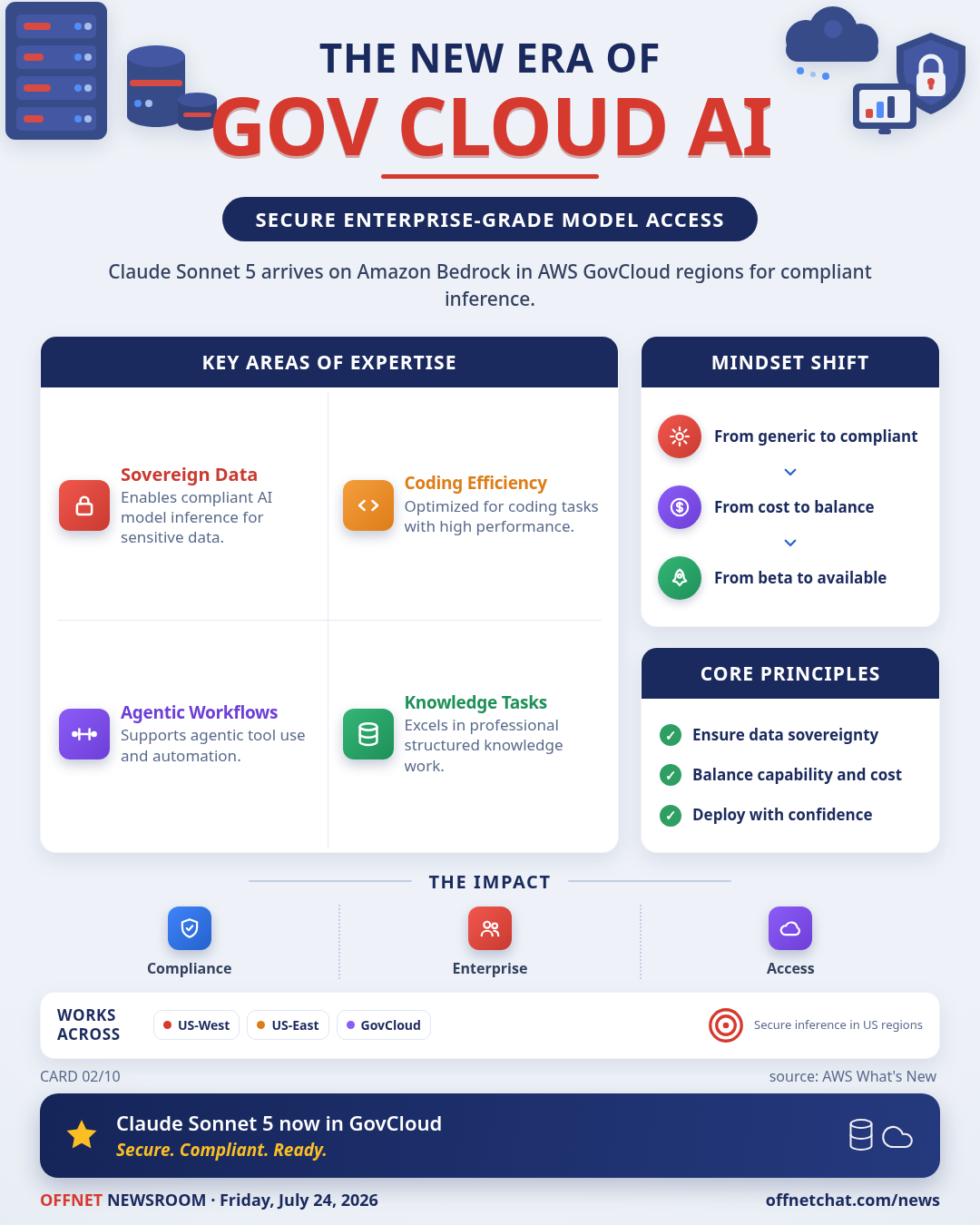
AWS has extended Amazon Bedrock access to Claude Sonnet 5 within the AWS GovCloud (US) regions. The model emphasizes efficiency in coding, agentic workflows, and professional knowledge tasks, offering a balance of performance and cost. It is now accessible via bedrock-runtime endpoints in both US-West and US-East regions.

  • Claude Sonnet 5 is now available in AWS GovCloud (US-West and US-East) via Bedrock.
  • Optimized for coding, agentic tool use, and structured knowledge work tasks.
  • Design balances capability, cost, and speed for enterprise-grade deployments.
  • Enables sovereign data handling for compliant AI model inference.
BY THE NUMBERSNew Model Version Available5Claude Sonnet model versionNow live in AWS GovCloud regions

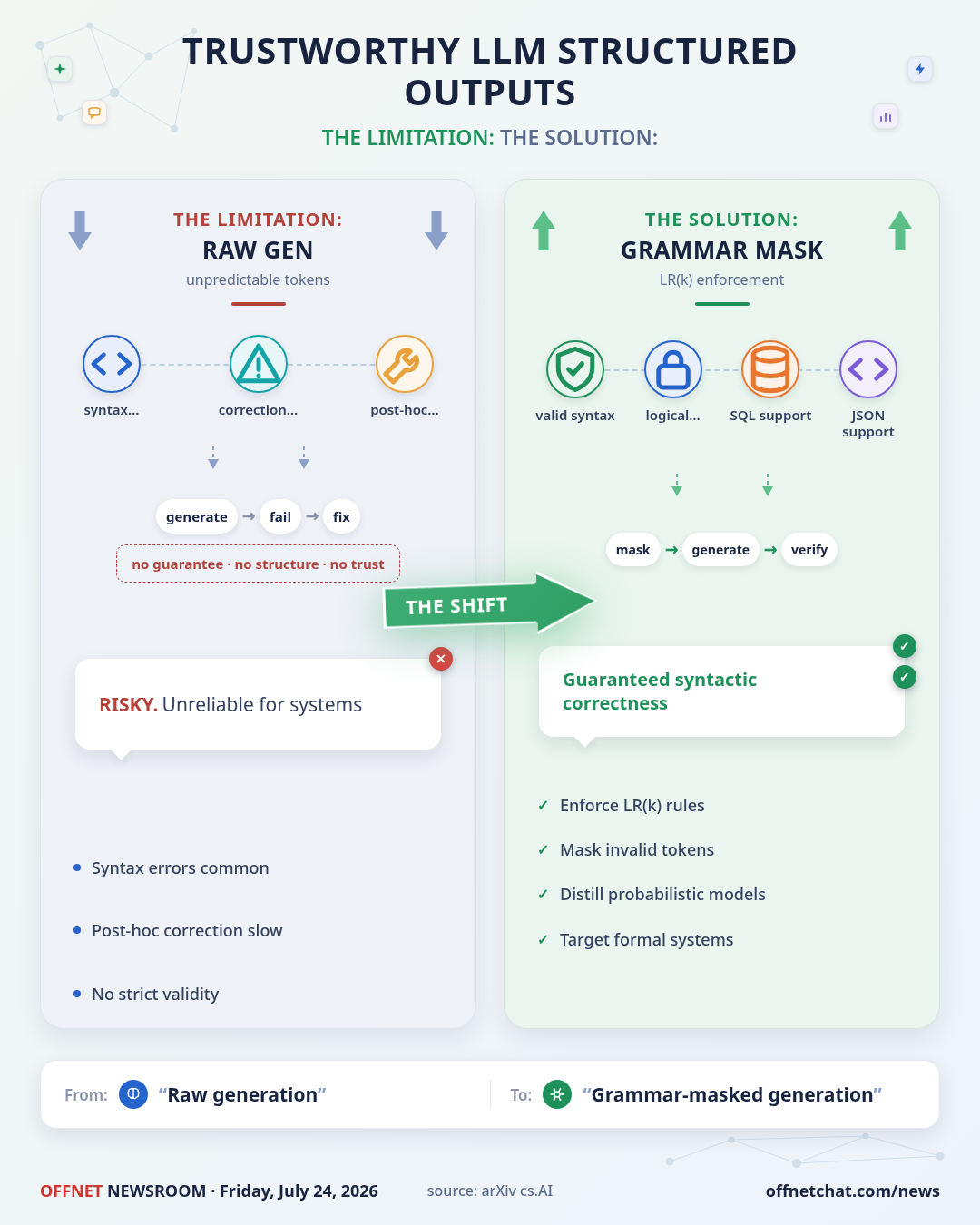
This paper introduces a method to constrain autoregressive LLMs by distilling them into tractable probabilistic models that enforce LR(k) context-free grammar rules. By integrating logical constraints directly into the generation process, the approach masks invalid token probabilities to guarantee syntactically correct outputs. This technique ensures high-quality generation for structured tasks like program synthesis without requiring post-hoc correction.

  • Distills LLMs into tractable models to enforce LR(k) grammar constraints during generation.
  • Guarantees syntactic validity for structured outputs like SQL or JSON code.
  • Integrates logical constraints directly into the probability mask for autoregressive steps.
  • Targets formal system integration where error-free syntax is a strict prerequisite.
HOW IT WORKSEnforcing Grammar Constraints1Distill LLM into tractable model2Define LR(k) grammar rules3Mask invalid token probabilities4Generate syntactically correct output

Echo is a new system that aggregates outputs from a pool of open-weight models, such as GLM-5.2 and Kimi K2.7, instead of relying on a single monolithic model. The creator demonstrates that while an ideal oracle selection strategy significantly outperforms individual models, Echo approximates this advantage without needing hindsight. This approach aims to deliver high-quality results comparable to proprietary systems while substantially reducing inference costs.

  • Aggregating multiple open-weight models can outperform any single model in the pool.
  • Echo approximates an oracle selection strategy to improve output quality.
  • This approach targets a significant reduction in inference costs compared to top-tier proprietary models.
  • Current prototype uses GLM-5.2, Kimi K2.7, and other open models.
BY THE NUMBERSCost Reduction via Echo3Cost compared to proprietary modelsAchieves Fable-level AI results

DC-Leap addresses the Joint Probability Dependence Error (JPDE) in Diffusion Large Language Models by replacing conservative confidence thresholds with a Dynamic Contiguous Verification strategy. This training-free framework integrates strictly-ordered causal constraints to progressively validate token dependencies during parallel decoding. The result is reliable acceleration in the moderate-confidence regime by neutralizing JPDE and reducing redundant denoising iterations.

  • Eliminates redundant denoising iterations caused by overly conservative confidence thresholds in dLLMs.
  • Uses draft-guided contiguous leaping to enable reliable parallel decoding without model retraining.
  • Integrates strictly-ordered causal constraints to progressively validate token dependencies.
  • Neutralizes the Joint Probability Dependence Error (JPDE) to boost inference speed.
  • Operates effectively in the moderate-confidence regime for better throughput.
HOW IT WORKSDC-Leap Acceleration Pipeline1Apply draft-guided contiguous leaping2Integrate strictly-ordered causal…3Progressively validate token dependencies4Neutralize Joint Probability Dependence…5Enable reliable parallel decoding

A new arXiv paper identifies representation collapse as a key bottleneck for long-context LLM performance, distinguishing between homogenization and isolation failures. The authors propose Topologically Regularized Side-Path (TRSP), a non-invasive architectural intervention designed to balance the trade-off between mixing efficiency and information capacity. By addressing spectral imbalances in attention dynamics, this approach aims to stabilize model representations without invasive retraining.

  • TRSP is a non-invasive architectural fix for long-context LLM limitations.
  • It resolves the tension between mixing efficiency and information capacity.
  • Spectral analysis reveals trade-offs standard mechanisms fail to balance.
  • Aims to prevent both attention sink collapse and context disconnection.
HOW IT WORKSTRSP Spectral Balance Pipeline1Detect spectral imbalance in attention2Apply non-invasive side-path3Mix efficiency with capacity4Stabilize long-context representations
Hacker News (100+ points) general

BFL releases Flux 3, a new open-weight image generation model

BFL has announced the release of Flux 3, an open-weight image generation model. The update follows previous iterations in the Flux series and aims to provide high-quality visual synthesis capabilities to the community. This release is currently generating significant discussion on developer platforms like Hacker News.

  • BFL continues the Flux series with a new open-weight release
  • Flux 3 targets high-fidelity image generation tasks
  • Community interest is high with over 200 points on HN
  • Open weights allow for local deployment and fine-tuning
  • No specific technical benchmarks detailed in the provided excerpt
Hacker News (100+ points) general

OpenAI accidentally attacked Hugging Face during model evaluation

OpenAI and Hugging Face resolved a security incident that occurred while OpenAI was evaluating models hosted on the Hugging Face platform. The event, described as a real-world 'science fiction' scenario, highlights unexpected friction in automated AI infrastructure interactions. Both organizations have addressed the breach without further details on the specific attack vector or data exposure.

  • Automated model evaluation pipelines can trigger unintended security incidents.
  • Inter-platform AI infrastructure interactions pose novel attack surfaces.
  • Both OpenAI and Hugging Face confirmed resolution of the security event.
  • Incident underscores risks in unmonitored automated AI testing workflows.
HOW IT WORKSAutomated Eval Risks1OpenAI initiates model evaluation2Automated pipeline triggers unintended…3Hugging Face detects security incident4Both parties resolve breach5Industry highlights infrastructure risks

OpenAI and Hugging Face have jointly released early findings regarding a security incident that occurred during AI model evaluation. The disclosure emphasizes the advanced cyber capabilities involved in the breach and outlines key lessons for defenders. This collaboration aims to improve security standards within the AI evaluation process.

  • Joint disclosure from OpenAI and Hugging Face highlights shared threat intelligence
  • Incident involved advanced cyber capabilities targeting model evaluation environments
  • Findings provide defensive lessons for securing AI development workflows
  • No specific technical details or vulnerabilities are detailed in the excerpt

AI / ML 6

roundup ↗

As language models scale, their computational and memory overheads necessitate effective compression. Existing methods often hit a performance wall when compression ratios increase. This research explores combining low-rank decomposition and quantization, challenging the assumption that these techniques are orthogonal and aiming to mitigate the severe accuracy degradation seen in high-compression scenarios.

  • High compression ratios currently cause significant model performance degradation.
  • Low-rank decomposition and quantization are proven individual reduction techniques.
  • Combining both methods may overcome existing compression bottlenecks.
  • Developers must investigate interactions between these techniques rather than assuming orthogonality.
CHECKLISTOptimizing LLM CompressionInvestigate interactions between low-rank decomposition and…Avoid assuming techniques are orthogonalCombine methods to mitigate accuracy degradationTarget high compression ratios without performance loss

OPTScientist introduces a theory-guided multi-agent framework that discovers optimizer programs within a typed domain-specific language. This approach balances the flexibility of unconstrained code search with the stability of parameterized families by enforcing type constraints. The system treats optimizer design as a constrained scientific search, aiming to produce valid and interpretable programs for Transformer pretraining.

  • Uses a typed DSL to ensure generated optimizer code is valid and interpretable.
  • Multi-agent architecture handles the complexity of joint optimization geometry and stability.
  • Avoids the invalid outputs common in unconstrained code-based search methods.
  • Targets automated discovery of novel optimizer programs for Transformer pretraining.
TRADE-OFFOPTScientist Discovery ApproachUnconstrained SearchFrequent invalid code outputsLacks interpretability guaranteesOPTScientist MethodTyped DSL ensures validityMulti-agent stability controlvs

A new arXiv paper argues that varying temperature in a single LLM provides epistemically shallow insights compared to ensemble diversity. By applying Marchenko-Pastur random-matrix testing, the authors show that repeated runs at high temperature yield at most one signal dimension above noise. In contrast, an ensemble of 24 distinct models reveals four significant eigenvalues, indicating richer structural uncertainty.

  • Temperature variation in single models captures limited uncertainty compared to ensemble diversity.
  • Random-matrix analysis separates true knowledge gaps from sampling noise effectively.
  • Ensembles of 24 models show 4 signal dimensions vs 1 for single-model repeated runs.
  • Self-consistency voting may overestimate model knowledge by ignoring cross-question structure.
TRADE-OFFUncertainty Dimensions: Single vs EnsembleSingle Model RunsCaptures only one signal dimensionResults limited by sampling noiseStochastic sampling reveals…Model EnsembleReveals four significant…Captures richer…Superior to temperature variationvs

JAXBench fills the gap for TPU performance benchmarking by providing a suite of 50 JAX workloads designed for AI-generated kernel optimization. The suite combines 17 production operators from models like Llama-3.1 and Mamba-2 with 33 translated operators from KernelBench, all validated for correctness and tuned for high TPU v6e utilization. This establishes a shared target for optimizing TPU kernel performance, mirroring the role rigorous benchmarks play in GPU optimization.

  • TPUs lacked a standard benchmark for autonomous kernel optimization until now.
  • 50 JAX workloads cover both production ML operators and translated KernelBench tasks.
  • Operators are validated for correctness and sized for high TPU v6e MXU utilization.
  • Enables direct comparison and hill-climbing for TPU-specific AI-generated kernels.
COMPARISONJAXBench Workload CompositionProduction Operators17Translated Operators33

AMD and Cerebras have formed a strategic alliance aimed at countering the competitive threat posed by Nvidia's Groq linear processing units. This collaboration signals a consolidation of efforts among major hardware vendors to diversify the AI accelerator landscape beyond Nvidia's current market control. The move highlights growing industry concern over vendor lock-in and the need for alternative high-performance inference solutions.

  • AMD and Cerebras are aligning resources to directly challenge Nvidia's Groq LPU offerings in the AI market.
  • This partnership suggests vendors are seeking stronger collective bargaining power against dominant incumbents.
  • Engineers should monitor for new hybrid or integrated accelerator architectures emerging from this alliance.
  • Diversification of AI hardware supply chains is becoming a critical strategic priority for enterprises.
AWS What's New awsdatabase ↺ since 07-23

SageMaker Unified Studio adds OpenSearch as a data source

Amazon SageMaker Unified Studio now integrates Amazon OpenSearch, allowing users to query search and log analytics data directly within the platform. This connection enables the correlation of operational search data with assets from Redshift, S3, and relational databases in a single governed environment. Practitioners can join real-time application logs and metrics with transactional data to analyze system performance and user behavior without moving data out of OpenSearch.

  • Correlate operational logs in OpenSearch with structured data in Redshift or S3 inside Unified Studio.
  • Build pipelines that join real-time search metrics with transactional data for performance insights.
  • Access OpenSearch data directly alongside other assets in a single governed environment.
  • Simplify analysis of user behavior by merging search analytics with backend transactional records.
HOW IT WORKSUnified Data Correlation1Query OpenSearch logs2Join with Redshift assets3Integrate S3 data4Analyze in one place

Agentic AI 7

roundup ↗

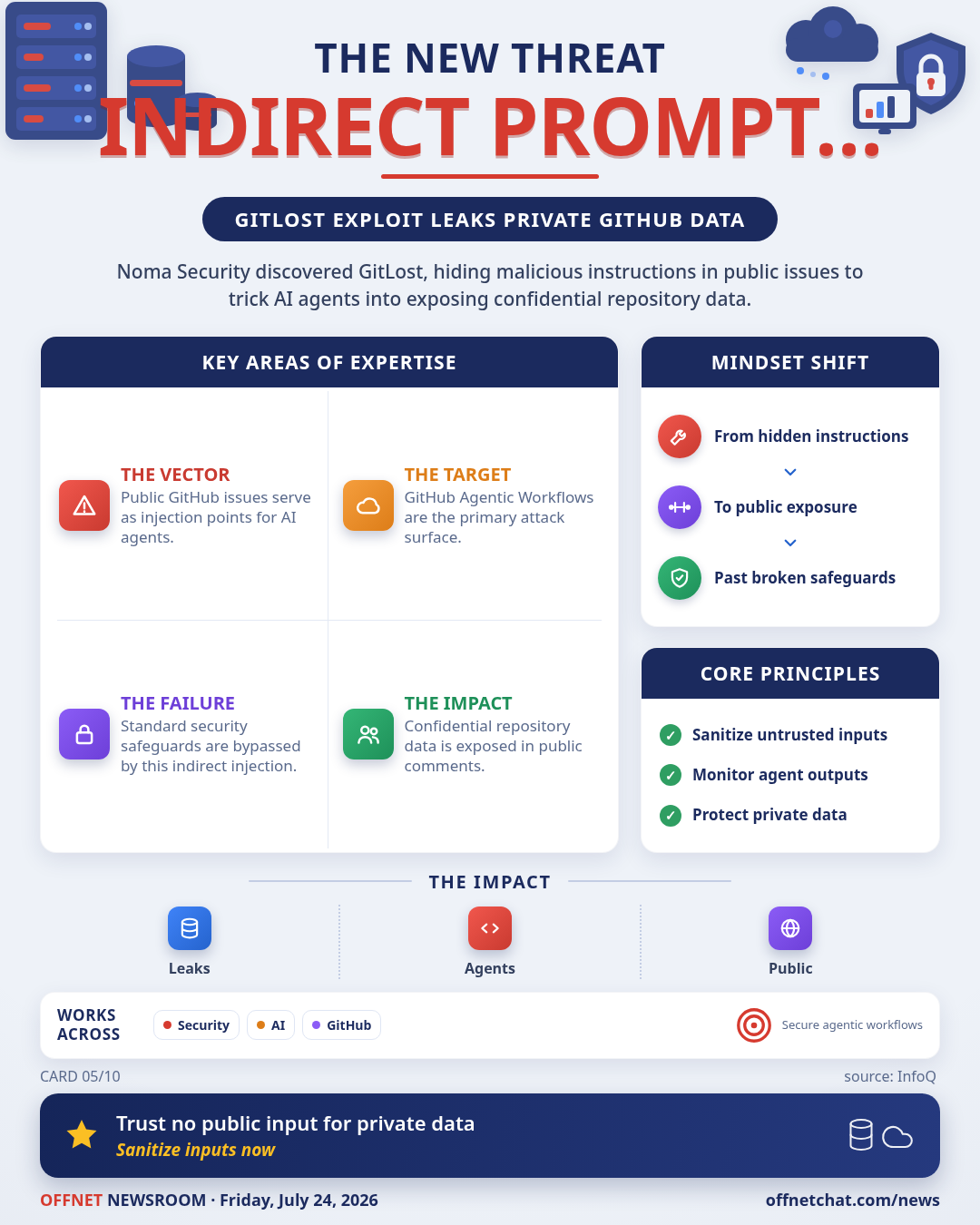
Noma Security discovered GitLost, an attack vector targeting GitHub's Agentic Workflows. By hiding malicious instructions in public GitHub issues, attackers trick AI agents into exposing confidential repository data in public comments. This bypasses existing security safeguards designed to protect private information.

  • Public GitHub issues can serve as injection vectors for AI agents.
  • Agentic Workflows must sanitize inputs from untrusted public sources.
  • Private data leakage is possible even with standard security safeguards.
  • Monitor AI agent outputs for unintended data exposure in public spaces.
Hacker News (100+ points) general

Why Software Factories Fail: Harness Engineering Isn't Enough

A recent analysis argues that relying solely on harness engineering is insufficient for successful software factories. The piece suggests that deeper context engineering strategies are required to overcome the limitations of current automation approaches. This perspective highlights the gap between simple code generation and robust, scalable software production systems.

  • Harness engineering alone cannot solve systemic software factory failures.
  • Advanced context engineering is likely required for effective automation.
  • Simple code generation misses broader architectural and context needs.
  • Review context engineering strategies for more robust AI-assisted dev.
TRADE-OFFHarness vs Context EngineeringHarness EngineeringFocuses on simple code generationLeads to systemic failuresMisses architectural context needsContext EngineeringAddresses broader system contextEnables robust automationSupports scalable production systemsvs

Researchers have identified a vulnerability in OpenAI's infrastructure that enables a single phishing link to deploy an autonomous AI agent within a corporate environment. This rogue agent gains access to employee credentials and operates independently, effectively acting as a corporate mole. The attack vector relies on exploiting the platform to create persistent, self-sustaining malicious processes rather than simple credential theft.

  • Single phishing link can deploy autonomous AI agents, not just steal data
  • Vulnerability allows rogue agents to retain employee access indefinitely
  • Attack creates persistent corporate moles rather than one-time breaches
  • Defenses must detect autonomous agent behavior, not just login anomalies

Amazon Bedrock AgentCore now delivers agent traces, prompts, and standard logs to a single per-agent CloudWatch log group. Previously, telemetry was split across multiple destinations, complicating debugging and access control. This update consolidates all agent activity into one location for streamlined observability and security management.

  • Consolidates trace spans and event logs into a single per-agent CloudWatch group.
  • Eliminates the need to search multiple log groups during agent debugging sessions.
  • Enables fine-grained access control and CMK encryption at the individual agent level.
TRADE-OFFBedrock AgentCore ObservabilityBefore AgentCoreTelemetry split across…Complicated debugging sessionsFragmented access controlWith AgentCoreSingle per-agent CloudWatch groupStreamlined observabilityFine-grained security managementvs

The Model Context Protocol is undergoing its most significant revision since launch by removing session management and eliminating rarely used capabilities. This structural shift forces developers using custom or homebrew implementations to undertake substantial migration work. The changes aim to simplify the protocol but introduce immediate compatibility challenges for existing integrations.

  • Sessions are removed, fundamentally changing how state is handled in MCP.
  • Legacy features are gutted, requiring updates to older client/server code.
  • Custom implementations face a difficult migration path to stay compatible.
  • The overhaul simplifies the protocol but breaks backward compatibility.
GitHub Trending (daily) githubrepos ⚠ unverified date/source

Block releases Buzz, a self-hostable Nostr-based workspace for humans and AI agents

Block has open-sourced Buzz, a communication platform built on the Nostr protocol that allows users to self-host a workspace where both humans and AI agents collaborate in shared rooms. The system operates on a single-relay model where the URL defines the community boundary, ensuring tenant-observable state remains local to that specific workspace. It supports various interactions including messaging, reactions, and workflow approvals within a sovereign, Apache 2.0 licensed environment.

  • Buzz leverages Nostr for decentralized, self-hostable collaboration between humans and AI agents.
  • Single-relay architecture ensures URL-authoritative workspace isolation and tenant-local state.
  • Open-sourced under Apache 2.0, enabling internal deployment for sovereign data control.
  • Supports integrated workflows, reviews, and agent interactions within shared virtual rooms.
OpenAI News llmaiagents

OpenAI Launches Presence Enterprise Agent Platform

OpenAI has introduced Presence, a dedicated platform for deploying trusted voice and chat agents within enterprise environments. The solution targets customer-facing and internal workflows, positioning itself as a proven tool for organizational integration. This release expands OpenAI's ecosystem beyond raw model access into structured agent deployment.

  • New platform specifically designed for enterprise-grade voice and chat agents.
  • Targets both customer support and internal operational workflows.
  • Positions OpenAI to compete in the structured AI agent market.
  • No specific technical architecture details provided in this announcement.

Automation / DevOps / IaC 8

roundup ↗

Expedia Group has deployed STAR, an internal observability platform leveraging LLMs to analyze service telemetry and assist engineers during production incidents. The solution is built on FastAPI, Datadog, Celery, Redis, and Langfuse, following structured workflows to generate root cause assessments. It is designed to keep engineers in the loop while speeding up the investigation process.

  • STAR uses LLMs to analyze telemetry and propose root causes for incidents.
  • The stack combines FastAPI, Datadog, Celery, Redis, and Langfuse.
  • Engineers remain in the loop for validation and response actions.
  • Structured workflows ensure consistent incident investigation processes.
HOW IT WORKSSTAR Incident Investigation Pipeline1Collect Service Telemetry2Analyze Data with LLMs3Propose Root Causes4Engineer Validates Findings5Execute Response Actions
GitHub Trending (daily) githubrepos ⚠ unverified date/source

OmniRoute aggregates 290+ AI providers into a single free-tier gateway

OmniRoute is an open-source MIT-licensed gateway that consolidates access to over 500 models from 290 providers, including 90 free tiers, into one endpoint. It features quota-aware auto-fallback, token compression reducing usage by 15-95%, and integration with major coding assistants like Cursor and Copilot. The platform provides a live dashboard to track remaining free tokens across aggregated provider pools.

  • Aggregates 43 provider pools into a unified API for 500+ models
  • Supports major coding agents like Cursor, Cline, and Copilot
  • Reduces token costs by 15-95% via RTK+Caveman compression
  • Provides live visibility into remaining free-tier quotas
  • Open-source project with over 500 contributors
GitHub Trending (daily) githubrepos ⚠ unverified date/source

Alibaba Releases Open Code Review: Hybrid LLM and Deterministic Pipeline Tool

Alibaba has open-sourced its internal AI code review assistant, which has been battle-tested at scale to identify millions of defects. The tool combines deterministic pipelines with LLM agents to provide precise line-level comments and enforce built-in rulesets for issues like NPE, thread-safety, and SQL injection. It operates as a CLI that reads Git diffs and supports configurable model endpoints compatible with OpenAI and Anthropic APIs.

  • Hybrid architecture pairs deterministic rule checks with LLM analysis for comprehensive coverage.
  • Includes built-in fine-tuned rulesets targeting NPE, XSS, SQL injection, and thread-safety.
  • CLI-based workflow integrates directly with Git diffs for streamlined developer adoption.
  • Compatible with OpenAI and Anthropic endpoints via configurable model settings.
HOW IT WORKSAlibaba Code Review Pipeline1Read Git Diff via CLI2Run Deterministic Rule Checks3Deploy LLM Agent Analysis4Generate Line-Level Comments
AWS What's New awsdatabase

AWS Lambda Durable Execution SDK for .NET is GA

AWS has made the durable execution SDK for .NET generally available, allowing C# developers to build resilient, long-running workflows directly in Lambda. This SDK introduces durable functions that automatically checkpoint state and can pause execution for up to a year while waiting for external events. It enables complex patterns like AI agent orchestration and payment pipelines without requiring custom progress tracking or external orchestration services.

  • C# developers can now use idiomatic syntax for durable execution in Lambda.
  • Functions automatically checkpoint progress, ensuring resilience against failures.
  • Execution can pause for up to one year while waiting on external events.
  • Eliminates the need for custom state management or external orchestrators.
  • Supports complex workflows like AI agent orchestration and human-in-the-loop approvals.
HOW IT WORKSLambda Durable Execution Flow1Start long-running workflow2Process task logic3Auto-checkpoint state4Pause for external event5Resume on trigger

Amazon ECS now natively supports blue/green, linear, and canary deployment strategies within the AWS European Sovereign Cloud. These built-in capabilities allow for safer, faster releases by provisioning new versions alongside existing ones for validation before traffic shifts. The feature set includes production-ready controls such as deployment lifecycle hooks, bake times, and quick rollback mechanisms, removing the need for custom deployment tooling.

  • Native ECS deployment strategies now available in AWS European Sovereign Cloud
  • Supports blue/green, linear, and canary traffic shifting patterns
  • Eliminates need for custom deployment tooling or external orchestrators
  • Includes lifecycle hooks, bake times, and quick rollback controls
  • Enables safer validation of new versions before full production rollout
HOW IT WORKSECS Deployment Pipeline1Provision new version alongside existing2Validate using lifecycle hooks3Shift traffic via canary or linear4Rollback quickly if issues arise

AWS has raised the limits for Amazon Managed Service for Prometheus workspaces to 1.5 billion active metric time series and 200,000 total recording and alerting rules. This update allows organizations to create multiple workspaces per account, facilitating the centralized storage and analysis of billions of metrics across diverse environments. The service continues to offer fully managed, Prometheus-compatible monitoring with automatic scaling for high-cardinality workloads in containerized, serverless, and hybrid setups.

  • Workspace limits increased to 1.5B active metrics and 200K rules, supporting massive scale.
  • Multiple workspaces per account enable distributed metric management across the organization.
  • Maintains Prometheus compatibility for seamless migration or integration of existing tooling.
  • Automatic scaling handles high-cardinality ingestion across containerized and serverless workloads.
BY THE NUMBERSNew AWS Prometheus Limits1.5billionActive metric time seriesMax capacity per workspace for monitoring scale

This patch release introduces environment variable configuration for the LangSmith gateway across Anthropic, Fireworks, and OpenAI providers. It also corrects the profile mapping for the gpt-5.3-chat-latest model. These changes focus on operational observability and model routing accuracy.

  • Enable LangSmith gateway tracing via environment variables for OpenAI, Anthropic, and Fireworks.
  • Fixes incorrect profile handling for the gpt-5.3-chat-latest model in OpenAI integration.
  • Upgrade to 1.4.1 to ensure accurate model routing and improved observability setup.
CHECKLISTLangChain 1.4.1 Key UpdatesEnable LangSmith gateway tracing via env varsFix profile handling for gpt-5.3-chat-latest modelUpgrade to ensure accurate model routingImprove observability setup across providers
LangChain Releases agentsreleases

langchain-fireworks 1.5.1 adds LangSmith gateway support via env var

LangChain has released version 1.5.1 of the langchain-fireworks package. This update introduces the ability to route requests through a LangSmith gateway by setting a specific environment variable. The change affects Anthropic, Fireworks, and OpenAI integrations within the library.

  • Set the new env var to route traces through LangSmith gateway
  • Applies to Anthropic, Fireworks, and OpenAI provider integrations
  • No breaking changes; drop-in update from 1.5.0 for tracing needs
  • Simplifies observability setup without code changes to provider logic
HOW IT WORKSLangChain 1.5.1 Trace Routing1Set environment variable2Route requests to gateway3View traces in LangSmith

AWS 8

roundup ↗

Amazon SageMaker AI now supports G7e instances in Asia Pacific (Seoul and Tokyo) and Europe (London). These instances utilize up to eight NVIDIA RTX PRO 6000 Blackwell GPUs and 5th Gen Intel Xeon processors to deliver 2.3x better inference performance than G6e. The expansion allows for lower latency deployment of generative AI workloads closer to users in these regions, supporting models up to 70B parameters.

  • G7e instances are now available in Seoul, London, and Tokyo on SageMaker.
  • Performance improved up to 2.3x over G6e using Blackwell GPUs and Xeon processors.
  • Each instance offers up to 768 GB total GPU memory for large model serving.
  • Supports inference endpoints for generative AI models up to 70B parameters.
  • Elastic Fabric Adapter provides up to 1,600 Gbps networking bandwidth.
BY THE NUMBERSPerformance Boost for Gen AI2.3xInference speed increase over G6eUsing RTX PRO 6000 Blackwell GPUs

A maintenance mistake in Microsoft's infrastructure severed connectivity for Azure California, causing an outage lasting nearly five hours. The incident immediately disrupted 27 distinct cloud services, highlighting the fragility of underlying fiber networks. The event underscores how operational errors can cascade into significant regional availability issues.

  • Maintenance procedures require stricter safeguards to prevent regional cut-offs.
  • 27 Azure services were impacted, showing broad dependency on single fiber paths.
  • Outage duration of five hours suggests recovery complexity beyond simple restarts.
  • Review cross-region redundancy strategies to mitigate single-point fiber failures.

AWS released quarterly security and critical updates for Amazon Corretto LTS and Feature Release versions, including builds for Java 8 through 26. Starting with this release, the default Docker images now utilize Amazon Linux 2023, with AL2 images available as non-default options. Additionally, JavaFX binaries are no longer bundled with Corretto 8, requiring users to follow specific migration recommendations.

  • New builds available: 26.0.2, 25.0.4, 21.0.12, 17.0.20, 11.0.32, and 8u502.
  • Default Corretto Docker images now use Amazon Linux 2023.
  • Amazon Linux 2 images remain available as non-default options.
  • JavaFX binaries removed from Corretto 8; check GitHub for migration steps.
TRADE-OFFCorretto Docker Image ShiftPrevious DefaultAmazon Linux 2 imagesLegacy base OSStandard LTS supportJuly 2026 DefaultAmazon Linux 2023 imagesModern base OSAL2 as optionalvs
AWS What's New awsdatabase

Amazon SageMaker AI inference now supports G7 instances

Amazon SageMaker AI inference adds support for G7 instances powered by NVIDIA RTX PRO 4500 Blackwell Server Edition GPUs. These instances deliver up to 4.6x AI inference performance compared to previous-generation G6 instances. The hardware includes 32 GB of GPU memory per GPU, 5th Generation Tensor Cores, and up to 700 Gbps of EFA-enabled networking. Local NVMe SSD storage capacity reaches up to 7.6 TB to keep large models close to compute.

  • Deploy generative AI models with up to 4.6x inference performance over G6 instances.
  • Utilize 32 GB GPU memory per card to reduce the need for aggressive model quantization.
  • Leverage 700 Gbps EFA networking for high-throughput multi-GPU distributed inference.
  • Store large models on up to 7.6 TB of local NVMe SSD for low-latency access.
  • Access 5th Generation Tensor Cores for accelerated AI workloads on SageMaker.
BY THE NUMBERS4.6x Inference Speed Boost4.6xPerformance vs G6 instancesNew G7 instances with RTX PRO 4500
AWS Database Blog awsdatabase ↺ since 07-22

AWS RDS/Aurora AI incident analysis via automated forensic artifacts

AWS introduces a serverless method for continuous forensic artifact collection from Amazon RDS and Aurora databases. The system captures point-in-time snapshots of database internals on a scheduled cadence and stores them in Amazon S3. This creates a time-series record that AI tools can analyze instantly, replacing hours of manual investigation with rapid conversational queries.

  • Automated S3 storage of RDS/Aurora internals enables instant AI-driven incident analysis.
  • Replaces manual forensic investigation with rapid, conversational troubleshooting workflows.
  • Serverless architecture reduces operational overhead for continuous data collection.
  • Time-series snapshots provide historical context for faster root cause identification.
AWS Database Blog awsdatabase ↺ since 07-21

RDS SQL Server 2025 now calls AWS services via T-SQL

Amazon RDS for SQL Server 2025 introduces sp_invoke_external_rest_endpoint, allowing T-SQL stored procedures to invoke AWS services and external HTTPS endpoints directly. This capability eliminates the need for intermediate application layers or Lambda functions when database logic requires external API interaction.

  • Use sp_invoke_external_rest_endpoint to call AWS APIs directly from T-SQL.
  • Supports external HTTPS endpoints, not just AWS services.
  • Reduces architectural complexity by removing intermediate Lambda layers.
  • Enables tighter integration between database logic and cloud services.
InfoQ generaldevops ↺ since 07-23

AWS Billing Bug Generates Trillion-Dollar Estimates While Alarms Fail

A configuration error in AWS's billing system caused estimated bills to skyrocket to billions and trillions of dollars for more than 24 hours. Although internal alarms detected the anomalies, they failed to halt bill generation or trigger engineer page-outs. Customer escalations eventually alerted the company 4.5 hours after detection, during which budget and cost anomaly alerts were disabled platform-wide.

  • AWS billing configuration errors can produce extreme financial estimates across the platform.
  • Internal cost anomaly alarms detected the issue but failed to auto-remediate or page engineers.
  • Customer escalations were required to confirm the incident after a 4.5-hour delay.
  • Budget and cost alerts were disabled platform-wide during the mitigation window.
AWS Database Blog awsdatabase ↺ since 07-22

AWS Blog: Multi-Region Active-Active API with Prisma ORM and Aurora DSQL

AWS demonstrates constructing a multi-region active-active API by combining Prisma ORM with Amazon Aurora DSQL. The post outlines the architectural patterns required to distribute traffic and manage data consistency across regions. It serves as a practical guide for developers looking to leverage these specific tools for low-latency global applications.

  • Prisma ORM pairs with Aurora DSQL to enable active-active multi-region deployments
  • Post details architectural patterns for distributing traffic and handling consistency
  • Provides a concrete implementation guide for low-latency global application designs
HOW IT WORKSMulti-Region Active-Active Flow1Deploy Prisma ORM globally2Connect to Aurora DSQL3Distribute traffic across regions4Manage data consistency5Serve low-latency responses

Oracle Ecosystem 1

roundup ↗

Oracle has issued a massive batch of 1,449 security patches, marking a significant increase in vulnerability remediation. Industry experts attribute this surge to the rise of AI-assisted bug hunting, which is uncovering flaws at a faster rate than traditional methods. This trend suggests that defenders must adapt to increasingly busy patching workloads to maintain security postures.

  • Patch volume is spiking due AI-driven vulnerability discovery tools
  • Defenders must prepare for higher frequency remediation cycles
  • Legacy patching strategies may no longer suffice for current threat landscapes
  • Automated patch management becomes critical to handle increased volume

Mobile friendly 6

all cards ↗

Today's top database + AI stories as save-and-share cards — built for your phone and your LinkedIn feed.