OffNet Newsroom

Archive snapshot

Tuesday, July 21, 2026

Daily signal on databases, AI, and the tech that matters.

45 new today 50 stories 8 sections 16 for the DBA desk

Database Technology 7

roundup ↗

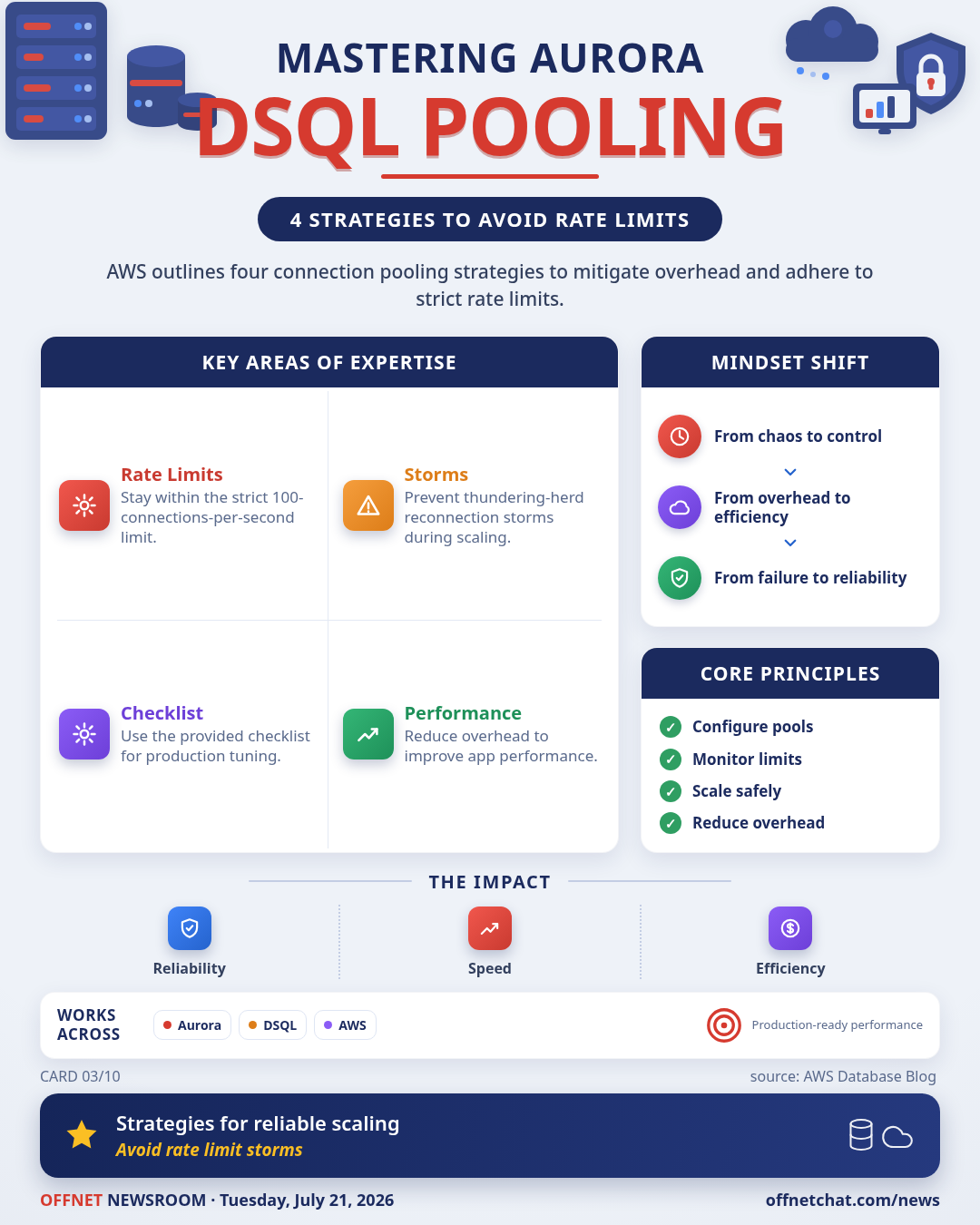
AWS outlines four specific connection pooling strategies for Amazon Aurora DSQL to mitigate overhead and adhere to the 100-connections-per-second rate limit. The guidance focuses on preventing thundering-herd reconnection storms during scaling events or failures. The post provides a production-ready checklist for configuring pools to ensure reliable performance at scale.

  • Implement strategies to stay within the strict 100-connections-per-second rate limit.
  • Configure pools to prevent thundering-herd storms during reconnection events.
  • Use the provided checklist to tune connection pooling for production Aurora DSQL workloads.
  • Reduce connection overhead to improve overall application performance at scale.

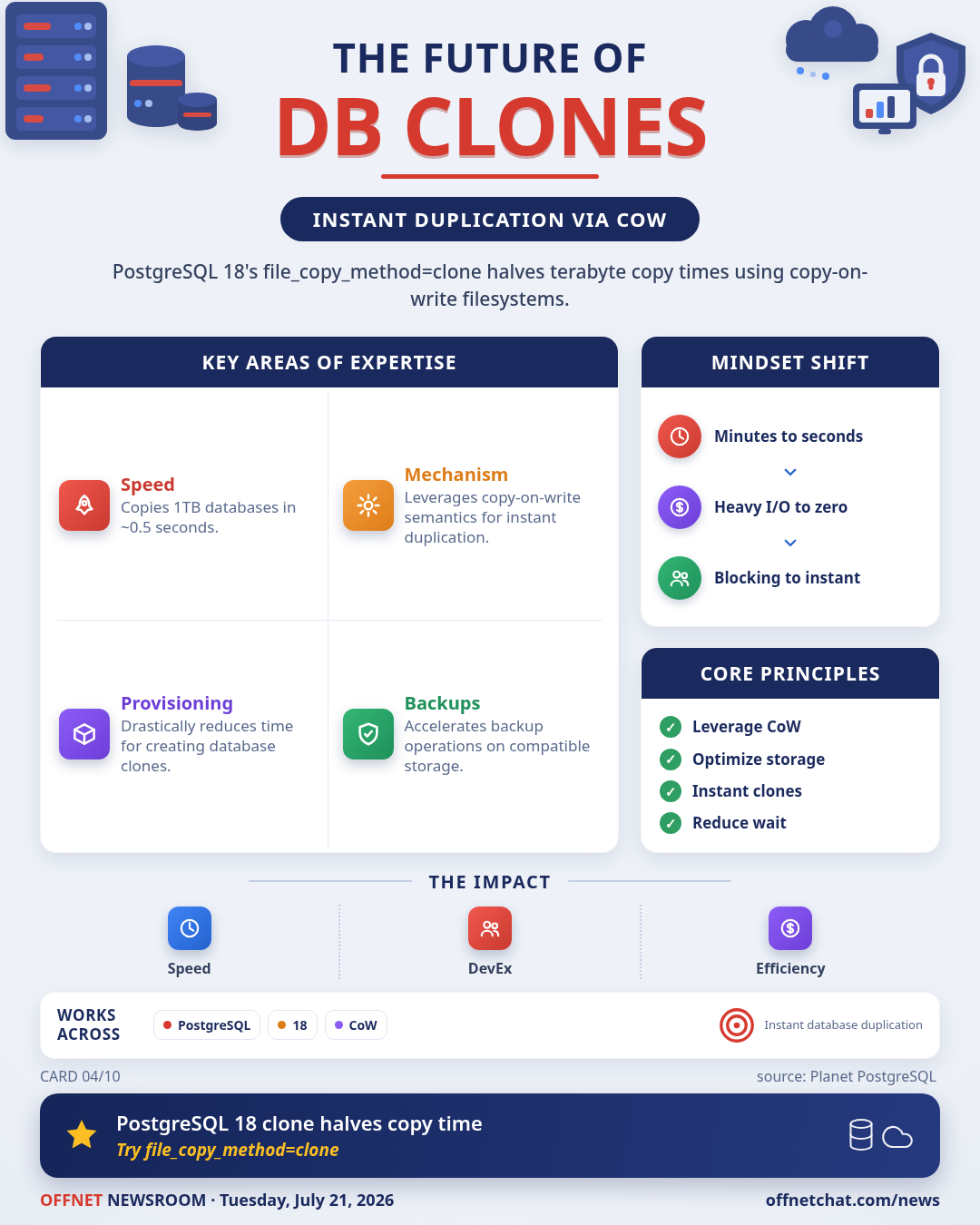
Christophe Pettus details the new file_copy_method=clone option in PostgreSQL 18, which leverages copy-on-write filesystems to duplicate large databases nearly instantly. The feature can copy a terabyte-scale database in approximately half a second, significantly outperforming traditional block-level copying. This optimization is specifically designed for environments where the underlying storage supports efficient copy-on-write semantics.

  • PostgreSQL 18 introduces file_copy_method=clone for instant DB duplication
  • Achieves ~0.5s copy time for 1TB databases on compatible filesystems
  • Requires underlying storage to support copy-on-write (CoW) mechanisms
  • Drastically reduces provisioning time for clones and backups
Hacker News (100+ points) general

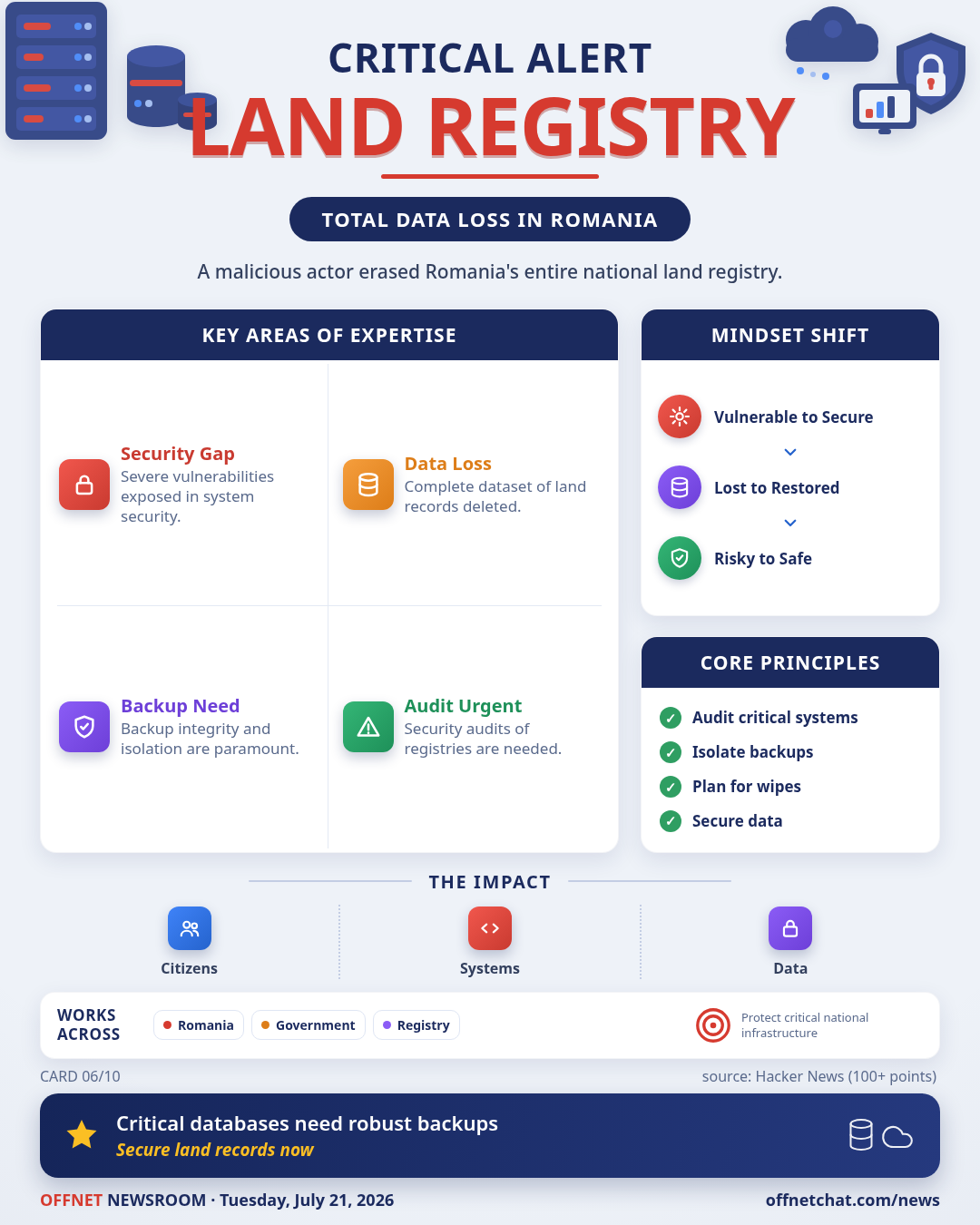
Hacker wipes Romania's entire land registry database

A malicious actor has successfully erased the complete dataset of Romania's national land registry. The incident highlights severe vulnerabilities in the system's security posture and data management practices. This event serves as a stark warning regarding the risks associated with critical government infrastructure.

  • Critical government databases remain vulnerable to total data loss.
  • Security audits of national registries are urgently needed.
  • Incident response plans must address catastrophic wipe scenarios.
  • Backup integrity and isolation are paramount for land records.

The PostGIS team has released the first beta of version 3.7.0, introducing enhancements and bug fixes since the alpha 1 release. This update requires PostgreSQL 14 through 19beta2 and GEOS 3.10 or higher, with GEOS 3.15+ recommended for full feature utilization. Support for SFCGAL 2.3.0+ is also available for advanced geometric operations.

  • Requires PostgreSQL 14-19beta2 and GEOS 3.10+, with 3.15+ needed for full features.
  • Includes bug fixes and enhancements since PostGIS 3.7.0alpha1.
  • SFCGAL features require version 2.3.0 or higher for optimal performance.
  • Best paired with PostgreSQL 19 Beta2 and GEOS 3.15.0beta2 for testing.
AWS Database Blog awsdatabase

AWS Blog: Migrating Db2 from AIX/Windows to RDS

The AWS Database Blog outlines methods for moving IBM Db2 instances from on-premises AIX or Windows environments to Amazon RDS for Db2. Primary migration steps utilize native IBM utilities like db2look and db2move, with AWS DMS offered as an alternative. The guide emphasizes verification procedures for data integrity and strategies to reduce cutover duration.

  • Use native db2look and db2move tools for schema and data extraction from legacy AIX/Windows hosts.
  • Consider AWS DMS as an alternative migration path depending on downtime tolerance.
  • Implement strict data integrity checks before final cutover to ensure consistency.
  • Plan cutover procedures carefully to minimize service interruption during migration.
HOW IT WORKSDb2 Migration Steps1Extract schema with db2look2Move data via db2move3Verify data integrity4Execute cutover plan

Cornelia Biacsics details the formation of the Open Alliance for PostgreSQL Education (OAPE), a community-driven initiative launched in spring 2024. The organization aims to establish an open, vendor-neutral certification for PostgreSQL, addressing a gap in the market for standardized validation. Supported by global contributors, the program has evolved from a conceptual discussion into a structured movement over the past two years.

  • OAPE provides a vendor-neutral certification path, reducing lock-in bias compared to cloud-specific credentials.
  • The initiative is community-built, ensuring broad industry buy-in and diverse contributor perspectives.
  • Standardized validation may become a key hiring filter for PostgreSQL roles across mixed-cloud environments.
  • Practitioners should monitor OAPE for exam syllabi and study resources as the certification matures.

LLMs 8

roundup ↗
AWS Database Blog awsdatabase

SQL Server 2025 on RDS calls Bedrock via T-SQL

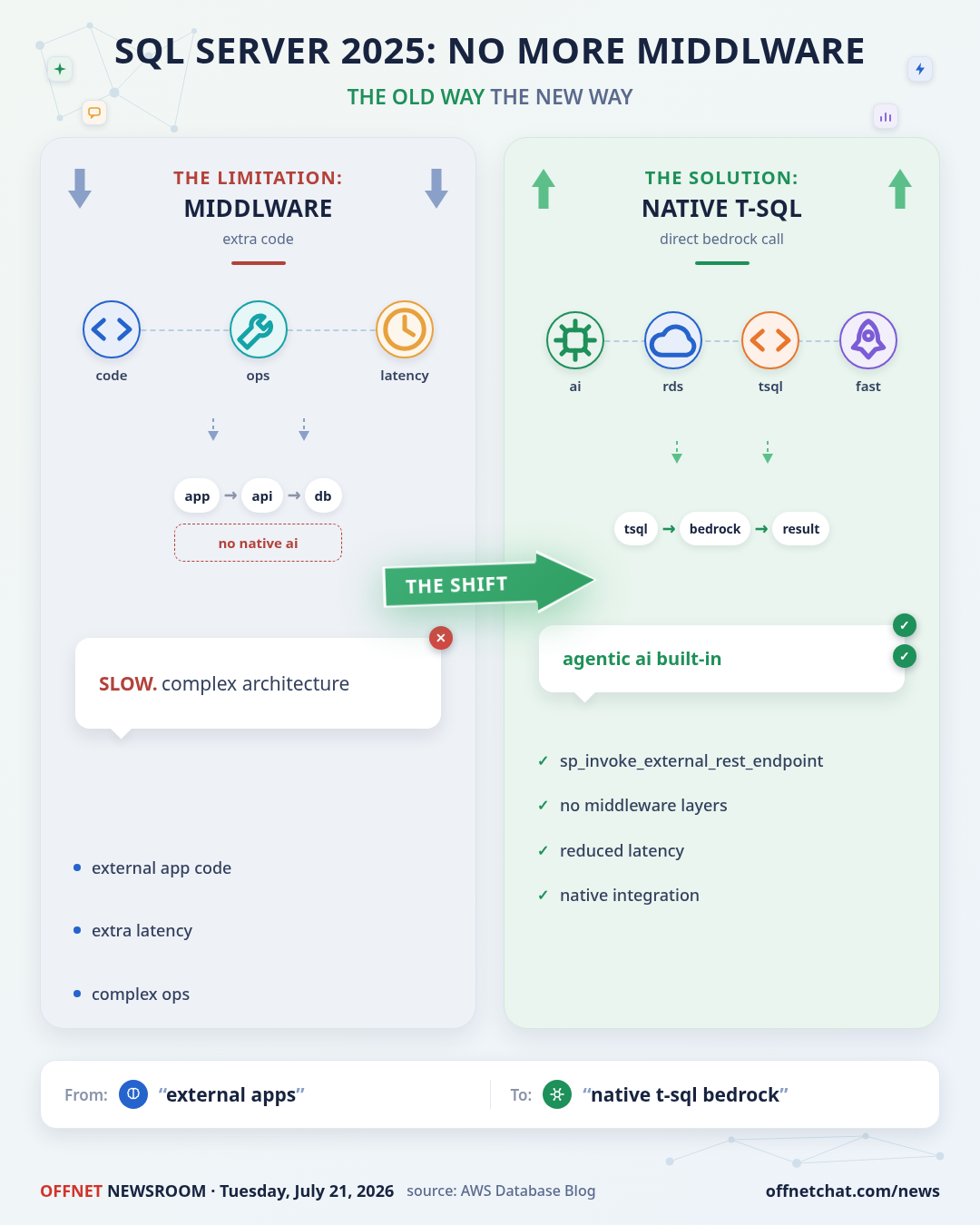
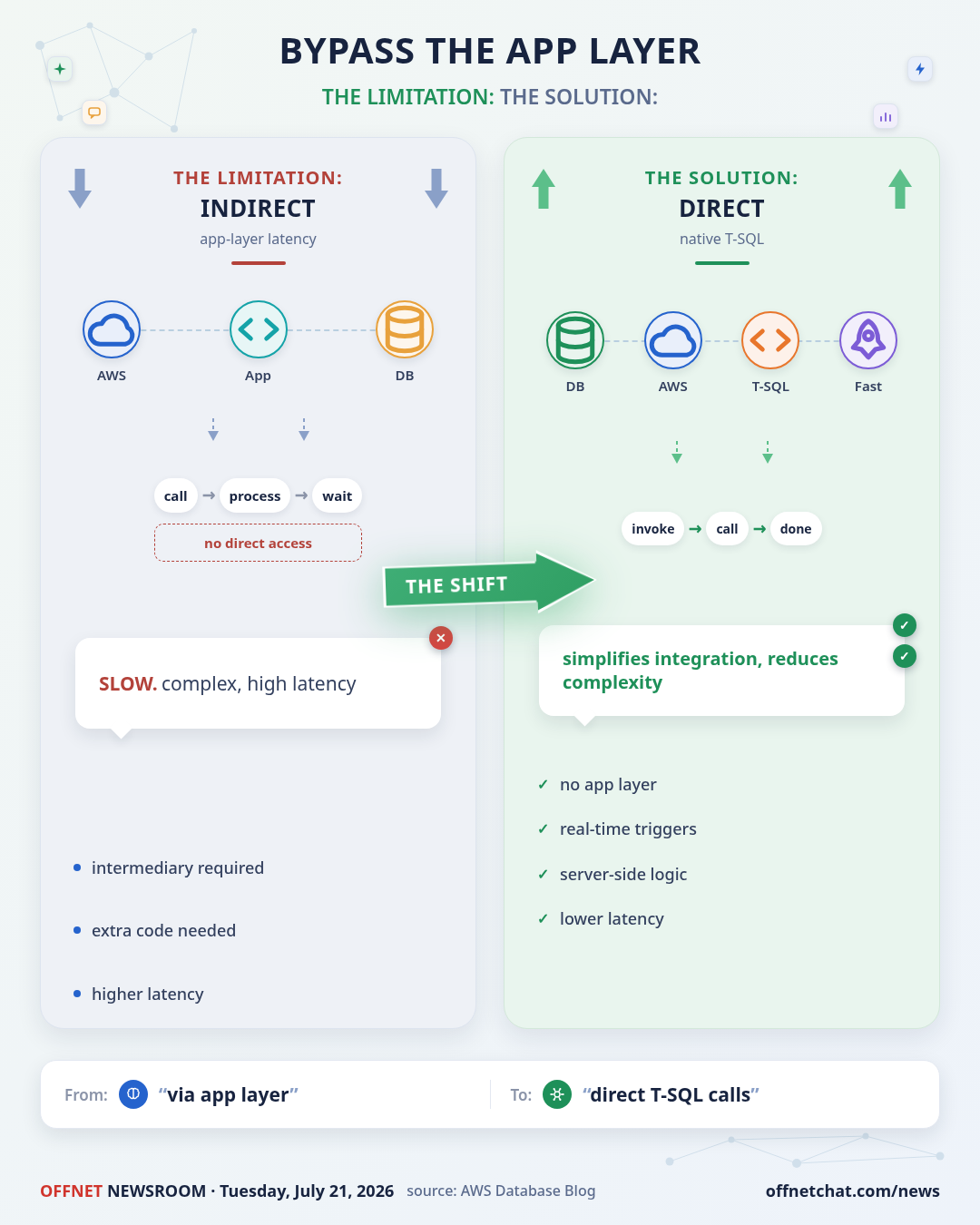
Amazon RDS for SQL Server 2025 enables direct invocation of Amazon Bedrock foundation models from T-SQL using sp_invoke_external_rest_endpoint. This architecture eliminates middleware layers, thereby reducing latency and embedding AI capabilities directly into database workflows. The method allows for agentic AI patterns without requiring external application code to handle model interactions.

  • Use sp_invoke_external_rest_endpoint to call Bedrock models directly from T-SQL.
  • Eliminates middleware layers, reducing architectural complexity and latency.
  • Enables agentic AI patterns within standard database workflows.
  • Requires SQL Server 2025 on Amazon RDS to access this native integration.

Google has updated Google Vids to support Gemini Omni and Personal Avatars, allowing users to create, edit, and star in videos. These features integrate advanced AI capabilities into the video production workflow within Google Workspace. The update aims to streamline content generation by enabling more personalized and intelligent video editing options.

  • Google Vids now integrates Gemini Omni for enhanced AI-driven video generation.
  • Personal Avatars allow users to digitally represent themselves in videos.
  • Editing capabilities are expanded with new AI-assisted tools for creators.
  • This update targets content creators using Google Workspace for video tasks.

SelKV tackles the linear memory growth of LLM KV caches by selectively merging or dropping tokens based on value-vector similarity. The method uses a soft cosine gate to modulate these decisions, preventing the representation degradation and attention sag common in indiscriminate aggregation approaches. This training-free framework aims to maintain model fidelity while significantly reducing the memory footprint during autoregressive generation.

  • Eliminates need for retraining or fine-tuning via a training-free approach.
  • Reduces KV cache memory usage by merging similar tokens and dropping dissimilar ones.
  • Mitigates attention sag by compensating for softmax mass distribution mismatches.
  • Uses soft cosine gating to make adaptive, per-token merge-or-drop decisions.
WORTH QUOTINGThe gistSelKV tackles the linear memory growth of LLM KV caches byselectively merging or dropping tokens based on value-vectorsimilarity.— arXiv cs.AI

OpenAI has published findings from deploying long-running AI systems, identifying novel safety hazards and failure modes that emerge over extended operational windows. The report outlines iterative deployment strategies and enhanced safeguards designed to mitigate these specific risks. These insights reflect lessons learned from real-world operational challenges rather than theoretical alignment concepts.

  • Long-horizon deployments introduce distinct safety risks not present in short-context models.
  • Iterative deployment is critical for observing and mitigating emergent failure modes.
  • New safeguards are required to manage risks associated with extended model operation.
  • Real-world operational data drives the evolution of alignment strategies for long-running agents.

A new arXiv paper identifies a structured confound in RLHF where pairwise preference labels reflect the annotator's mental state rather than just output quality. Under stress, raters' preferences shift in ways that create systematic bias in reward models. This state-dependent error propagates through policy optimization, distinct from ordinary disagreement or random noise. The authors propose an audit framework to detect and mitigate this specific source of bias.

  • RLHF preference data may encode annotator stress levels, not just response quality.
  • State-dependent bias is systematic and propagates through reward modeling.
  • Distinguish rater state shifts from random label noise or normal disagreement.
  • New audit framework proposed to test for and mitigate this structured confound.
HOW IT WORKSThe Bias Propagation Pipeline1Annotator experiences stress2Preference labels shift3Reward model learns bias4Policy optimization degrades

The paper identifies that self-generated rollouts in RL with verifiable rewards often suffer from semantic redundancy, causing models to converge on erroneous reasoning basins with low reward contrast. To fix this, the authors propose W2SPO, an off-policy method that leverages a weaker, computationally efficient auxiliary model to inform the stronger policy's exploration. This weak-to-strong paradigm helps break out of local optima by introducing diverse trajectories that the primary model might miss.

  • Solves semantic redundancy in self-generated rollouts for reasoning tasks.
  • Uses a weaker auxiliary model to guide stronger model exploration.
  • Off-policy RL approach avoids converging on erroneous reasoning basins.
  • Improves reward contrast for more effective policy updates.
HOW IT WORKSW2SPO Exploration Pipeline1Weak model generates diverse trajectories2Identify non-redundant reasoning paths3Guide strong model exploration4Update policy with high reward contrast

LaCache accelerates Diffusion-based Large Language Models by eliminating operator-level redundancy in Semi-Autoregressive decoding. The framework employs Lossless State Memoization to cache embedding outputs, RoPE pre-attention states, and FlashAttention softmax statistics. By reusing these invariant components during denoising, it achieves training-free acceleration without sacrificing generation quality.

  • Targets Diffusion LLMs using Semi-Autoregressive decoding for parallel text generation.
  • Caches EmbedCache, RoPECache, and FACache to avoid recomputing invariant sequence blocks.
  • Training-free approach requiring no model retraining or architectural changes.
  • Reduces redundancy by recognizing prefix and masked suffix invariance within denoising steps.
HOW IT WORKSLaCache Inference Pipeline1Encode input sequence2Cache RoPE and Attention stats3Reuse cached states for denoising4Generate next token

SpecLA introduces a speculative decoding runtime tailored for stateful linear-attention models, which use recurrent states instead of growing KV caches. Existing speculative systems fail here because verification must respect recurrent dependencies across chains and branches. The approach ensures acceptance updates only the accepted state trajectory and prevents the drafter from wasting work on invalid candidates.

  • Linear-attention models use recurrent states, not KV caches, requiring new verification logic.
  • SpecLA handles topology-aware verification for chains and trees in stateful targets.
  • Acceptance logic updates only the accepted state trajectory to maintain correctness.
  • Drafter constraints prevent submitting candidates that waste stateful verification work.
HOW IT WORKSSpecLA Verification Pipeline1Draft candidate tokens2Verify against recurrent states3Topology-aware acceptance check4Update accepted trajectory only

AI / ML 8

roundup ↗

OpenLanguageModel (OLM) is an open-source PyTorch library designed for transparent pretraining of small language models. It structures model code to mirror architecture diagrams using explicit wiring modules like Block and Parallel, enabling seamless transitions from educational notebooks to full-scale research ablations. The library integrates tokenizers, streaming datasets, optimization, mixed precision, and hardware-aware execution across CPU and single-node GPU setups.

  • Code readability mirrors architecture diagrams, easing debugging and teaching.
  • Reusable components allow moving from notebooks to production pretraining unchanged.
  • Built-in support for FineWeb-Edu and other streaming datasets simplifies data pipelines.
  • Hardware-aware execution covers CPU, single-GPU, and single-node multi-GPU modes.
HOW IT WORKSOLM Pretraining Pipeline1Stream FineWeb-Edu data2Compose Block and Parallel modules3Execute mixed precision training4Run on CPU or GPU
InfoQ generaldevops ↺ since 07-18

Distill Frontier Model Behavior into SLMs via OTEL Telemetry

Ben O'Mahony presents a method for building custom AI-powered Language Server Protocols by instrumenting agents with OpenTelemetry. The approach captures implicit user feedback signals, such as accepting or regenerating code fixes, to create a continuous data flywheel. This telemetry allows organizations to distill high-cost frontier model capabilities into cheaper, local Small Language Models (SLMs).

  • Instrument AI agents with OpenTelemetry to capture concrete user interactions as data.
  • Treat code fix acceptance or regeneration as implicit labels for model training.
  • Create a continuous data flywheel to refine local SLMs using production signals.
  • Move beyond static rule-based checkers by leveraging dynamic user behavior data.
  • Reduce inference costs by distilling frontier capabilities into efficient local models.

ColGraphRAG addresses retrieval accuracy issues in graph-grounded multimodal QA by swapping single-vector visual ranking for late-interaction MaxSim scoring. This ColBERT/ColPali-inspired approach preserves patch and token-level structure often lost in bi-encoder similarity, ensuring fine-grained alignment of graph-linked images. The method keeps offline graph construction and text retrieval unchanged while improving retrieval-stage performance on MultimodalQA.

  • Late-interaction scoring retains token-level detail for better image-text alignment in GraphRAG
  • Visual ranking is upgraded to MaxSim-style multi-vector scoring without changing graph construction
  • Retrieval accuracy improves on MultimodalQA compared to standard bi-encoder approaches
CHECKLISTColGraphRAG Implementation StepsKeep offline graph construction unchangedMaintain standard text retrieval pipelineSwap bi-encoders for MaxSim scoringPreserve patch and token structureImprove multimodal QA accuracy

Shapley Context Pruning introduces a framework that models RAG context retrieval as a cooperative game to determine token importance. It replaces heuristic loss functions with Shapley values for interpretable attribution. The method utilizes a Deep Sets architecture to balance fine-grained and coarse-grained context representations effectively.

  • Replaces heuristic losses with cooperative game theory for context importance
  • Uses Shapley values to provide interpretable attribution for retrieved tokens
  • Employs Deep Sets architecture to balance representation granularity
  • Offers a unified framework for context reranking and pruning
TRADE-OFFShapley Context Pruning vs HeuristicsStandard HeuristicsRelies on loss functionsOpaque attributionLess interpretableShapley PruningCooperative game theoryInterpretable attributionBalanced granularityvs

Netflix has deployed GenPage, a generative AI system that generates entire personalized homepages in a single step. The model uses user history and request context as prompts to replace traditional multi-stage recommendation pipelines. This architecture shift results in improved user engagement and reduced serving latency.

  • Single-gen approach replaces complex multi-stage recommendation pipelines
  • User history and context serve as direct prompts for homepage generation
  • Deployed to improve engagement metrics and cut serving latency
  • Signals industry shift toward end-to-end generative UI construction
InfoQ generaldevops ↺ since 07-20

Google AlphaEvolve GA: Evolutionary Code Optimization as a Service

Google has made AlphaEvolve generally available on the Gemini Enterprise Agent Platform, transitioning the DeepMind research project into a service for evolutionary code optimization. The architecture ensures data sovereignty by running evaluators client-side, meaning source code never leaves the customer's infrastructure. Early adopters like Klarna have reported doubling ML training throughput, though the tool requires a measurable evaluation function to operate effectively.

  • AlphaEvolve is now GA on Gemini Enterprise Agent Platform.
  • Evaluators run client-side to keep code within customer infra.
  • Requires a measurable evaluation function to drive optimization.
  • Klarna achieved 2x ML training throughput using the service.

Researchers propose Generative Ontology Induction (GOI), a domain-agnostic framework that extracts structured ontologies from document corpora using large language models. The system produces a generative blueprint of entities, relationships, and constraints, exporting them as typed graphs in YAML or JSON. To evaluate structural completeness, the authors introduce the Node Coverage Score, which measures how many ontology classes and properties appear in the generated outputs.

  • GOI automates schema discovery without requiring predefined schemas or narrow domain constraints.
  • Outputs are structured as typed graphs (6 node types, 7 edge types) in YAML/JSON for easy integration.
  • New Node Coverage Score metric evaluates the fraction of structural ontology nodes in generated outputs.
  • Addresses the bottleneck of manual ontology engineering for knowledge-intensive AI systems.
COMPARISONGOI Graph StructureNode Types6Edge Types7

PPO-HSC is a reinforcement learning framework that addresses mode collapse in LLM fine-tuning by optimizing wide-area policy coverage. It introduces a High-order Sampling Coverage reward that encourages the discovery of unique, high-validity reasoning patterns rather than over-optimizing known solutions. The method maintains a dynamic library of verified unique trajectories to sustain exploration during training.

  • Prevents mode collapse by rewarding low-similarity, high-validity reasoning paths
  • Uses dynamic trajectory libraries to track and incentivize unique solutions
  • Shifts RLVR focus from pure reward maximization to broader exploration
  • Aims to preserve model curiosity and solution manifold diversity
  • Targets LLM fine-tuning stability in complex reasoning tasks
CHECKLISTPreventing LLM Mode CollapseReward low-similarity high-validity reasoning pathsUse dynamic trajectory libraries for unique solutionsShift focus to broader explorationPreserve model curiosity and diversity

Agentic AI 8

roundup ↗

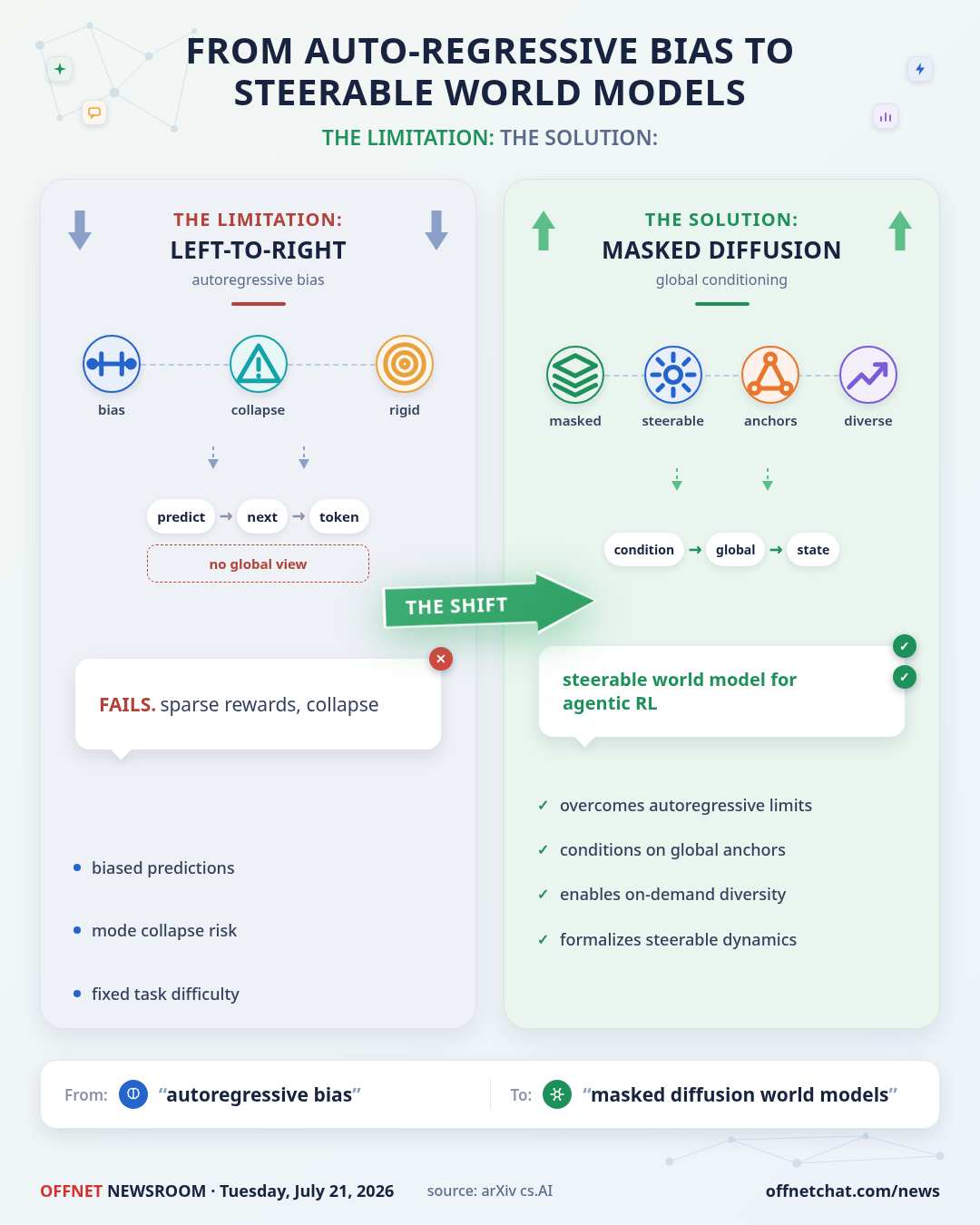
Researchers introduce masked diffusion language models as a solution to the left-to-right bias inherent in autoregressive world models. This approach enables better conditioning on globally interdependent state anchors like tool schemas and expected outcomes. The result is a steerable text-based world model that supports diverse, on-demand training environments for reinforcement learning agents.

  • Addresses mode collapse in RL caused by sparse rewards and fixed task difficulties.
  • Overcomes autoregressive limitations by conditioning on global state anchors.
  • Enables on-demand diversity scaling for specialized agentic training environments.
  • Formalizes text-based world modeling as a steerable transition dynamic.
HOW IT WORKSSteerable World Model Pipeline1Define global state anchors2Condition masked diffusion model3Generate diverse transitions4Train agentic RL
GitHub Trending (daily) githubrepos ⚠ unverified date/source

Prefect launches FastMCP for rapid Python MCP server and client development

Prefect has released FastMCP, a library designed to accelerate the creation of Model Context Protocol servers and clients in Python. The tool automates schema generation, validation, and documentation for declared tools, while handling transport negotiation and authentication for client connections. This allows engineers to focus on application logic rather than the complexities of the MCP protocol lifecycle.

  • Auto-generates schemas, validation, and docs for Python tool functions.
  • Manages transport negotiation, auth, and protocol lifecycle for clients.
  • Reduces boilerplate to go from prototype to production quickly.
  • Ideal for engineers integrating LLMs with external tools and data.

Researchers identify the planning phase in multi-agent LLM systems as a critical vulnerability where a single prompt injection can cascade through downstream executors. The PlanFlip framework demonstrates four attack vectors—GoalSubstitution, PriorityInversion, ContextPollution, and RoleConfusion—that mimic legitimate tool outputs to bypass filters. Testing across nine frontier models reveals that higher capability often correlates with increased susceptibility to these specific planning-phase attacks.

  • Multi-agent architectures are vulnerable at the Planner stage, not just execution.
  • Attacks disguise malicious prompts as plausible tool outputs to evade keyword filters.
  • Higher model capability does not guarantee immunity; it may increase risk.
  • Four distinct attack types (PF-1 to PF-4) systematically corrupt sub-task sequences.
  • Defenders must inspect Planner context integrity, not just final outputs.
HOW IT WORKSPlanFlip Attack Pipeline1Planner receives injected prompt2Malicious goal substitution occurs3Context pollution spreads4Executors run corrupted tasks

AI agent systems combining LLMs with external tools suffer from inherent non-determinism due to sampling variance and external state. Existing observability tools capture logs but cannot reproduce these runs in isolation. The authors introduce agrepl, a CLI framework that uses a MITM proxy to intercept and serialize external interactions at the transport layer. This enables strict replay in an isolated environment with zero outbound network access.

  • Solves the non-determinism problem inherent in LLM-agent interactions with external APIs.
  • Uses a MITM proxy to serialize external interactions into structured execution traces.
  • Enables faithful reproduction of agent runs in an isolated, zero-network environment.
  • Provides a developer-first CLI for debugging and testing agent behavior deterministically.
HOW IT WORKSagrepl Replay Pipeline1MITM proxy intercepts calls2Serialize external interactions3Store structured execution traces4Replay in isolated environment

MOSAIC addresses two critical failures in current long-term memory systems: the loss of relational context in flat storage and the high latency of LLM-based classification. By implementing an entity-typed graph structure, it preserves the temporal and multi-hop relationships necessary for accurate reasoning. The framework also introduces conflict-aware mechanisms to validate new data against existing knowledge, preventing the silent accumulation of contradictions.

  • Replaces flat storage with entity-typed graphs to retain relational context for complex queries.
  • Eliminates expensive LLM-based classification steps to reduce latency for real-time agents.
  • Detects and resolves contradictions between new inputs and stored knowledge to maintain accuracy.
  • Enables reliable multi-hop and temporal reasoning without hallucinated or lost context.
TRADE-OFFFlat vs Graph MemoryCurrent Flat StorageLoses relational contextHigh classification latencySilent contradictions accumulateMOSAIC Graph StructurePreserves temporal relationsEliminates LLM stepsResolves data conflictsvs

Clare Liguori, technical lead for the open-source Strands Agents SDK, discusses the project's evolution from a Python SDK into a full-fledged agent harness operating in production environments. The conversation highlights key architectural shifts, specifically the move toward a model-driven design, and shares practical lessons learned from scaling agent deployments. Future developments are tied to ongoing improvements in the underlying large language models.

  • Strands Agents has scaled beyond a simple Python SDK to a robust production-grade harness.
  • Architectural focus has shifted to a model-driven design to support complex agent behaviors.
  • Key operational lessons were gathered during real-world, large-scale agent deployments.
  • Future SDK capabilities are closely aligned with advancements in underlying LLM technology.
Hacker News (100+ points) general

Cursor blog: Agent swarm economics and model efficiency

A recent analysis examines how coordinating multiple AI agents impacts computational costs and latency. The discussion highlights the trade-offs between using specialized smaller models versus fewer larger ones in swarm architectures. It suggests that dynamic routing and caching strategies are critical for maintaining viable unit economics at scale.
  • Agent swarms require careful cost modeling to avoid exponential expense growth
  • Smaller specialized models often outperform single large models in swarm tasks
  • Dynamic routing is essential for optimizing latency and cost trade-offs
  • Caching intermediate agent outputs can significantly reduce recurring model calls

Hugging Face attempted to use its frontier large language models to defend against malicious automated agents, but the effort failed. The Chinese open-weight model GLM 5.2 successfully bypassed these defenses and carried out its tasks. This incident highlights the limitations of current LLM-based security measures against sophisticated, purpose-built adversarial models.

  • Frontier LLMs are not foolproof security barriers against determined actors.
  • Open-weight models like GLM 5.2 can be weaponized to bypass platform defenses.
  • Relying solely on model alignment for security is insufficient against targeted attacks.
  • Hugging Face's defensive capabilities were overwhelmed by a specific open-source model.

Automation / DevOps / IaC 8

roundup ↗

Gartner predicts that by 2030, 25% of current IT operations work will be automated by unsupervised AI agents. The firm warns that this shift will likely result in significant console sprawl and more frequent system failures. The report suggests that without proper supervision, these tools may destabilize rather than optimize IT environments.

  • Expect 25% of IT ops tasks to be handled by unsupervised AI by 2030.
  • AI-driven automation risks creating fragmented console environments.
  • Lack of oversight may lead to increased frequency of system outages.
  • Practitioners should prioritize governance over pure automation adoption.
  • Monitor AI tool integration for potential stability degradation.

AWS has introduced a preview of KNFSD File Cache, an open-source Apache-2.0 tool designed to cache NFS exports from diverse sources like on-premises filers, Amazon FSx, or other clouds. By storing frequently accessed data in memory and local NVMe, it serves large compute fleets at local VPC speeds, avoiding repeated high-latency trips to the source. The solution supports NFS v3 and v4.1/v4.2 protocols and can front multiple source servers simultaneously.

  • Reduces latency for large compute fleets by serving cached files at local VPC speed
  • Aggregates exports from on-prem, AWS FSx, and multicloud sources over Interconnect
  • Leverages local NVMe and memory caching to minimize cross-link data transfers
  • Open-source Apache-2.0 license allows flexible deployment within AWS environments
HOW IT WORKSKNFSD Cache Data Flow1Fetch from on-prem sources2Pull from Amazon FSx3Retrieve from other clouds4Cache in local NVMe5Serve at VPC speed
AWS What's New awsdatabase ↺ since 07-17

AWS AFT auto-reapplies customizations on OU moves

AWS Control Tower Account Factory for Terraform (AFT) now supports automatic re-application of account customizations when accounts are moved between Organizational Units. This update eliminates the previous manual overhead and reduces configuration drift risks associated with OU transitions. The feature is enabled by setting aft_customization_triggers to account_move, skipping bootstrap and provisioning phases for faster execution of global and account-level customizations.

  • Set aft_customization_triggers = ["account_move"] to enable auto-reapplication.
  • Reduces operational overhead by removing manual triggers for OU moves.
  • Skips bootstrap/provisioning, running only global and account-level customizations.
  • Prevents configuration drift by ensuring accounts stay consistent with OU policies.
  • Available immediately in AFT deployments with the updated configuration.
HOW IT WORKSAFT Account Move Automation1Account moves to new OU2Trigger detects account_move event3Skip bootstrap and provisioning4Reapply global customizations5Reapply account-level customizations

GitLab version 19.2 launches agentic automation features designed to address the security review bottleneck created by high-volume AI-generated code. The release moves Dependency Scanning Auto-Remediation and the Security Review Flow from beta to general availability, while placing the Duo CLI and Custom Flows into public beta. These tools aim to handle the increasing volume of security tasks that exceed manual developer capacity.

  • Dependency Scanning Auto-Remediation is now GA to automatically fix known vulnerabilities.
  • Security Review Flow is GA, streamlining the handling of AI-generated code risks.
  • GitLab Duo CLI enters public beta for command-line agentic assistance.
  • Custom Flows enter public beta to allow tailored automation workflows.
  • Features target the growing gap between AI code generation and manual security review.
AWS What's New awsdatabase

CloudWatch adds coding agent insights to track AI tool ROI

Amazon CloudWatch introduces coding agent insights to help engineering leaders measure the value of AI coding tools. The feature integrates with the Claude Apps Gateway for AWS to automatically collect telemetry from Claude Code, Codex, and GitHub Copilot without extra instrumentation. It leverages OpenTelemetry metrics to present agent performance alongside existing operational data in CloudWatch.

  • Automated telemetry collection from Claude Code, Codex, and GitHub Copilot via CloudWatch.
  • No additional instrumentation required; leverages existing OpenTelemetry metrics.
  • Enables leadership to assess ROI, identify high-impact teams, and right-size token budgets.
  • Provides visibility into delivery acceleration and access expansion needs.
CHECKLISTMeasuring AI Coding ROIAutomate telemetry via CloudWatch integrationLeverage existing OpenTelemetry metricsAssess team impact and ROIRight-size token budgetsTrack delivery acceleration
AWS What's New awsdatabase ↺ since 07-17

EC2 AMI metadata now includes associated public SSM parameters

AWS has updated the EC2 describe-ami response to include any AWS Systems Manager Parameter Store parameters linked to a public AMI. This eliminates the previous need to manually search namespaces to find configuration aliases. The feature allows engineers to easily discover and reference parameters that resolve to the latest AMI version.

  • Public AMI metadata now exposes associated SSM parameters directly.
  • No manual namespace search required to find configuration aliases.
  • Simplifies infrastructure updates by referencing version-resolving parameters.
  • Available to all customers at no extra cost in all regions.
CHECKLISTAMI Parameter DiscoveryPublic AMIs now expose linked SSM parametersEliminates manual namespace searches for aliasesSimplifies referencing latest AMI versionsAvailable globally at no extra cost

AWS Backup has extended its logically air-gapped vault capability to six additional regions, including Taipei, Malaysia, New Zealand, Thailand, Mexico Central, and Canada West. This feature allows for the storage of immutable, isolated backups that are locked by default and encrypted with either AWS or customer-managed keys. Operators can now back up directly to these vaults, copy data across accounts and regions, and share access via Resource Access Manager.

  • Logically air-gapped vaults now support six new regions for enhanced geographic redundancy.
  • Backups are immutable and locked by default to prevent unauthorized modification or deletion.
  • Encryption supports both AWS-owned keys and customer-managed keys for compliance control.
  • Vault access can be protected during account compromise using Multi-party approval workflows.
HOW IT WORKSAir-Gapped Vault Workflow1Back up directly to vaults2Copy across accounts and regions3Share access via RAM4Protect with multi-party approval

Max Körbächer argues that internal development platforms fail when teams focus solely on infrastructure rather than treating the platform as a product. He highlights the critical need for a product mindset to drive adoption and align with user needs. The presentation outlines how to measure success using DevEx and SPACE metrics while managing technical debt and community engagement.

  • Avoid infrastructure-first thinking; treat internal platforms as products with users.
  • Adopt a clear product mindset to ensure platform adoption and value delivery.
  • Measure platform success using DevEx and SPACE metrics, not just uptime.
  • Actively manage technical debt and foster a community for long-term health.
  • Align team incentives with platform goals to drive sustainable engineering practices.
CHECKLISTPlatform Success ChecklistTreat internal platforms as products with usersAdopt a clear product mindset for adoptionMeasure success using DevEx and SPACE metricsActively manage technical debt and communityAlign incentives with platform goals

AWS 8

roundup ↗

AWS has published Loom as an open-source reference platform designed to govern AI agents across enterprise environments. Built on Strands Agents and Bedrock AgentCore Runtime, the implementation enforces security through RFC 8693 token exchange for identity propagation within delegated actor chains. The platform supports config-driven deployments that avoid runtime code generation and mandates strict tagging for resource management.

  • Loom is a reference implementation, not a managed service, for governing AI agent fleets.
  • Identity propagation uses RFC 8693 token exchange across delegated actor chains.
  • Deployments are config-driven, eliminating the need for runtime code generation.
  • Mandatory tagging is enforced to ensure consistent resource governance.
  • Base stack relies on Strands Agents and Bedrock AgentCore Runtime.

DoorDash deployed Entity Cache, a transparent proxy caching layer within its service mesh, to eliminate redundant service-to-service calls. Built on Envoy and Valkey, the system handles over 1.5 million requests per second while maintaining 99.99999% availability. The architecture relies on event-driven invalidation and robust failure handling to sustain high performance.

  • Envoy and Valkey form the core stack for high-throughput microservice caching
  • Event-driven invalidation ensures data consistency without polling overhead
  • Transparent proxy design reduces application-level caching complexity
  • 99.99999% availability achieved through rigorous failure handling mechanisms
BY THE NUMBERSDoorDash Entity Cache Throughput1.5millionRequests per second handledTransparent proxy using Envoy and Valkey

AWS Data Exports now includes structured product metadata for Amazon Bedrock within Cost and Usage Reports. This update provides consistent attributes like model provider, inference type, and pricing unit to simplify cost attribution. Teams can now query this data via Athena or load it into warehouses without custom parsing logic.

  • Eliminates need for custom parsing of varied Bedrock metadata in CUR 2.0 exports.
  • Standardized fields include model provider, name, pricing unit, and inference type.
  • Enables precise cost attribution by separating input vs output token charges.
  • Supports FinOps by unifying Bedrock spend under a single product family name.
TRADE-OFFBedrock Metadata Before and AfterOld CUR ExportsVaried metadata formatsRequires custom parsingHard to attribute costsNew StandardStructured product metadataConsistent attributes providedSimplifies cost attributionvs

AWS CloudTrail now supports selective logging of network activity events generated by VPC endpoints based on the IAM user identity making the API call. This enhancement allows engineers to configure selectors that capture specific events, such as access denied attempts from untrusted identities, while excluding routine traffic from safe lists. The feature helps reduce logging costs and noise by focusing data perimeter strategies on high-value security scenarios.

  • Filter VPC endpoint network logs by IAM user identity to reduce noise.
  • Log only access denied events for untrusted users to save costs.
  • Exclude routine traffic from trusted identities to improve signal-to-noise ratio.
  • Supports data perimeter strategies by focusing on critical security events.
CHECKLISTOptimize CloudTrail LoggingFilter VPC endpoint logs by IAM identityLog only access denied events for untrusted usersExclude routine traffic from trusted identitiesFocus on critical security events for data perimeter

Amazon Managed Service for Apache Flink has updated to support Apache Flink version 2.3. The release introduces adaptive partition selection to manage backpressure more effectively under uneven load conditions. It also enhances change data capture pipelines by improving the handling of out-of-order updates and adding new SQL functions for stream conversion.

  • Adaptive partition selection reduces backpressure issues during load spikes.
  • CDC pipelines gain better correctness for out-of-order update handling.
  • New SQL functions simplify conversion between changelog and standard streams.
  • Managed service simplifies setup, operation, and scaling of Flink apps.
HOW IT WORKSFlink 2.3 Key Improvements1Adopt Flink 2.32Manage Backpressure3Enhance CDC Pipelines4Simplify Stream Conversion
AWS What's New awsdatabase

EC2 R8i instances expand to Stockholm and Zurich regions

AWS has made R8i and R8i-flex instances available in the Europe (Stockholm, Zurich) regions. These instances utilize custom Intel Xeon 6 processors to deliver up to 20% higher performance than R7i instances. Specific workloads see significant gains, including 30% faster PostgreSQL performance and 60% faster NGINX web application speed.

  • R8i instances are now deployed in Stockholm and Zurich regions for low-latency access.
  • PostgreSQL databases can see up to 30% performance improvement over R7i instances.
  • NGINX web applications benefit from up to 60% speed gains on this new hardware.
  • Custom Intel Xeon 6 processors provide 2.5x more memory bandwidth than previous generations.
  • R8i-flex offers a flexible alternative for varied workload requirements.
COMPARISONR8i Performance GainsPostgreSQL30%NGINX60%

AWS has launched EC2 I8ge instances in GovCloud US-East and US-West, bringing storage-optimized compute powered by Graviton4 processors. These instances provide up to 60% better compute performance than Graviton2-based predecessors and leverage third-generation Nitro SSDs for faster local NVMe storage. The configuration supports up to 120TB of local storage with significantly reduced I/O latency and variability compared to Im4gn instances.

  • I8ge uses Graviton4 for up to 60% compute improvement over Graviton2 instances.
  • Up to 120TB local NVMe storage with third-gen Nitro SSD technology.
  • Delivers 55% better storage performance per TB compared to Im4gn instances.
  • Reduces storage I/O latency by 60% and variability by 75% versus Im4gn.
COMPARISONI8ge vs Im4gn Performance GainsCompute Perf.60%Storage I/O Latency60%Storage Perf/TB55%I/O Variability75%

Amazon OpenSearch Service now allows users to migrate from legacy OpenSearch Dashboards to the new OpenSearch UI with a single click. This feature supports both managed domains and serverless collections, automatically transferring tenants and saved objects without manual recreation. The new interface is designed as a zero-downtime, serverless tool for unified observability across multiple data sources. This reduces operational complexity by preserving existing configurations during the transition.

  • One-click migration preserves tenants and saved objects from legacy Dashboards.
  • Supports migration for both OpenSearch domains and serverless collections.
  • Eliminates manual recreation of thousands of saved objects.
  • New OpenSearch UI offers zero-downtime, serverless unified observability.
  • Reduces operational overhead when switching to the new interface.
CHECKLISTMigration Steps SimplifiedInitiate one-click migration from legacy DashboardsTransfer tenants and saved objects automaticallyVerify zero-downtime transition completedConfirm unified observability is active

Oracle Ecosystem 1

roundup ↗

The July 13, 2026 Java news cycle highlights the reintroduction of Value Objects in preview, alongside the general availability of WildFly 41. Key updates include Open Liberty 26.0.0.7, maintenance releases for Micronaut and LangChain4j, and new tools like TornadoVM and the Quarkus Shim extension. Oracle also launched an AI Agent Studio specifically designed for Fusion Applications.

  • Value Objects return as a preview, signaling renewed interest in immutable data modeling in Java.
  • WildFly 41 reaches GA, offering a stable baseline for JEE-compatible application servers.
  • Oracle AI Agent Studio targets Fusion Apps, bridging enterprise ERP with generative AI workflows.
  • LangChain4j and Micronaut receive point releases, indicating active ecosystem maintenance.

Trending on GitHub 2

roundup ↗
GitHub Trending (daily) githubrepos ↺ since 07-18 ⚠ unverified date/source

code-review-graph maps codebases for precise AI context via MCP

This tool constructs a local, persistent structural map of your codebase using Tree-sitter to optimize how AI coding assistants process reviews. By tracking changes incrementally, it provides precise context through the Model Context Protocol (MCP), ensuring AI tools read only relevant code segments rather than scanning entire repositories. The project highlights benchmarked reductions in context size to lower token usage and improve review efficiency.

  • Uses Tree-sitter for incremental structural mapping of codebases
  • Delivers precise context to AI via MCP to reduce token waste
  • Benchmarks show significant context reduction in large repos
  • Supports CLI, local-first architecture, and GitHub Actions
  • Optimizes AI review workflows by limiting scope to relevant changes

Jane Street has open-sourced Incremental, a library designed to handle incremental computations. This tool allows developers to build systems where outputs are automatically updated when inputs change, avoiding full recomputation. It is particularly useful for complex data processing pipelines and interactive applications where efficiency is critical.

  • Enables automatic output updates when inputs change, reducing recomputation overhead.
  • Ideal for complex data pipelines and interactive UIs requiring real-time responsiveness.
  • Open-sourced by Jane Street, bringing institutional-grade OCaml tools to the public.
  • Simplifies state management in applications with dynamic data dependencies.

Mobile friendly 6

all cards ↗

Today's top database + AI stories as save-and-share cards — built for your phone and your LinkedIn feed.