OffNet Newsroom

Archive snapshot

Sunday, July 19, 2026

Daily signal on databases, AI, and the tech that matters.

21 new today 48 stories 7 sections 13 for the DBA desk

Database Technology 7

roundup ↗
Planet PostgreSQL database

PostgreSQL external_pid_file GUC enables custom PID pathing

Christophe Pettus details the external_pid_file GUC, which allows PostgreSQL to write a secondary PID file to a user-specified location. This feature addresses compatibility issues with cluster managers that expect the PID file at a fixed path, such as /run/postgresql/postgresql.pid. It provides a straightforward runtime configuration option to bridge gaps between default PostgreSQL behavior and external orchestration requirements.
  • Set external_pid_file to point to the path expected by your cluster manager.
  • Resolves PID file location mismatches without modifying PostgreSQL source or startup scripts.
  • Useful for environments where systemd or other supervisors enforce strict PID paths.
  • Configurable via postgresql.conf or command line for flexible deployment.

Uber maintains OpenSearch availability during zone outages by combining native shard allocation with an Odin-based isolation group system. This architecture ensures that both query and ingestion workloads remain operational despite infrastructure failures. The approach leverages container orchestration to manage node placement and resilience strategies.

  • Uber uses Odin container orchestration to enforce isolation groups for OpenSearch nodes.
  • Native shard allocation is combined with custom logic to handle zone outages.
  • Both query and ingestion capabilities are preserved during infrastructure failures.
  • This design prevents total cluster unavailability when a single zone goes down.
InfoQ generaldevops ↺ since 07-16

Postgres for Production Agents: Scaling AI with JSONB and HNSW

Gwen Shapira details how teams are using PostgreSQL as a foundational layer for enterprise AI agents. The approach leverages native JSONB parsing and high-recall HNSW vector indexing to provide both deterministic and semantic context to LLMs. Strategies include applying vector quantization to accelerate queries by four times and implementing robust methods for managing agentic memory.

  • Use HNSW vector indexing for high-recall semantic search within existing Postgres fleets.
  • Apply vector quantization to achieve up to 4x query speed improvements.
  • Combine JSONB parsing with vector search for hybrid deterministic-semantic context.
  • Implement structured strategies for persisting and retrieving agentic memory.
  • Leverage Postgres as a unified store for mission-critical AI features.

Amazon RDS now offers a preview environment for PostgreSQL 19 Beta 2, allowing engineers to test pre-release features on a fully managed platform. Key additions include parallel autovacuum with configurable worker limits to prevent maintenance bottlenecks on large datasets. The release also introduces the REPACK CONCURRENTLY command for online table rebuilding and native SQL Property Graph Query support for standard relationship traversals.

  • Test parallel autovacuum tuning to prevent maintenance I/O saturation on large tables.
  • Evaluate REPACK CONCURRENTLY as a built-in alternative to pg_repack for online storage reclamation.
  • Assess SQL/PGQ support to potentially remove external graph processing logic from application layers.
  • Validate RDS preview environment stability before planning upgrades to PostgreSQL 19 GA.

Fleet impact: Parallel autovacuum with configurable workers requires tuning autovacuum_max_workers and related parameters to prevent resource contention in RDS Aurora PostgreSQL or RDS PostgreSQL fleets. Test REPACK CONCURRENTLY to replace third-party extensions, reducing dependency overhead and simplifying storage reclamation strategies for production instances.

CHECKLISTPostgreSQL 19 RDS Preview ActionsTest parallel autovacuum tuning for large tablesEvaluate REPACK CONCURRENTLY for online storage reclamationAssess native SQL Property Graph Query supportValidate RDS preview stability before GA upgrade
AWS Database Blog awsdatabase ↺ since 07-16

AWS launches open-source Bulk Executor for DynamoDB bulk operations

AWS has released an open-source Bulk Executor tool that simplifies large-scale bulk operations on Amazon DynamoDB tables without requiring custom code. The tool supports commands such as count, find, delete, and update across entire tables. This utility aims to reduce the development effort previously needed for handling massive data sets in DynamoDB.

  • Eliminates need for custom coding to perform bulk operations on DynamoDB tables.
  • Supports core bulk commands: count, find, delete, and update.
  • Designed to handle large-scale operations efficiently out of the box.
  • Available as an open-source solution for immediate adoption.
  • Simplifies data management tasks that were previously complex to implement.
Percona Blog database ↺ since 07-15

MySQL 9.7 LTS Released Post-8.0 EOL with Stability Focus

Percona highlights MySQL 9.7 as a new Long-Term Support release arriving after the End-of-Life of MySQL 8.0. The update introduces various features across multiple technical domains aimed at enhancing stability for production environments. This LTS designation signals a shift toward sustained support and reliability for users migrating away from older versions.
  • MySQL 8.0 has reached End-of-Life, making 9.7 LTS the critical upgrade path for stability.
  • The release bundles diverse features targeting improved operational robustness.
  • LTS status ensures long-term maintenance and security patches for enterprise fleets.
  • Immediate migration planning is required to avoid unsupported legacy versions.
THE SHIFTMySQL Upgrade Path Shift8.0END OF LIFE9.7NEW LTS RELEASECritical stability migration target

LLMs 8

roundup ↗
Hacker News (100+ points) general

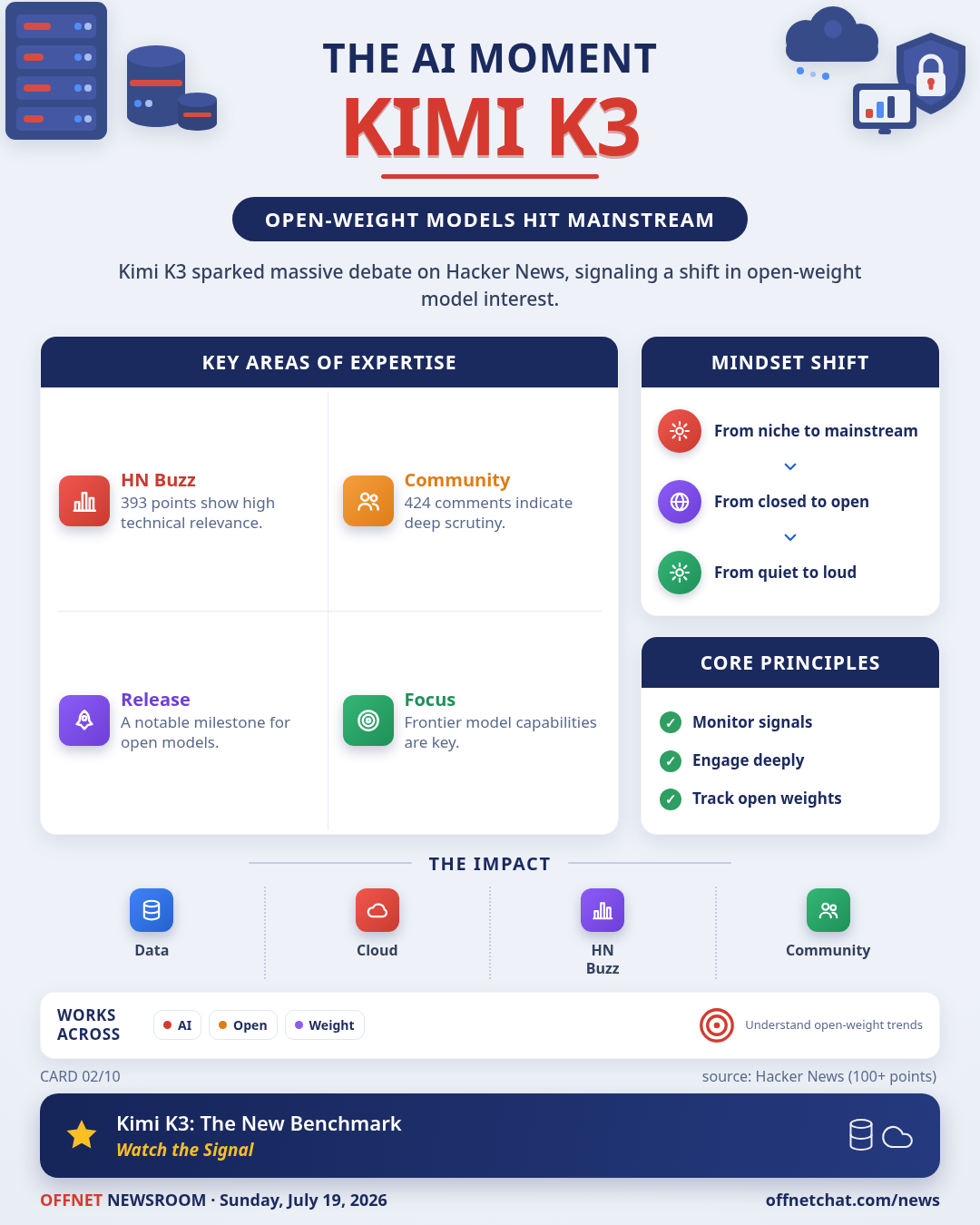
Kimi K3 and the 393-point HN signal for open-weight models

An article titled 'The Kimi K3 Moment' has garnered significant attention on Hacker News, accumulating over 393 points and 424 comments. The discussion centers on the release or performance of the Kimi K3 model, suggesting a notable shift or milestone in the current AI landscape. The high engagement indicates strong community interest in this specific development within the open-weight or frontier model space.

  • Kimi K3 is generating substantial debate and interest on Hacker News.
  • The 393-point score signals high technical relevance to the audience.
  • 424 comments suggest deep community scrutiny of the model's capabilities.
  • No specific database or infrastructure impact details are provided in the source.
Hacker News (100+ points) general

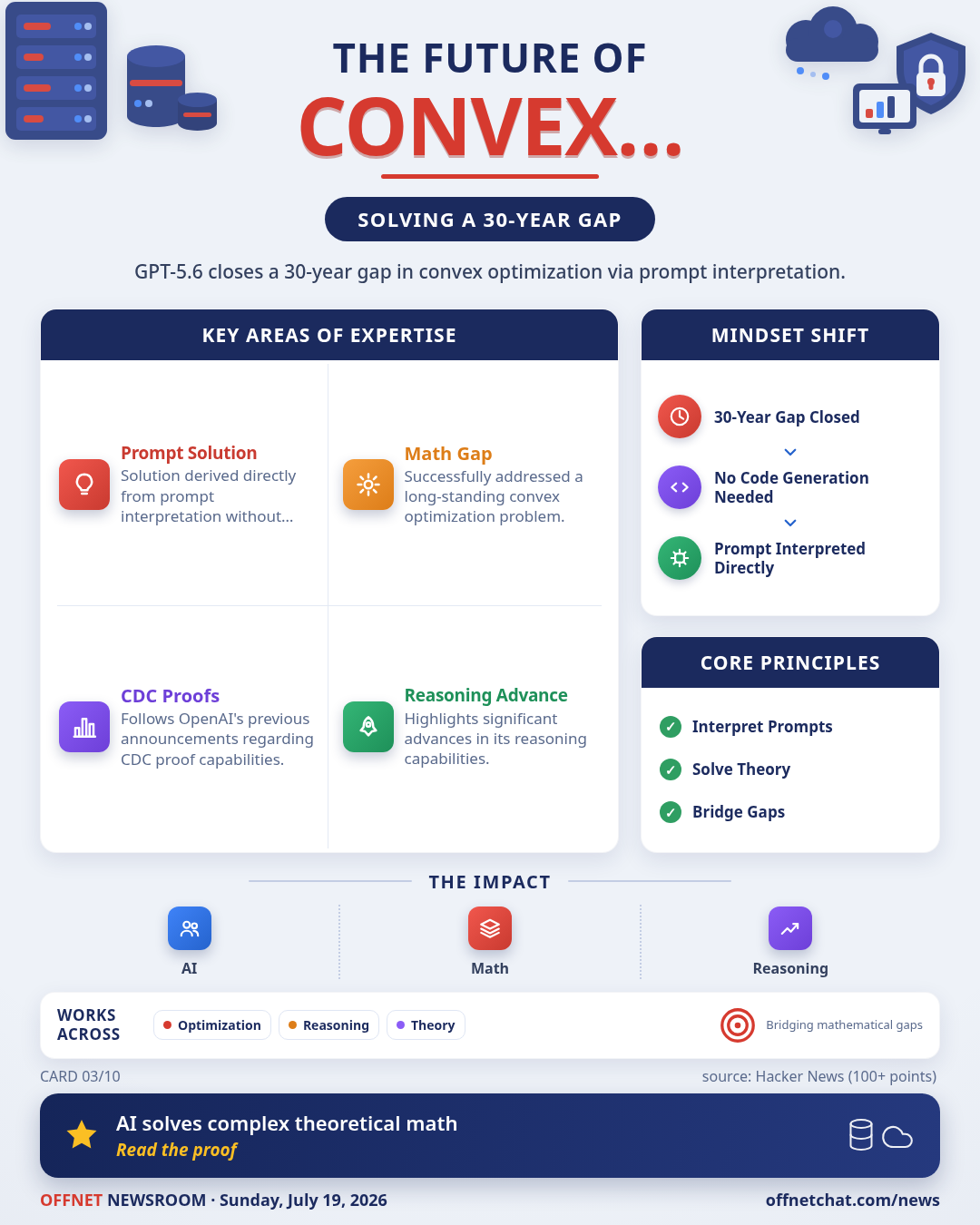
GPT-5.6 closes 30-year gap in convex optimization via prompt

GPT-5.6 has reportedly solved a 30-year-old problem in convex optimization by interpreting a specific prompt. This development follows an earlier announcement from OpenAI regarding CDC proofs. The model's ability to bridge this mathematical gap highlights significant advances in its reasoning capabilities.

  • GPT-5.6 successfully addressed a long-standing convex optimization problem.
  • The solution was derived directly from prompt interpretation without code generation.
  • This follows OpenAI's previous announcements regarding CDC proof capabilities.
  • Demonstrates growing potential for AI to solve complex theoretical math problems.
Hacker News (100+ points) general

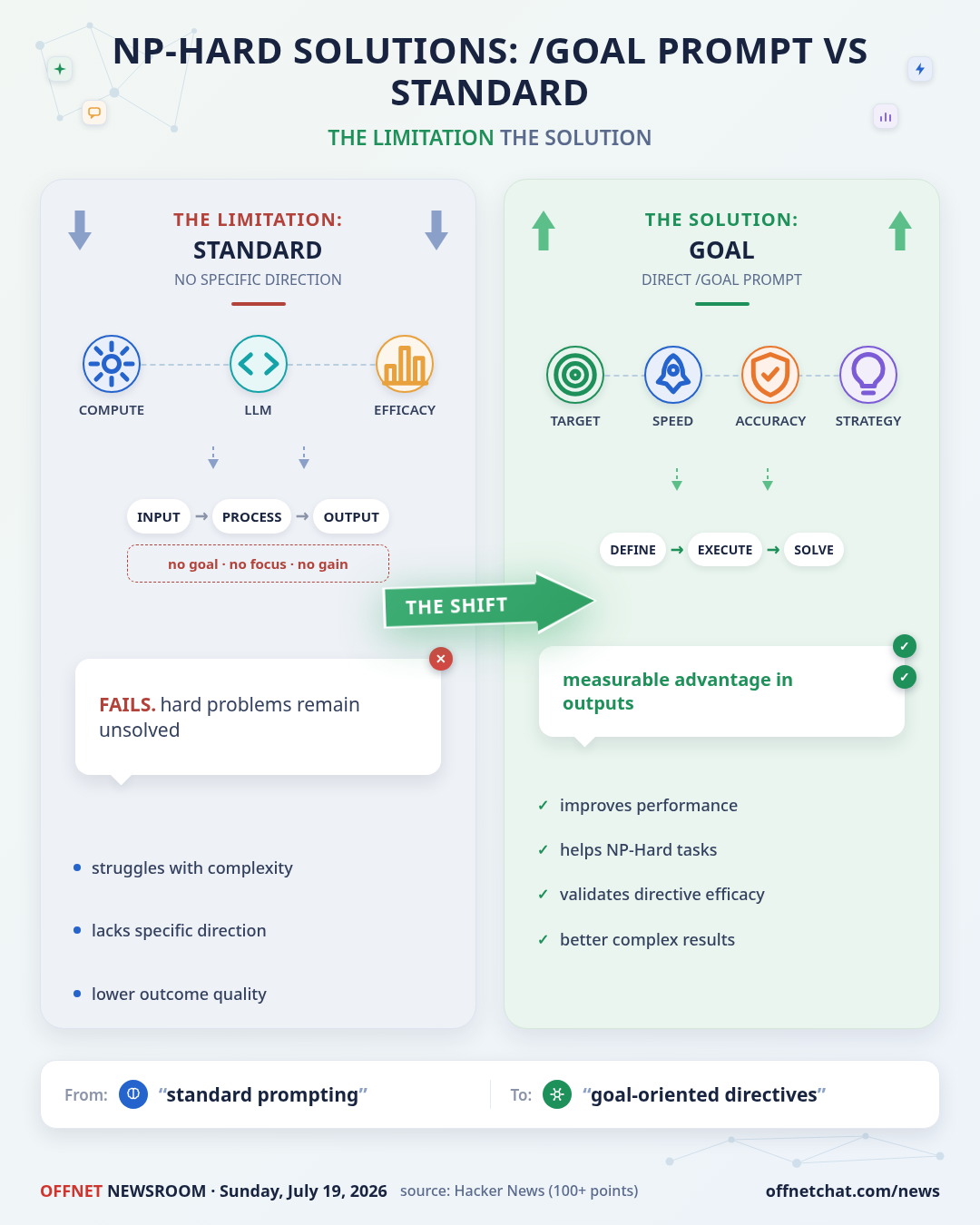
Fable 5 vs GPT-5.6 Sol: Does /goal prompt help with NP-Hard problems?

A comparative analysis evaluates Fable 5 against GPT-5.6 Sol on an NP-Hard problem to determine if the /goal directive improves performance. The study investigates whether this specific prompting mechanism offers a measurable advantage in solving complex computational tasks. Results focus on the efficacy of goal-oriented instructions in large language model outputs.

  • Tests Fable 5 against GPT-5.6 Sol on NP-Hard problems.
  • Evaluates if the /goal prompt directive improves outcomes.
  • Focuses on LLM performance in complex computational tasks.
  • Highlights specific prompting strategies for hard problems.
GitHub Trending (daily) githubrepos ⚠ unverified date/source

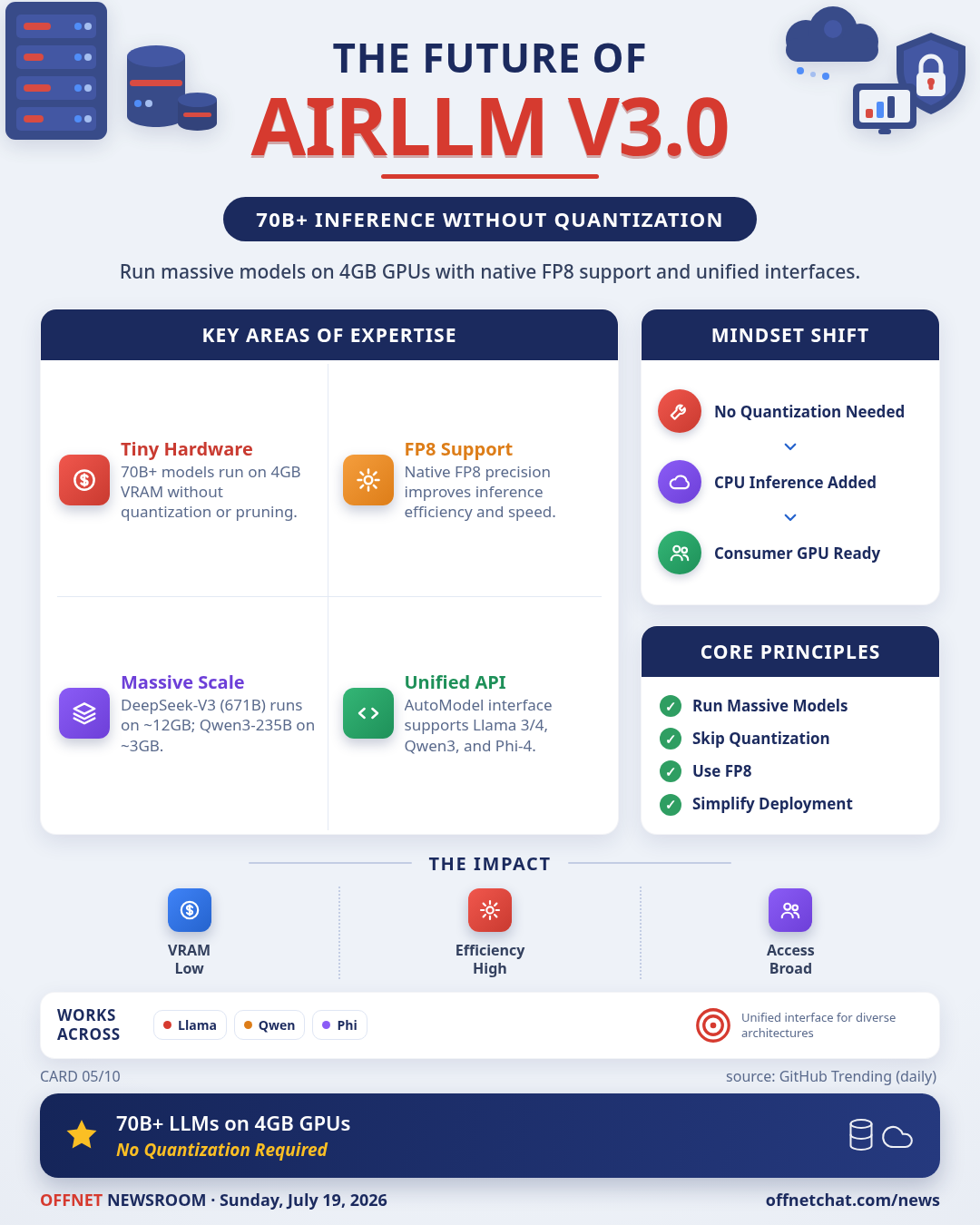
AirLLM v3.0 enables 70B+ LLM inference on 4GB GPUs without quantization

AirLLM v3.0 dramatically reduces inference memory requirements, allowing 70B parameter models to run on a single 4GB GPU without quantization, distillation, or pruning. The update adds FP8 support and enables running massive models like DeepSeek-V3 (671B) on approximately 12GB and Qwen3-235B on roughly 3GB. It provides a unified AutoModel interface supporting recent architectures including Llama 3.x/4, Qwen3, and Phi-4, alongside CPU inference capabilities.

  • AirLLM eliminates the need for quantization to run 70B+ models on consumer-grade 4GB GPUs.
  • Massive models like DeepSeek-V3 (671B) are now viable on ~12GB VRAM hardware.
  • New v3.0 release introduces native FP8 model support for improved efficiency.
  • Unified AutoModel interface simplifies deployment across diverse model families.
  • CPU inference is supported, offering flexibility for systems with limited GPU resources.

OpenAI CFO Sarah Friar has released a practical scorecard designed to quantify the value of AI systems. The framework evaluates performance based on useful work delivered, cost per successful task, system dependability, and the return on compute investment. This tool aims to provide a standardized method for assessing AI efficiency and economic impact.

  • Shift focus from raw model output to useful work delivered by AI systems.
  • Track cost per successful task to optimize operational spending.
  • Measure dependability to ensure reliability in production environments.
  • Evaluate return on compute to justify infrastructure investments.
Hacker News (100+ points) general

Transcribe.cpp brings standalone C++ speech recognition to the edge

Transcribe.cpp is a new project that enables speech transcription using pure C++, eliminating the need for Python dependencies or heavy frameworks. The tool is designed for environments where minimal footprint and direct system integration are critical. It leverages modern C++ features to provide efficient audio processing capabilities directly within applications.

  • Pure C++ implementation removes Python runtime dependencies for easier deployment
  • Low memory footprint makes it suitable for edge devices and constrained systems
  • Direct integration simplifies building custom voice interfaces without external services
TRADE-OFFTranscribe.cpp vs Standard STTStandard STTRequires Python runtimeHeavy framework dependenciesHigh memory footprintTranscribe.cppPure C++ implementationMinimal system footprintDirect edge integrationvs
Hacker News (100+ points) general

Codex Resets: New approach to LLM context management gains traction

A new tool or methodology called Codex Resets is appearing on Hacker News with significant community engagement, suggesting a shift in how developers handle large context windows or state in AI coding assistants. The high point count and comment volume indicate strong interest in solving context drift or performance degradation issues common in prolonged coding sessions. This likely addresses the practical need for cleaner state management when interacting with large language models over extended periods.

  • Context management is becoming a critical pain point for AI-assisted coding workflows.
  • Community interest in 'reset' mechanisms suggests current context windows are insufficient.
  • New tools emerging to manage state may improve coding assistant reliability.
  • Monitor this trend as it could influence how IDEs integrate with LLMs.

South Korea is pivoting an existing large language model project to prioritize national security and data sovereignty. The initiative aims to eventually match the capabilities of the Mythos platform by focusing on localized, secure AI infrastructure.

  • Local LLMs are being repurposed for security and sovereignty needs
  • Goal is to achieve parity with the Mythos platform eventually
  • Reflects growing trend of national AI infrastructure control
  • No immediate technical benchmarks provided in current report
  • Focus remains on adapting existing models rather than greenfield builds

AI / ML 7

roundup ↗
Hacker News (100+ points) general

Moonshine Micro: Speech Recognition and TTS under 500KB

The Moonshine AI project introduces a micro variant capable of performing both speech recognition and text-to-synthesis within a footprint smaller than 500KB. This lightweight model enables on-device audio processing without relying on heavy cloud dependencies or large local installations. The approach targets edge scenarios where memory and compute resources are strictly constrained.

  • Enables full audio pipeline (STT/TTS) on resource-constrained edge devices
  • Model size under 500KB eliminates need for large local inference servers
  • Suitable for offline-first applications with strict memory budgets
  • Reduces latency by removing network round-trips to cloud APIs
AWS What's New awsdatabase ↺ since 07-15

GuardDuty AI Protection detects threats in Bedrock and SageMaker

Amazon GuardDuty now includes AI Protection to monitor AWS AI services like Bedrock and SageMaker. It analyzes CloudTrail events to identify AI-specific risks such as prompt injections and anomalous model usage. This feature helps security teams detect cost harvesting attacks without requiring custom tooling or manual configuration.

  • Monitors Amazon Bedrock and SageMaker for AI-specific threats automatically.
  • Detects prompt injection attempts and unusual model invocation patterns.
  • Identifies cost harvesting attacks that force excessive GPU time and token usage.
  • Leverages CloudTrail management and data events for continuous visibility.
  • Reduces need for custom security tooling to secure AI workloads.
TRADE-OFFGuardDuty vs Traditional AI SecurityTraditional ApproachRequires custom security toolingNeeds manual configurationLacks AI-specific threat detectionGuardDuty AI ProtectionAutomated monitoring of Bedrock…Detects prompt injections and…Leverages existing CloudTrail eventsvs
AWS What's New awsdatabase ↺ since 07-15

AWS Security Hub adds AI inventory for org-wide asset visibility

AWS Security Hub now includes an AI inventory feature to give security teams a centralized, continuously updated view of AI assets across the organization. This addresses the visibility gap caused by rapid deployment of AI agents, models, and pipelines. The feature automatically discovers and catalogs AI workloads using three discovery methods, starting with managed services like Amazon Bedrock and SageMaker.

  • Centralized visibility is now available for AI agents, models, and pipelines across the organization.
  • Security teams can connect AI assets to active threats and misconfigurations in one place.
  • Managed services like Bedrock and SageMaker are inventoried automatically via AWS Config.
  • No additional configuration is required to start discovering workloads in supported services.
HOW IT WORKSAI Asset Discovery Pipeline1Scan managed services2Catalog AI workloads3Detect threats4Update inventory
Hugging Face Blog llmaiml ↺ since 07-17

IBM Research: Model Routing Complexity in Production

IBM Research highlights that while model routing appears straightforward, real-world deployment introduces significant complexity. The analysis suggests that simple strategies often fail under dynamic workloads, requiring more robust architectural approaches. This insight warns practitioners against underestimating the operational overhead of dynamic model selection.

  • Simple routing logic often fails in production environments
  • Dynamic workloads introduce hidden complexity to model selection
  • Robust routing requires advanced strategies beyond basic heuristics
  • Operational overhead of dynamic selection is frequently underestimated
TRADE-OFFRouting Reality CheckSimple LogicFails under dynamic loadsIgnores operational overheadAssumes static behaviorRobust ArchitectureHandles complex workloadsManages hidden costsUses advanced strategiesvs
The Register general ↺ since 07-17

Researcher poisons open-weight AI model for under $100

A new study demonstrates that open-weight AI models can be compromised through data poisoning attacks costing less than $100. The research highlights the inherent lack of verification mechanisms in these models, which demand trust from users without providing cryptographic proof of integrity. This low barrier to attack suggests that current open-weight distributions may be more vulnerable to manipulation than previously assumed.

  • Open-weight models lack built-in verification, making them vulnerable to silent manipulation.
  • Poisoning attacks can now be executed for under $100, lowering the threat actor's cost.
  • Practitioners must assume model integrity is not guaranteed by default distribution.
  • Trust in open-weight models requires external validation and auditing processes.
AWS What's New awsdatabase ↺ since 07-18

SageMaker HyperPod adds partition-level topology for Slurm clusters

Amazon SageMaker HyperPod now allows network topology configuration at the partition level for Slurm-orchestrated clusters. Users can mix tree and block topologies within a single cluster, assigning the optimal setting based on the instance types in each partition. This alignment reduces GPU-to-GPU latency and improves NCNC collective operation efficiency, boosting distributed training throughput.

  • Split clusters into partitions with distinct topologies (tree vs block) based on hardware.
  • Optimize NCCL performance by matching topology to instance interconnect capabilities.
  • HyperPod auto-selects topology per partition using compute instance group specs.
  • Block topology suits high-bandwidth instances like ml.p6e-gb200.36xlarge.
  • Tree topology remains viable for hierarchical interconnect instance types.
TRADE-OFFTopology Choices by InstanceBlock TopologySuits high-bandwidth instancesml.p6e-gb200.36xlargeOptimizes NCCL efficiencyTree TopologyHierarchical interconnect typesFlexible partition setupReduces GPU latencyvs

Hugging Face and NVIDIA have integrated NeMo Automodel with the Diffusers library to streamline the fine-tuning of large-scale video and image generation models. This collaboration aims to simplify the infrastructure complexity typically associated with training multimodal foundation models at scale. The release provides a unified workflow for engineers looking to adapt these models for specific use cases without managing disparate toolchains.

  • Integrates NVIDIA NeMo Automodel directly with Hugging Face Diffusers for easier model adaptation.
  • Targets scalable fine-tuning workflows for both video and image generation models.
  • Reduces infrastructure overhead by unifying model management and training pipelines.
  • Enables practitioners to leverage NVIDIA's scaling capabilities within the HF ecosystem.

Agentic AI 8

roundup ↗

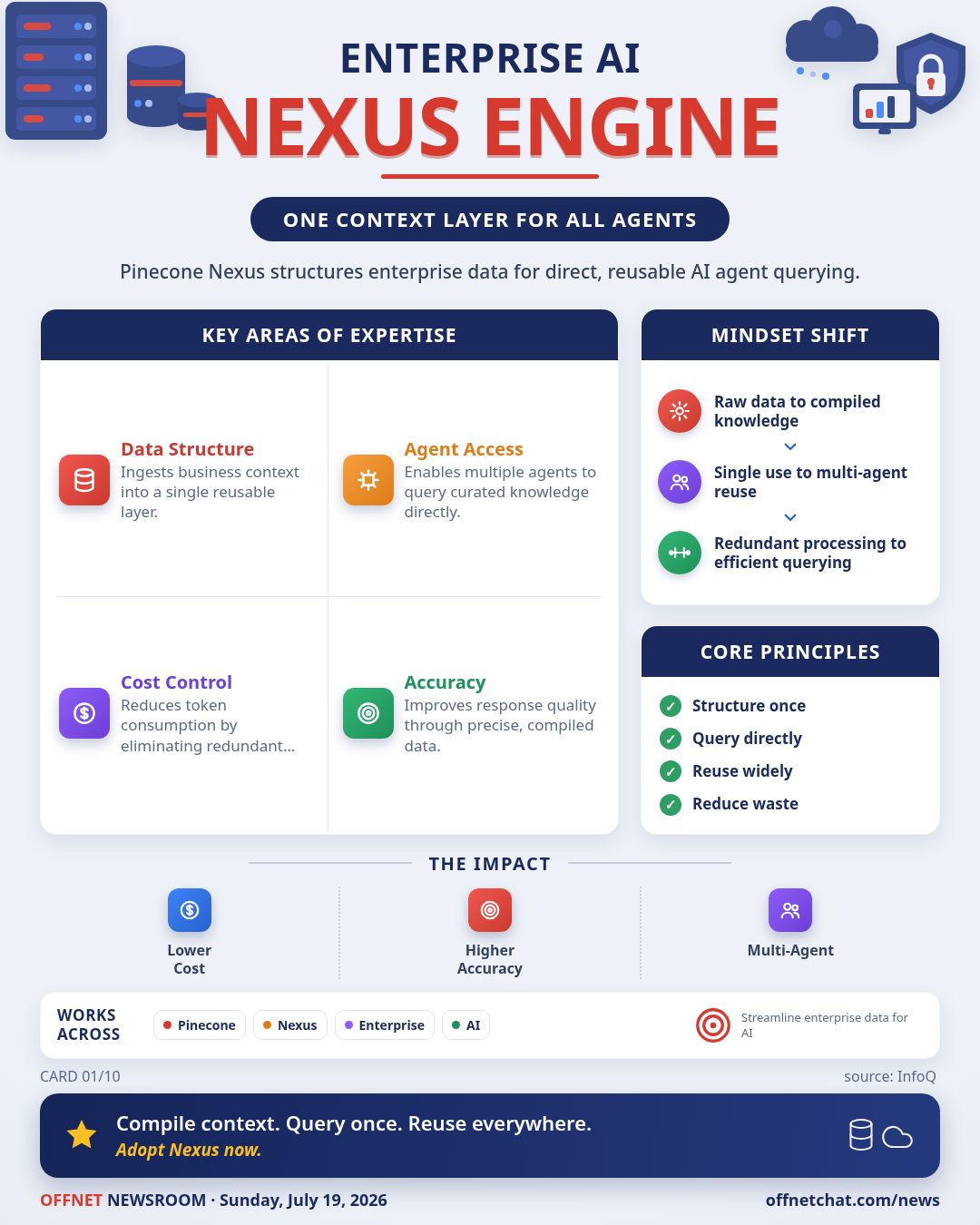
Pinecone has generally released Nexus, a knowledge engine designed to structure enterprise data for direct querying by AI agents. The system allows teams to ingest and curate business context once, creating a reusable layer that serves multiple agents. This approach aims to reduce token consumption and improve response accuracy by eliminating redundant data processing.

  • Nexus structures enterprise data into a reusable layer for AI agent queries.
  • Ingesting context once reduces token costs and improves accuracy.
  • Enables multi-agent reuse of curated business context.
  • Shifts focus from raw data to compiled, queryable knowledge.
GitHub Trending (daily) githubrepos ⚠ unverified date/source

Npx ui-skills routes AI agents through specific UI design capabilities

The open-source ui-skills package provides a CLI tool to guide AI agents toward the appropriate design engineering skill set for a given task. It allows developers to categorize and retrieve specific UI competencies, such as motion design or baseline UI patterns, directly from the command line. This approach aims to standardize how AI assistants handle frontend implementation details by selecting the right pre-defined skill context.

  • Use npx ui-skills start to dynamically route AI agents to relevant UI design tasks.
  • Categorize skills like motion or layout to ensure agents apply correct design patterns.
  • Retrieves baseline UI standards programmatically for consistent frontend generation.
  • MIT licensed tool designed to enhance design engineering workflows with AI.
HOW IT WORKSRouting AI UI Skills1Run npx ui-skills start2Identify specific UI task3Select relevant design skill4Apply correct pattern context
GitHub Trending (daily) githubrepos ⚠ unverified date/source

Wigolo: Local-first MCP web intelligence for AI agents

Wigolo is a local-first web intelligence tool designed for AI coding agents, offering search, fetch, crawl, and research capabilities via MCP. It operates without API keys or cloud dependencies, ensuring zero query costs and data privacy. The tool integrates with major IDEs and frameworks like LangChain, Cursor, and Claude Code as a local server.

  • Runs locally as an MCP server, eliminating cloud dependencies and API key requirements.
  • Provides search, crawl, and extract tools for AI agents at zero monetary cost.
  • Integrates with popular coding assistants like Cursor, Claude Code, and VS Code.
  • Supports standard frameworks including LangChain, CrewAI, and Vercel AI SDK.
AWS What's New awsdatabase ↺ since 07-16

OpenSearch Service integrates with AWS Agent Toolkit via MCP

Amazon OpenSearch Service now supports the Agent Toolkit for AWS, allowing AI coding agents like Cursor and Claude Code to manage domains and collections directly. This integration leverages the AWS Model Context Protocol (MCP) server to translate natural-language requests into specific API calls. A curated skill handles routing for key tasks including migration, operations, and search execution.

  • AI agents can now provision and manage OpenSearch domains using natural language.
  • Integration uses AWS MCP server to execute API calls on behalf of coding tools.
  • Curated skill routes requests for migration, operations, and semantic search.
  • Supports major AI coding agents like Cursor, Claude Code, and Kiro.
HOW IT WORKSAI Agent Domain Management Flow1User issues natural language request2AWS MCP server translates request3Curated skill routes to task4API call executes on OpenSearch
InfoQ generaldevops ↺ since 07-17

AI Agent Spend Outpaces Cloud Billing Guardrails

Recent incidents show attackers and autonomous agents burning through cloud credits in hours, far exceeding traditional daily billing cycles. A three-person agency faced a $14,000 AWS bill after static keys were stolen and used for rapid Claude invocations on Bedrock. Similarly, an earlier incident saw an agent provision $6,531 of oversized infrastructure in just 24 hours, highlighting a critical lag in financial detection.

  • Static access keys remain a primary vector for rapid credential theft and abuse.
  • Cloud billing alerts typically lag by a day, missing agent-speed spending spikes.
  • Autonomous agents can provision expensive infrastructure before human review occurs.
  • Organizations need real-time financial guardrails to match agent execution speed.
AWS What's New awsdatabase ↺ since 07-15

AWS Lambda Console Adds One-Click Setup for Coding Agents

The AWS Lambda console now features a one-click setup prompt for coding agents, automating the configuration of AWS Serverless skills and the Serverless Model Context Protocol (MCP) server. This integration embeds serverless best practices directly into the agent's workflow, removing the previous need to manually navigate multiple documentation pages for setup. Developers can now initiate this streamlined configuration immediately upon starting their Lambda journey.

  • Eliminates manual config friction by bundling AWS Serverless skills and MCP server setup into a single prompt.
  • Embeds serverless best practices natively into coding agents from the first interaction.
  • Available across the entire Lambda developer journey, from initial exploration to first function creation.
  • Streamlines agent usage for building, testing, and deploying Lambda functions without external documentation lookups.
HOW IT WORKSLambda Agent Setup Flow1Start Lambda journey2Trigger one-click prompt3Auto-configure Serverless skills4Activate MCP server5Build functions instantly

Cars24 has integrated OpenAI-powered voice and chat agents to manage over one million monthly conversation minutes. The implementation successfully recovers 12% of previously lost leads by engaging potential customers through automated interactions. Additionally, the company is extending these agentic workflows to support various internal teams, streamlining operations across the organization.

  • Voice and chat agents can handle massive volume, scaling to 1M+ monthly minutes effectively.
  • Automated lead recovery mechanisms can recoup approximately 12% of lost sales opportunities.
  • Agentic workflows are expanding beyond customer support to improve internal team efficiency.
  • OpenAI integration serves as a core infrastructure component for Cars24's communication strategy.

A new CNCF technical analysis argues that agentic AI will rely on the existing cloud-native ecosystem rather than requiring entirely new infrastructure. This position highlights how mature distributed application patterns can support the complex needs of autonomous AI agents. The report suggests leveraging established cloud-native principles to ensure these systems remain trustworthy and operational.

  • Agentic AI does not need a new infrastructure stack; reuse existing cloud-native foundations.
  • Trustworthiness in agents is achieved by applying proven distributed system patterns.
  • CNCF analysis bridges the gap between mature infrastructure and emerging AI workloads.
  • Operators should focus on integrating agents into current cloud-native pipelines.

Automation / DevOps / IaC 7

roundup ↗
Hacker News (100+ points) general

Step-by-step guide to controlling a spare Mac with Claude Code

A new article details the process of configuring a spare Mac to be remotely controlled by Claude Code. The guide provides specific instructions for setting up the environment, likely involving SSH access and command-line interfaces to enable automated agent operations. This approach allows developers to leverage idle hardware for AI-driven tasks or development workflows.

  • Remote control of macOS via CLI enables automated agent workflows
  • Use spare hardware to offload AI-driven development tasks
  • Step-by-step setup reduces friction for agent-based operations
  • SSH configuration is key for secure remote access
HOW IT WORKSSetup Remote Mac For Claude1Configure SSH access securely2Install necessary CLI tools3Set up environment variables4Launch Claude Code agent5Monitor remote operations

Ruth Linehan details a migration from Kotlin to Rust for high-performance caching services, challenging assumptions about delivery speed and engineering overhead. The talk highlights how Rust's borrow checker and compile-time safety reduce the developer feedback loop. Additionally, the presentation profiles optimization techniques using Criterion and flamegraphs to enhance concurrent code paths.

  • Rust can outperform Kotlin in delivery velocity for high-throughput caching workloads.
  • Compile-time safety via the borrow checker significantly shortens the developer feedback loop.
  • Engineering overhead decreases despite Rust's steep initial learning curve.
  • Criterion and flamegraphs are essential for profiling and optimizing Rust concurrency.
GitHub Trending (daily) githubrepos ↺ since 07-18 ⚠ unverified date/source

code-review-graph: Local-first graph for precise AI code context

This tool builds a persistent structural map of your codebase using Tree-sitter to optimize AI coding assistants. By tracking changes incrementally and exposing precise context via MCP, it ensures AI tools read only relevant code during reviews. The project highlights benchmarked reductions in token usage for large repository workflows.

  • Uses Tree-sitter to create a persistent, local graph of codebase structure.
  • Integrates with AI tools via MCP to deliver precise, minimal context.
  • Reduces token consumption by preventing AI from re-reading irrelevant code.
  • Tracks changes incrementally to maintain accuracy in large repos.
  • Available as a pip package with documentation for CLI and GitHub Actions.
GitHub Trending (daily) githubrepos ↺ since 07-17 ⚠ unverified date/source

PostHog trending as open-source AI observability and product analytics platform

PostHog is gaining traction on GitHub as a comprehensive, open-source solution for building autonomous software products. The platform aggregates telemetry including analytics, session replay, feature flags, and error tracking to provide full context for AI agents. This data enables automated diagnosis of issues and generation of pull requests to fix problems proactively.

  • Unifies analytics, session replay, and error tracking into a single open-source stack.
  • Enables AI agents to diagnose issues and generate pull requests autonomously.
  • Supports self-driving product modes by turning user signals into actionable reports.
  • Accessible via web, desktop, Slack, and Model Context Protocol (MCP).
AWS What's New awsdatabase ↺ since 07-17

AWS AFT auto-reapplies customizations when accounts move OUs

AWS Control Tower's Account Factory for Terraform now supports automatic re-application of account customizations upon Organizational Unit changes. Previously, moving accounts required manual intervention to prevent configuration drift, introducing operational overhead. The new feature allows opt-in automation via a specific configuration flag, skipping bootstrap phases for faster execution of global and account-level customizations.

  • Set aft_customization_triggers = ["account_move"] to enable automatic re-application.
  • Eliminates manual steps and reduces configuration drift risks during OU moves.
  • Workflow skips bootstrap and provisioning, running only global and account-level customizations.
  • Ensures accounts stay consistent with OU-specific configurations immediately after movement.
CHECKLISTEnable AFT Auto-ReapplySet aft_customization_triggers to account_moveEliminate manual steps and drift risksSkip bootstrap for faster executionEnsure immediate OU consistency
AWS What's New awsdatabase ↺ since 07-15

AWS Flink adds AI Agent Skills for guided app development and ops

Amazon Managed Service for Apache Flink now supports AI Agent Skills that provide coding assistants with specialized guidance for building and managing streaming applications. These skills cover key operational tasks including troubleshooting, scaling, monitoring, and cost optimization, while also facilitating upgrades to newer Flink versions like 2.2. This integration allows developers to leverage existing AI tools, such as Kiro, to handle complex Flink configurations without requiring deep domain expertise.

  • AI coding assistants get expert Flink guidance for common dev and ops tasks.
  • Simplifies troubleshooting, scaling, monitoring, and cost optimization workflows.
  • Accelerates development and streamlines upgrades to latest Flink versions.
  • Integrates with existing agents like Kiro to reduce specialized knowledge barriers.
WORTH QUOTINGThe gistAmazon Managed Service for Apache Flink now supports AIAgent Skills that provide coding assistants with specializedguidanc…— AWS What's New
InfoQ generaldevops ↺ since 07-17

AWS Continuum launches agentic code security for vulnerability lifecycle

AWS has released Continuum, a new integrated platform designed to automate the discovery, enforcement, and remediation of security issues across codebases and dependencies. The initial release features four agentic capabilities targeting the entire vulnerability lifecycle: penetration testing, code review, threat modeling, and code vulnerability management. This tool aims to provide enterprises with a centralized approach to securing applications from development through deployment.

  • AWS Continuum automates security workflows across codebases and dependencies.
  • Four agentic modes cover pen testing, code review, threat modeling, and vuln remediation.
  • Platform focuses on the full vulnerability lifecycle for enterprise applications.
  • Initial launch targets integration of security directly into the development pipeline.
  • Designed to reduce manual effort in discovering and enforcing security policies.

AWS 8

roundup ↗

AWS has launched CloudFormation Express Mode, an option that marks stack operations as complete immediately after resource configuration is applied. This approach eliminates the need to wait for full resource stabilization before reporting success. The change is designed to significantly reduce overall infrastructure deployment times for users adopting this mode.

  • Marks stack operations complete upon configuration apply, not resource stabilization.
  • Significantly reduces infrastructure deployment times compared to standard mode.
  • New deployment option available in AWS CloudFormation for faster CI/CD pipelines.
  • Shifts failure detection from deployment time to post-deployment resource health checks.

Amazon S3 Event Notifications now include system-generated tags in payloads sent to EventBridge, SQS, SNS, and Lambda. These tags allow you to filter events from thousands of buckets using a single EventBridge rule instead of listing individual bucket names. AWS automatically includes tags applied by services like CloudFormation in these new notifications at no extra cost.

  • Filter S3 events across thousands of buckets with one EventBridge rule using system tags
  • No additional cost for system-generated tags in S3 Event Notifications
  • Tags from AWS CloudFormation are automatically included in new event payloads
  • Available in all AWS Regions for general purpose buckets
HOW IT WORKSS3 Event Filtering Flow1CloudFormation applies tags to S3 buckets2S3 generates event notifications with tags3EventBridge receives tagged event payloads4Single rule filters thousands of buckets

Forrester reports that despite billions in European semiconductor manufacturing investments, true tech sovereignty remains out of reach. The analysis indicates that hardware production alone cannot sever dependence on American and Chinese cloud infrastructure and software ecosystems. Consequently, European efforts to decouple from US tech giants will likely fail without addressing the underlying software and services layer.

  • Manufacturing fabs alone do not equal tech sovereignty
  • US cloud and software dominance remains unbroken
  • Chinese hardware influence persists alongside US software
  • EU strategy misses the critical software dependency layer
AWS What's New awsdatabase ↺ since 07-16

AWS expands R8gd and M8gd instances for RDS and Aurora in new regions

Amazon RDS and Aurora have extended support for R8gd and M8gd instance families to 12 and 6 additional regions respectively. These instances leverage Optimized Reads with local NVMe storage for ephemeral data, significantly reducing network access latency. This architecture delivers up to 165% better throughput and 120% improved price-performance compared to R6g instances for Aurora PostgreSQL.

  • R8gd and M8gd instances are now available in 12 and 6 new regions for RDS and Aurora.
  • Local NVMe storage for temp tables reduces network I/O, boosting query performance.
  • Aurora PostgreSQL sees up to 165% throughput gain and 120% better price-performance over R6g.
  • Complex queries and index rebuilds benefit from reduced storage access latency.
  • I/O-Optimized configurations extend local storage usage for additional efficiency gains.
COMPARISONPerformance Gains Over R6gThroughput165%Price-Performance120%

A defect in Amazon's billing software has generated erroneous cost projections that exceed one billion dollars for some AWS customers. The company is currently working to resolve the underlying issue and has advised users not to panic while the fix is implemented. This incident highlights the fragility of automated financial forecasting tools within large-scale cloud infrastructure.

  • Verify actual usage data immediately rather than relying on inflated system estimates.
  • Monitor AWS status pages for updates on the billing fix resolution timeline.
  • Review budget alerts to ensure they were not triggered by erroneous historical data.
  • Document any discrepancies between estimated and actual invoices for future audits.
AWS What's New awsdatabase ↺ since 07-16

AWS expands Graviton4 R8g and M8g support to 20+ new regions

AWS has extended general availability of Graviton4-based R8g and M8g database instances to additional regions across Asia Pacific, Europe, Americas, and GovCloud. R8g instances are now supported for Aurora MySQL/PostgreSQL and RDS PostgreSQL/MySQL/MariaDB in these new areas. M8g instances are available for RDS PostgreSQL, MySQL, and MariaDB in the expanded footprint. These instances deliver up to 40% performance gains and 29% better price-performance compared to Graviton3.

  • R8g (Graviton4) now available for Aurora and RDS in 13 new regions including London, Paris, and Hyderabad.
  • M8g (Graviton4) expanded to RDS PostgreSQL/MySQL/MariaDB in 12 new regions like Cape Town and Calgary.
  • Expect up to 40% performance improvement over Graviton3 for compatible database workloads.
  • On-demand pricing offers up to 29% better price-performance compared to previous generation instances.
  • Check regional availability before planning migrations to leverage new instance types.
COMPARISONGraviton4 Performance Gains40% Perf Gain40%29% Price Perf29%
InfoQ generaldevops ↺ since 07-16

AWS Launches Self-Hosted Claude Apps Gateway for Centralized Control

AWS and Anthropic have released the Claude apps gateway as a self-hosted control plane designed to manage Claude Code and Claude Desktop usage. This single stateless container consolidates identity, policy enforcement, telemetry, routing, and spending limits. It directs inference requests to either Amazon Bedrock or the Claude Platform on AWS.

  • Centralizes identity and policy management for Claude Code and Desktop in one place.
  • Runs as a stateless container, simplifying deployment and scaling.
  • Enforces spend caps and telemetry tracking at the gateway level.
  • Routes inference traffic to Amazon Bedrock or Claude Platform on AWS.
AWS What's New awsdatabase ↺ since 07-18

AWS expands U7in-24TB high-memory instances to Europe (Paris)

AWS has launched u7in-24tb.224xlarge instances in the Europe (Paris) region, extending the availability of its seventh-generation high-memory compute. These instances utilize custom fourth-generation Intel Xeon Scalable processors and provide 24 TiB of DDR5 memory per node. They deliver up to 200 Gbps of network bandwidth and 100 Gbps of EBS bandwidth, positioning them for large-scale in-memory workloads.

  • U7in-24TB instances now available in AWS Europe (Paris) region
  • Features 24 TiB DDR5 memory with 896 vCPUs per node
  • Powered by custom fourth-gen Intel Xeon Scalable (Sapphire Rapids)
  • Offers up to 45% better price performance than U-1 instances
  • Supports 200 Gbps network bandwidth and ENA Express connectivity
BY THE NUMBERSMassive Memory Capacity24TiBDDR5 memory per nodeHigh-memory instances in Europe Paris

Trending on GitHub 3

roundup ↗
GitHub Trending (daily) githubrepos ⚠ unverified date/source

Moonshot AI winds down Kimi CLI in favor of Kimi Code CLI

Moonshot AI is transitioning its terminal AI agent from Kimi CLI to Kimi Code CLI, a next-generation tool with automatic configuration migration. The original project is being gradually deprecated, though existing docs and installations remain accessible. Kimi Code CLI functions as both a coding agent and a shell, capable of reading, editing code, executing commands, and web fetching autonomously.

  • Kimi CLI is being phased out; users should migrate to Kimi Code CLI for continued support.
  • Configuration and session data migrate automatically during the transition to the new CLI.
  • The new agent operates as a full shell environment with autonomous planning and execution.
  • Existing documentation and installations remain available during the wind-down period.
  • Capabilities include code editing, shell command execution, and web search integration.
InfoQ generaldevops ↺ since 07-18

Dolt 2.0 Adds Automatic Storage Cleanup, Compression, and Vector Support

DoltHub has released version 2.0 of its open-source version-controlled SQL database, introducing automatic garbage collection and compression to optimize storage usage. This update also enhances compatibility with large data types and adds support for vector data, broadening its utility for AI and high-volume workloads. The release aims to reduce operational overhead by automating storage maintenance tasks previously handled manually.

  • Automatic garbage collection and compression reduce manual storage maintenance overhead.
  • New vector data type support enables integration with AI and embedding workflows.
  • Improved large data type handling supports higher volume and complex schemas.
  • Version control features remain core, allowing branch-based SQL development.
CHECKLISTDolt 2.0 Key UpgradesAutomatic garbage collection reduces manual maintenanceCompression optimizes storage usage efficiencyVector support enables AI integrationEnhanced large data type handling
GitHub Trending (daily) githubrepos ↺ since 07-17 ⚠ unverified date/source

Apache Ossie aims to standardize semantic metadata across AI, BI, and analytics tools

Apache Ossie is an incubating open-source project establishing a vendor-neutral specification for exchanging semantic models. It targets the fragmentation in data analytics, AI, and BI ecosystems by creating a single source of truth for data definitions. The initiative seeks to ensure consistent metadata interpretation and interoperability across diverse platforms.

  • Targets semantic layer fragmentation in modern data stacks
  • Promotes vendor-agnostic model exchange and interoperability
  • Incubating status means the spec is still evolving
  • Critical for maintaining consistent data definitions in AI/BI workflows
TRADE-OFFOssie vs Fragmented EcosystemsCurrent StateFragmented semantic layersVendor lock-in risksInconsistent data definitionsOssie VisionSingle source of truthVendor-neutral specificationCross-platform interoperabilityvs

Mobile friendly 6

all cards ↗

Today's top database + AI stories as save-and-share cards — built for your phone and your LinkedIn feed.