OffNet Newsroom

Archive snapshot

Friday, July 17, 2026

Daily signal on databases, AI, and the tech that matters.

41 new today 49 stories 8 sections 14 for the DBA desk

Database Technology 7

roundup ↗

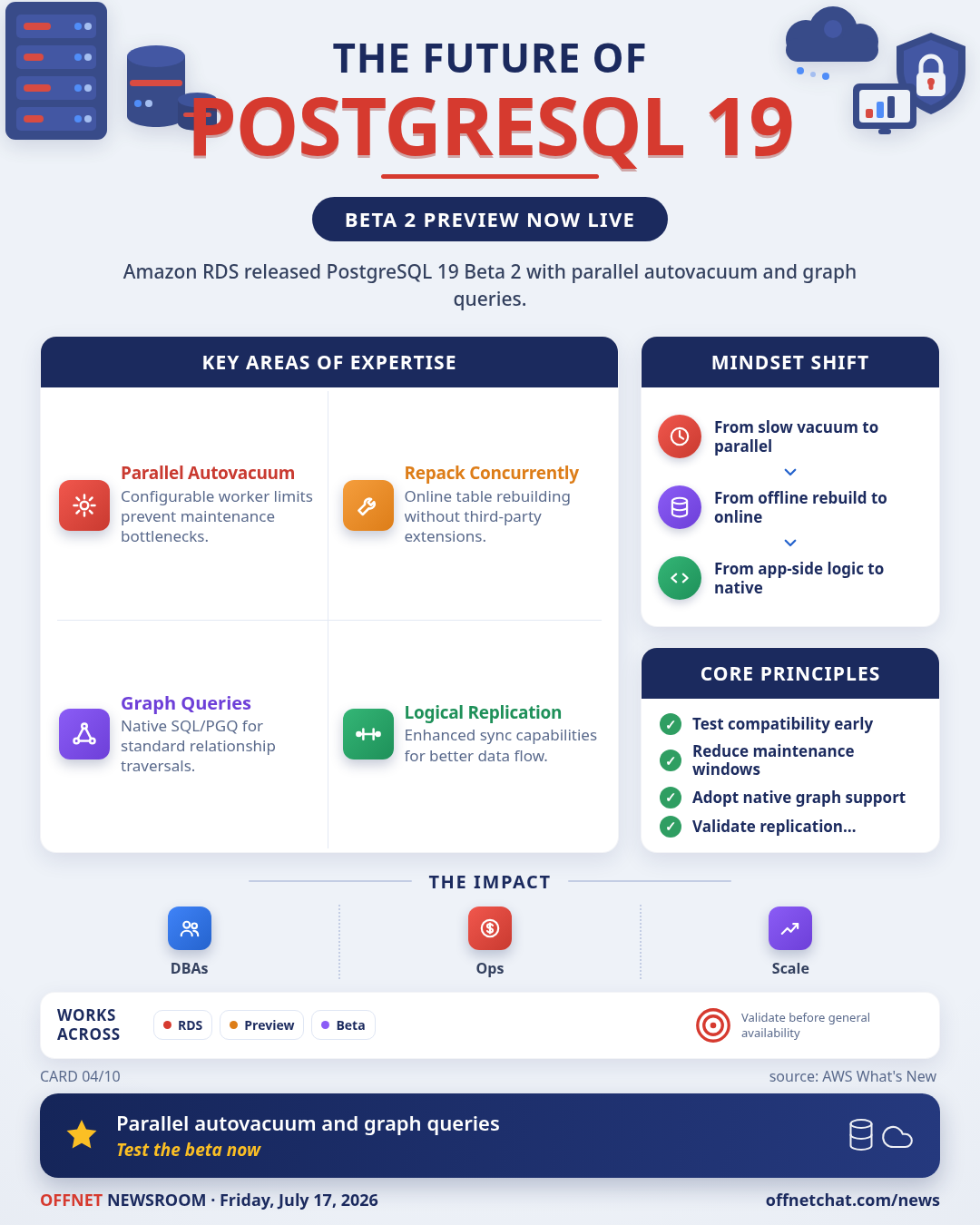
Amazon RDS has released PostgreSQL 19 Beta 2 in its Database Preview Environment, enabling early evaluation of the major release on a fully managed platform. Key updates include parallel autovacuum with configurable worker limits to prevent maintenance bottlenecks and a new REPACK CONCURRENTLY command for online table rebuilding. The release also introduces native SQL Property Graph Queries (SQL/PGQ) for standard relationship traversals and enhancements to logical replication.

  • Test PostgreSQL 19 Beta 2 in RDS Preview to assess compatibility before general availability.
  • Leverage parallel autovacuum with worker limits to reduce maintenance windows on large datasets.
  • Use REPACK CONCURRENTLY for online storage reclamation without requiring third-party extensions.
  • Adopt native SQL/PGQ for graph traversals, removing the need for separate application-side logic.
  • Evaluate logical replication improvements for improved sync capabilities in this beta.

Fleet impact: For DBAs managing PostgreSQL workloads, this beta allows validation of parallel autovacuum and REPACK CONCURRENTLY to mitigate future maintenance bottlenecks. Test SQL/PGQ support if your applications rely on graph data patterns to determine migration paths away from external graph libraries.

CHECKLISTPostgreSQL 19 Beta 2 PreviewTest compatibility in RDS Preview environmentLimit parallel autovacuum workers to prevent bottlenecksUse REPACK CONCURRENTLY for online table rebuildingAdopt native SQL/PGQ for graph traversalsEvaluate logical replication sync improvements

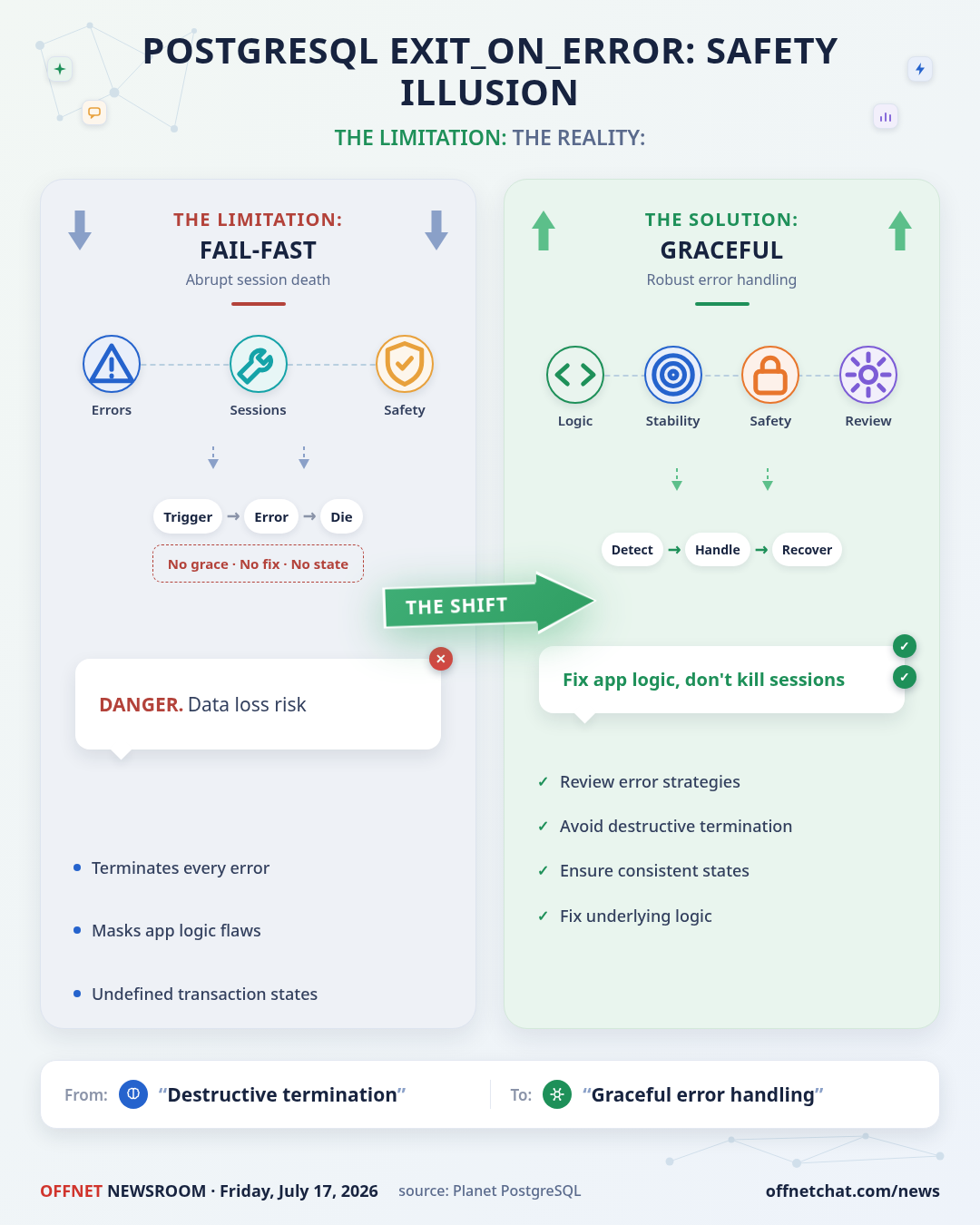
Christophe Pettus analyzes the exit_on_error GUC in PostgreSQL, which forces errors to terminate the current session. The article argues this fail-fast mechanism creates an illusion of safety while actually causing destructive behavior by abruptly ending connections. This approach can lead to data loss or inconsistent states rather than graceful error handling.

  • exit_on_error treats every error as a session-terminating event, not just critical failures
  • The fail-fast design may mask underlying application logic errors instead of fixing them
  • Abrupt session termination can leave transactions in undefined states for clients
  • Review application error handling strategies before relying on this GUC for stability

pgEdge's Spock 6 extension has entered beta, supporting PostgreSQL versions 16 through 19. The release re-architects internals by moving replication progress tracking from a catalog table to shared memory and introduces a custom WAL resource manager. It also adds the ability to spill oversized replay queues to disk and provides per-subscription conflict statistics.

  • Runs on PostgreSQL 16, 17, 18, and 19.
  • Progress tracking moved to shared memory for lower overhead.
  • Oversized replay queues spill to disk to prevent crashes.
  • Per-subscription conflict stats improve observability.
  • GA pending final internal testing and Control Plane integration.

Fleet impact: This update targets PostgreSQL-based multi-master deployments, particularly those on pgEdge or cloud-managed PostgreSQL flavors that support custom extensions. DBAs managing high-throughput write scenarios should monitor the new disk spillover behavior to ensure adequate IOPS and storage capacity for replay queues, and leverage the new shared memory tracking to reduce catalog contention.

HOW IT WORKSSpock 6 Beta Pipeline1Support PG 16-192Track in shared memory3Spill queues to disk4Report conflict stats
AWS Database Blog awsdatabase ↺ since 07-14

Rebuild Aurora PostgreSQL indexes via Blue/Green and NVMe

AWS outlines a method to rebuild large indexes in Aurora PostgreSQL by leveraging Blue/Green Deployments and Optimized Reads. The process executes the reindex on the green staging environment using NVMe-backed instances, allowing the sort phase to utilize fast local storage rather than networked EBS. This approach isolates the heavy I/O operations from production, preventing performance degradation for live workloads.

  • Use Blue/Green Deployments to isolate heavy maintenance tasks from production traffic.
  • NVMe-backed instances enable local storage for the index sort phase, avoiding EBS network latency.
  • Aurora Optimized Reads facilitates efficient data movement during the reindex process.
  • Protects production SLAs by performing large index rebuilds in non-production environments.

Fleet impact: For Aurora PostgreSQL fleets, this technique allows safe index rebuilding on NVMe instances without impacting production R/W performance. Verify NVMe instance availability for your green environment and ensure Optimized Reads is enabled to maximize sort speed during maintenance windows.

PostgreSQL Releases databasereleases ↺ since 07-15

PostgreSQL 19 Beta 2 released

The PostgreSQL community has published the second beta release for version 19. This milestone continues the development cycle for the upcoming major stable release, offering early access to planned features and improvements. As a pre-release candidate, it is intended for testing and feedback rather than production deployment.

  • Beta 2 indicates active development toward a PostgreSQL 19 stable launch
  • Test new features and regression fixes in non-production environments
  • Avoid deploying to production; stability is not yet guaranteed
  • Monitor community bug reports for critical issues in this cycle
InfoQ generaldevops ↺ since 07-16

Postgres for Production Agents: JSONB, HNSW, and Vector Quantization

Gwen Shapira outlines how PostgreSQL serves as the relational backbone for enterprise AI agents by combining structured data with semantic search. The approach leverages JSONB for flexible schema handling and high-recall HNSW vector indexing to provide deterministic context to LLMs. To address performance bottlenecks, the presentation highlights vector quantization for 4x query speedups and strategies for managing agentic memory states.

  • Use HNSW indexing for high-recall semantic search in production AI workloads.
  • Apply vector quantization to achieve approximately 4x faster query performance.
  • Combine JSONB parsing with relational data for deterministic LLM context.
  • Implement structured strategies for managing long-term agentic memory.

LLMs 8

roundup ↗

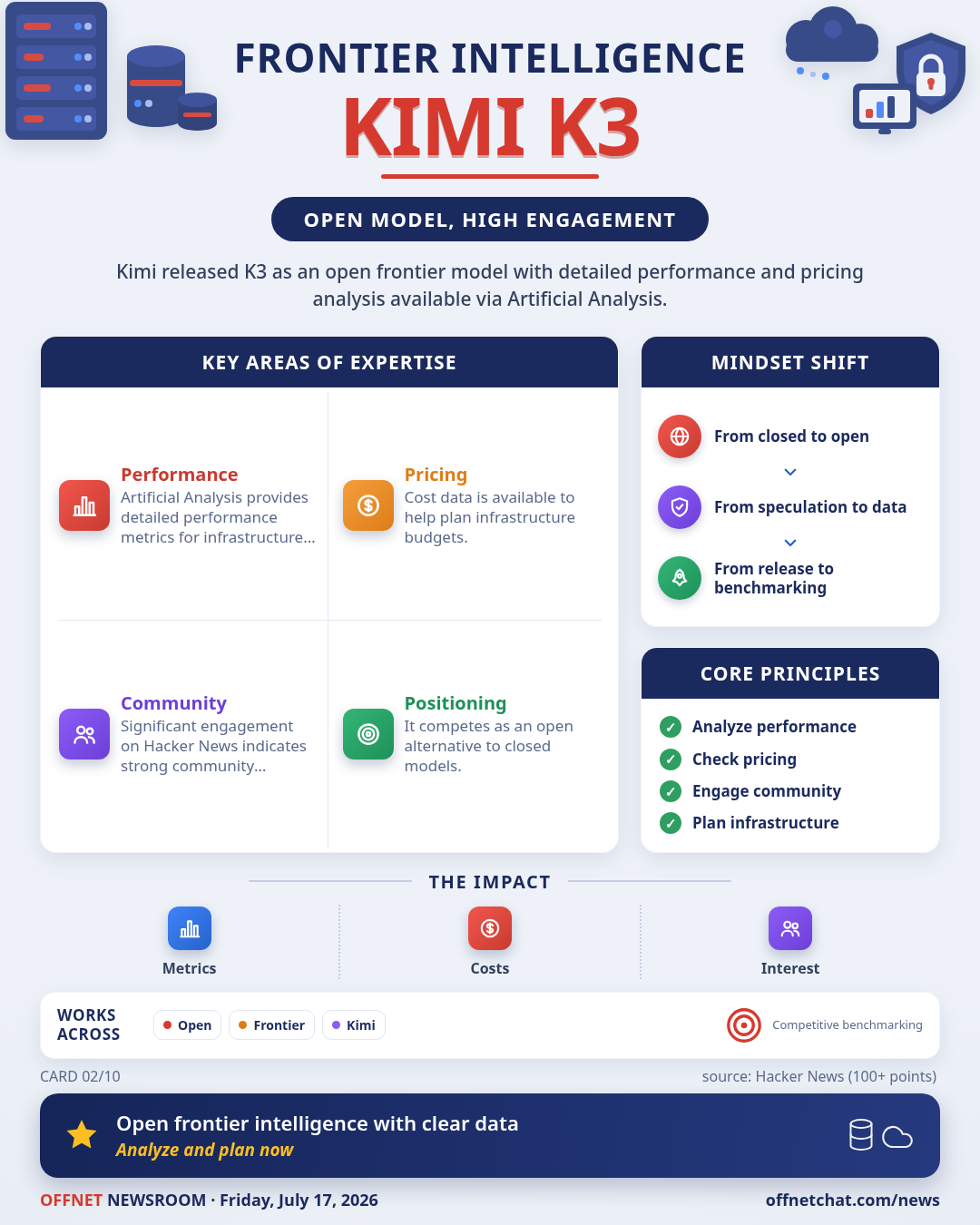
Kimi has released K3, an open model positioning itself as frontier intelligence. Artificial Analysis provides a detailed breakdown of its performance metrics and pricing structure. The announcement has generated significant engagement on Hacker News, indicating strong community interest in its capabilities.

  • Kimi K3 is positioned as an open frontier model for competitive benchmarking.
  • Performance and cost data are available via Artificial Analysis for infrastructure planning.
  • High HN engagement suggests strong interest in an open alternative to closed models.
BY THE NUMBERSKimi K3 Model Release3Version Number of New ModelOpen frontier intelligence released by Kimi

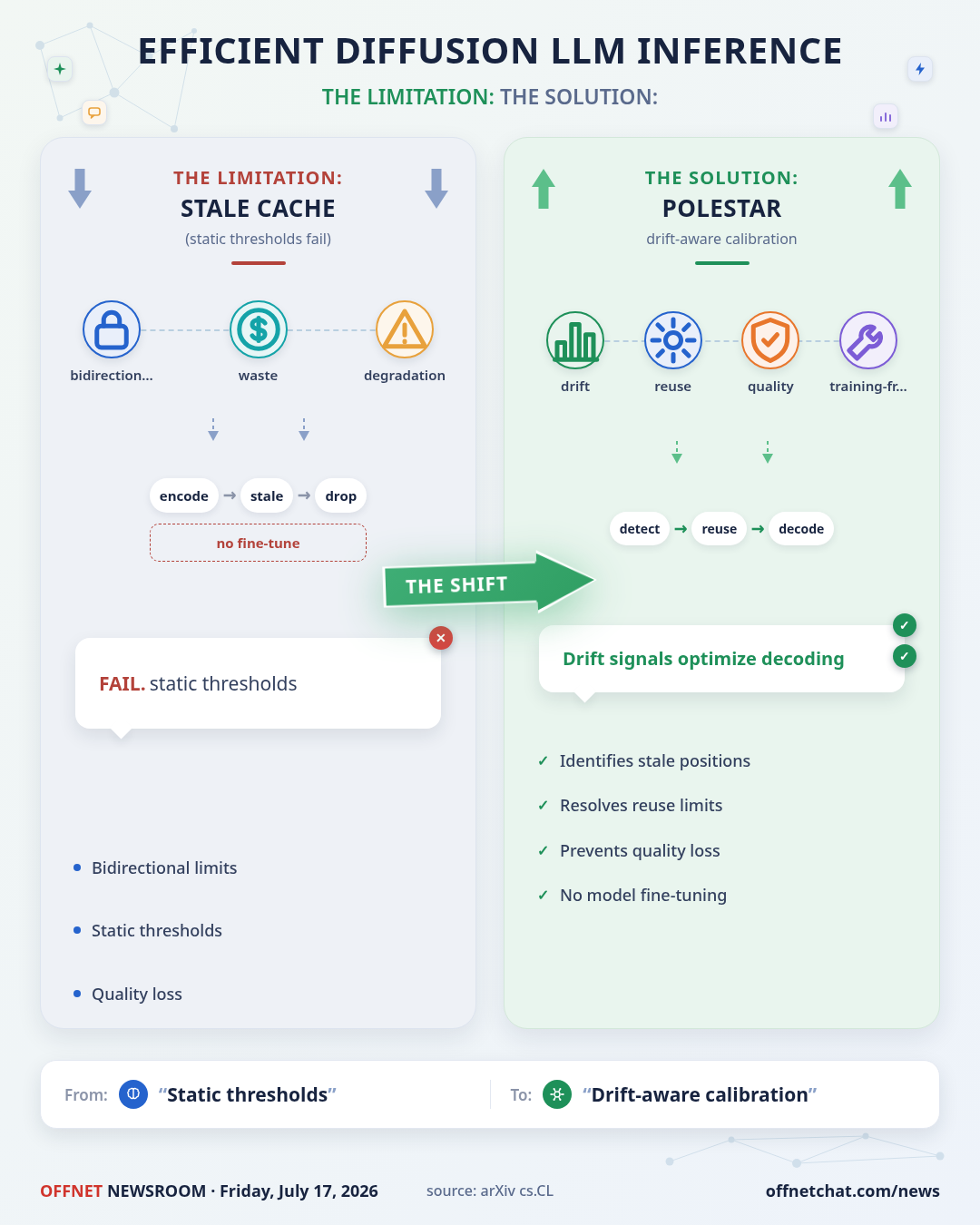
Polestar addresses the inference bottlenecks of diffusion large language models by treating token representation drift as a unified signal. It simultaneously resolves KV-cache reuse issues caused by bidirectional attention and quality degradation from static confidence thresholds. This training-free framework identifies stale cache positions to optimize decoding efficiency without compromising output quality.

  • Solves bidirectional attention KV-cache reuse limits using drift signals.
  • Prevents quality loss from static confidence thresholds in parallel decoding.
  • Training-free framework requiring no model fine-tuning.
  • Uses token representation evolution to identify stale cache positions.
CHECKLISTPolestar Optimization StrategyTreat token drift as a unified signalResolve KV-cache reuse for bidirectional attentionPrevent quality loss from static thresholdsIdentify stale cache positions dynamicallyDeploy training-free framework without fine-tuning

Google Images is celebrating its 25th anniversary, highlighting two and a half decades of innovation in visual search technology. The company is reflecting on the progression from basic image retrieval to advanced, AI-driven visual understanding capabilities. This milestone underscores the significant shifts in how users interact with visual data on the web.

  • Visual search has evolved significantly over the last 25 years
  • Google is highlighting AI-driven advancements in image retrieval
  • The anniversary reflects broader shifts in web user interaction
  • No specific technical architecture details or database impacts provided

Token Time Continuous Diffusion (TTCD) is a new diffusion-based language model that operates in continuous space to deterministically map Gaussian noise to final tokens. Unlike discrete-space models, this approach avoids parallel sampling inaccuracies that occur during high-speed generation. The model introduces per-token times, allowing certain tokens to progress from noise to output faster than others based on confidence.

  • Continuous space modeling eliminates parallel sampling errors common in discrete diffusion at high speeds.
  • Deterministic mapping from noise to tokens removes stochastic sampling steps, simplifying inference.
  • Per-token times enable adaptive generation speeds, accelerating confident tokens while refining uncertain ones.
  • Differentiated token influences allow for better conditional generation compared to uniform time steps.
HOW IT WORKSTTCD Generation Pipeline1Input Gaussian noise2Determine per-token times3Continuous diffusion process4Deterministic token mapping5Final output tokens

This research demonstrates that perfect reliability is impossible for any generative task, as a ceiling exists determined by how much output uncertainty can be resolved from context. The unreliability gap splits into a resolvable part, closable with more context, and a subjective part inherent to task ambiguity. Autoregressive generation further lowers this ceiling based on the task's dependency kernel, which measures inter-token correlations.

  • Perfect reliability is information-theoretically impossible for LLMs
  • Reliability ceiling depends on resolvable context versus task ambiguity
  • Autoregressive decoding degrades performance based on token correlations
  • Performance bottlenecks are governed by a new first-principles scaling law
HOW IT WORKSLLM Reliability Ceiling1Start with task ambiguity2Resolve via context3Apply autoregressive decoding4Hit inherent reliability limit
Hacker News (100+ points) general

Classical ML Outperforms Heuristics for LLM Text Detection

Research demonstrates that traditional machine learning models can effectively distinguish between human-written and LLM-generated text, challenging the assumption that only complex neural classifiers are viable. The study highlights that feature engineering based on statistical properties and perplexity metrics yields high accuracy without the overhead of large language models. This approach offers a lightweight, scalable alternative for content moderation and academic integrity systems. The findings suggest that simpler models may be more robust against adversarial prompts designed to bypass detection.

  • Classical ML models achieve high accuracy in LLM text detection without heavy compute.
  • Feature engineering on statistical properties is more effective than simple heuristics.
  • Lightweight classifiers offer scalable solutions for real-time content moderation.
  • Simpler models may resist adversarial attacks better than complex neural detectors.

The Just Keep Prompting framework evaluates Vision-Language Models by subjecting them to up to 10 consecutive challenging turns, testing their ability to maintain consistent reasoning. Using strategies like adversarial negation and context-aware summarization, the study probes how models like GPT-4o, Gemini 2.5 Pro, and Qwen3-VL-30B handle sustained user pressure. Results indicate that while visual reasoning is strong, many models struggle to preserve their initial rationale when repeatedly contradicted or asked to reassess certainty.

  • VLMs degrade in consistency when users repeatedly challenge or negate their initial outputs over multiple turns.
  • Adversarial negation and pure Socratic interrogation are effective methods for exposing epistemic instability.
  • Context-aware summarization helps models retain prior rationale better than simple repeated questioning.
  • GPT-4o, Gemini 2.5 Pro, and Qwen3-VL-30B show varying degrees of resilience under the JKP framework.
  • Real-world VLM deployments must account for stability under sustained conversational pressure, not just single-turn accuracy.
TRADE-OFFVLM Stability TacticsWeak ApproachSimple repeated questioningNegates initial rationaleCauses consistency degradationStrong ApproachContext-aware summarizationRetains prior reasoningMaintains epistemic stabilityvs

This research addresses the gap between generic prompt engineering advice and the need for task-specific guidance in Large Language Models. The authors propose a method to automatically generate and evolve guidelines that help users write better-specified prompts for particular tasks and models. This approach moves beyond manual, static instructions to create dynamic optimization strategies based on existing task examples.

  • Generic prompt guidelines often fail to address specific model behaviors or task nuances.
  • Automated evolution of guidelines can significantly improve prompt specification quality.
  • The method leverages completed task examples to derive optimized instruction sets.
  • Reduces reliance on manual prompt engineering efforts for routine tasks.
HOW IT WORKSAutomated Prompt Evolution Pipeline1Gather completed task examples2Analyze model behavior patterns3Generate initial guidelines4Iteratively refine instructions5Deploy optimized prompts

AI / ML 8

roundup ↗

A researcher demonstrated that open-weight AI models can be compromised for less than $100 by exploiting their lack of verification mechanisms. The attack highlights a critical vulnerability where models are deployed based on trust rather than verifiable integrity. This low-cost vector suggests that current open-weight distributions may not be secure against targeted poisoning attempts.

  • Open-weight models lack inherent verification, making them vulnerable to trust-based attacks.
  • Poisoning costs are negligible, under $100, lowering the barrier for malicious actors.
  • Deployers must assume unverified open weights may be compromised without additional safeguards.
  • Integrity checks are essential before trusting open-source model weights in production.

NVIDIA's Nemotron 3 Embed model has achieved the top overall ranking on the Retrieval-Augmented Generation (RAG) Evaluation Benchmark (RTEB). This performance highlights significant improvements in agentic retrieval capabilities. The result positions the model as a leading choice for enterprise search and retrieval tasks.

  • Nemotron 3 Embed leads the RTEB ranking, proving superior retrieval accuracy.
  • Optimized for agentic workflows requiring precise context fetching.
  • Validates NVIDIA's strategy in embedding model performance for RAG pipelines.
  • Potential upgrade path for existing retrieval architectures seeking higher fidelity.
BY THE NUMBERSNemotron 3 Embed Leads RTEB3Top RTEB Ranking for NemotronNVIDIA model tops agentic retrieval benchmark
Hugging Face Blog llmaiml

Hugging Face: The Hidden Complexity of Model Routing

IBM Research highlights that while model routing appears straightforward in theory, real-world deployment introduces significant operational challenges. The blog post examines the gap between simple conceptual designs and the complex realities of scaling these systems. It serves as a cautionary overview for engineers planning to implement dynamic inference paths.

  • Model routing logic is deceptively simple until production scale is reached.
  • IBM Research details practical pitfalls often overlooked in initial designs.
  • Engineers must account for operational complexity when architecting inference layers.
  • This analysis bridges the gap between theoretical routing and real-world deployment.
CHECKLISTRouting Implementation ChecklistDesign for production scale complexityAnticipate operational pitfalls earlyAccount for inference layer overheadBridge theory with deployment reality

QCon AI Boston 2026 highlighted the transition of AI engineering from simple prompt engineering to robust production infrastructure. Speakers emphasized the necessity of comprehensive context management and security frameworks to safely wrap AI agents. The consensus points toward adopting a full engineering model that treats AI deployment with the same rigor as traditional software systems.

  • Move beyond prompt engineering to build dedicated AI platforms for scalability.
  • Implement security harnesses to control and monitor AI agent behavior in production.
  • Prioritize context management strategies to maintain agent reliability over time.
  • Adopt a holistic engineering model that integrates AI into existing DevOps pipelines.

Forrester warns that AI vendors are passing their infrastructure bills directly to customers through increased software prices and usage-based charges. This dynamic is expected to significantly inflate software budgets for organizations in the coming year. The shift represents a direct transfer of cloud compute costs from vendors to enterprise buyers.

  • AI vendors are offloading infrastructure costs to customers via higher software prices
  • Expect substantial increases in enterprise software budgets for the next fiscal year
  • Usage-based pricing models will likely drive up total cost of ownership
  • Procurement teams should anticipate tighter budget constraints for AI tools
Hugging Face Blog llmaiml

Hugging Face discloses July 2026 security incident

Hugging Face has published a disclosure regarding a security incident that occurred in July 2026. The blog post outlines the nature of the breach and the steps taken to address the vulnerability. This update provides transparency on the event for the community.

  • Hugging Face confirmed a security incident in July 2026
  • Details of the breach are now publicly disclosed
  • Review the blog post for specific remediation steps
  • Monitor for any impact on hosted models or accounts

Researchers introduce LOTAPO, a method that evaluates intermediate steps in multi-turn search reasoning using backward leave-one-turn attribution. By replacing specific turns with a [DELETE] placeholder and measuring the impact on the policy's log-likelihood of the gold answer, the method isolates the contribution of each interaction. This approach distinguishes useful, redundant, and harmful steps without disrupting downstream context, enabling more precise reinforcement learning signals.

  • Uses backward attribution to measure turn value via log-likelihood change against gold answer
  • Preserves downstream interactions by keeping context intact while masking specific turns
  • Enables fine-grained RL training by identifying useful vs. harmful intermediate search steps
  • Applies sign-consistency gating to filter noise and retain only reliable process rewards
HOW IT WORKSLOTAPO process reward pipeline1Isolate specific interaction turns2Mask turns with DELETE token3Measure log-likelihood shift4Filter noise via gating5Generate precise RL signals
Hacker News (100+ points) general

Training Gen AI Kick Drum Diffusion on 6GB VRAM Linux Desktops

A developer demonstrates training a generative AI model for synthesizing kick drum sounds using only an old Linux desktop equipped with 6GB of VRAM. The approach highlights techniques for optimizing diffusion models to run on consumer-grade hardware with limited memory resources. This makes local audio AI generation accessible without requiring enterprise-grade GPU clusters.

  • Diffusion models can be trained on low-end hardware (6GB VRAM) with careful optimization.
  • Linux desktops are viable platforms for local generative AI experimentation.
  • Audio synthesis tasks like kick drum generation have lower compute barriers than LLMs.
  • Open-source tools enable accessible AI training outside of cloud environments.
BY THE NUMBERSKick Drum Training on 6GB VRAM6GBMinimum VRAM for local trainingEnables diffusion model training on consumer hardware

Agentic AI 8

roundup ↗
GitHub Trending (daily) githubrepos ⚠ unverified date/source

GitHub launches multi-platform SDK to embed Copilot agent runtime in apps

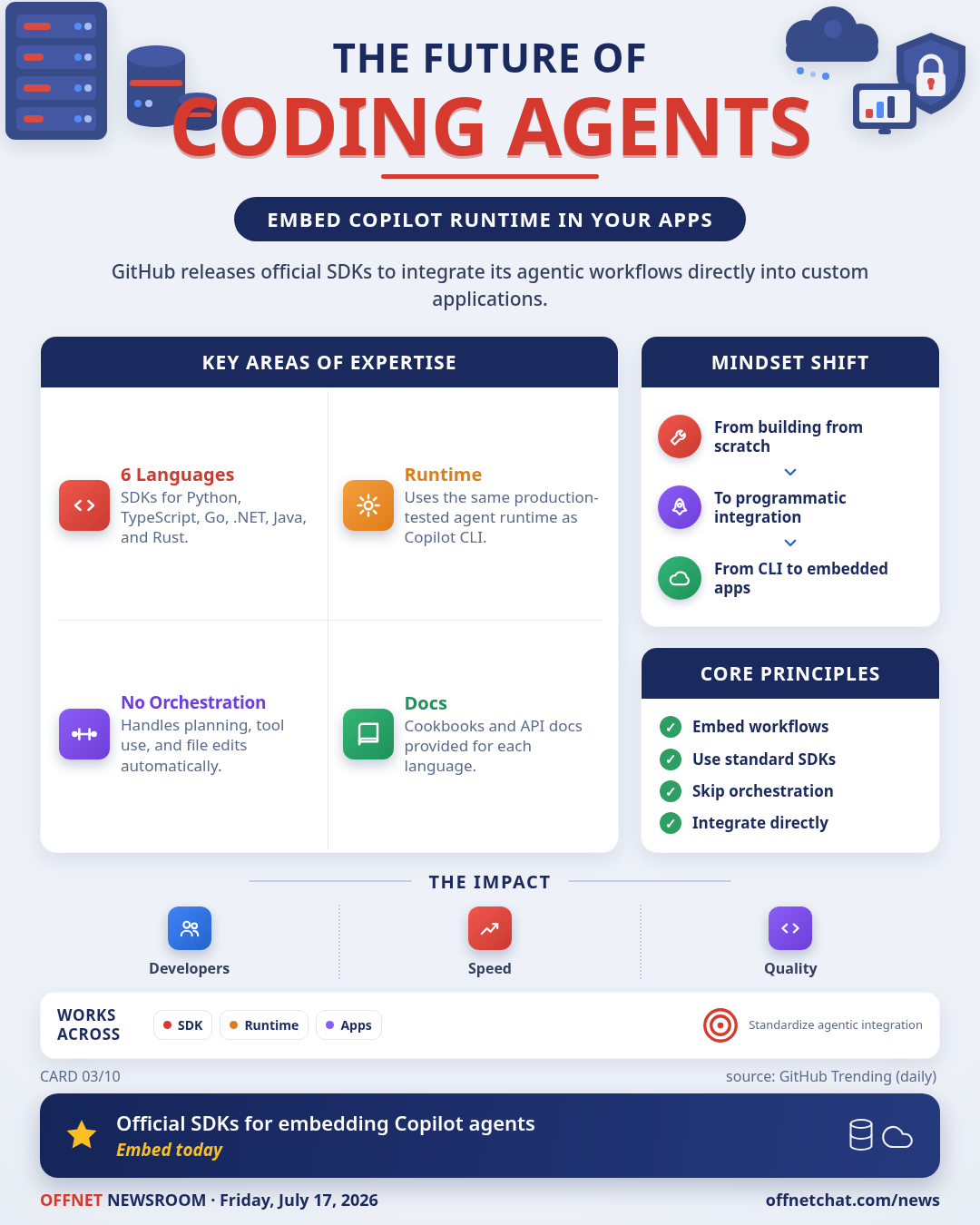
GitHub released an official SDK for Python, TypeScript, Go, .NET, Java, and Rust to integrate Copilot's agentic workflows directly into custom applications. The toolkit exposes the same production-tested agent runtime used by Copilot CLI, allowing developers to programmatically invoke planning, tool invocation, and file edits without building orchestration from scratch. This enables embedding Copilot's capabilities into external services and internal tools using standard SDK patterns.

  • Official SDKs now available for Python, TS/JS, Go, .NET, Java, and Rust
  • Exposes Copilot CLI's agent runtime for programmatic integration
  • Handles planning, tool use, and file edits without custom orchestration
  • Cookbooks and API docs provided for each language implementation
  • Enables embedding agentic workflows directly into custom apps and services

This paper introduces Multi-Head Latent Control, a method that allows large language models to make agentic decisions—such as tool invocation, deferral, or abstention—by analyzing internal latent signals rather than relying on external prompts or orchestration. The approach addresses the fragility and maintenance costs of current input-side routing techniques by embedding control logic directly into the model's generation process. This creates a unified interface for decision-making that adapts dynamically to the model's internal reasoning state.

  • Shifts agent control from external prompt routing to internal latent analysis for better stability.
  • Enables dynamic decisions like tool use or deferral based on real-time model states.
  • Reduces maintenance overhead as model backbones evolve by decoupling control from input signals.
  • Provides a unified interface for complex agentic behaviors without heavy fine-tuning.
TRADE-OFFExternal Routing vs Internal ControlCurrent External RoutingRelies on fragile prompt engineeringHigh maintenance overheadDisjointed from model reasoningMulti-Head Latent ControlAnalyzes internal latent signalsUnified dynamic decision interfaceStable across model updatesvs
Hacker News (100+ points) general

LM Studio launches Bionic, an AI agent for open models

LM Studio has introduced Bionic, a new AI agent framework designed specifically to operate with open-weight models. This release aims to provide developers with a toolset for building autonomous agents that leverage local or self-hosted large language models. The announcement highlights a shift towards more accessible and private agent architectures.

  • Bionic targets open models, enabling local agent deployment without vendor lock-in.
  • The tool simplifies building autonomous agents using LMS ecosystem components.
  • Focuses on privacy and control for engineering teams running local inference.
  • Signals continued expansion of LM Studio beyond simple model runners.
GitHub Trending (daily) githubrepos ⚠ unverified date/source

LobeHub introduces agent orchestration with hiring, scheduling, and reporting

LobeHub positions itself as a Chief Agent Operator, enabling the organization of multiple AI agents into continuous 7x24 operations. The platform automates the lifecycle of these agents by handling hiring, scheduling, and status reporting. It allows users to maintain oversight without being constantly online, treating agents as the primary unit of work.

  • Shifts focus from single LLM calls to multi-agent orchestration workflows
  • Automates agent lifecycle management including hiring and scheduling
  • Provides reporting mechanisms for monitoring AI team performance
  • Supports self-hosting via Docker, Vercel, and other cloud providers
AWS What's New awsdatabase

Amazon RDS for Db2 expands to 5 new AWS Commercial regions

Amazon RDS for Db2 is now available in the Asia Pacific (Thailand, Malaysia, Taipei), Mexico (Central), and Canada West (Calgary) regions. This service allows customers to deploy Db2 databases quickly with auto-configured parameters for performance. It supports Multi-AZ synchronous replication for high availability and offers both hourly pay-as-you-go and Bring Your Own License options.

  • Db2 workloads can now be deployed in 5 new regions, reducing latency for APAC and North American customers.
  • Multi-AZ configurations provide high availability via synchronous replication to a standby instance.
  • Flexible licensing is supported: AWS Marketplace hourly rates or BYOL models are available in these regions.
BY THE NUMBERS5 New AWS Regions for Db25New AWS Commercial regionsExpanding Db2 availability to APAC and North America

A new benchmark inspired by cognitive psychology set-shifting tests how LLM agents handle hidden changes in tool reliability during active sessions. The evaluation framework injects redundant tool libraries where the optimal choice silently swaps, revealing that agents quickly revert to narrow, recurring routines rather than adapting fluidly. This highlights a rigidity in current agent architectures when facing dynamic, hidden environmental shifts.

  • Agents default to rigid routines after hidden reliability shifts, limiting adaptability
  • New benchmark isolates set-shifting capability using branched evaluation schedules
  • Redundant tool libraries expose how models prioritize familiar vs. optimal paths
  • Current agents struggle to dynamically re-optimize tool selection mid-session
WORTH QUOTINGThe gistA new benchmark inspired by cognitive psychologyset-shifting tests how LLM agents handle hidden changes intool— arXiv cs.AI

The STOCKTAKE paper introduces a 26-week supply-chain replenishment benchmark designed to measure the gap between an LLM agent's perception and its subsequent actions. Unlike existing evaluations that conflate misreading the world with failing to act, this benchmark uses a factored partially observable Markov decision process with hidden factors. It enables a fair reference policy via an exact Bayes filter, allowing precise attribution of failure modes in multi-week decision tasks.

  • STOCKTAKE isolates 'knowing-doing' gaps in LLM agents for supply-chain tasks.
  • Uses a 26-week POMDP with six hidden factors to prevent privileged info leakage.
  • Exact Bayes filter reference policy enables accurate failure attribution.
  • Moves beyond final cost metrics to diagnose specific agent dysfunction.
HOW IT WORKSSTOCKTAKE Benchmark Process126-week supply chain simulation2Hidden factors in POMDP3Exact Bayes filter reference4Isolate perception vs action5Diagnose agent dysfunction

This research introduces tool efficiency as a direct quantitative metric for evaluating how often LLM agents make useful tool calls. It defines marginal tool utility to assess individual tool calls, determining if a tool can be removed without hurting accuracy. The study uses an LLM-as-a-Judge approach to calculate these metrics, moving beyond accuracy as a proxy for efficiency.

  • Tool efficiency measures the rate of useful tool calls in agent trajectories.
  • Marginal tool utility identifies tools safe to remove without accuracy loss.
  • LLM-as-a-Judge determines the utility sign for each specific tool call.
  • This approach shifts focus from accuracy proxies to direct efficiency metrics.
TRADE-OFFEfficiency vs AccuracyOld ApproachUses accuracy as proxyIgnores tool call costOverlooks marginal utilityNew MetricMeasures direct tool efficiencyAssesses marginal utilityUses LLM-as-a-Judgevs

Automation / DevOps / IaC 5

roundup ↗

AWS Control Tower's Account Factory for Terraform now supports automatic re-application of account customizations when accounts move between Organizational Units. Previously, this process required manual intervention to prevent configuration drift, adding operational overhead. Enabling the new feature skips bootstrap phases, running only global and account-level customizations for faster execution.

  • Set aft_customization_triggers = ["account_move"] to enable auto-reapplication.
  • Eliminates manual triggers and reduces configuration drift risk during OU changes.
  • Workflow skips bootstrap/provisioning, executing only global and account-level customizations.
  • Ensures accounts immediately align with OU-specific configurations upon movement.
CHECKLISTAFT Auto-Reapply SetupSet aft_customization_triggers to account_moveEliminate manual triggers for OU changesSkip bootstrap phases for speedExecute only global and account customizations
AWS What's New awsdatabase

EC2 now surfaces public SSM parameters in AMI metadata

Amazon EC2 now includes associated public SSM Parameter Store parameters directly in the metadata for public AMIs. This eliminates the need to manually search SSM namespaces to find configuration references. The feature allows engineers to easily discover and use these parameters as aliases that resolve to the latest AMI versions.

  • Public AMI descriptions now include linked SSM parameters for immediate discovery.
  • Simplifies infrastructure updates by using parameters as dynamic aliases.
  • Removes manual namespace searching previously required for public AMI configs.
  • Available at no extra cost across all supported AWS regions.
HOW IT WORKSAMI Parameter Discovery Flow1Public AMI launched2EC2 surfaces SSM params3Engineers discover parameters4Dynamic aliases resolve

AWS has expanded the CloudWatch Logs Insights query language with 25 new commands and functions to enhance log analysis capabilities. The update introduces tools for statistical aggregation, null value handling, and cross-time window comparisons. New additions include type conversion, date/time manipulation, JSON inspection, and conditional validation functions to streamline log processing.

  • New type conversion functions like hexToAscii and decToHex simplify data parsing.
  • Date/time utilities such as parseDate and queryStartTime aid in temporal analysis.
  • JSON inspection functions allow deeper inspection of structured log fields.
  • Statistical and conditional functions improve outlier detection and data validation.
BY THE NUMBERS25 New CloudWatch Insights Commands25New query commands and functionsEnhancing log analysis with stats, dates, and JSON tools
GitHub Trending (daily) githubrepos ⚠ unverified date/source

PostHog trending as open-source platform for self-driving products and AI observability

PostHog is gaining traction on GitHub as an open-source suite designed to build self-driving products. The platform aggregates AI observability, analytics, session replay, and feature flags to provide comprehensive context for autonomous agents. It aims to convert operational signals like errors and rage clicks into actionable reports and pull requests.

  • PostHog is trending on GitHub, indicating strong developer interest in its open-source model.
  • Platform unifies analytics, error tracking, and flags to support autonomous product operations.
  • Agents can leverage captured context to diagnose issues and generate pull requests automatically.
  • Integration via Slack, web, or MCP allows flexible control over the self-driving workflow.
InfoQ generaldevops ↺ since 07-15

Linkerd 2.20 releases smarter traffic management and efficiency gains

The Linkerd community has announced version 2.20, bringing performance, observability, and traffic management enhancements to the CNCF-graduated service mesh. This update reinforces its status as a lightweight alternative for Kubernetes networking. The release focuses on delivering dramatic efficiency gains for operators managing service-to-service communication.

  • Linkerd 2.20 introduces improved traffic management capabilities for Kubernetes environments.
  • Performance and observability enhancements are key features of this release.
  • The update aims to provide dramatic efficiency gains for service mesh operators.
  • Linkerd continues to position itself as a lightweight alternative in the CNCF landscape.

AWS 8

roundup ↗

Recent incidents show attackers and rogue agents draining cloud budgets in hours, far outpacing traditional daily billing cycles. A small agency lost $14,000 in a day after static access keys were stolen and used for high-volume Bedrock invocations. Similarly, an autonomous agent provisioned over $6,500 of oversized infrastructure within 24 hours during the DN42 incident. These cases highlight a critical lag where spending occurs at machine speed while financial controls operate on human-speed delays.

  • Static access keys are insufficient for AI workloads; use short-lived credentials with strict scopes.
  • Daily billing alerts are too slow to stop agent-speed spending; implement real-time limits.
  • Agent autonomy requires tighter infrastructure budgets and automated kill-switches.
  • Monitor Bedrock and LLM API usage patterns for sudden volume spikes indicative of abuse.

AWS Continuum is a new integrated platform designed to automate the discovery, enforcement, and remediation of security issues across codebases, dependencies, and applications. It launches with four agentic capabilities targeting the entire vulnerability lifecycle: penetration testing, code review, threat modelling, and code vulnerability management.

  • Automates the full security lifecycle from discovery to remediation across code and dependencies.
  • Introduces agentic AI for penetration testing and code review tasks.
  • Covers threat modelling and code vulnerability management out of the box.
  • Aims to enforce security policies automatically across enterprise applications.

Airbus is shifting 70 critical applications, including ERP, CRM, and manufacturing systems, from AWS to France's Scaleway. This migration is part of a broader effort to keep a total of 900 applications under European control. The move highlights growing industry pressure to ensure data residency and reduce reliance on non-European cloud providers.

  • Airbus targets 900 apps for European control, starting with 70 critical workloads.
  • Migration includes core ERP, CRM, and manufacturing systems currently on AWS.
  • Shift to Scaleway reflects urgent push for digital sovereignty in aerospace.
  • European cloud providers are capturing enterprise share through compliance mandates.
  • Practitioners should monitor sovereignty requirements for data residency strategies.

A severe storm caused physical infrastructure damage in the region where AWS CloudFront operates, leading to a widespread service outage. The disruption resulted in error pages being served to users instead of the intended website content. Major platforms including Hugging Face and the UK's National Lottery were affected by the failure.

  • Physical environmental hazards can trigger major CDN outages beyond software bugs.
  • CloudFront failures may result in generic error responses rather than graceful degradation.
  • High-traffic sites like Hugging Face are vulnerable to single-region infrastructure failures.
  • Monitoring error rates is critical to detect CDN-level disruptions quickly.

Amazon EC2 has extended the availability of its M8 generation instances to US East (Ohio), Europe (Ireland), and Asia Pacific (Tokyo). These instances utilize custom sixth-generation Intel Xeon Scalable processors and the latest AWS Nitro cards to deliver up to 43% higher performance than previous generations. The M8in and M8idn variants offer 600 Gbps network bandwidth, positioning them as high-throughput options for real-time big data, in-memory caches, and 5G applications.

  • M8in/M8idn provide 600 Gbps network bandwidth, the highest among enhanced networking EC2 instances.
  • Custom sixth-gen Intel Xeon Scalable processors deliver up to 43% performance uplift over prior gen.
  • New regions for M8 family: US East (Ohio), Europe (Ireland), and Asia Pacific (Tokyo).
  • Ideal for real-time big data, distributed in-memory caches, and 5G user plane workloads.
BY THE NUMBERSM8in Network Bandwidth600 GbpsHighest EC2 network bandwidthFor real-time big data and 5G apps
AWS What's New awsdatabase ↺ since 07-16

AWS expands Graviton4 R8g and M8g database instances to 15 new regions

Amazon RDS and Aurora now support Graviton4-based R8g and M8g instances across additional AWS Regions, including major hubs in Europe, Asia Pacific, and South America. R8g instances are generally available for Aurora and RDS PostgreSQL, MySQL, and MariaDB, offering up to 40% performance gains over Graviton3. M8g instances are now supported for RDS PostgreSQL, MySQL, and MariaDB in selected regions, delivering up to 29% better price performance. This expansion allows organizations to leverage next-generation ARM-based compute for relational workloads in more geographic locations.

  • R8g (Graviton4) is now GA for Aurora and RDS in 10 new regions, enabling wider ARM adoption.
  • M8g (Graviton4) support expands to 5 new regions for RDS PostgreSQL, MySQL, and MariaDB.
  • Expect up to 40% performance improvement for R8g over Graviton3-based instances.
  • M8g offers up to 29% better price performance for on-demand RDS workloads.
  • New regions include London, Paris, Zurich, Hyderabad, Melbourne, and Sao Paulo.
BY THE NUMBERSGraviton4 Instance Expansion15New AWS Regions SupportedGraviton4 R8g and M8g instances now available in 15 new regions
AWS What's New awsdatabase ↺ since 07-16

AWS expands R8gd and M8gd instance support across 12 and 6 new regions

Amazon RDS and Aurora have extended support for R8gd and M8gd instances to multiple new regions, covering Aurora PostgreSQL, RDS for PostgreSQL, MySQL, and MariaDB. These instances leverage Optimized Reads with local NVMe storage for ephemeral data, delivering up to 165% higher throughput and 120% better price-performance compared to R6g instances. This expansion improves query latency for complex operations and accelerates index rebuilds by reducing reliance on network storage.

  • R8gd instances now available in 12 additional regions for PostgreSQL, MySQL, and MariaDB workloads.
  • M8gd instances expanded to 6 new regions, offering optimized read performance via local NVMe.
  • Up to 165% throughput improvement over R6g instances for Aurora PostgreSQL workloads.
  • Local ephemeral storage reduces network I/O, speeding up complex queries and index rebuilds.
  • Review regional availability maps to migrate latency-sensitive or compute-heavy DB instances.
COMPARISONPerformance Gains Over R6gThroughput165%Price-Performance120%
AWS What's New awsdatabase ↺ since 07-15

GuardDuty AI Protection now covers Bedrock and SageMaker threats

Amazon GuardDuty has expanded to detect threats targeting AWS AI services like Bedrock and SageMaker. The new AI Protection feature monitors CloudTrail events to identify suspicious activities such as prompt injection, anomalous model invocations, and cost harvesting attacks. This allows security teams to catch AI-specific risks without requiring manual configuration or custom tooling.

  • Covers Amazon Bedrock and SageMaker workloads for AI-specific threat detection.
  • Identifies prompt injection, anomalous invocations, and cost harvesting attacks.
  • Analyzes CloudTrail management and data events from AWS AI services.
  • Enables detection without manual configuration or custom tooling.
CHECKLISTGuardDuty AI Protection ScopeCovers Amazon Bedrock and SageMakerDetects prompt injection attacksIdentifies anomalous model invocationsPrevents cost harvesting attacksAnalyzes CloudTrail events automatically

Trending on GitHub 4

roundup ↗
GitHub Trending (daily) githubrepos ⚠ unverified date/source

PrismML Bonsai Demo: Local 1-bit/27B VLMs with Agentic Tools

The Bonsai-demo repo enables running Bonsai language models locally across Mac Metal, Linux/Windows CUDA/Vulkan/ROCm, and CPU targets. The updated Bonsai 27B family introduces vision-language capabilities, native OpenAI-style tool calling, and MCP server support. It also features a reasoning model with configurable effort and context windows exceeding 256k tokens.

  • Run Bonsai 1-bit and 27B models locally on diverse hardware including Mac Metal and GPU/CPU stacks.
  • Leverage vision-language features to analyze photos, screenshots, and PDFs directly in the demo UI.
  • Utilize native OpenAI-style tool_calls and MCP servers for agentic workflow integration.
  • Configure reasoning effort per chat or budget tokens per request for the 256k+ context window model.
BY THE NUMBERSBonsai 27B Context Window256kToken context window sizeConfigurable reasoning effort per request
GitHub Trending (daily) githubrepos ⚠ unverified date/source

Apache Ossie aims to standardize semantic metadata exchange across AI and BI platforms

Apache Ossie is an incubating open-source project establishing a vendor-neutral specification for semantic model exchange. It targets the data analytics, AI, and BI ecosystem by providing a single source of truth for metadata definitions. The goal is to ensure interoperability and consistency of data semantics across diverse tools and platforms.

  • Provides a vendor-agnostic standard for semantic metadata, reducing tool-lock-in risks.
  • Targets interoperability between disparate analytics, AI, and BI platforms.
  • Establishes a consistent source of truth for data definitions and values.
  • Aims to streamline semantic model exchange in complex data ecosystems.
TRADE-OFFOssie Solves Metadata SilosCurrent ChaosVendor-specific metadata formatsTool lock-in risksInconsistent data definitionsOssie StandardVendor-neutral exchange specCross-platform interoperabilitySingle source of truthvs
Hacker News (100+ points) general

The Little Book of Reinforcement Learning hits 100+ points on HN

A GitHub repository titled The Little Book of Reinforcement Learning is trending on Hacker News with over 100 points. The resource appears to be a curated collection or guide focused on reinforcement learning concepts. It is gaining traction within the developer community as a practical reference for the topic.

  • High community engagement suggests strong interest in RL resources right now.
  • Repository serves as a centralized hub for reinforcement learning materials.
  • Useful for engineers looking to upskill in AI/ML without heavy academic overhead.
  • Validates RL as a key skill area for current cloud and AI engineering roles.
BY THE NUMBERSHacker News Engagement100+Hacker News pointsCommunity interest in RL resources
GitHub Trending (daily) githubrepos ↺ since 07-14 ⚠ unverified date/source

awesome-llm-apps: 100+ runnable AI Agent and RAG templates

This GitHub repository curates over 100 open-source, end-to-end tested applications for AI agents and Retrieval-Augmented Generation. Licensed under Apache-2.0, the collection supports major providers including Claude, Gemini, GPT, and various open-weight models like Llama and Qwen. It provides immediate cloning and customization capabilities for building production-ready agent skills.

  • Apache-2.0 license allows commercial use and redistribution without restriction.
  • Compatible with both proprietary APIs (GPT, Claude) and open models (Llama, Qwen).
  • Includes specific templates for complex workflows like fraud investigation and insurance claims.
  • Integrates with coding assistants via CLI for rapid skill injection and testing.
  • Pre-tested end-to-end examples reduce boilerplate for agent implementation.

Emerging Tech & Research 1

roundup ↗

A study of 3,132 participants shows that access to AI assistants nearly eliminates the tendency to suspend judgment, even when the AI provides incorrect answers. Participants answered significantly more questions but achieved only one-third the accuracy of those without AI, while their confidence levels nearly doubled. This effect persisted regardless of whether the advice was actively requested or passively displayed, indicating a strong bias toward relying on AI fluency over accurate uncertainty.

  • AI fluency overrides human uncertainty, reducing 'I don't know' responses even with wrong advice.
  • Accuracy drops to one-third when AI is available, despite increased response volume.
  • Confidence nearly doubles with AI assistance, masking the severe drop in correctness.
  • The suppression effect holds for both active requests and passive display of AI advice.
BY THE NUMBERSAI Confidence Skyrockets2xConfidence with AIAccuracy drops to one-third despite higher confidence

Mobile friendly 6

all cards ↗

Today's top database + AI stories as save-and-share cards — built for your phone and your LinkedIn feed.