OffNet Newsroom

Archive snapshot

Wednesday, July 15, 2026

Daily signal on databases, AI, and the tech that matters.

42 new today 50 stories 7 sections 11 for the DBA desk

Database Technology 8

roundup ↗

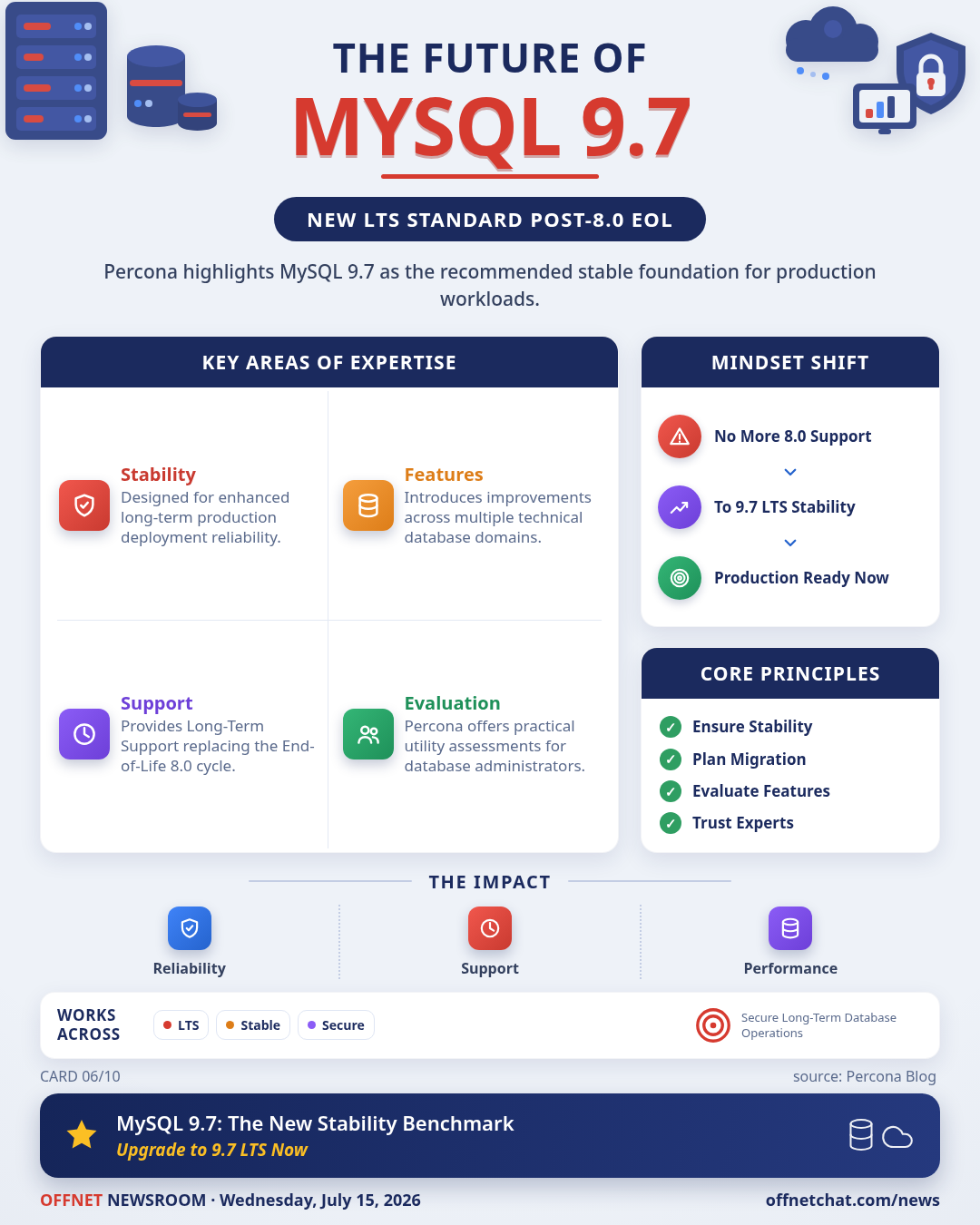
Percona highlights MySQL 9.7 as a new Long-Term Support release designed to replace the End-of-Life MySQL 8.0. The update introduces features across multiple technical domains aimed at enhancing operational stability. The release is positioned as the next stable foundation for production workloads following the previous LTS cycle.

  • MySQL 8.0 has reached End-of-Life, making 9.7 the recommended LTS path.
  • Release focuses on enhanced stability for long-term production deployments.
  • Feature set spans multiple technical domains within the MySQL environment.
  • Percona provides evaluation of practical utility for database administrators.
THE SHIFTMySQL LTS Transition8.0END OF LIFE9.7NEW LTSStability focus for production

LakeQuest is a 9,846-pair benchmark designed to evaluate question answering systems on noisy, weakly structured data lakes rather than clean corpora. It spans AI/ML metadata, retail banking, and biomedical domains, requiring models to navigate heterogeneous tables and linked metadata. The benchmark focuses on the full retrieve-and-synthesize pipeline, addressing the gap where current tests ignore the complexity of real-world data discovery.

  • Evaluates end-to-end performance over heterogeneous, weakly structured data rather than clean schemas.
  • Covers three distinct domains: AI/ML metadata, retail banking, and biomedical drug information.
  • Requires systems to handle noisy discovery of tables, passages, and linked metadata.
  • Human-validated pairs ensure realistic assessment of retrieve-and-synthesize pipelines.
HOW IT WORKSLakeQuest QA Pipeline1Navigate heterogeneous tables2Discover noisy metadata3Retrieve relevant passages4Synthesize final answer
AWS What's New awsdatabase

Amazon Aurora DSQL now available in Europe (Spain)

AWS has expanded Amazon Aurora DSQL availability to the Europe (Spain) Region, supporting single-Region clusters. This serverless distributed SQL database offers active-active high availability and multi-Region strong consistency. It is designed to provide virtually unlimited scalability and zero infrastructure management for always-available applications.

  • Aurora DSQL is now live in Europe (Spain) for single-Region deployments.
  • Features include active-active HA and multi-Region strong consistency.
  • Serverless architecture eliminates infrastructure management overhead.
  • Enables effortless scaling and resilience for distributed SQL workloads.
  • Expands the global footprint of fast, serverless distributed SQL capabilities.
CHECKLISTAurora DSQL Spain LaunchDeploy single-Region clusters in Europe (Spain)Enable active-active high availabilityEnsure multi-Region strong consistencyEliminate infrastructure management overheadScale effortlessly for distributed workloads

With pgAgent on its way out, Regina Obe is guiding the migration to pg_timetable by detailing how to install it as a Linux service. This second part of the series focuses on the operational configuration required to run the scheduler reliably. Obe is also developing a pg_timetable UI for pgAdmin that mirrors the familiar pgAgent interface to ease the transition for users.

  • pgAgent is being deprecated, making pg_timetable the recommended replacement for job scheduling.
  • New guidance is available for installing pg_timetable as a persistent Linux service.
  • A pgAdmin UI for pg_timetable is in development to replicate the existing pgAgent experience.
  • The new UI pull request is currently being cleaned up before final commit.
CHECKLISTMigrating to pg_timetableInstall pg_timetable as a Linux serviceConfigure operational settings for reliabilityWait for pgAdmin UI final commitReplace deprecated pgAgent scheduling jobs

The Odyssey connection pooler for PostgreSQL and Apache Cloudberry has reached version 1.5.1, bringing extended protocol support and performance improvements for pipelining. New capabilities include shared pools, transaction pooling pinning, and explicit CPU affinity support. The release also adds observability features like queue time metrics, Prometheus exporter enhancements, and SSLKEYLOGFILE support.

  • Improves pipelining performance and fixes protocol violations for better stability.
  • Adds queue time metrics (avg/total wait) and pool_notice_after_waiting_ms for debugging.
  • Supports CPU affinity and shared pools for more granular resource control.
  • Includes SSLKEYLOGFILE support to aid in TLS traffic analysis and debugging.
CHECKLISTOdyssey 1.5.1 Key UpdatesFix protocol violations for stabilityAdd queue time metricsSupport CPU affinityEnable SSLKEYLOGFILE for debugging

Christophe Pettus highlights that setting the event_source GUC alone is insufficient on Windows. The operating system does not recognize the specified source name until it is explicitly registered in the Windows Event Log. This registration step is mandatory for logs to appear correctly in the Event Viewer.

  • Setting event_source GUC does not auto-register the log source on Windows
  • Manual registration in Windows Event Log is required before logging works
  • Unregistered sources will fail to display messages in Event Viewer
  • This is a configuration prerequisite for Windows-specific PostgreSQL deployments

Seph Gentle proposes Schemaboi, an experimental format that embeds self-contained schemas directly into file headers, inspired by the adaptability of HTML and HTTP. This approach ensures data remains readable without external definitions by prioritizing forward, backward, and sideways compatibility. The goal is to enable data format evolution without requiring central coordination or risking data loss.

  • Embeds schemas in file headers to eliminate external definition dependencies.
  • Supports forward, backward, and sideways compatibility for seamless evolution.
  • Enables format changes without central coordination or data loss.
  • Inspired by HTML/HTTP patterns for enduring adaptability.

LLMs 8

roundup ↗
arXiv cs.CL researchllm

LLM Countdown Subcircuit Identified in Llama-3.1-70B

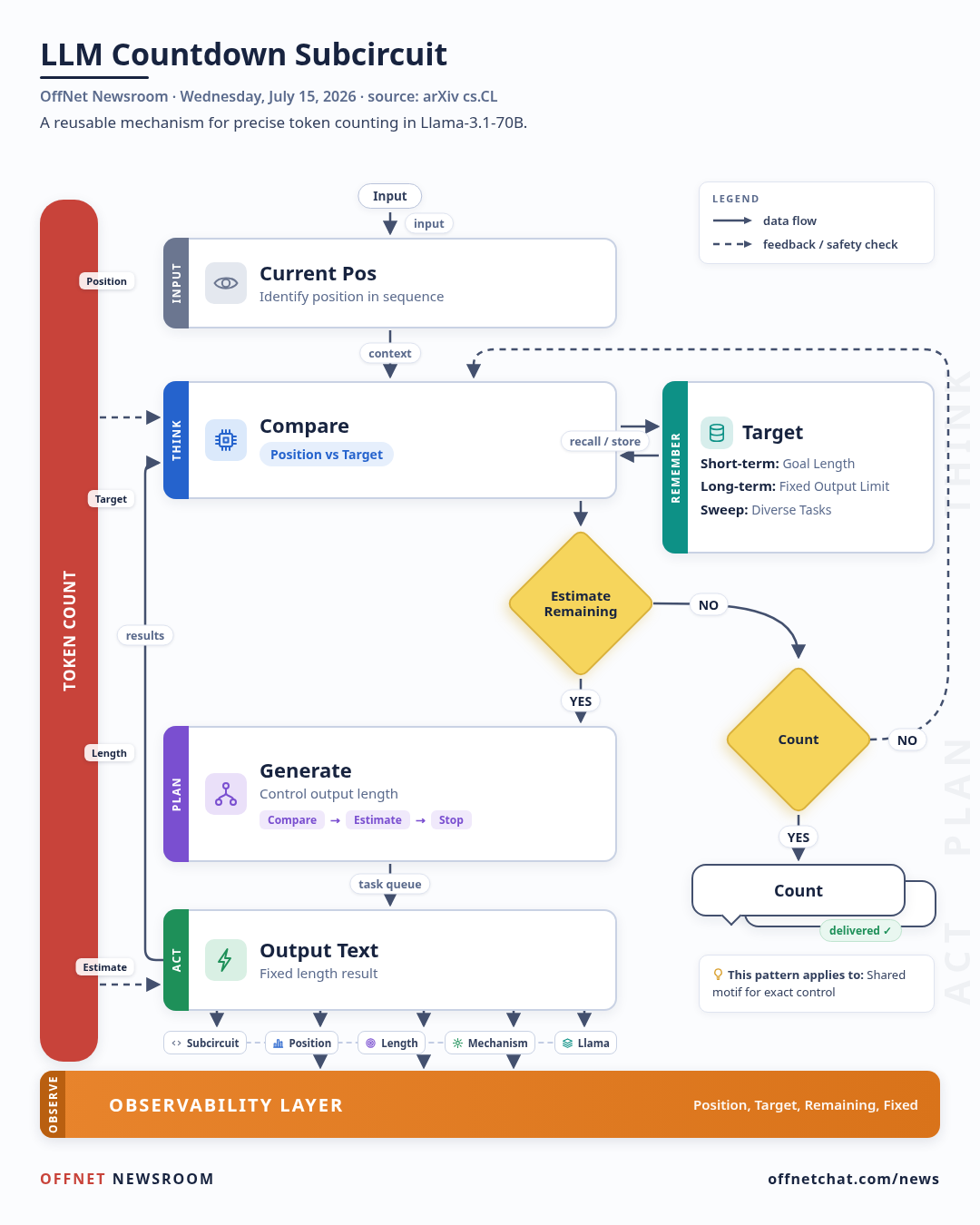
Researchers have isolated a specific mechanism in Llama-3.1-70B-Instruct that enables precise token counting across diverse tasks. This countdown subcircuit compares the current token position against a target length to estimate remaining tokens. The study reveals that this motif is shared across various applications requiring exact length control, such as sentence generation and sequence formatting.

  • LLMs use a reusable subcircuit for precise token counting tasks.
  • Mechanism compares current position to a goal length estimate.
  • Identified in Llama-3.1-70B-Instruct via controlled experiments.
  • Explains consistent performance in fixed-length output generation.
  • Shared motif suggests generalizable counting architecture in models.
HOW IT WORKSCountdown Subcircuit Process1Compare current token position2Estimate target length goal3Calculate remaining tokens4Adjust output generation
Hacker News (100+ points) general

Bonsai 27B: 27B-parameter model designed to run on mobile devices

PrismML has released Bonsai 27B, a large language model with 27 billion parameters capable of operating on smartphones. The model represents a significant step in optimizing large models for edge deployment without requiring cloud infrastructure. This release highlights ongoing efforts to shrink model size while maintaining performance for on-device applications.

  • 27B parameter count is unusually large for on-device inference
  • Enables local AI processing without cloud dependency
  • Targets mobile hardware constraints specifically
  • Signals shift toward edge-native LLM architectures
  • Reduces latency and privacy concerns for end users
BY THE NUMBERSMobile AI Milestone27BParameters for on-device useUnusually large for smartphone inference

Gartner predicts a shift toward hybrid AI models where workloads are offloaded to local desktops whenever feasible. This approach aims to contain the escalating costs associated with cloud-based token usage. By processing data locally, organizations can reduce their reliance on expensive external inference services.

  • Local inference reduces variable cloud token costs significantly
  • Hybrid models balance latency needs with budget constraints
  • Desktop AI hardware becomes a cost-control lever, not just a novelty
  • Offloading decisions should prioritize data sensitivity and volume

Researchers demonstrate that training decoder-only transformers on chronologically filtered data can significantly reduce the performance lag of point-in-time language models. By scaling to 4 billion parameters and 1 trillion tokens from FineWeb, they eliminate future information leakage that compromises causal inference in finance and social sciences. The study produces a sequence of monthly checkpoints spanning from 201, showing that scale is a viable strategy to bridge the gap with unconstrained models.

  • Chronological filtering prevents future data leakage, ensuring valid backtests and causal inference.
  • Scaling to 4B parameters and 1T tokens substantially narrows the performance gap of PIT models.
  • Monthly checkpoints allow reconstruction of model capabilities at specific historical dates.
  • This approach enables temporal analysis without the bias inherent in unrestricted internet corpora.
BY THE NUMBERSScaling PIT Models4BParameters to narrow gap1T tokens from FineWeb eliminate leakage
Hacker News (100+ points) general

Parallel Codex Instances Solve 20 Erdős Problems

A new study demonstrates that running twenty separate Codex accounts in parallel can successfully solve twenty distinct Erdős problems. The approach leverages concurrent model execution to handle the computational load of these complex mathematical challenges. This method highlights the scalability of AI-assisted problem solving when distributed across multiple instances.

  • Parallelizing LLM requests tackles multiple complex problems simultaneously
  • Erdős problems serve as benchmarks for advanced AI reasoning capabilities
  • Scaling model instances offers a practical path for batch math verification
  • Concurrent execution may reduce time-to-solution for heavy proofs

A security researcher confirmed that xAI's Grok build has stopped uploading entire code repositories to the cloud. However, the researcher asserts that the termination of these uploads was not caused by xAI's stated privacy directive. This suggests the underlying cause or mitigation may differ from the company's public explanation.

  • Grok builds previously exfiltrated full repositories to external cloud storage
  • Uploads have ceased, but the fix mechanism remains disputed by researchers
  • xAI's claimed privacy command is not the actual cause of the stoppage
  • Verify internal telemetry to confirm if leaks are truly suppressed

Researchers introduce CANDI-QA, a new benchmark designed to evaluate large language models in specialized fields like medicine and finance. Unlike traditional QA datasets, this resource focuses on contextual grounding, user awareness, and domain-specific accuracy. The dataset consists of expert-curated question-answer pairs structured to test precise information extraction and nuanced understanding.

  • New benchmark moves beyond general knowledge to test domain-specific LLM capabilities.
  • Evaluates contextual grounding and user alignment in sensitive fields like healthcare.
  • Features expert-curated pairs focusing on precise information extraction tasks.
  • Addresses gaps in traditional QA benchmarks for specialized professional use cases.
TRADE-OFFCANDI-QA vs Traditional QATraditional BenchmarksFocuses on general…Lacks domain-specific nuanceIgnores contextual groundingCANDI-QA BenchmarkTargets niche domains like medicineTests user awareness and alignmentUses expert-curated precise pairsvs

The MAGE framework provides a controlled environment to analyze how components like episodic memory and multi-objective selection interact during iterative prompt optimization. Researchers identified the Prompt Optimization Coupling Effect (POCE), where multiple stochastic signals in a reflective loop simultaneously boost performance and amplify variance. This study serves as an ablation platform rather than a claim of superior absolute optimization.

  • MAGE is an analysis framework, not a standalone optimizer proposal.
  • POCE shows combined signals improve performance while increasing variance.
  • Episodic memory and Pareto selection interact in closed reflective loops.
  • Results highlight trade-offs in multi-component prompt optimization strategies.
TRADE-OFFMAGE Framework RoleCommon MisconceptionStandalone optimization solutionClaims superior performanceSimple improvement toolActual PurposeControlled analysis environmentAblation study platformReveals component interactionsvs

AI / ML 8

roundup ↗

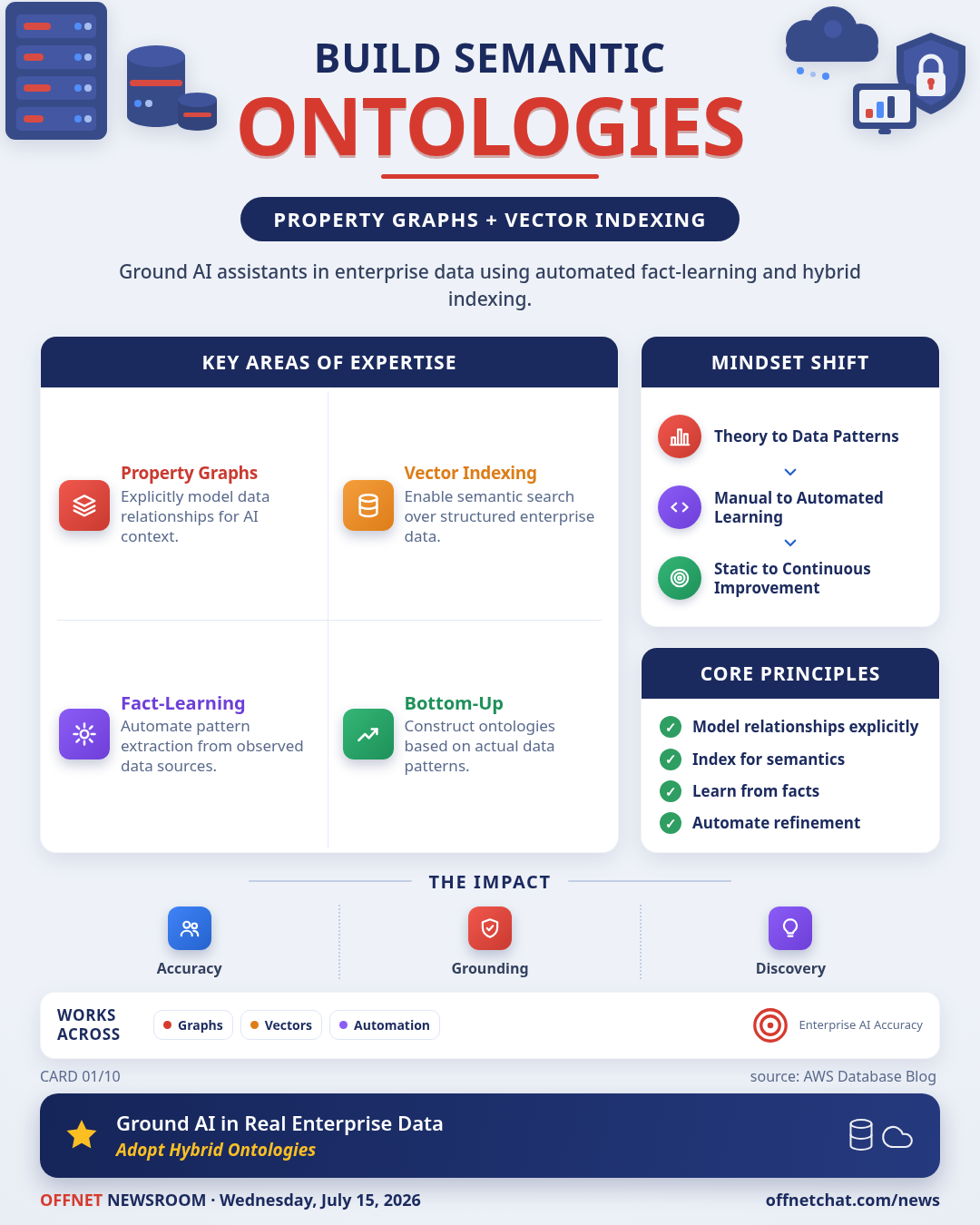
AWS outlines a method for grounding AI assistants in enterprise data by constructing a semantic ontology from existing information. The approach combines property graph stores for relationship mapping with vector indexing to enable semantic search capabilities. An automated fact-learning layer is introduced to refine the ontology by extracting patterns directly from observed data rather than relying on theoretical models.

  • Use property graphs to explicitly model data relationships for AI context.
  • Implement vector indexing to enable semantic search over structured data.
  • Adopt a bottom-up ontology approach based on actual data patterns.
  • Automate fact-learning to continuously improve assistant accuracy.

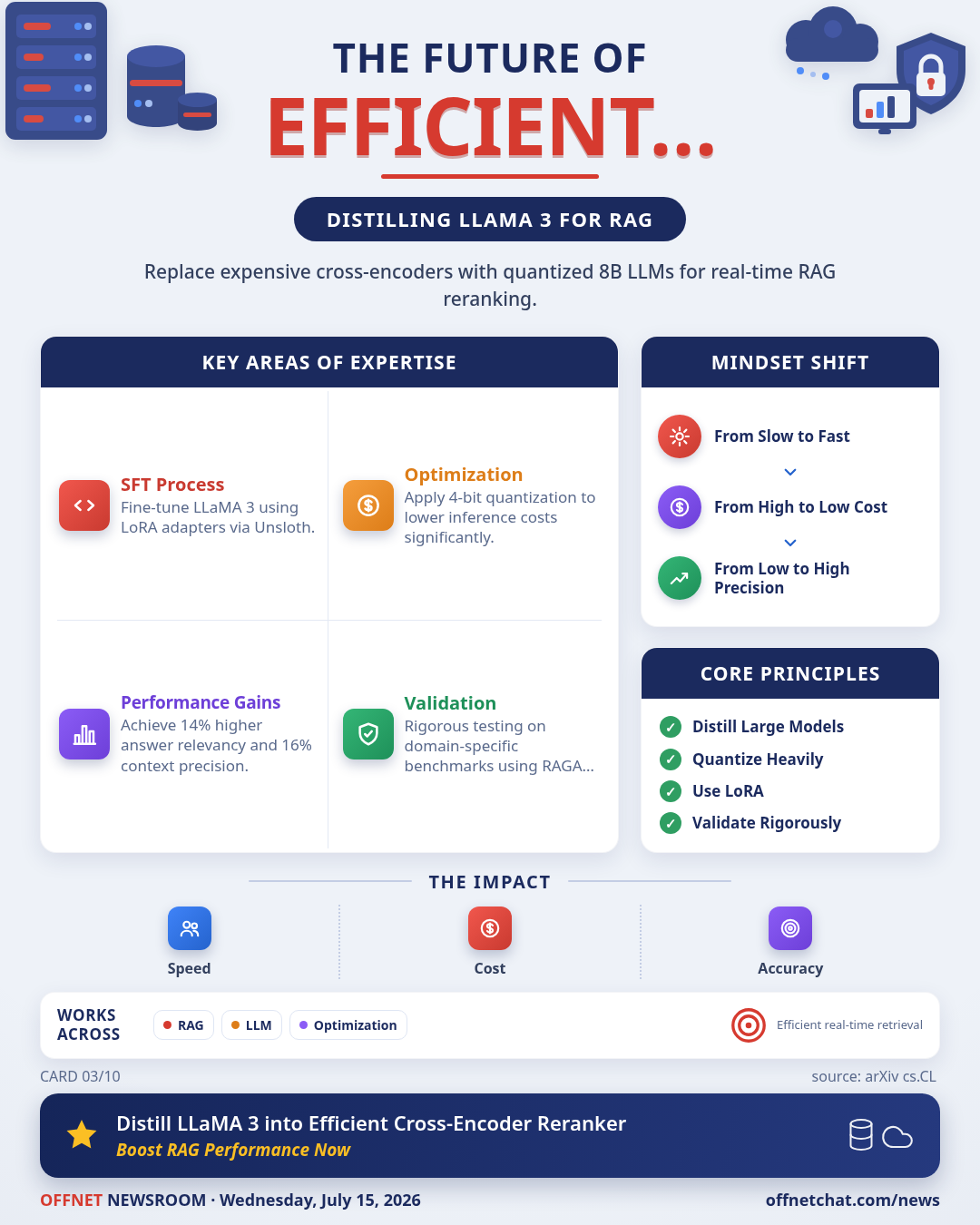
This paper addresses the high inference costs of cross-encoders in RAG pipelines by fine-tuning LLaMA 3 (8B) as a drop-in reranker. The process involves supervised fine-tuning with LoRA adapters using the Unsloth framework, followed by 4-bit quantization to optimize performance. Evaluated on a domain-specific QA benchmark, the model significantly improves answer relevancy, context precision, and answer accuracy compared to standard retrievers.

  • Replaces expensive cross-encoders with a quantized 8B LLM for real-time RAG reranking.
  • Achieves 14% gain in answer relevancy and 16% in context precision via distillation.
  • Uses Unsloth and LoRA for efficient fine-tuning, then 4-bit quantization for deployment.
  • Validated on domain-specific benchmarks using RAGAS framework for rigorous metrics.
COMPARISONRAG Metrics Gained via DistillationAnswer Relevancy14%Context Precision16%

Researchers propose TAKE, a framework that distills large-scale text corpora down to 0.1% of their original size while maintaining downstream task fidelity. The method leverages influence functions to quantify each sample's contribution to the training objective. By convolving knowledge-based influence along the training trajectory, TAKE generates a single per-sample score to identify and retain the most informative data points.

  • Reduces training data volume to 0.1% of original size, significantly lowering storage and compute costs.
  • Uses influence functions to measure individual sample contribution to downstream objectives.
  • Convolve influence along training trajectory to capture dynamic informative samples.
  • Enables efficient continual learning by retaining only high-impact text data.
BY THE NUMBERSTAKE Distillation Efficiency0.1%Retained data volumeOriginal size reduced to 0.1% while maintaining fidelity

This research paper introduces a framework that decomposes image-based retinal diagnoses into structured argumentation components based on the Toulmin model. Instead of treating ML predictions as final claims, the system extracts biomarkers as grounds, uses a MedGemma agent to validate the warrant, and defines qualifiers and rebuttals. This approach shifts from black-box outputs to a structured, interpretable diagnostic assistance model.

  • Decomposes ML predictions into Toulmin's claim, grounds, warrant, qualifier, rebuttal, and backing.
  • Uses specialized models for biomarker extraction (grounds) rather than raw image features.
  • Employs a MedGemma agent to analyze the warrant linking evidence to the diagnostic claim.
  • Enables structured interpretability by explicitly modeling qualifiers and potential rebuttals.
HOW IT WORKSToulmin ML Diagnostic Pipeline1Extract biomarker grounds2Validate warrant via MedGemma3Define claim and qualifier4Model rebuttal scenarios

SupplyNetPy is a new open-source Python library designed for modeling and simulating arbitrary multi-echelon supply chain networks. It supports discrete-event simulation with features like perishable inventory, node disruptions, and stochastic demand. The tool allows users to define networks as graphs and provides detailed performance reports, validated against analytical benchmarks and commercial tools.

  • Open-source Python library for high-fidelity supply chain simulation
  • Supports arbitrary multi-echelon structures and discrete-event modeling
  • Handles perishable inventory, disruptions, and stochastic lead times
  • Validated against commercial tools and analytical benchmarks
  • Extensible architecture via inheritance for custom components
CHECKLISTSupplyNetPy Key FeaturesModel multi-echelon supply chainsSimulate discrete events and disruptionsHandle perishable inventory and stochastic demandValidate against commercial toolsExtend via custom components
AWS What's New awsdatabase ↺ since 07-14

OpenAI Privacy-Filter for PII detection now on SageMaker JumpStart

AWS has added OpenAI's bidirectional privacy-filter model to SageMaker JumpStart, enabling one-click deployment for PII detection and masking. The model performs context-aware token classification in a single forward pass, identifying spans like emails, names, and secrets. This allows engineering teams to build high-throughput data sanitization workflows directly on AWS infrastructure.

  • OpenAI's bidirectional model now available via SageMaker JumpStart for easy deployment.
  • Detects PII spans including emails, names, secrets, and account numbers in one pass.
  • Designed for high-throughput sanitization workflows on AWS or on-premises.
  • Tunable architecture supports context-aware masking for sensitive text data.
CHECKLISTDeploying PII DetectionOne-click deploy OpenAI model via SageMaker JumpStartIdentify emails names secrets and account numbersPerform context-aware masking in a single passBuild high-throughput sanitization workflows on AWS
AWS What's New awsdatabase ↺ since 07-14

Qwen3 Embedding and Reranking Models Now in SageMaker JumpStart

AWS has added Qwen3-VL-Embedding-2B and Qwen3-Reranker-4B to SageMaker JumpStart. The embedding model handles initial recall for mixed modalities like text, images, and video. The reranker then refines these results for higher precision retrieval.

  • Qwen3-VL-Embedding-2B supports text, images, screenshots, and video inputs for cross-modal search.
  • Qwen3-Reranker-4B improves precision by re-ranking initial recall results from the embedding model.
  • Both models are available via SageMaker JumpStart for immediate deployment on AWS infrastructure.
  • This pairing enables building comprehensive, multi-stage retrieval pipelines with specialized capabilities.
HOW IT WORKSQwen3 Retrieval Pipeline1Ingest text and video2Qwen3-VL-Embedding-2B recall3Qwen3-Reranker-4B precision4Finalized search results
AWS What's New awsdatabase ↺ since 07-14

Gemma-4-E2B-it now on SageMaker JumpStart for efficient multimodal AI

AWS has added Google DeepMind's Gemma-4-E2B-it to SageMaker JumpStart, offering a multimodal model optimized for local execution. The model supports text, image, and audio inputs with native function calling and a step-by-step reasoning mode. It enables agentic workflows and handles complex tasks like OCR, code generation, and UI understanding.

  • Gemma-4-E2B-it is available via SageMaker JumpStart for rapid deployment
  • Model optimized for efficient local execution on AWS infrastructure
  • Supports multimodal inputs including text, image, audio, and video
  • Includes built-in reasoning mode for step-by-step problem solving
  • Enables agentic workflows through native function calling capabilities
TRADE-OFFGemma-4-E2B-it CapabilitiesInput TypesText processingImage analysisAudio recognitionCore FeaturesNative function callingStep-by-step reasoningAgentic workflowsvs

Agentic AI 8

roundup ↗

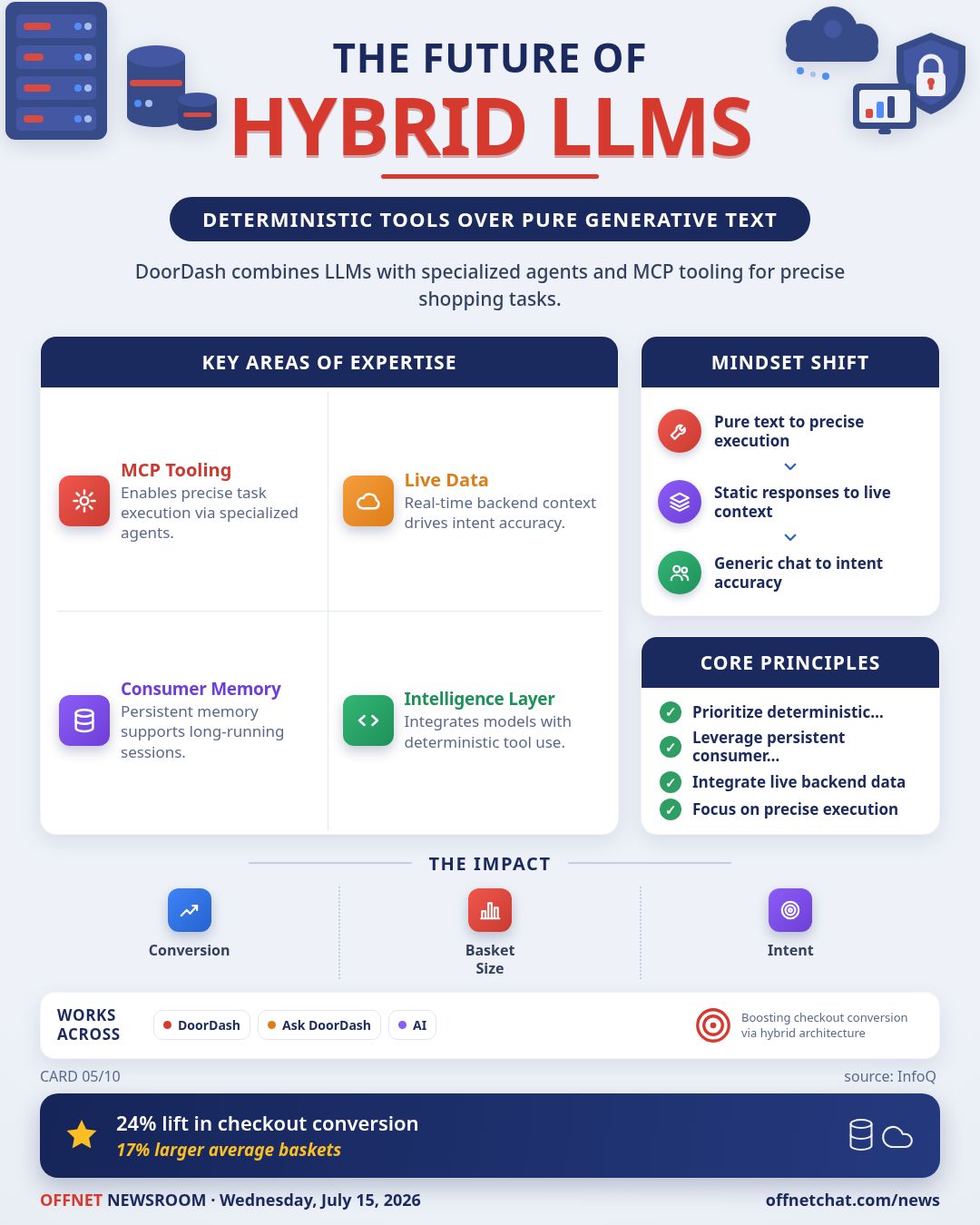
DoorDash engineered Ask DoorDash by integrating large language models with specialized agents and MCP-based tooling, supported by an intelligence layer handling persistent consumer memory and live backend data. This hybrid approach moves beyond pure generative text to execute precise shopping tasks with real-time context. Early metrics indicate a 24% lift in checkout conversion and a 17% increase in basket size, driven by improved intent accuracy through memory-backed sessions.

  • Combines LLMs with specialized agents and MCP tooling for precise task execution.
  • Persistent consumer memory and live backend data drive intent accuracy.
  • Resulted in 24% higher checkout conversion and 17% larger average baskets.
  • Architecture prioritizes deterministic tool use over pure generative responses.
COMPARISONDoorDash AI Impact MetricsCheckout Conversion24%Basket Size17%

OpenAI has implemented encryption for MultiAgentV2 messages within the Codex agent framework, effectively hiding internal system instructions from developers. This security measure prevents engineers from inspecting the exact prompts and logic guiding the agent's behavior during runtime. The move raises concerns about the ability to audit agent decisions and troubleshoot unexpected outputs in production environments.

  • Encrypted MultiAgentV2 messages block visibility into agent instructions
  • Debugging agent errors becomes significantly harder without prompt access
  • Auditing agent behavior for compliance or safety is now opaque
  • Developers lose direct insight into how Codex agents are guided
AWS What's New awsdatabase

AWS Lambda Console Adds One-Click Setup for Coding Agents

The AWS Lambda console now offers a one-click prompt to configure coding agents with AWS Serverless skills and the Serverless Model Context Protocol (MCP) server. This update embeds serverless best practices directly into the agent configuration, removing the need to manually navigate documentation for setup. Developers can initiate this streamlined process at any stage of their Lambda journey, from initial exploration to creating their first function.

  • Eliminates manual configuration friction for coding agents in the Lambda console.
  • Automatically installs AWS Serverless skills and Serverless MCP server.
  • Embeds serverless best practices directly into agent workflows from day one.
  • Available across all Lambda console entry points for new and existing users.
HOW IT WORKSOne-Click Agent Setup1Open Lambda Console2Click One-Click Prompt3Install Serverless Skills4Configure MCP Server

Public battery aging datasets often suffer from inconsistent formats and scattered metadata, making them difficult to use for health management. BatteryLake addresses this by implementing a governed data lakehouse that uses LLM agents to extract metadata and synthesize dataset-specific converters. This agentic, physics-grounded framework ensures outputs are tied to verbatim evidence, automatically abstaining when no supporting data exists.

  • Solves fragmentation in public battery aging data through automated, reproducible curation.
  • Uses LLM agents to generate converters grounded in verbatim evidence from source papers.
  • Mitigates hallucination risks by having agents abstain when no metadata evidence is found.
  • Provides benchmark-ready assets by handling domain-specific semantics of electrochemical time-series.
HOW IT WORKSBatteryLake Agentic Curation Pipeline1Ingest heterogeneous battery aging datasets2Extract metadata using LLM agents3Synthesize dataset-specific converters4Ground outputs in verbatim evidence5Abstain if no supporting data

Multi-agent and memory-augmented LLM systems often place coordination content, shared state, prior discussion, tool outputs, summaries, and role instructions, inside the same finite prompt used for the current task. This creates a practical allocation problem: every token spent on coordination is unavailable to task instructions or evidence when a call is assembled under a fixed context budget. The authors introduce the Roundtable Context Window Test (RCWT) to measure this displacement by varying coordination content while controlling total budget, position order, task family, and scoring.

  • Coordination tokens directly displace task-relevant evidence in fixed-context calls.
  • RCWT isolates this effect by varying coordination content while holding budget constant.
  • Protocol controls for position order, task family, and scoring to ensure valid metrics.
  • Current commercial models show baseline recall retention under moderate displacement at W=4096.
CHECKLISTRCWT Protocol EssentialsHold fixed context budget constant at 4096 tokensVary coordination content volume to measure displacementControl position order and task family variablesScore recall retention to isolate effect

Google and industry partners have introduced the Agentic Resource Discovery (ARD) specification, an open standard designed to streamline how AI agents find and verify tools, APIs, and other agents. The specification establishes a discovery layer utilizing catalogs and registries to enable dynamic capability discovery. It builds upon existing protocols like MCP and OpenAPI for execution while prioritizing trust and interoperability across agents.

  • ARD provides an open standard for publishing and discovering AI tools and agents.
  • Discovery relies on catalogs and registries rather than hard-coded endpoints.
  • Execution leverages established protocols like MCP and OpenAPI for compatibility.
  • The spec emphasizes trust and interoperability between different agent systems.
Hacker News (100+ points) general

Open source is no longer free in the agentic AI era

ThoughtWorks argues that the traditional assumption of zero-cost open-source software is breaking down as agentic AI workflows increase infrastructure consumption. The article highlights how autonomous agents driving more queries and compute resources are shifting the true cost of OSS from licensing to operational overhead. Engineers must now account for these hidden expenses when planning for scalable AI-integrated systems.

  • Agentic AI drives higher compute and query loads, increasing infrastructure costs for OSS dependencies.
  • The 'zero-cost' model fails when autonomous agents continuously interact with open-source libraries.
  • Architects must budget for operational overhead, not just licensing, in AI-native environments.

This research addresses the latency and data-sensitivity constraints of deploying large language models for industrial closed-loop control by fine-tuning compact Small Language Models like Qwen2.5-3B. The proposed framework replaces opaque, high-latency cloud inference with a local agent that generates control policies from natural language specifications. To ensure safety, the system employs a multi-agent self-correction loop where a plant-aware validator, such as a digital twin, checks candidate actions before execution.

  • Fine-tuned SLMs offer a viable path for low-latency, edge-native industrial control automation.
  • Natural language policy generation reduces manual redesign effort for control systems.
  • Validator-guided correction loops mitigate hallucination risks in autonomous decision-making.
  • Digital twin integration enables safe pre-execution verification of AI-generated actions.
HOW IT WORKSMulti-Agent Validation Loop1Natural language input2SLM generates policy3Digital twin validates4Execute or correct

Automation / DevOps / IaC 8

roundup ↗
Hacker News (100+ points) general

Tailscale TS-2026-009: Insecure SSH args allowed root access

Tailscale disclosed a security vulnerability where insecure handling of command-line arguments in its SSH service permitted unauthorized root access. The flaw allows attackers to bypass intended restrictions by manipulating how arguments are processed. This issue has been addressed in a recent security bulletin released by the company.

  • Tailscale SSH service had a critical argument handling flaw.
  • Exploit could bypass restrictions to gain root access.
  • Patch is available in the latest security bulletin.
  • Review your SSH configurations for potential exposure.
Hacker News (100+ points) general

Dependabot adds default package cooldown to version updates

GitHub is introducing a default package cooldown mechanism for Dependabot version updates to reduce noise and prevent update storms. This change aims to stabilize CI/CD pipelines by spacing out automated dependency changes. The feature applies to version update workflows without requiring manual configuration for most users.

  • Automated updates now include a default cooldown period to reduce pipeline noise.
  • Helps prevent update storms that can overwhelm CI/CD resources and reviewers.
  • Applies to Dependabot version updates by default, requiring no extra config.
  • Improves stability for large fleets managing many dependencies simultaneously.

Evaluating context-reduction layers solely by text removal ignores actual billing metrics. A pre-specified campaign of 2,908 Claude Code runs analyzed whether compressing retrieved context or tool outputs truly lowers costs without hurting success rates. The study compares baseline execution against hook-based compression and API-boundary proxies across multiple models and repositories. Results challenge the assumption that fewer tokens automatically translate to lower provider bills.

  • Token count is a poor proxy for actual API billing in coding agents.
  • Context compression may fail to reduce costs even if text volume drops.
  • Success rates and trajectory length must be monitored alongside cost.
  • API-boundary proxies offer a distinct optimization vector compared to hooks.
  • Evaluated 2,848 runs across 103 tasks and seven repositories.
BY THE NUMBERSRuns Analyzed in Study2,908Total Claude Code RunsEvaluated to challenge token cost assumptions

The Linkerd community has released version 2.20, introducing enhancements focused on performance, observability, and traffic management. This update reinforces the CNCF-graduated service mesh's standing as a lightweight networking solution for Kubernetes environments. The release aims to provide more intelligent control over service-to-service communication while reducing resource overhead.

  • New traffic management features offer finer control over service mesh routing.
  • Performance optimizations deliver significant efficiency gains for cluster resources.
  • Enhanced observability tools improve visibility into mesh traffic patterns.
  • Reinforces Linkerd's position as a lightweight Kubernetes networking alternative.
Hacker News (100+ points) general

Microsoft patches record 570 security flaws in latest update cycle

Microsoft has released emergency software updates to address a record-breaking 570 security vulnerabilities across its product ecosystem. This massive patch cycle highlights the increasing complexity and attack surface of modern enterprise software stacks. Security teams are urged to prioritize these updates to mitigate potential exploitation vectors immediately.

  • Microsoft addressed 570 vulnerabilities, setting a new record for a single update cycle.
  • The volume of fixes suggests significant technical debt or coordinated discovery efforts.
  • Prioritize patching to reduce exposure to zero-day exploitation attempts.
  • Review release notes to identify critical flaws affecting your specific infrastructure.
BY THE NUMBERSRecord 570 Security Flaws Patched570New record for single update cycleHighlights increasing complexity of enterprise software stacks
GitHub Trending (daily) githubrepos ⚠ unverified date/source

Win11Debloat: Lightweight PowerShell Script for Windows Telemetry and Bloat Removal

Raphire/Win11Debloat is a standalone PowerShell script designed to declutter Windows 10 and 11 systems without requiring installation. It automates the removal of pre-installed apps, disables telemetry, and strips intrusive interface elements. The tool targets system administrators and power users seeking rapid, script-based customization of the OS environment.

  • No installation required; runs directly as a PowerShell script for immediate use.
  • Supports both Windows 10 and Windows 11 for broad compatibility.
  • Automates bulk removal of pre-installed apps and telemetry services.
  • Includes features tailored for system administrators and power users.
  • Reduces manual configuration effort by decluttering interface elements.
AWS What's New awsdatabase ↺ since 07-11

AWS DMS Schema Conversion adds AI agent automation via MCP Server

AWS has integrated AI agent automation into Database Migration Service Schema Conversion through the AWS MCP Server. This allows coding agents like Kiro, Claude Code, and Cursor to autonomously execute migration workflows from within an IDE. The new dms-schema-conversion skill enforces predefined API patterns and operational rules to reduce trial-and-error during schema conversion.

  • Connect IDE-based AI agents to DMS Schema Conversion using the AWS MCP Server
  • Agents can autonomously create projects, browse metadata, and generate assessment reports
  • Predefined skill procedures enforce operational sequencing to minimize trial-and-error
  • Supports conversion of remaining code objects like stored procedures via natural language
HOW IT WORKSAutomated Schema Conversion Pipeline1Connect IDE agents via MCP Server2Agents create migration projects3Browse database metadata4Generate assessment reports5Convert code objects
AWS What's New awsdatabase ↺ since 07-11

EMR on EKS adds AI-powered Spark troubleshooting agent

Amazon EMR on EKS now integrates an Apache Spark troubleshooting agent that diagnoses job failures using natural language prompts. The system automatically analyzes Spark History Server data, distributed executor logs, and cluster configurations to pinpoint issues like memory errors, data skew, and resource contention. Users can access this feature directly from the console via a 'Troubleshoot with AI' button on failed jobs, eliminating the need to manually sift through logs.

  • Diagnose Spark failures on EMR on EKS using natural language queries for root cause analysis.
  • Agent automatically inspects executor logs, history server data, and cluster configs for issues.
  • Covers memory errors, data skew, resource contention, and connectivity failures.
  • Consistent troubleshooting experience now available across EMR on EC2, Serverless, and EKS.
  • Access the feature directly via the 'Troubleshoot with AI' option in the EMR on EKS console.
TRADE-OFFTroubleshooting EvolutionOld WayManual log siftingComplex debugging skills neededTime-consuming root cause analysisNew AI WayNatural language promptsInstant automated diagnosisDirect console accessvs

AWS 8

roundup ↗

AWS has extended Amazon GuardDuty to monitor AI-specific workloads in Bedrock and SageMaker. The service analyzes CloudTrail events to identify threats like prompt injection and anomalous model invocations. It also detects cost harvesting attacks where actors exhaust GPU time and tokens. This provides visibility into AI security without requiring custom tooling or manual configuration.

  • GuardDuty now covers Bedrock and SageMaker for AI threat detection
  • Detects prompt injection, anomalous invocations, and cost harvesting
  • Analyzes CloudTrail management and data events automatically
  • Reduces need for custom security tooling for AI workloads
CHECKLISTGuardDuty AI Threat DetectionMonitor Bedrock and SageMaker workloadsDetect prompt injection attacksIdentify anomalous model invocationsSpot GPU cost harvestingAnalyze CloudTrail events automatically

AWS Security Hub now includes an AI inventory feature to provide centralized security teams with a continuous, organization-wide view of AI assets and their security posture. This capability addresses the visibility gap that arises as organizations rapidly deploy AI agents, models, and pipelines. The feature automatically discovers and catalogs AI workloads across the AWS environment to help secure assets that might otherwise go unnoticed.

  • Centralized visibility into AI assets eliminates blind spots in security posture.
  • Automatically discovers AI workloads without requiring additional configuration.
  • Catalogs managed AI services via AWS Config resources from Amazon Bedrock.
  • Includes Bedrock AgentCore and Amazon SageMaker in the inventory scope.
  • Connects AI assets to active threats and misconfigurations for better defense.
CHECKLISTSecure AI Assets NowGain organization-wide visibility into AI assetsAutomatically discover AI workloads without extra configCatalog services via AWS Config resourcesConnect assets to active security threats

Amazon Redshift Serverless now automatically maintains zero-ETL and Amazon S3 event integrations when restoring a namespace from a snapshot or recovery point. Previously, these integrations were marked as failed during restore, forcing manual recreation and risking data ingestion gaps. This update ensures integrations resume operation immediately after restore, simplifying disaster recovery and testing workflows.

  • Snapshot restores now keep zero-ETL and S3 event integrations active without manual reconfiguration.
  • Eliminates data ingestion gaps and administrative overhead during disaster recovery or testing.
  • Reduces risk of errors associated with rebuilding complex data pipelines post-restore.
HOW IT WORKSSeamless Snapshot Restore Flow1Create namespace snapshot2Restore from recovery point3Integrations resume automatically4Zero manual reconfiguration

Google Cloud's VMware service has suffered a resilience degradation triggered by a faulty update. This issue coincides with VMware's own warning regarding a critical flaw in its load balancer components. The incident highlights the fragility of managed VMware offerings when underlying software patches introduce regressions.

  • Google Cloud VMware service resilience is currently compromised due to a recent update.
  • The outage aligns with VMware's disclosure of a critical load balancer vulnerability.
  • Practitioners should monitor Google Cloud status pages for VMware service health.
  • Verify load balancer configurations if running on affected VMware infrastructure.
  • Treat pending VMware patches with caution until resilience is restored.

Amazon Managed Service for Apache Flink now integrates AI Agent Skills that provide coding assistants with expert, up-to-date guidance for building and operating Flink applications. These skills cover common tasks like troubleshooting, scaling, monitoring, and version upgrades, transforming specialized knowledge into a guided experience. This allows developers to independently manage application health and accelerate development using existing tools like Kiro.

  • AI coding assistants now access expert Flink guidance for tasks like scaling and monitoring
  • Simplifies upgrades to latest Apache Flink versions like 2.2 without deep expertise
  • Reduces dependency on specialized knowledge by turning complex ops into guided workflows
  • Compatible with existing AI agents like Kiro to boost developer productivity
HOW IT WORKSFlink AI Skill Workflow1Developer invokes AI agent2Agent accesses Flink skills3Guided scaling or monitoring4Version upgrade to 2.25Independent app management

New York has become the first state to pause construction of data centers exceeding 50 megawatts while regulators draft new rules. The moratorium aims to address environmental concerns and shield ratepayers from the financial and infrastructural strain of massive power demands. This move signals a tightening regulatory landscape for large-scale AI and cloud infrastructure projects in the region.

  • New York pauses all datacenter builds over 50MW pending new regulatory framework
  • Focus is on protecting the electrical grid and reducing costs for ratepayers
  • Environmental impact assessments will likely become stricter for large deployments
  • Other states may follow suit as power constraints become a critical bottleneck
  • Project timelines for major hyperscaler expansions in NY are now uncertain
AWS Database Blog awsdatabase ↺ since 07-14

Aurora PostgreSQL: Rebuild large indexes via Blue/Green and NVMe

AWS describes using Blue/Green Deployments to rebuild large indexes on Aurora PostgreSQL without impacting production. The process performs the reindex on the green staging environment using NVMe-backed instances, allowing the sort phase to leverage fast local storage instead of networked EBS. This approach isolates the heavy I/O and compute costs from the active blue production cluster.

  • Isolate expensive reindexing workloads by targeting the green staging environment exclusively.
  • Select NVMe-backed instance classes to utilize local storage for the sort phase, reducing network overhead.
  • Use Aurora Optimized Reads to enhance performance during the index rebuild process.
  • Avoid production latency spikes by keeping the heavy I/O off the active blue cluster.

Fleet impact: For DBAs managing Aurora PostgreSQL, this offers a zero-downtime path to handle massive index maintenance. Verify that your NVMe instance classes have sufficient local storage capacity for the sort operations, and plan your Blue/Green deployment cycles to absorb the staging rebuild time before cutover.

InfoQ generaldevops ↺ since 07-14

Eliminating Latency in Multi-Region AWS APIs by Dropping Discovery Calls

Regional outages exposed a hidden latency bottleneck in a multi-region AWS API architecture. The root cause was a pre-flight discovery call embedded in every client session, originally implemented as the only available option at the time. The engineering team successfully removed this round trip to enable viable global failover, detailing the implementation steps and rollout costs.

  • Pre-flight discovery calls add unavoidable latency, hindering rapid global failover.
  • Legacy design choices can become critical bottlenecks during regional outages.
  • Removing hidden round trips is essential for low-latency multi-region architectures.
  • The team documented the specific costs and steps required to execute this change.

Trending on GitHub 2

roundup ↗
GitHub Trending (daily) githubrepos ⚠ unverified date/source

Shubhamsaboo/awesome-llm-apps: 100+ Runnable AI Agent & RAG Templates

This repository aggregates over 100 end-to-end tested, Apache-2.0 licensed applications for AI agents and Retrieval-Augmented Generation. It supports various large language models including Claude, Gemini, GPT, and open-source options like Llama and Qwen. The collection includes practical examples such as insurance claim processing and fraud investigation agents, complete with step-by-step tutorials.

  • Provides cloneable, customizable templates for rapid prototyping of LLM-based applications.
  • Covers diverse use cases including RAG, agent skills, and multi-agent team simulations.
  • Compatible with major proprietary and open-source model providers out of the box.
  • Includes direct integration commands for coding agents to add new skills instantly.
GitHub Trending (daily) githubrepos ↺ since 07-14 ⚠ unverified date/source

Hallmark: Anti-AI-slop design skill for AI coding agents

Hallmark is a design skill for Claude Code, Cursor, and Codex that prevents AI-generated code from looking generic. It enforces a macrostructure, selects from twenty themes, and runs fifty-seven tests to reject on-distribution defaults. The tool uses four verbs to build new UIs or audit existing code against anti-patterns.

  • Built for Claude Code, Cursor, and Codex to enforce consistent, non-generic design output.
  • Uses fifty-seven slop-test gates and self-critique to reject standard LLM design defaults.
  • Offers 'hallmark audit' to score existing code against anti-patterns without editing.
  • Generates distinct layouts rather than simple color swaps or template variations.
HOW IT WORKSHallmark Anti-Slop Process1Select from twenty themes2Enforce macrostructure layout3Run fifty-seven tests4Reject on-distribution defaults

Mobile friendly 6

all cards ↗

Today's top database + AI stories as save-and-share cards — built for your phone and your LinkedIn feed.