OffNet Newsroom

Archive snapshot

Monday, July 13, 2026

Daily signal on databases, AI, and the tech that matters.

24 new today 44 stories 7 sections 15 for the DBA desk

Database Technology 7

roundup ↗

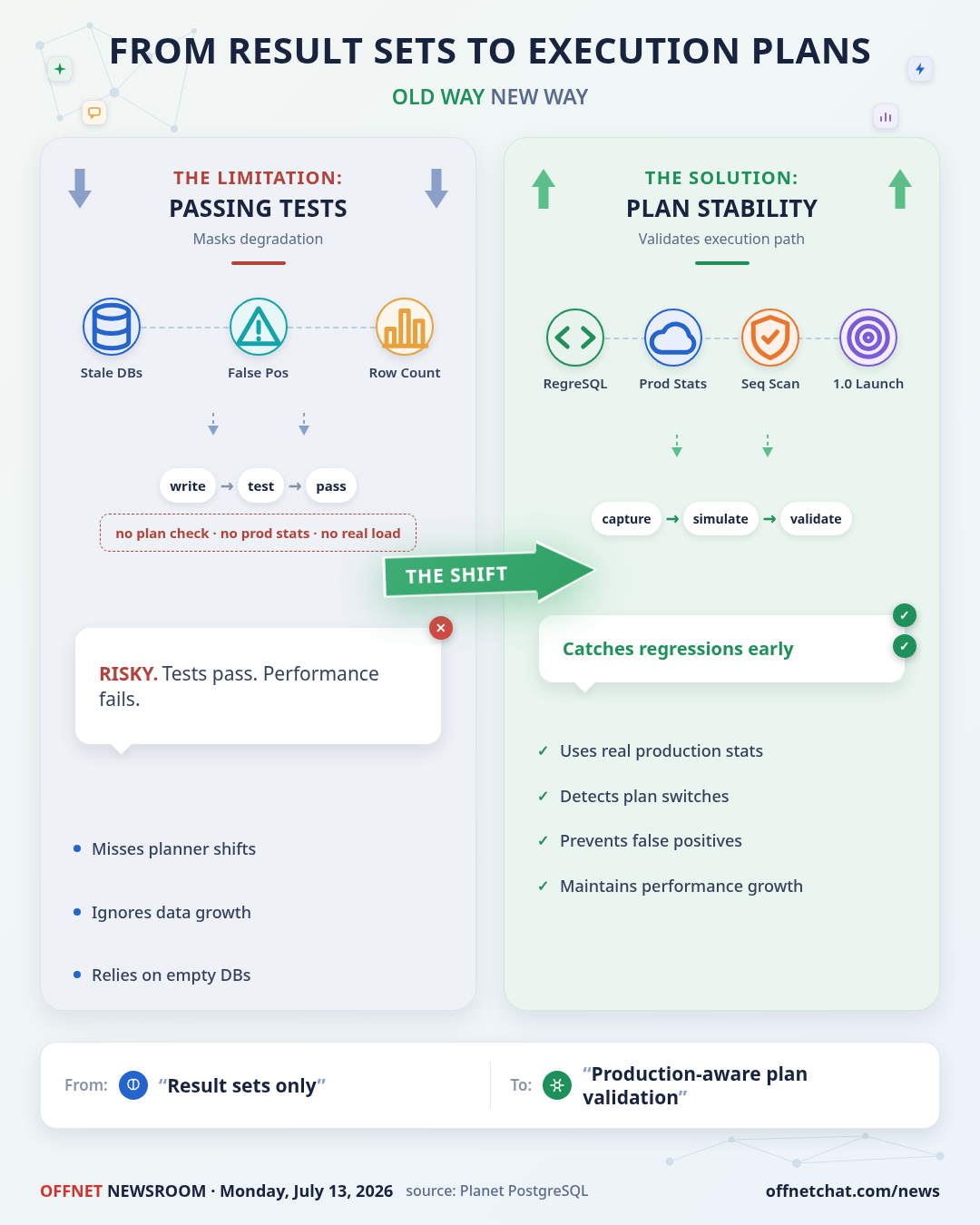
RegreSQL 1.0 addresses the limitation of previous tools by validating query execution plans, not just result sets. It leverages real production statistics to catch regressions caused by planner shifts, such as unexpected sequential scans on growing tables. This approach prevents scenarios where tests pass despite significant performance degradation due to data growth or index changes.

  • RegreSQL 1.0 shifts focus from row correctness to execution plan stability.
  • Uses production statistics to simulate real-world query planning behavior.
  • Detects regressions caused by planner switches to sequential scans.
  • Prevents false positives from empty or stale development databases.
  • Essential for maintaining performance as table sizes increase over time.
AWS What's New awsdatabase ↺ since 07-11

AWS DMS Schema Conversion adds offline SQL Server support

AWS Database Migration Service now allows offline schema conversion for Microsoft SQL Server by extracting metadata locally and uploading it to the service. This approach removes the need for direct connectivity, bypassing security reviews, firewall changes, and VPN setups. It delivers identical conversion results to the connected method while accommodating strict security policies that prohibit external tool access to production databases.

  • Extract SQL Server metadata using standard commands in your own environment before uploading.
  • Eliminate delays from security reviews, firewall rules, and VPN configuration for migrations.
  • Achieves the same conversion accuracy as the connected method without live database access.
  • Ideal for production environments with strict policies against external tool connectivity.
HOW IT WORKSOffline SQL Server Migration Steps1Extract metadata locally using standard…2Upload extracted data to AWS DMS3Perform schema conversion in the cloud4Deploy migrated schema to target system
AWS Database Blog awsdatabase ↺ since 07-10

AWS RDS Oracle: Diagnose and resolve replica lag via wait events

This second part of a series on Amazon RDS for Oracle Read Replicas focuses on troubleshooting replication lag. It details methods for monitoring lag using CloudWatch metrics and database views, followed by an analysis of common root causes through wait event identification. The post provides actionable steps to resolve performance issues causing delays in replica synchronization.

  • Monitor replication lag using Amazon CloudWatch metrics and specific database views for real-time visibility.
  • Identify root causes by analyzing database wait events to pinpoint bottlenecks in the replication stream.
  • Apply targeted troubleshooting steps to resolve performance issues affecting read replica synchronization.
  • Part 2 builds on Part 1's configuration optimizations with deeper diagnostic and resolution techniques.

Fleet impact: For DBAs managing RDS for Oracle fleets, this guidance is critical for maintaining read scalability without data staleness. Prioritize wait event analysis during lag spikes to distinguish between I/O contention and network/redo transmission issues, ensuring you apply the correct remediation rather than blindly scaling instances.

Percona Blog database ↺ since 07-11

Percona builds experimental MySQL 9.7 with DuckDB storage engine

Percona has released an experimental MySQL 9.7 build featuring a DuckDB storage engine that routes analytical queries from marked tables directly to DuckDB. This approach allows analytical workloads to run on the same server and connection as transactional data without duplicating the dataset. Early TPC-H benchmarks at scale factor 10 show InnoDB timing out on six queries and taking 1317 seconds on others, highlighting the performance gap DuckDB aims to fill.

  • Experimental MySQL 9.7 build enables ENGINE=DuckDB for analytical offloading from InnoDB.
  • Analytical queries run in-process without data duplication or separate infrastructure.
  • InnoDB struggled with TPC-H Q6-Q22 timeouts and high latency at scale factor 10.
  • Validates hybrid transactional/analytical processing within a single database instance.
BY THE NUMBERSDuckDB Beats InnoDB Latency1317 secondsInnoDB query timeTimeouts on 6 of 17 TPC-H queries
AWS Database Blog awsdatabase ↺ since 07-10

AWS RDS for Oracle: Reduce Replication Lag via Redo Compression

AWS Database Blog details how enabling redo compression for Amazon RDS for Oracle replicas can optimize and reduce replication lag. This first part of a series focuses specifically on the configuration and impact of the redo compression feature. A subsequent post will cover monitoring, troubleshooting, and resolution techniques for replication lag.

  • Enable redo compression on RDS for Oracle replicas to minimize replication lag
  • Part 1 covers the mechanics of redo compression; Part 2 addresses monitoring and troubleshooting
  • Redo compression reduces network payload, potentially improving stream replication performance
  • Review AWS documentation for specific parameter settings required to activate this feature

Fleet impact: For Oracle ExaCC/RAC fleets replicating to RDS for Oracle, enabling redo compression can significantly reduce WAN bandwidth usage and lag during peak loads. Verify that the target RDS instance supports the feature and test compression ratios in a non-prod environment to gauge network impact before production rollout.

GitHub Trending (daily) githubrepos ↺ since 07-10 ⚠ unverified date/source

pgrust: Rust-based Postgres rewrite passes 100% of regression tests

The pgrust project, a Postgres rewrite in Rust, now passes 100% of the Postgres 18.3 regression suite, covering over 46,000 queries. It maintains disk compatibility with existing Postgres data directories, allowing systems to boot directly from them. The current architecture uses a thread-per-connection model, replacing the traditional process-per-connection approach.

  • pgrust achieves full regression test parity with Postgres 18.3, ensuring behavioral compatibility.
  • Disk compatibility allows migration or side-by-side usage with existing Postgres data directories.
  • Shifts from process-per-connection to thread-per-connection, potentially impacting concurrency models.
  • Leverages Rust and AI-assisted development to explore deeper server internals changes.
BY THE NUMBERSFull Test Parity Achieved100%Regression tests passedPostgres 18.3 suite, 46,000 queries

LLMs 8

roundup ↗

This paper argues that LLM reliability depends less on model capability and more on inference-time control mechanisms like task framing and context selection. It introduces CogniConsole, an architecture that externalizes this control into a structured interface combining programmatic coordination with bounded prompt reasoning. Probes in a multi-step interactive environment show that adding structural scaffolding systematically reduces output variance and failure rates.

  • Reliability is driven by inference-time control layers, not just model size or capability.
  • CogniConsole externalizes control via a structured interface for task framing and context.
  • Structural scaffolding significantly lowers output variance in multi-step interactions.
  • Programmatic coordination combined with bounded reasoning improves system stability.
HOW IT WORKSCogniConsole Inference Pipeline1Programmatic Task Coordination2Bounded Prompt Reasoning3Context Selection4Output Generation

This paper addresses the accuracy degradation LLMs face when processing long contexts by introducing self-guided test-time training. Rather than adapting parameters across the entire noisy context or relying on random span sampling, the method identifies relevant evidence spans for specific questions. This instance-specific adaptation allows the model to utilize long inputs more effectively without the prohibitive cost of full-context training.

  • Long-context accuracy drops as models struggle to filter irrelevant noise.
  • Test-time training adapts parameters per instance but is usually too expensive.
  • Self-guided selection targets only relevant spans, reducing noise significantly.
  • Avoids the pitfalls of random span sampling used in prior TTT approaches.
HOW IT WORKSSelf-Guided Test-Time Training1Identify relevant evidence spans2Select instance-specific context3Adapt model parameters4Improve long-context accuracy

Researchers introduce Soofi S 30B-A3B, a sovereign open-source foundation model blending Mixture-of-Experts with a hybrid Mamba-Transformer architecture. Designed for German and English, it activates only 3 billion of its 30 billion parameters per token, maintaining near-constant inference cache size as context expands. Pretrained on 27 trillion tokens with an emphasis on German, it matches dense 14-27B models on benchmarks and leads in code generation among comparable open models.

  • Hybrid Mamba-Transformer design enables constant inference cache growth for long-context efficiency.
  • Activates only 3B parameters per token (of 30B total), boosting throughput for high-concurrency workloads.
  • Trained on 27T tokens with up-weighted German data, outperforming European sovereign baselines.
  • Achieves best-in-class code aggregates for both English and German among 17 open base models.
BY THE NUMBERSSoofi S Efficiency3 billionActive parameters per tokenOf 30 billion total parameters

A recent analysis indicates that automated agents and bots now consume more internet bandwidth than human users. This shift suggests the web infrastructure is increasingly optimized for machine-to-machine communication rather than human interaction. The trend highlights a fundamental change in how digital resources are allocated and accessed.

  • Bot traffic exceeds human usage, reshaping web infrastructure priorities.
  • Network optimization must account for machine-to-machine protocols.
  • Human-centric metrics may no longer reflect actual web load.
  • Security models need updates to handle high-volume automated agents.
  • Resource allocation strategies should adapt to AI-driven demand.

HALO introduces a hybrid method to enhance frozen pretrained language models by adding adaptive extra computation. It uses a coarse refinement stage followed by selective second-stage refinement on specific tokens, determined by token scoring and monotonic halting. This approach avoids the waste of fixed refinement steps while achieving top average performance on MMLU-Pro and GPQA-Diamond benchmarks.

  • Applies adaptive computation to frozen models, avoiding full retraining costs.
  • Uses token scoring and monotonic halting to selectively refine only necessary tokens.
  • Outperforms fixed-step refinement methods on MMLU-Pro and GPQA-Diamond.
  • Balances compute efficiency with improved transfer performance via hybrid stages.
HOW IT WORKSHALO Adaptive Refinement Pipeline1Coarse refinement stage2Token scoring analysis3Monotonic halting check4Selective second-stage refinement

WILDTRACE evaluates how models integrate evidence dispersed naturally across distant passages in long documents, addressing a gap in existing benchmarks. Unlike needle-in-a-haystack probes or reverse-engineered chains, this dataset uses real-world scenarios like incident reports and novels where facts are organically scattered. The benchmark aims to assess true long-document analysis capabilities rather than artificial retrieval tasks.

  • Focuses on source-internal evidence integration rather than artificial needle probes.
  • Tests reasoning over naturally dispersed facts in complex documents like incident reports.
  • Addresses distribution and placement gaps found in prior multi-hop reasoning benchmarks.
TRADE-OFFWILDTRACE vs Prior BenchmarksPrior BenchmarksArtificial needle-in-haystack probesReverse-engineered reasoning chainsSynthetic fact placementWILDTRACE ApproachNatural evidence trailsReal-world incident reportsOrganically scattered factsvs

A new study identifies 'deceptive grounding' in clinical RAG systems, where models correctly cite real documents but attribute evidence to the wrong entity, such as swapping drug X for drug Y. This failure bypasses standard faithfulness and hallucination metrics because the citations are technically valid, even though the semantic link is incorrect. Testing 13 models revealed deceptive grounding rates between 8% and 87% under adversarial conditions, with medical fine-tuned models showing significant vulnerability.

  • Standard RAG evals miss entity attribution errors, allowing wrong drugs to be linked to correct papers.
  • Deceptive grounding rates hit 87% in adversarial settings across 13 tested models.
  • Medical fine-tuned models are not immune to this specific attribution failure mode.
  • Practitioners must add entity-resolution checks beyond simple faithfulness metrics.
BY THE NUMBERSDeceptive Grounding Prevalence87%Max adversarial grounding errorObserved across 13 clinical RAG models

This paper investigates why knowledge distillation works for large language models by decomposing output scores into nonlinear interactions between input variables. The authors find that the common mechanism across various distillation methods is the sparsification of these interactions. Student models retain only a subset of significant interactions while suppressing others to zero, effectively simplifying the model's decision logic.

  • KD efficacy stems from interaction sparsification, not just probability matching.
  • Student models suppress nonlinear input interactions to near-zero values.
  • Retained interactions represent the core logic preserved during distillation.
  • This provides a unified theoretical framework for analyzing diverse KD methods.
CHECKLISTWhat matters hereKD efficacy stems from interaction sparsification, not just…Student models suppress nonlinear input interactions to near-zero…Retained interactions represent the core logic preserved during…This provides a unified theoretical framework for analyzing diverse…

AI / ML 3

roundup ↗

Mixture-of-Experts models often trigger frequent expert switching between consecutive tokens, causing costly weight swaps between storage and fast memory. This work introduces StickyMoE, a differentiable routing consistency loss that penalizes abrupt switches, encouraging the router to maintain assignments across semantically coherent spans. Unlike post-hoc fine-tuning, this method integrates directly into pretraining without architectural changes.

  • StickyMoE adds a single hyperparameter lambda to penalize abrupt expert switches during training.
  • Encourages router consistency across adjacent tokens to reduce memory bandwidth pressure.
  • No architectural modifications required; integrates directly into the pretraining loop.
  • Addresses the root cause of weight swapping rather than relying on caching heuristics.
  • Enables more memory-efficient inference on edge devices by stabilizing expert activation.
HOW IT WORKSStickyMoE Training Pipeline1Integrate consistency loss2Penalize abrupt switches3Stabilize expert assignments4Enable efficient inference
AWS What's New awsdatabase ↺ since 07-10

SageMaker Feature Store adds batch writes and record listing

Amazon SageMaker Feature Store now supports BatchWriteRecord, enabling high-throughput ingestion of multiple records across feature groups in a single API call. The update also introduces ListRecords for discovering stored data without predefined identifiers and allows custom naming for offline store tables and databases. These enhancements reduce API overhead and latency while improving offline store cataloging flexibility.

  • Use BatchWriteRecord to ingest features at scale with fewer API calls and lower latency.
  • Discover stored records dynamically via ListRecords without needing specific record identifiers.
  • Define custom names for databases and tables within the offline store for better organization.
  • Optimize training data pipelines by reducing the overhead of single-record writes.
HOW IT WORKSSageMaker Feature Store Enhancements1Batch ingest features2Discover records dynamically3Name offline tables4Optimize pipelines
The Register general ↺ since 07-12

AI shift: Customers favor specialized small models over massive generalists

OpenAI and Anthropic have dominated with large, versatile AI models, but market sentiment is shifting toward smaller, purpose-built tools. This trend suggests that customers are prioritizing efficiency and specific utility over the capabilities of massive generalist systems. The industry is moving away from the 'Swiss Army Knife' approach in favor of targeted solutions.

  • Market preference is shifting from massive generalist models to smaller, specialized tools.
  • Customers value efficiency and specific utility over broad, all-encompassing capabilities.
  • The era of the 'Swiss Army Knife' AI may be ending in favor of targeted solutions.
  • Specialized small models may offer better ROI for specific enterprise use cases.

Agentic AI 8

roundup ↗

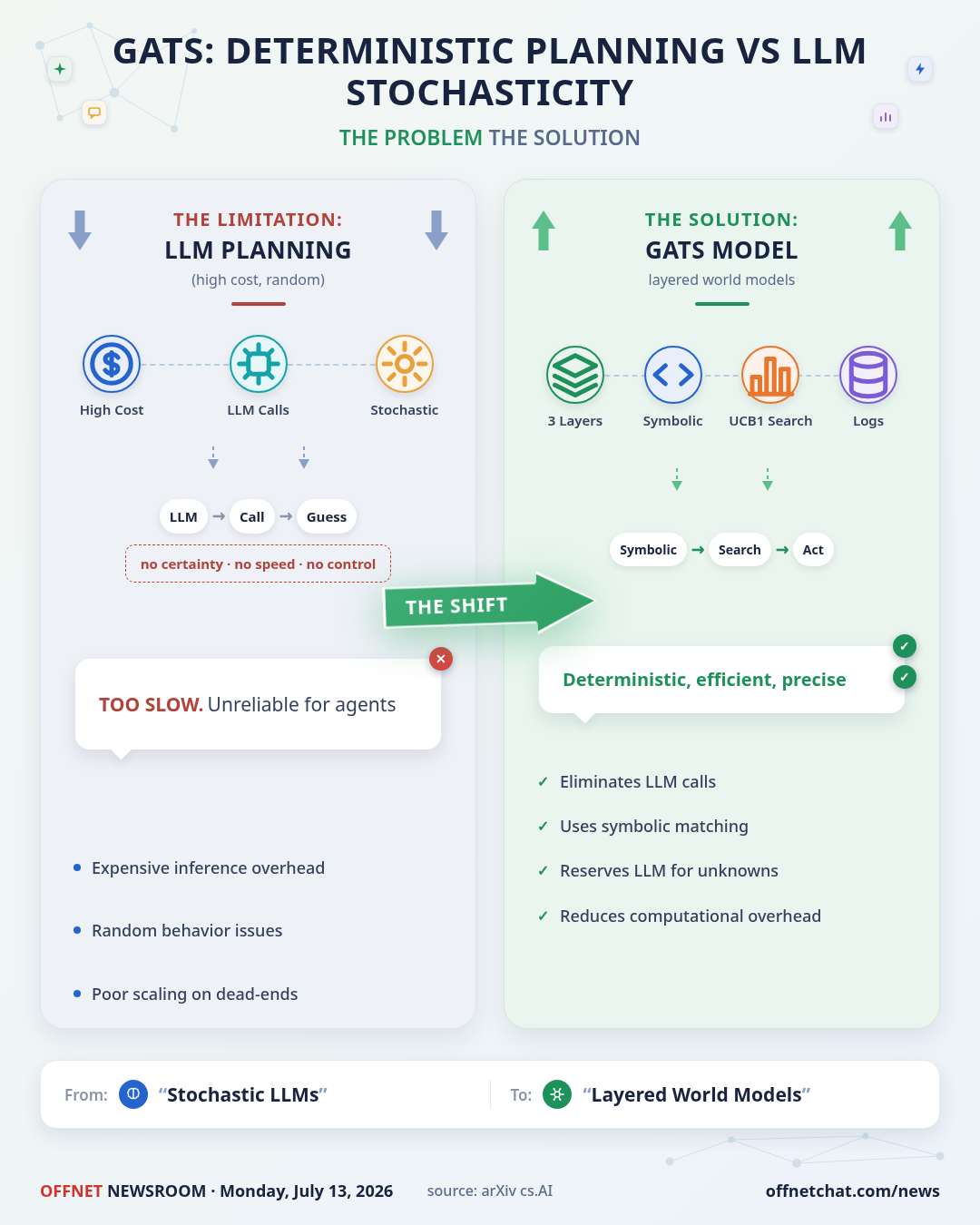
The GATS framework addresses the high cost and stochastic behavior of LLM-based planning tools like LATS and ReAct by eliminating LLM calls during inference. It combines systematic UCB1-based tree search with a three-layer world model that handles exact symbolic matching, execution log statistics, and LLM predictions only for unknown actions. This approach aims to deliver superior planning performance on synthetic tasks with branching paths and dead-ends while reducing computational overhead.

  • GATS removes LLM inference during the planning phase, significantly cutting computational costs.
  • A layered world model handles known actions via symbolic matching and logs, reserving LLMs for unknowns.
  • UCB1-based tree search provides systematic exploration, reducing the stochastic behavior of prior methods.
  • Performance gains are demonstrated on synthetic tasks involving complex branching and dead-ends.
  • This architecture offers a deterministic alternative to purely LLM-driven agent planning workflows.
HOW IT WORKSGATS Planning Pipeline1Run UCB1 tree search2Match known actions symbolically3Check execution log stats4Query LLM for unknowns

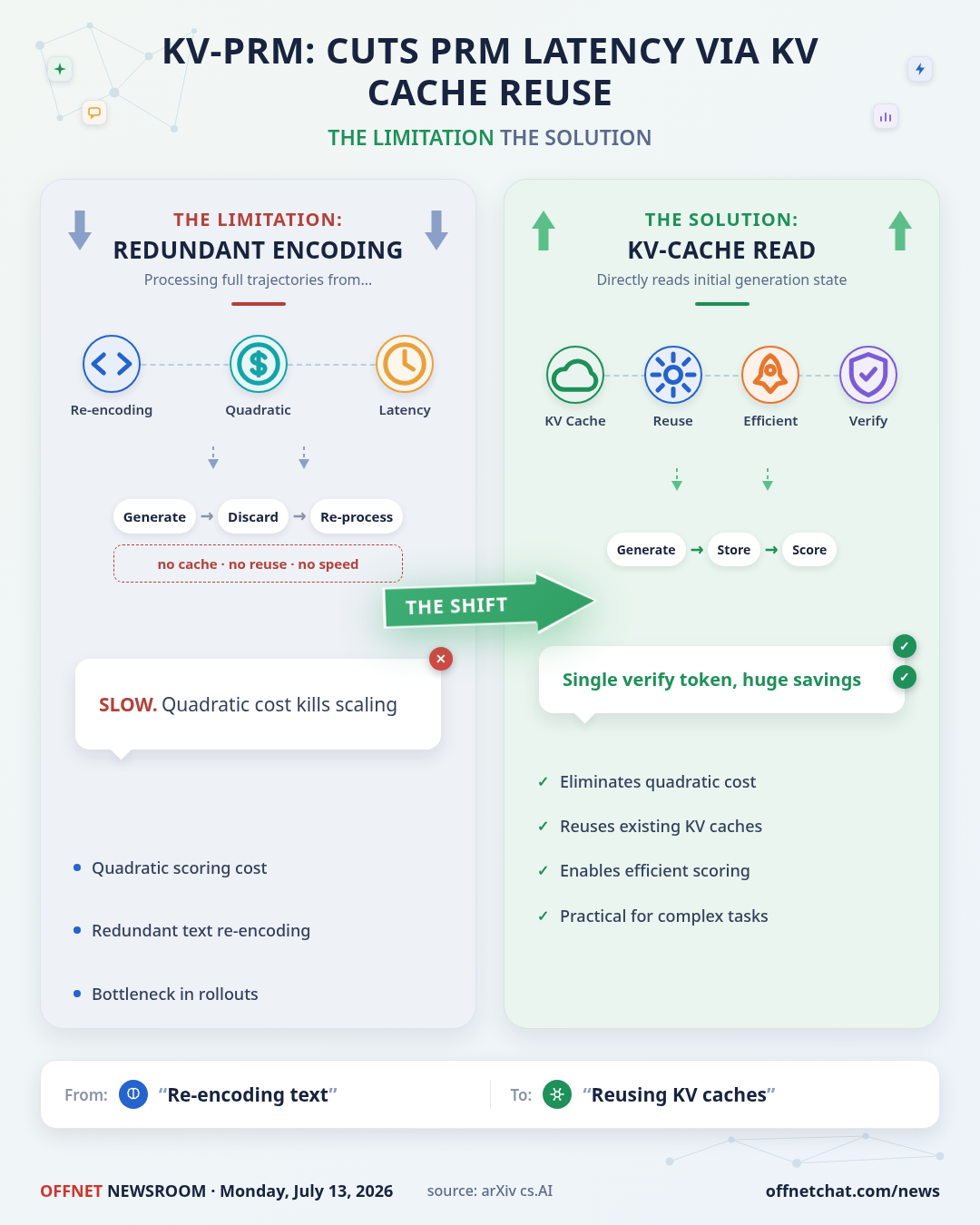
KV-PRM addresses the quadratic scoring cost of text-based Process Reward Models in long multi-agent rollouts by eliminating redundant text re-encoding. Instead of processing full trajectories from scratch, the model directly reads the KV cache generated during the LLM's initial generation phase. This approach allows for efficient scoring of agent steps using a single verify token, significantly reducing computational bottlenecks in test-time scaling.

  • Eliminates quadratic scoring cost by reusing existing KV caches instead of re-encoding text.
  • Enables efficient Process Reward Modeling for long-context multi-agent rollouts.
  • Reduces test-time scaling overhead, making PRMs more practical for complex agent tasks.
  • Validates KV cache reuse as a viable optimization for inference-time reward signals.
HOW IT WORKSKV-PRM Efficiency Pipeline1LLM generates initial trajectory2System caches KV states3Single verify token scores steps4Eliminates redundant text re-encoding

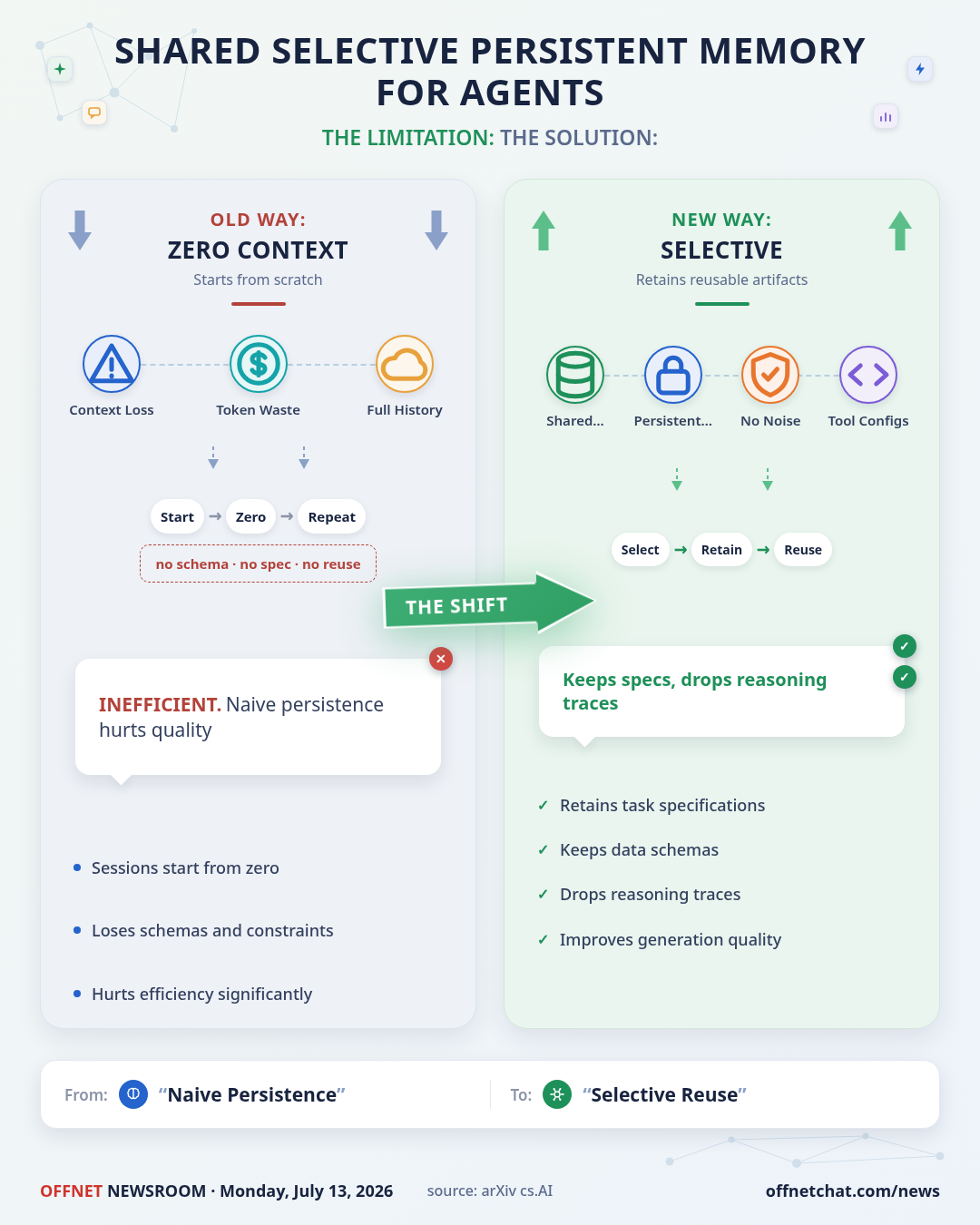
This paper addresses the context loss problem in agentic LLMs that generate code via multi-turn tool use, where sessions typically start from zero. The proposed architecture, shared selective persistent memory, retains reusable context such as task specifications, data schemas, and tool configurations while discarding irrelevant session-specific reasoning traces. This approach avoids the token inefficiency and quality degradation associated with naively persisting entire conversation histories.

  • Agentic LLMs lose productive context like schemas and constraints between sessions, hurting efficiency.
  • Selective persistence keeps reusable artifacts (specs, schemas) while dropping verbose reasoning traces.
  • Shared memory workspaces allow multiple sessions to leverage retained context without token bloat.
  • Reduces irrelevant context noise, improving generation quality compared to full history retention.
TRADE-OFFFull History vs Selective MemoryFull History RetentionIncludes verbose reasoning tracesCauses token bloatDegrades generation qualitySelective Persistent…Keeps reusable schemasDiscards irrelevant noiseImproves efficiencyvs

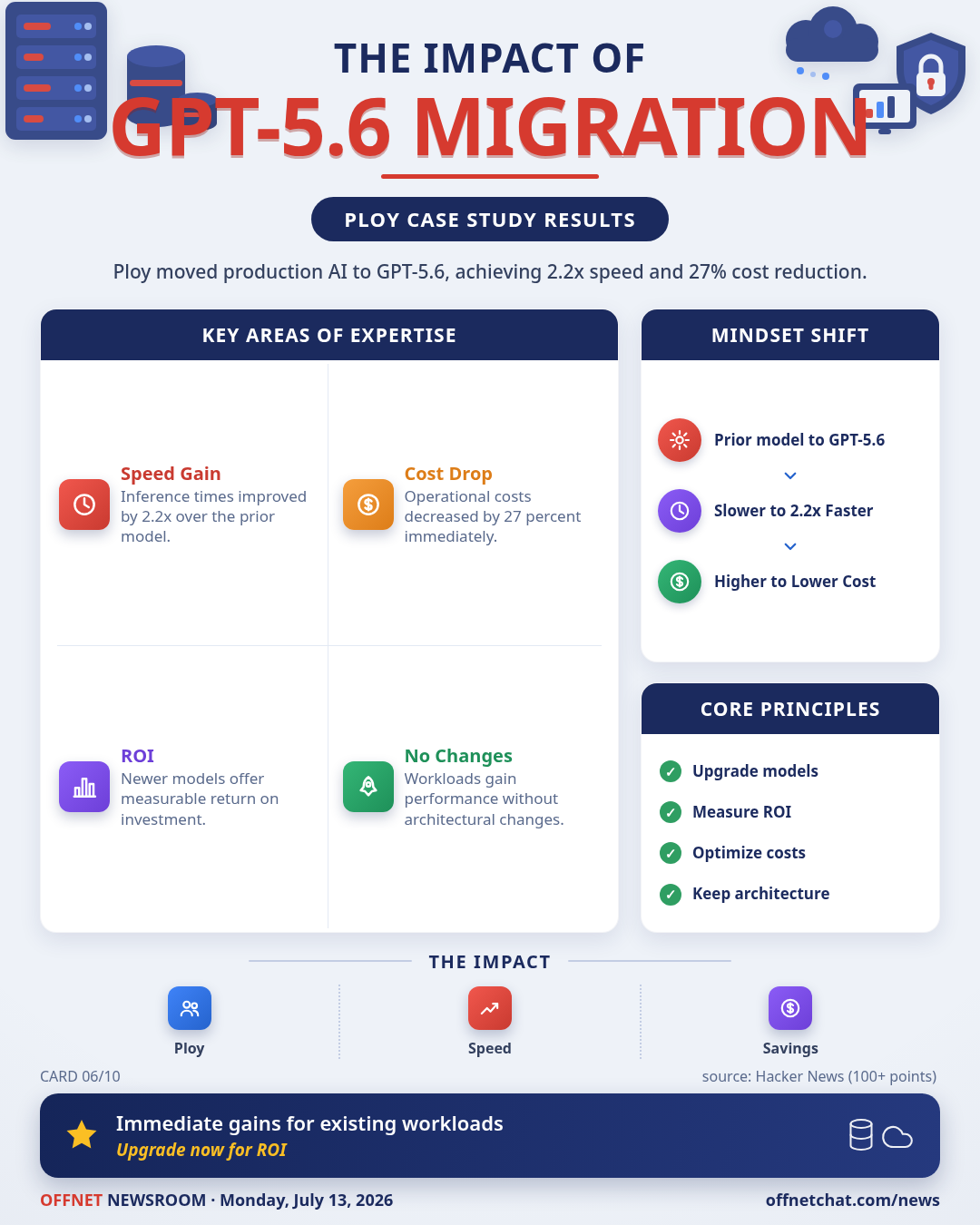
Ploy published a case study detailing the migration of a production AI agent from a previous model version to GPT-5.6. The move resulted in a 2.2x improvement in latency and a 27% reduction in operational costs. These metrics highlight the immediate performance and economic benefits of upgrading to the latest model generation for existing workloads.

  • GPT-5.6 delivers 2.2x faster inference times compared to the prior model version in production.
  • Migration yields a 27% reduction in costs, improving the unit economics of AI agent operations.
  • Upgrading to newer model generations offers measurable ROI through speed and cost efficiency.
  • Production workloads can benefit from immediate performance gains without architectural changes.
GitHub Trending (daily) githubrepos ⚠ unverified date/source

Destructive Command Guard blocks risky shell commands in AI coding agents

Destructive Command Guard is a high-performance hook designed to intercept and block dangerous git and shell commands before they execute. It integrates with major AI coding tools like Claude Code, Cursor, and GitHub Copilot to prevent accidental file deletion. The tool supports both native hooks and compatibility layers across various agent environments.

  • Prevents accidental data loss by blocking destructive shell commands in AI coding workflows
  • Supports Claude Code, Cursor, Gemini CLI, Copilot, and others via hooks or compatibility layers
  • Acts as a safety net for autonomous agents executing high-risk git operations
  • Requires installation per agent or project, potentially adding deployment complexity

This paper introduces GRACE, a method to manage persistent system instructions for LLM agents by storing them as a typed semantic graph instead of flat text. It validates updates within local neighborhoods to prevent conflicts as the instruction set grows over long operational horizons. The approach reconstructs accepted graph changes as incremental edits to the final system prompt, ensuring reliable context evolution under distribution shifts.

  • Replaces fragile flat-text instruction maintenance with a structured typed semantic graph.
  • Validates updates locally to reduce verification complexity as context scales.
  • Enables reliable long-horizon agent operation by handling accumulated instruction interactions.
  • Reconstructs graph updates as incremental edits to maintain a consistent system prompt.
HOW IT WORKSGRACE Instruction Evolution Pipeline1Store instructions as typed semantic graph2Validate updates in local neighborhoods3Resolve conflicts during evolution4Reconstruct incremental prompt edits5Deliver stable long-horizon agent state

OpenProver is an open-source system for automated theorem proving that uses a Planner-Worker-Verifier architecture to generate and check proofs in Lean 4. A Planner agent manages a scratchpad and repository, delegating tasks to parallel Workers while a Verifier ensures correctness. The system supports an interactive terminal interface, allowing human operators to monitor and guide the proof search process directly.

  • Uses a Planner-Worker-Verifier architecture for structured, parallel proof generation.
  • Integrates Lean 4 for automatic formal verification of all generated proofs.
  • Fully open-source with reproducible evaluation capabilities.
  • Offers interactive terminal mode for human-guided proof search and steering.
HOW IT WORKSOpenProver Architecture Pipeline1Planner manages scratchpad2Workers generate proofs3Verifier checks correctness4Human steers process

An empirical study logging requests to Anthropic's endpoint reveals that Claude Code exhibits significantly higher token overhead than OpenCode. The analysis shows Claude Code sends approximately 33,000 tokens before actually processing the user prompt, compared to just 7,000 tokens with OpenCode. This inefficiency is attributed to a less effective caching strategy and higher harness token usage in the agentic coding tool.

  • Claude Code's pre-prompt token transmission is nearly 5x higher than OpenCode's.
  • Inefficiency stems from poor cache strategy and excessive harness token usage.
  • Monitor usage meters closely when switching between agentic coding tools.
  • Log API requests to verify actual token consumption in your specific workflows.

Automation / DevOps / IaC 8

roundup ↗
Hacker News (100+ points) general

GhostLock: 15-year-old stack-UAF vulnerability in Linux kernel

Researchers have identified GhostLock, a use-after-free flaw rooted in the Linux kernel's stack handling that has persisted across distributions for 15 years. The vulnerability allows for potential privilege escalation or system instability by accessing freed stack memory. This finding highlights deep-seated issues in long-standing kernel memory management patterns that remain unpatched in many environments.

  • GhostLock is a stack-based Use-After-Free (UAF) bug in the Linux kernel.
  • The vulnerability has existed for 15 years across all major Linux distributions.
  • Exploitation could lead to privilege escalation or system crashes.
  • Review kernel versions and apply patches if available to mitigate risk.

Cloudflare discovered and patched a long-standing race condition in hyper, the popular Rust HTTP library, where large responses were silently truncated despite returning a 200 OK status. The bug required specific timing conditions to trigger and had remained undetected for years. It has now been resolved in the upstream codebase.

  • Hyper now correctly handles large responses without silent data loss under race conditions.
  • Teams using Rust HTTP clients should verify they are on the patched hyper version.
  • HTTP/1 implementations in Rust require scrutiny for timing-related edge cases.
  • Upstream fixes in core libraries like hyper can prevent subtle data integrity issues.
GitHub Trending (daily) githubrepos ⚠ unverified date/source

Prefect Rises on GitHub as Python Workflow Orchestration Tool

Prefect is a Python-based framework designed to transform simple scripts into resilient, production-grade data pipelines. It supports scheduling, caching, retries, and event-based automations to handle dynamic workflows. The platform offers visibility through a self-hosted server or the managed Prefect Cloud dashboard.

  • Elevate Python scripts to production workflows with minimal code changes
  • Built-in resiliency features include retries, caching, and dynamic reactions
  • Monitor pipeline activity via self-hosted server or Prefect Cloud
  • Supports event-based automations for reactive data processes
InfoQ generaldevops ↺ since 07-11

Chaos Engineering Strategies for Large-Scale GPU Clusters

Bryan Oliver outlines practical fault-injection techniques designed for the unique constraints of large GPU clusters, addressing complex topologies and RDMA network protocols. The presentation covers seven specific strategies to handle challenges like NUMA misalignments and maximize the efficiency of high-value hardware. It emphasizes building robust observability loops to detect and recover from these induced failures effectively.

  • Target NUMA misalignments and RDMA protocol failures during chaos tests.
  • Apply seven specific fault-injection strategies for GPU cluster resilience.
  • Build observability loops to detect complex topology-related failures.
  • Maximize efficiency of multi-million dollar hardware investments.
  • Address engineering challenges specific to large-scale AI infrastructure.
InfoQ generaldevops ↺ since 07-11

GitHub Copilot CLI Terminal UI Goes GA with Tabs and Config-Free Setup

GitHub has released the redesigned Copilot CLI terminal interface as generally available. The update introduces a tabbed layout for managing sessions, gists, issues, and pull requests. It also features an in-session, form-driven setup for MCP servers and plugins, eliminating the need to hand-edit configuration files.

  • Tabbed layout simplifies managing multiple sessions, gists, and PRs in one view.
  • Form-driven setup for MCP servers and plugins removes manual config file editing.
  • UI is now theme-aware and includes improved screen reader accessibility.
  • Terminal experience is now generally available for broader adoption.

OpenAI engineers resolved a complex issue in ChatGPT's infrastructure by identifying two distinct faults: silent hardware corruption on an Azure host and a race condition in GNU libunwind's setcontext function. The latter presented a one-instruction vulnerability window that had persisted for 18 years. The breakthrough was achieved by shifting from individual core dump examination to population-level crash analysis across the fleet.

  • Switching to population-level crash analysis revealed multiple root causes masked as a single failure.
  • An 18-year-old race condition in GNU libunwind's setcontext function caused intermittent crashes.
  • The vulnerability window was extremely narrow, consisting of only a single instruction.
  • Silent hardware corruption on Azure infrastructure compounded the software-level race condition.
AWS What's New awsdatabase ↺ since 07-11

SageMaker HyperPod adds AMI-based config for continuous Slurm clusters

Amazon SageMaker HyperPod now allows AMI-based node lifecycle configuration for Slurm clusters operating in continuous provisioning mode. This update eliminates the need to download, configure, or upload lifecycle scripts to S3, as the AMI pre-bakes necessary software like Docker, Enroot, and Pyxis. Nodes are automatically provisioned with production-ready configurations, including Slurm accounting and SSH keys, as capacity becomes available.

  • No more S3 script uploads for lifecycle config in continuous provisioning mode
  • AMI pre-loads AI/ML runtime stack: Docker, Enroot, Pyxis, and Slurm
  • Automated setup of SSH keys, accounting, and log rotation on node launch
  • Simplifies scaling workflows by removing manual config steps for new nodes
HOW IT WORKSSageMaker HyperPod Node Setup1Pre-bake AMI with Docker and Slurm2Provision node in continuous mode3Auto-attach SSH keys and accounting4Node ready for AI workloads
InfoQ generaldevops ↺ since 07-11

Linux Foundation Launches Akrites to Defend OSS from AI Threats

The Linux Foundation has introduced Akrites, an initiative designed to safeguard critical open source software against emerging AI-enabled cyber threats. This industry-wide effort targets the rapidly evolving nature of attacks that leverage artificial intelligence to compromise foundational codebases. The program represents a coordinated response to protect the integrity of widely used software ecosystems.

  • New Linux Foundation initiative targets AI-driven attacks on critical OSS.
  • Focuses on defending foundational codebases from evolving cyber threats.
  • Industry-wide collaboration aims to harden open source supply chains.
  • No immediate technical implementation details or database impacts provided.

AWS 8

roundup ↗

Netflix engineers detail their pivot to CloudStream, a reusable framework for capturing, converting, and deploying data at scale. The architecture moves key-value abstractions from stateless to stateful models to safely handle terabytes of bulk data. This approach leverages specific data access patterns and Pathfinder prototypes to streamline operations. The result is a deployment process that is 99% faster than previous methods.

  • Adopt stateful key-value abstractions to safely migrate terabytes of bulk data
  • Use CloudStream as a repeatable framework for capture, conversion, and deployment
  • Leverage Pathfinder prototypes to validate architectural changes before full rollout
  • Analyze data access patterns to optimize throughput and reduce latency
  • Achieve 99% faster data rollouts by standardizing the migration pipeline
AWS What's New awsdatabase ↺ since 07-09

Amazon Aurora DSQL CDC GA: Stream real-time changes to Kinesis

Amazon Aurora DSQL Change Data Capture is now generally available, allowing developers to stream real-time insert, update, and delete events directly to Amazon Kinesis Data Streams. This managed feature supports event-driven architectures by integrating with AWS Lambda, Amazon S3, Redshift, and OpenSearch via Data Firehose, all without requiring infrastructure management. The service is designed to operate with zero impact on the underlying database workload performance.

  • Aurora DSQL CDC is GA and integrates natively with Kinesis Data Streams for real-time event streaming.
  • Automatically captures inserts, updates, and deletes without managing infrastructure or impacting DB performance.
  • Enables event-driven workflows by triggering Lambda functions or delivering data to S3, Redshift, and OpenSearch.
  • Available in all AWS Regions where Aurora DSQL is currently supported.
HOW IT WORKSAurora DSQL CDC Pipeline1Aurora DSQL captures changes2Stream to Kinesis3Trigger Lambda or S34Load Redshift or OpenSearch
AWS What's New awsdatabase ↺ since 07-11

EMR on EKS adds AI-driven Spark troubleshooting agent

Amazon EMR on EKS now integrates an Apache Spark troubleshooting agent that allows data engineers to diagnose job failures using natural language queries. The agent automatically analyzes Spark History Server data, distributed executor logs, and cluster configurations to identify root causes like memory errors or data skew. It provides automated root cause analysis and PySpark code recommendations, eliminating the need to manually navigate complex logs. This feature extends the troubleshooting agent's coverage to all EMR deployment options, including EC2 and Serverless.

  • Diagnose EMR on EKS failures via natural language in the console.
  • Agent analyzes history server data, logs, and configs for root causes.
  • Identifies memory errors, data skew, contention, and connectivity issues.
  • Provides automated root cause analysis and PySpark code fixes.
  • Spark troubleshooting agent now covers EC2, Serverless, and EKS.
CHECKLISTEMR AI Troubleshooting GuideDiagnose failures via natural language queriesAnalyze logs and cluster configurations automaticallyIdentify root causes like memory errorsGet automated PySpark code recommendationsCovers EC2, Serverless, and EKS

AWS Neuron 2.31.0 introduces NKI 0.5.0 with MX FP8 scale dtype support, tensor indirection for optimized indexed access, and zero-cost layout transformation APIs. The release adds a public beta UltraServer Operator for Amazon EKS to automate Trainium UltraServer workload management. Additionally, the Neuron Compiler uses a redesigned backend by default on Trn2 and Trn3 for better performance, while the Runtime simplifies configuration with contiguous shared scratchpad support.

  • NKI 0.5.0 adds MX FP8 scale dtype and tensor indirection for efficient indexed access patterns.
  • UltraServer Operator for EKS automates discovery, allocation, and resource claims for Trainium workloads.
  • Neuron Compiler backend redesign is now default on Trn2 and Trn3, boosting inference/training performance.
  • Neuron Runtime supports contiguous shared scratchpad, removing manual page size configuration needs.
CHECKLISTAWS Neuron 2.31 Key UpdatesEnable MX FP8 scale dtype in NKI 0.5.0Automate Trainium workloads with UltraServer OperatorUse redesigned compiler backend for Trn2/3Leverage contiguous shared scratchpad in Runtime
AWS What's New awsdatabase ↺ since 07-11

Amazon DocumentDB Adds R8g.24xlarge and R8g.48xlarge Instances

Amazon DocumentDB now supports R8g.24xlarge and R8g.48xlarge instances powered by AWS Graviton4 processors and DDR5 memory. These new nodes offer up to 1,536 GiB of memory and 192 vCPUs, enabling larger in-memory working sets and higher throughput. They are designed to handle high-concurrency transactional applications and memory-intensive operational workloads.

  • R8g instances leverage Graviton4 and DDR5 for improved throughput and memory capacity.
  • R8g.48xlarge provides 192 vCPUs and 1,536 GiB RAM for massive working sets.
  • Suitable for high-concurrency transactions and large-scale document processing.
  • Deploy via Console, CLI, or SDK by modifying existing clusters or creating new ones.
BY THE NUMBERSThe headline number1,536GiBAmazon DocumentDB Adds R8g.24xlarge and R8g.48xlarge…
AWS What's New awsdatabase ↺ since 07-10

SageMaker Unified Studio adds operators for Bedrock, S3 Tables, and Glue Catalog

Amazon SageMaker Unified Studio Workflows now includes 19 new operators to orchestrate Amazon Bedrock, S3 Tables, S3 Vectors, AWS Glue Data Catalog, and MWAA Serverless. These additions enable users to manage Bedrock guardrails, provision S3 resources, and handle Glue catalog tasks directly within the visual workflow builder. This update eliminates the need to write custom integration code or switch between multiple AWS consoles for these specific service interactions.

  • 19 new operators added for Bedrock, S3 Tables/Vectors, Glue Catalog, and MWAA Serverless
  • Visual workflow creator now supports managing Bedrock guardrails and Glue catalog objects
  • No custom DAG code required for provisioning/deleting S3 Tables and Vectors
  • Reduces context switching by orchestrating diverse AWS services from one interface
  • Available in all AWS Regions as of the publication date
BY THE NUMBERSNew SageMaker Operators Count19New operators added to SageMakerOrchestrating Bedrock, S3, Glue, and MWAA
AWS What's New awsdatabase ↺ since 07-11

AWS Expands R8in/R8ib/R8idn/R8idb EC2 Instances to Tokyo, Frankfurt, Ireland

AWS has extended availability of sixth-generation Intel Xeon Scalable-powered R8in, R8ib, R8idn, and R8idb instances to Asia Pacific (Tokyo) and Europe (Frankfurt, Ireland) regions. These instances feature custom sixth-gen processors and latest Nitro cards, delivering up to 43% better compute performance per vCPU than previous R6 generations. The R8in and R8idn variants offer 600 Gbps network bandwidth, the highest among enhanced networking EC2 instances, targeting big data, in-memory caches, AI/ML caching fleets, and 5G Telco applications.

  • New regions for R8in/ib/idn/idb: Tokyo, Frankfurt, Ireland
  • Up to 43% better compute per vCPU vs R6in/6idn
  • R8in/idn provide 600 Gbps network bandwidth
  • Ideal for big data, AI/ML caches, and 5G Telco workloads
  • Powered by custom 6th-gen Intel Xeon and latest Nitro cards
BY THE NUMBERSRecord Network Bandwidth for EC2600 GbpsHighest enhanced networking bandwidthAvailable on R8in and R8idn instances
AWS What's New awsdatabase ↺ since 07-11

AWS Organizations auto-applies departure SCPs for new console orgs

AWS Organizations now automatically attaches service control policies (SCPs) that prevent member accounts from leaving or closing when a new organization is created via the console. This default behavior safeguards multi-account environments by blocking unintended departures from day one. Central security teams gain immediate protection without manual configuration during initial setup.

  • New orgs created via console get departure-blocking SCPs automatically
  • Members cannot leave or close accounts without explicit policy override
  • Reduces initial security configuration effort for new AWS entrants
  • Existing orgs are not retroactively affected by this change
  • CloudOps teams should verify SCP inheritance in new deployments
CHECKLISTNew Org Security DefaultsAuto-applies departure-blocking SCPs for new console orgsBlocks member account closure or departure by defaultRequires explicit policy override to remove restrictionsApplies only to new orgs, not existing ones

Trending on GitHub 2

roundup ↗
GitHub Trending (daily) githubrepos ⚠ unverified date/source

Open-Inspect: Open-source background coding agents with Slack and PR integration

ColeMurray/background-agents introduces an open-source system for offloading development tasks to background AI agents. Inspired by Ramp's Inspect, it provides hosted agents capable of accessing full dev environments like Node.js, Python, and VS Code. The system supports real-time multiplayer collaboration, scheduled cron jobs, and direct integration with Slack, GitHub PRs, and Linear.

  • Integrates directly into Slack, GitHub PRs, and Linear issues for seamless workflow automation.
  • Supports multiplayer sessions allowing multiple engineers to collaborate in real-time sandboxes.
  • Enables scheduled tasks via cron and webhook triggers like Sentry alerts for autonomous operations.
  • Generates PRs with proper commit attribution tied to the user who initiated the prompt.
  • Allows selection of preferred AI models, including Anthropic Claude, for varied reasoning needs.

The pglayers project publishes 53 PostgreSQL extensions as minimal Docker images built from scratch, containing only shared libraries, control files, and SQL scripts. Users can compose these onto the official postgres image using COPY --from, eliminating the need for apt-get or build tools in the final container. This approach allows practitioners to enable extensions like pgvector and PostGIS with a simple CREATE EXTENSION command after deployment.

  • Eliminates compilation steps and build tools from final Docker images.
  • Supports 53 extensions including pgvector, PostGIS, and pg_cron.
  • Uses COPY --from to stack extensions onto official postgres base images.
  • Simplifies dependency management for containerized PostgreSQL deployments.
BY THE NUMBERS53 Extensions Without Compilation53%Extensions available via DockerZero build tools needed in final image

Mobile friendly 6

all cards ↗

Today's top database + AI stories as save-and-share cards — built for your phone and your LinkedIn feed.