OffNet Newsroom

Archive snapshot

Sunday, July 12, 2026

Daily signal on databases, AI, and the tech that matters.

12 new today 45 stories 8 sections 20 for the DBA desk

Database Technology 7

roundup ↗
GitHub Trending (daily) githubrepos ⚠ unverified date/source

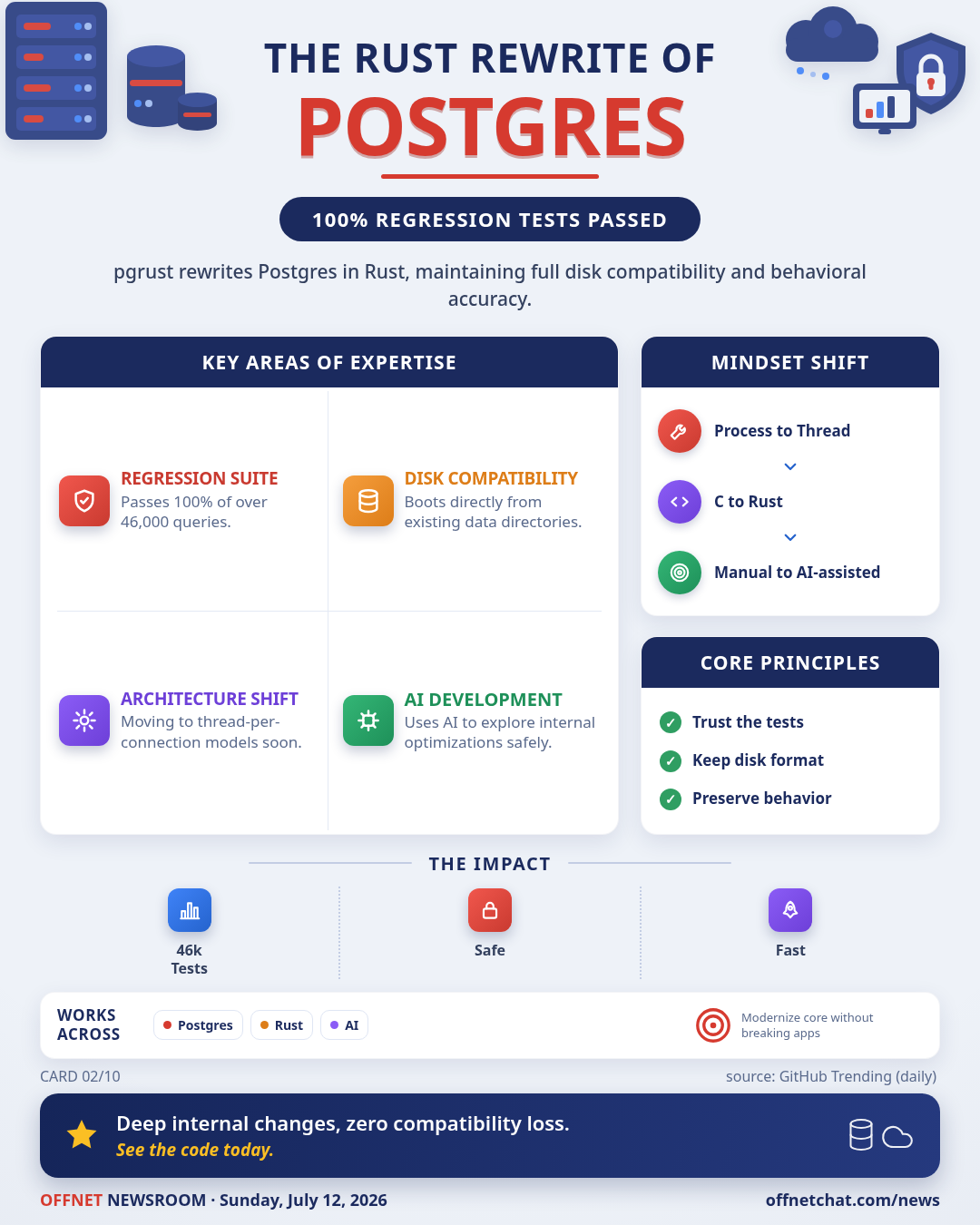
pgrust: Postgres 18.3 rewrite in Rust passes 100% regression tests

The pgrust project offers a Postgres-compatible database engine rewritten in Rust, targeting Postgres 18.3 compatibility. It currently passes 100% of the Postgres regression suite, covering over 46,000 queries, and maintains disk compatibility to boot from existing Postgres data directories. The project leverages Rust and AI-assisted programming to facilitate deeper internal server changes while preserving standard Postgres behavior.

  • Disk-compatible with Postgres 18.3; can boot directly from existing data directories.
  • Passes 100% of Postgres regression suite, validating deep behavioral compatibility.
  • Upcoming version shifts from process-per-connection to a thread-per-connection model.
  • Uses AI-assisted development to explore internal optimizations while keeping tests as the oracle.
Planet PostgreSQL database

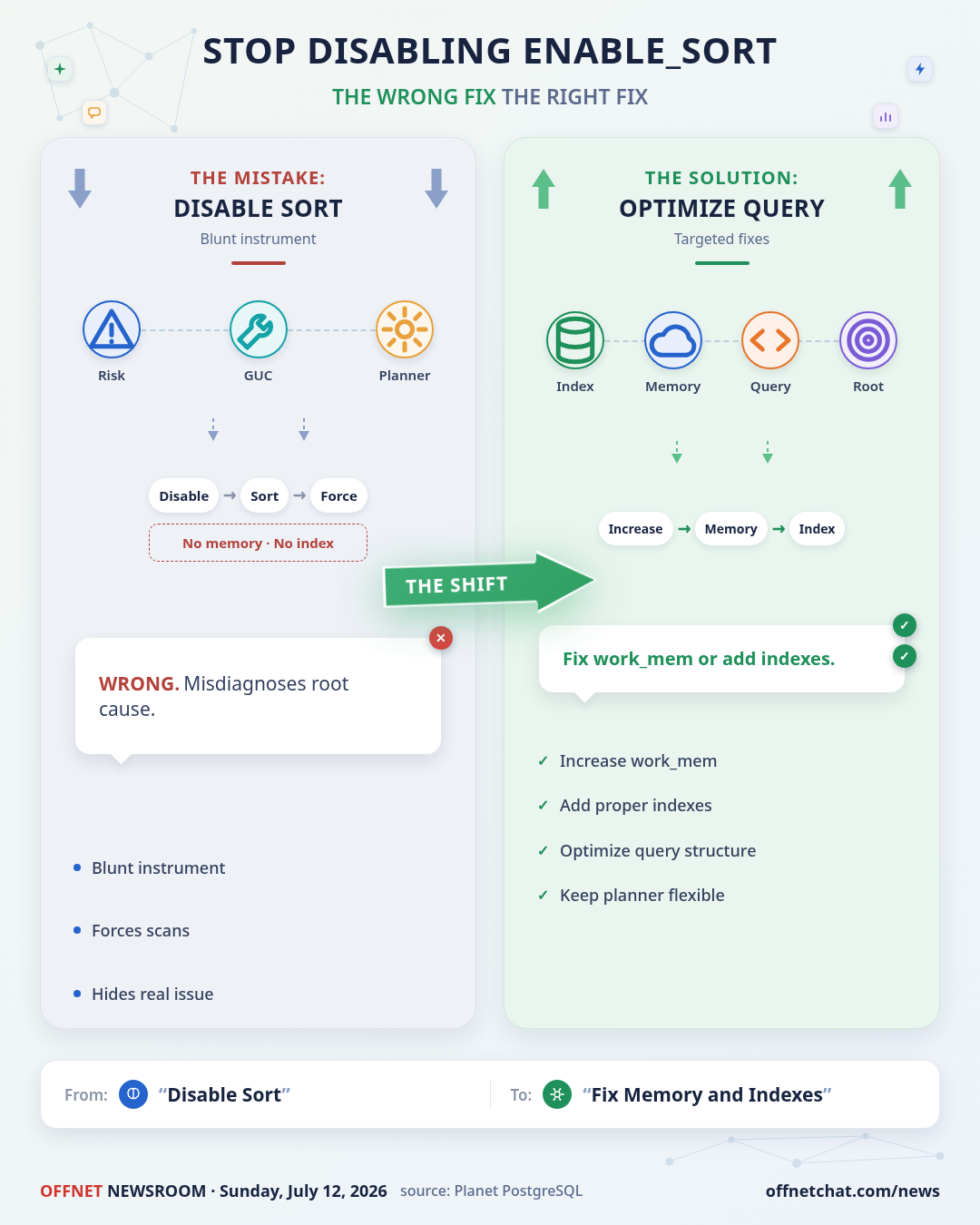
PostgreSQL: Disable enable_sort for slow sorts? Wrong target

Christophe Pettus warns against disabling the enable_sort GUC to resolve slow sorting operations. This approach misdiagnoses the root cause, as performance issues typically stem from insufficient work_mem or missing indexes rather than the planner being forced to use sorts. The correct strategy involves increasing memory allocation or optimizing query structures with appropriate indexing.

  • Do not disable enable_sort to fix slow sorts; it is a blunt instrument.
  • Increase work_mem to allow more in-memory sorting for better performance.
  • Add or optimize indexes to eliminate the need for sorting entirely.
  • Misusing this GUC can force inefficient sequential scans or sorts.
Hacker News (100+ points) general

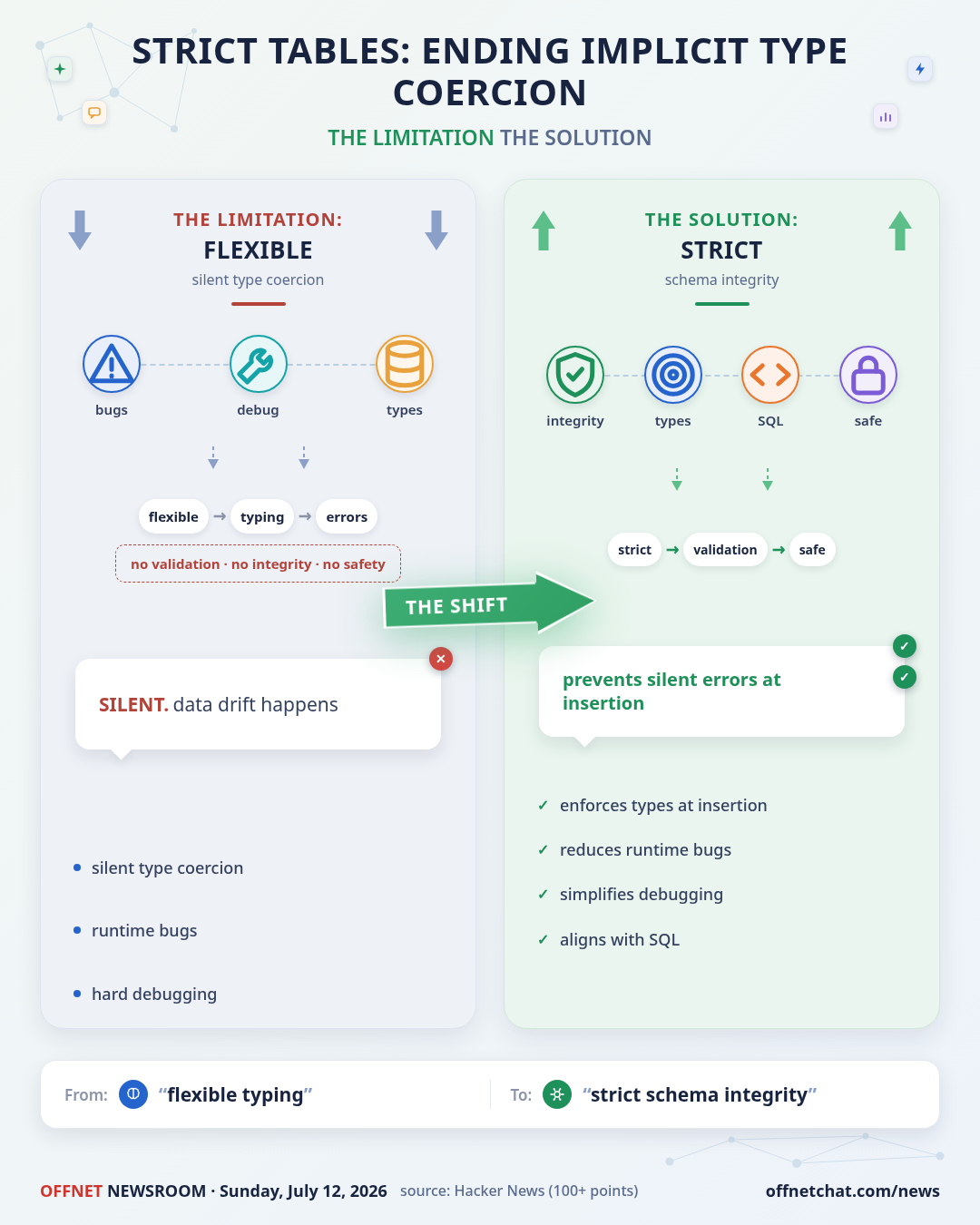
SQLite strict tables enforce schema integrity at creation time

Recent discussions advocate for using STRICT tables in SQLite to enforce schema integrity from the moment of creation. This approach prevents implicit type affinity issues and ensures that data types are validated strictly, aligning SQLite behavior more closely with traditional relational database expectations. The recommendation highlights a shift towards stricter data modeling practices within the SQLite ecosystem.

  • Enforces data types at insertion time, preventing silent type coercion errors.
  • Reduces runtime bugs caused by SQLite's default flexible typing behavior.
  • Simplifies debugging by making schema violations immediately apparent during DML.
  • Aligns SQLite usage with standard SQL expectations for type safety.
CHECKLISTAdopting Strict TablesEnforce data types at insertion timeReduce runtime bugs from flexible typingSimplify debugging with immediate violationsAlign usage with standard SQL expectations
GitHub Trending (daily) githubrepos ⚠ unverified date/source

Prisma ORM trending: next-gen type-safe client and declarative migrations

Prisma ORM is a next-generation tooling suite for Node.js and TypeScript that provides an auto-generated, type-safe query builder via Prisma Client. The platform includes Prisma Migrate for declarative data modeling and migration management, alongside Prisma Studio for visual database editing. It supports a wide range of backend architectures, including REST, GraphQL, and gRPC APIs, as well as serverless and microservices environments.

  • Prisma Client generates type-safe query builders, reducing runtime errors in Node.js/TS apps.
  • Declarative migrations in Prisma Migrate simplify schema versioning and sync.
  • Prisma Studio offers a GUI for viewing and editing data directly in the database.
  • Supports diverse backend types including serverless, microservices, REST, and GraphQL.
AWS Database Blog awsdatabase ↺ since 07-10

Diagnose RDS Oracle Replica Lag via Wait Events and CloudWatch

This follow-up to a two-part series focuses on troubleshooting replication lag for Amazon RDS for Oracle Read Replicas. It details how to monitor lag using CloudWatch metrics and database views, then identify root causes through wait event analysis. The guide provides specific steps to resolve the performance issues causing delays.

  • Monitor replication lag using Amazon CloudWatch metrics and internal database views for real-time visibility.
  • Use wait event analysis to pinpoint the specific root causes behind replication delays.
  • Apply targeted troubleshooting steps to resolve performance bottlenecks affecting Oracle read replicas.
  • Follow up on Part 1 for context on redo compression and configuration optimization techniques.
Percona Blog database ↺ since 07-11

Percona experiments with DuckDB as MySQL 9.7 storage engine for analytics

Percona has released an experimental MySQL 9.7 build that allows tables using ENGINE=DuckDB to offload analytical queries directly to DuckDB on the same server. This architecture eliminates the need for a second data copy by handling analytics in-memory without involving InnoDB. Benchmarks on TPC-H at scale factor 10 show that while InnoDB timed out on six queries, the DuckDB engine handled the load significantly faster.

  • MySQL 9.7 experimental build supports ENGINE=DuckDB for hybrid OLAP/OLTP workloads.
  • Analytical queries run in-memory via DuckDB, avoiding InnoDB serialization bottlenecks.
  • No data duplication required; tables are accessible natively via standard connections.
  • InnoDB timed out on 6 of 22 TPC-H queries; DuckDB completed them efficiently.
  • Feature is experimental and targets mixed-transactional environments needing quick analytics.
TRADE-OFFInnoDB vs DuckDB on TPC-HInnoDB PerformanceTimed out on 6 queriesFailed to complete loadSerialization bottlenecks presentDuckDB EngineCompleted all 22 queriesHandled load significantly fasterIn-memory processing enabledvs

LLMs 4

roundup ↗

OpenAI and Anthropic have established dominant positions with general-purpose AI capabilities, but market sentiment is shifting toward smaller, purpose-built alternatives. Industry observers note that customers are increasingly valuing targeted solutions over broad, all-encompassing models. This transition suggests a move away from the 'Swiss Army Knife' approach in favor of more focused utility.

  • Monolithic AI models face growing competition from niche, specialized tools
  • Customers prioritize specific utility over broad general-purpose capabilities
  • Market demand is shifting toward smaller, purpose-built AI solutions
  • Generalist providers may need to adapt to fragmented use cases
OpenAI News llmaiagents ↺ since 07-10

Microsoft 365 Copilot switches to GPT-5.6 as default model

Microsoft has updated Microsoft 365 Copilot to use GPT-5.6 as its preferred underlying model. This change aims to deliver improved performance and output quality across core productivity applications including Word, Excel, PowerPoint, and the new Cowork feature. The upgrade is positioned to accelerate workflows and enhance the overall fidelity of AI-generated content within the suite.

  • GPT-5.6 is now the default model for Microsoft 365 Copilot
  • Updates target Word, Excel, PowerPoint, Chat, and Cowork
  • Focus is on higher quality outputs and faster task completion
  • No specific technical benchmarks or latency metrics provided
OpenAI News llmaiagents ↺ since 07-10

OpenAI launches GPT-Live voice models for ChatGPT

OpenAI has released GPT-Live, a new generation of voice models designed to enable more natural human-AI interactions. These models are currently powering the ChatGPT Voice feature. The release marks a shift toward real-time, conversational AI interfaces.

  • GPT-Live powers ChatGPT Voice with improved natural interaction
  • Focus is on real-time voice capabilities rather than text
  • Signals OpenAI's push into conversational AI interfaces
LangChain Releases agentsreleases ↺ since 07-11

langchain-openai 1.3.5 adds explicit prompt caching support

The langchain-openai package has updated to version 1.3.5, introducing a feature for explicit prompt caching. This release also includes a chore to refresh model profile data. The update is available via the standard release channel.

  • Explicit prompt caching is now supported in the OpenAI integration.
  • Model profile data has been refreshed for accuracy.
  • Upgrade to langchain-openai 1.3.5 to access these changes.

AI / ML 8

roundup ↗
Hacker News (100+ points) general

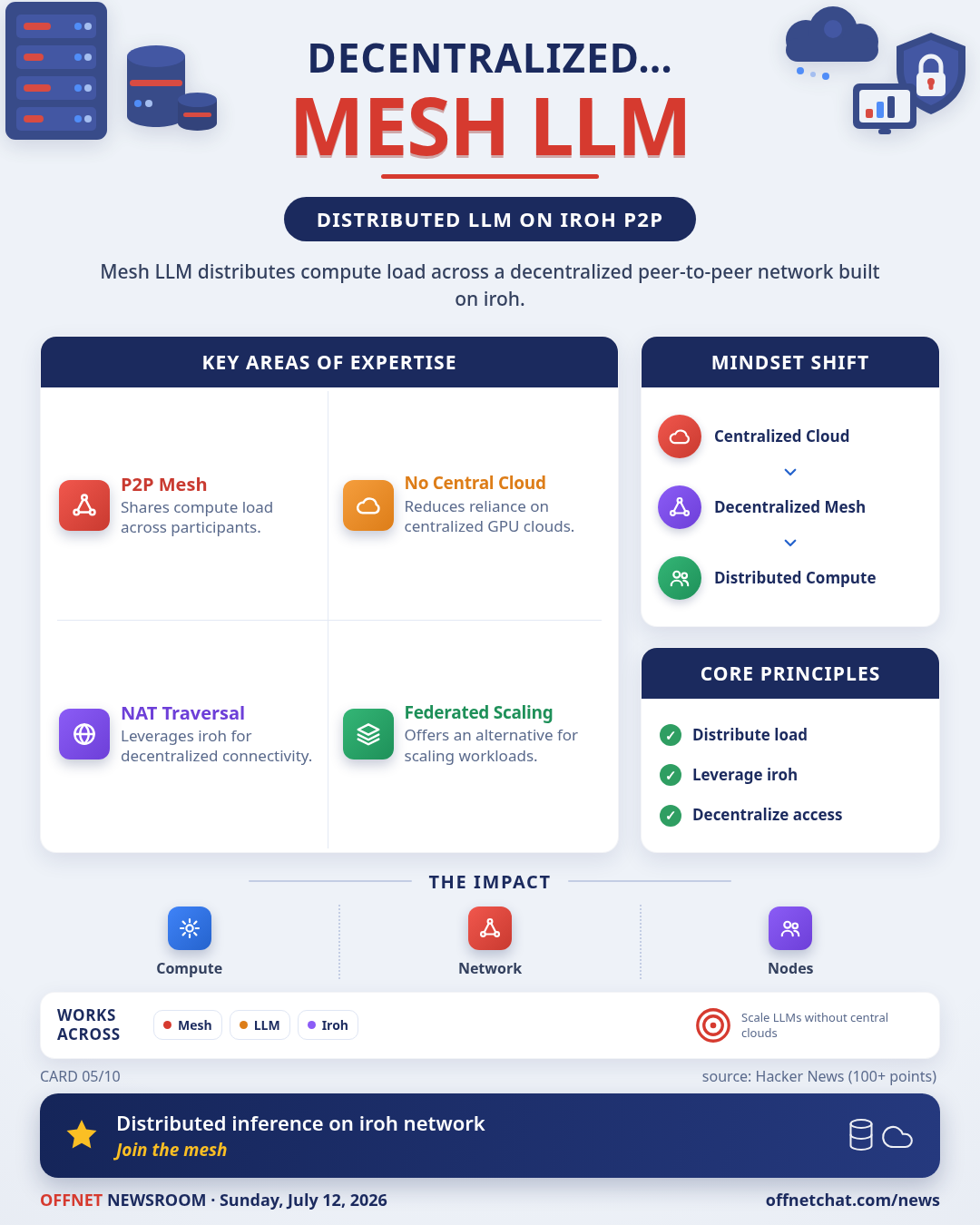
Mesh LLM brings distributed inference to iroh network

A new project named Mesh LLM enables large language model inference across a decentralized peer-to-peer network built on iroh. This approach distributes compute load among participants rather than relying on centralized cloud infrastructure. The system leverages iroh's networking capabilities to manage connectivity between nodes running the model.

  • Distributed inference reduces reliance on centralized GPU clouds.
  • Leverages iroh for decentralized connectivity and NAT traversal.
  • Shares compute load across a peer-to-peer mesh network.
  • Offers a federated alternative for scaling LLM workloads.
WORTH QUOTINGThe gistA new project named Mesh LLM enables large language modelinference across a decentralized peer-to-peer network builton— Hacker News (100+ points)
AWS What's New awsdatabase ↺ since 07-11

Amazon EMR on EKS adds AI-powered Spark troubleshooting agent

AWS has enabled the Apache Spark troubleshooting agent for Amazon EMR on EKS, allowing data engineers to diagnose job failures using natural language queries. The agent automatically analyzes Spark History Server data, distributed executor logs, and cluster configurations to provide root cause analysis and PySpark code recommendations. This eliminates the need for manual log navigation and extends AI-driven troubleshooting support to all EMR deployment options.

  • Diagnose EMR on EKS job failures via natural language in the console.
  • Agent analyzes history server data, logs, and config for root cause analysis.
  • Provides automated PySpark code recommendations to fix identified issues.
  • Troubleshooting coverage now spans EC2, Serverless, and EKS deployments.
TRADE-OFFEMR Troubleshooting EvolutionPrevious MethodManual log navigation requiredTime-consuming root cause analysisNew AI AgentNatural language query interfaceAutomated code recommendationsvs
AWS What's New awsdatabase ↺ since 07-10

SageMaker Feature Store adds batch writes, record listing, and custom offline tables

Amazon SageMaker Feature Store now supports BatchWriteRecord to ingest multiple records across feature groups in a single API call, reducing latency and call volume. It also introduces ListRecords for discovering stored items without pre-known identifiers and allows creating databases and tables with custom names in the offline store. These updates target high-throughput ingestion and easier data discovery for AI model training pipelines.

  • Use BatchWriteRecord to reduce API overhead and latency when ingesting large feature datasets.
  • Leverage ListRecords to discover available data in feature groups without tracking specific IDs.
  • Gain flexibility in offline storage by naming databases and tables explicitly in S3-backed stores.
  • Optimize training data pipelines by batching writes to the online store for faster feature retrieval.
CHECKLISTOptimize SageMaker Feature StoreUse BatchWriteRecord to reduce API overheadLeverage ListRecords for data discoveryName offline databases and tables explicitlyBatch writes for faster retrieval
AWS What's New awsdatabase ↺ since 07-10

SageMaker Unified Studio adds operators for Bedrock, S3 Tables, and Glue Catalog

Amazon SageMaker Unified Studio Workflows now includes 19 new operators covering Amazon Bedrock, S3 Tables, S3 Vectors, AWS Glue Data Catalog, and MWAA Serverless. These additions enable visual orchestration of tasks like managing Bedrock guardrails, provisioning S3 resources, and triggering workflow runs without custom code. The feature is available in all AWS Regions.

  • No custom integration code needed for Bedrock, S3 Tables, S3 Vectors, Glue, or MWAA Serverless
  • Visual workflow creator supports managing Bedrock guardrails and S3 resource lifecycle
  • Reduces context switching between consoles by centralizing orchestration in SageMaker
  • Glue Data Catalog operations for tables and databases are now directly supported
  • Feature availability extends to all AWS Regions
BY THE NUMBERSNew SageMaker Unified Studio Operators19New operators added across servicesCovers Bedrock, S3 Tables, Glue, and MWAA
AWS What's New awsdatabase ↺ since 07-10

AWS Neuron 2.31.0 adds NKI 0.5.0, UltraServer Operator, and Trn2/3 compiler updates

AWS Neuron 2.31.0 introduces NKI 0.5.0 with MX FP8 scale support, tensor indirection for optimized indexed access, and zero-cost view APIs for layout transformations. The release includes the Neuron UltraServer Operator for Amazon EKS in public beta to automate Trainium UltraServer workload management. Additionally, the Neuron Compiler features a redesigned code generation backend now enabled by default on Trn2 and Trn3, while the Runtime adds contiguous shared scratchpad support to simplify device configuration.

  • NKI 0.5.0 adds MX FP8 scale dtype support for improved precision efficiency.
  • Tensor indirection reduces instruction count in indexed access patterns.
  • UltraServer Operator for EKS automates discovery and resource claims for Trainium.
  • Redesigned compiler backend is now default on Trn2 and Trn3 for better performance.
  • Contiguous shared scratchpad removes manual page size configuration in Runtime.
HOW IT WORKSNeuron 2.31.0 Release Highlights1NKI 0.5.0 MX FP8 support2Tensor indirection optimization3UltraServer Operator for EKS4Trn2/3 Compiler backend default5Contiguous scratchpad support
AWS What's New awsdatabase ↺ since 07-08

SageMaker Unified Studio adds OpenLineage support to IAM-based domains

Amazon SageMaker Unified Studio now enables OpenLineage-compatible data lineage tracking within IAM-based domains, a feature previously limited to IAM Identity Center environments. The service captures lineage events from Apache Spark jobs on EMR, AWS Glue, and SageMaker Visual ETL, offering interactive graphs with configurable depth and column-level detail. Practitioners can programmatically manage, query, and delete lineage events via the new DeleteLineageEvent API.

  • Lineage tracking is now available in IAM-based domains, matching IAM Identity Center capabilities.
  • Supports event ingestion from EMR, AWS Glue, SageMaker Visual ETL, and notebooks.
  • Interactive graphs allow configurable depth and column-level lineage views.
  • New DeleteLineageEvent API enables programmatic removal of published events.
HOW IT WORKSUnified Studio Lineage Pipeline1Ingest events from EMR2Process via AWS Glue3Track SageMaker Visual ETL4Visualize in interactive graphs5Manage via Delete API
Hugging Face Blog llmaiml ↺ since 07-10

Hugging Face: Profiling PyTorch Attention Mechanisms

This Hugging Face blog post, the third in a series on PyTorch profiling, focuses specifically on analyzing attention layers. It provides guidance on how to effectively profile these components to identify bottlenecks in transformer models. The article aims to help engineers optimize performance by understanding attention computation characteristics.

  • Part 3 of Hugging Face's PyTorch profiling series targets attention layers specifically.
  • Guidance provided on identifying performance bottlenecks within transformer attention mechanisms.
  • Aims to help practitioners optimize model throughput and latency through better profiling.
  • Focuses on technical details relevant to deep learning engineers and ML ops.
Hugging Face Blog llmaiml ↺ since 07-09

Hugging Face introduces native vLLM backend for Transformers

Hugging Face has integrated vLLM directly into the Transformers library, enabling high-throughput inference without external services. This native integration allows practitioners to leverage vLLM's optimizations while maintaining the familiar API of the Transformers ecosystem. The move simplifies deployment workflows by removing the need for separate server infrastructure for model serving.

  • Use vLLM optimizations directly within the standard Transformers API.
  • Eliminate the overhead of managing separate vLLM server instances.
  • Maintain code compatibility while gaining significant inference speedups.
  • Simplify infrastructure by combining modeling and serving layers.

Agentic AI 7

roundup ↗

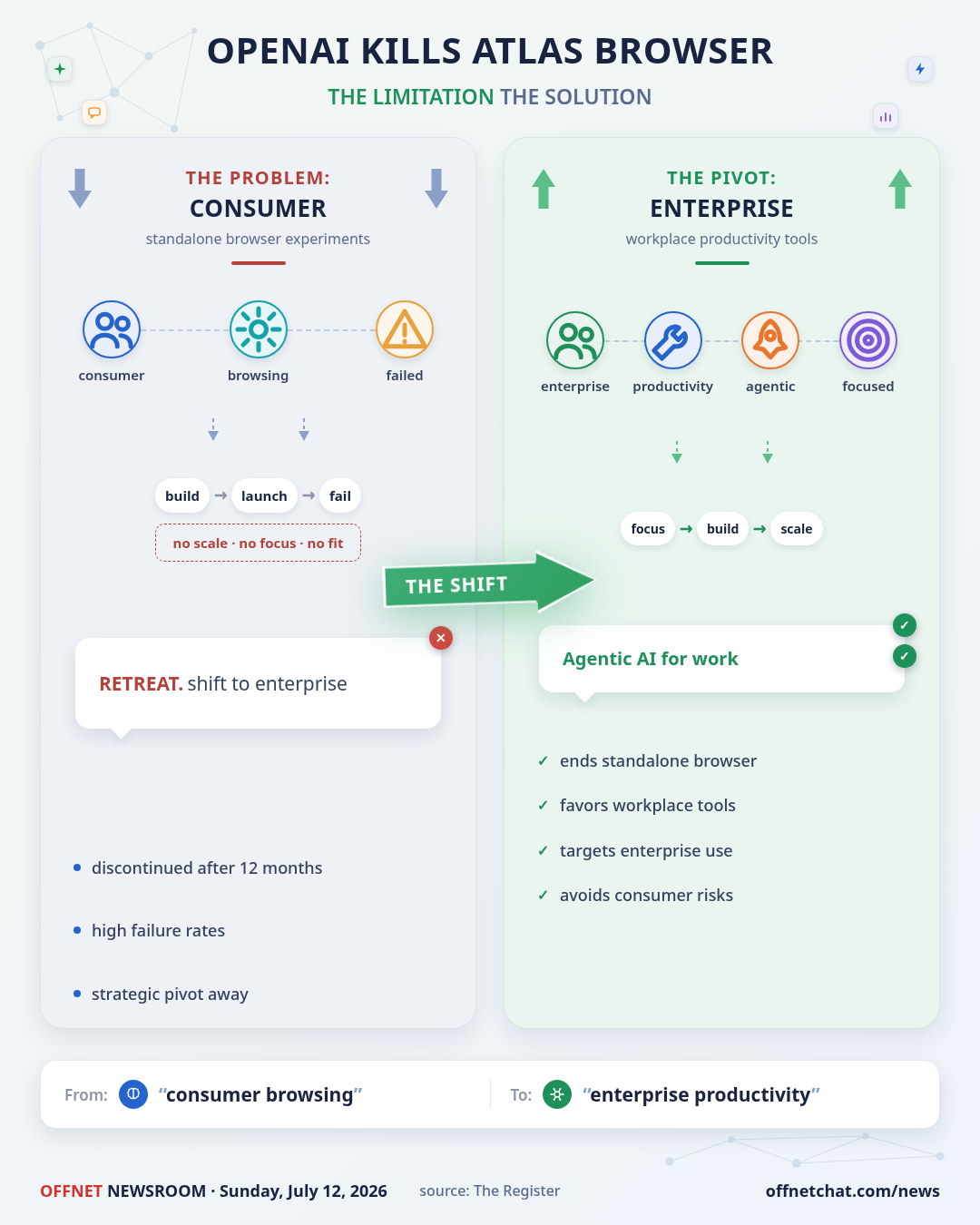
OpenAI has discontinued its standalone Atlas browser after less than a year in operation. The company is shifting its agentic AI ambitions away from general-purpose browsing tools toward workplace productivity applications. This move signals a strategic retreat from consumer-facing standalone experiments in favor of enterprise-oriented solutions.

  • OpenAI ends the standalone Atlas browser experiment after under 12 months
  • Strategic focus shifts from general browsing to workplace productivity tools
  • Agentic AI development is being redirected toward enterprise use cases
  • Consumer-facing standalone AI browser experiments face high failure rates
Hacker News (100+ points) general

100-Line Lisp Agent Demonstrates Minimalist AI Implementation

A recent article details the construction of a functional AI agent using only 100 lines of Lisp code. This implementation highlights how core agent behaviors can be distilled into a compact, readable codebase without external dependencies. It serves as a practical example for understanding agent architecture at its most fundamental level.

  • Proves complex agent logic can be implemented in under 100 lines of code
  • Uses Lisp to demonstrate clarity and minimalism in AI system design
  • Serves as an educational reference for understanding agent internals
  • No external libraries required, relying on core language features
AWS What's New awsdatabase ↺ since 07-11

AWS DMS Schema Conversion gains AI agent automation via MCP Server

AWS Database Migration Service Schema Conversion now integrates with the AWS MCP Server, enabling AI coding agents like Kiro, Claude Code, and Cursor to drive migration workflows from within IDEs. These agents autonomously handle project creation, metadata browsing, schema conversion, and report generation by following predefined DMS-specific procedures rather than improvising. This integration aims to reduce trial-and-error loops by enforcing operational sequencing rules and schema exclusion patterns during the conversion process.

  • Connect popular AI coding agents to DMS Schema Conversion via the AWS MCP Server.
  • Execute complete migration workflows using natural language commands inside your IDE.
  • Agents follow strict DMS procedures to minimize trial-and-error in schema conversion.
  • Automation covers project setup, metadata analysis, and assessment report generation.
  • Predefined skill includes API patterns and operational rules for consistent results.
HOW IT WORKSDMS AI Agent Workflow1Connect AI Agent via MCP2Issue Natural Language Command3Create Project & Browse Metadata4Execute Schema Conversion5Generate Assessment Report
AWS Database Blog awsdatabase ↺ since 07-10

AWS DMS Schema Conversion adds agentic AI for natural language workflows

AWS has integrated AI agents into DMS Schema Conversion to orchestrate migration tasks via natural language. The agent handles the full lifecycle, including project creation, metadata browsing, schema conversion, and report generation. This allows users to execute complex migration steps through conversational prompts rather than manual GUI interactions.

  • AI agents manage DMS SC workflows end-to-end via natural language prompts
  • Automates project creation, metadata browsing, and schema conversion steps
  • Generates and exports assessment reports without manual intervention
  • Reduces friction in database modernization by simplifying complex tasks
AWS What's New awsdatabase ↺ since 07-10

AWS MCP Server adds OAuth support for AI agent authentication

The AWS MCP Server now accepts industry-standard OAuth connections via AWS Sign-In, allowing AI agents to authenticate without extra software. This update maintains existing IAM permissions and governance controls while enabling both interactive browser and headless programmatic authorization flows. Administrators can now manage access using IAM policies alongside new capabilities like token introspection, revocation APIs, and CloudTrail audit events.

  • AI agents connect to AWS MCP Server using standard OAuth via AWS Sign-In.
  • No additional authentication software is required for agent connectivity.
  • Existing IAM permissions and governance controls continue to apply.
  • Supports interactive browser login and headless programmatic authorization.
  • New admin controls include token introspection, revocation, and CloudTrail auditing.
CHECKLISTNew AWS MCP OAuth FeaturesConnect agents via standard OAuth using AWS Sign-InManage access with existing IAM policies and controlsEnable token introspection and revocation APIs for adminsAudit activity through new CloudTrail events
Google AI Blog aillm ↺ since 07-08

Gemini API expands managed agents with background tasks and remote MCP

Google has expanded its Managed Agents feature in the Gemini API to support long-running background tasks and integration with remote Model Context Protocol (MCP) servers. This update allows developers to build more complex, asynchronous agent workflows that can operate independently of the initial request cycle. The release also bundles other enhancements to the managed agents capability for broader developer use.

  • Supports long-running background tasks for asynchronous agent execution
  • Enables integration with remote MCP servers for extended tooling
  • Part of a broader feature bundle launch for Gemini API managed agents
  • Facilitates more complex, decoupled agent workflows for developers
GitHub Trending (daily) githubrepos ↺ since 07-11 ⚠ unverified date/source

Google releases Stitch Skills for MCP coding agents

Google Labs has published stitch-skills, a library of Agent Skills compatible with the Stitch MCP server. This collection includes design and plugin tools that adhere to the Agent Skills open standard. It enables seamless integration with major coding agents like Claude Code, Cursor, and Gemini CLI.

  • Enables AI coding agents to interact with Google Stitch design tools via MCP.
  • Supports multiple agents including Claude Code, Cursor, and Codex.
  • Installs easily via CLI commands for global or per-project setup.
  • Follows the Agent Skills open standard for broad interoperability.
TRADE-OFFStitch Skills vs Old MethodsStandard IntegrationManual API coding requiredComplex error handling logicVendor-specific implementationStitch Skills ApproachOpen standard agent skillsSeamless MCP server integrationSupports Claude, Cursor, Geminivs

Automation / DevOps / IaC 8

roundup ↗
GitHub Trending (daily) githubrepos ⚠ unverified date/source

Terraform remains top GitHub trending repo for IaC management

HashiCorp's Terraform continues to dominate GitHub trending lists, serving as the primary tool for safely creating and versioning infrastructure. It codifies cloud and on-prem APIs into declarative configuration files that teams can share and treat as code. The platform supports both popular service providers and custom in-house solutions through its source-available model.

  • Declarative config files enable safe, predictable infrastructure changes across teams.
  • Supports existing providers and custom in-house infrastructure solutions.
  • Version control and code review workflows are integral to the IaC process.
  • Certification and learning resources available via HashiCorp's official platforms.
InfoQ generaldevops ↺ since 07-11

Datadog uses Claude and Cursor for AI-driven production migration

Datadog engineer Arnold Wakim details a production migration where AI tools Claude and Cursor helped overcome storage backend limitations. The team leveraged these models to refactor critical infrastructure, resulting in significant performance improvements. The process highlights both effective strategies and pitfalls encountered during this AI-assisted engineering effort.

  • AI pair programmers can assist with complex refactoring in production environments
  • Storage backend limits may require innovative architectural solutions
  • Performance gains justify the effort of AI-assisted migration strategies
  • Reviewing what didn't work is as valuable as documenting successes

Percona Operator for MySQL 1.2.0 introduces cross-site replication to support multi-region deployments. The update also adds support for encrypted backups stored in object storage and automatic storage scaling. These features address common operational gaps for fleets expanding beyond a single cluster.

  • Enables warm replica clusters in second data centers for improved disaster recovery.
  • Supports encrypted backups in object storage to meet auditor requirements.
  • Adds automatic storage scaling to reduce manual intervention during growth.
InfoQ generaldevops ↺ since 07-11

Chaos Engineering Strategies for Large-Scale GPU Clusters

Bryan Oliver presents techniques for applying chaos engineering to complex AI infrastructure, focusing on large GPU clusters. The talk addresses handling intricate topologies, RDMA network protocols, and NUMA misalignments through practical fault injection. The goal is to maximize hardware efficiency and establish robust observability loops for multi-million dollar investments.

  • Apply chaos engineering to validate stability in large-scale GPU clusters.
  • Address specific infrastructure challenges like RDMA and NUMA misalignments.
  • Implement seven practical fault-injection strategies for robust testing.
  • Build observability loops to ensure efficiency and reliability of AI hardware.
AWS Database Blog awsdatabase ↺ since 07-08

AWS Automates PostgreSQL Audit Log Extraction to S3 via CloudWatch

AWS published a guide to building an automated pipeline that extracts PostgreSQL audit logs from CloudWatch Logs. The solution converts these entries into structured CSV format in near real time and stores them in Amazon S3 for long-term analysis.

  • Eliminates manual log retrieval by automating extraction from CloudWatch Logs to S3.
  • Converts unstructured log data into structured CSV for easier parsing and analysis.
  • Enables near real-time processing of audit events for timely security monitoring.
  • Leverages S3 for durable, long-term storage of compliance and audit trails.

Percona Blog compares practical migration strategies for moving production PostgreSQL workloads from the Crunchy Data Kubernetes operator to the Percona operator. The analysis focuses on balancing trade-offs between downtime, operational complexity, rollback safety, and cost. It details specific paths to minimize business risk during the transition.

  • Migration involves more than data movement; it requires evaluating downtime and rollback safety.
  • Percona provides a comparison of trade-offs including cost and operational complexity.
  • Practical paths are defined to help engineers manage business risk during the switch.
  • The guide supports DBAs moving from Crunchy Data to Percona's Kubernetes-native solution.
TRADE-OFFCrunchy vs Percona MigrationCrunchy DataEstablished Kubernetes operatorHigh operational complexitySignificant migration downtimePercona OperatorKubernetes-native solutionSimplified managementMinimized business riskvs

GitHub has generally available the redesigned Copilot CLI terminal interface, introducing a tabbed layout for managing sessions, gists, issues, and pull requests. The update features a form-driven setup process for MCP servers, skills, and plugins, eliminating the need to manually edit configuration files. Additionally, the UI has been refined for better accessibility, including screen reader support and theme awareness.

  • Tabbed layout consolidates sessions, gists, issues, and PRs in a single terminal view.
  • Form-driven setup for MCP servers and plugins removes manual config file editing.
  • Improved accessibility includes screen reader support and theme-aware design.
  • Terminal interface is now generally available for all users.
AWS What's New awsdatabase ↺ since 07-11

SageMaker HyperPod adds AMI-based node config for continuous Slurm provisioning

Amazon SageMaker HyperPod now allows AMI-based configuration for Slurm clusters operating in continuous provisioning mode. This update removes the need to download, configure, or upload lifecycle scripts to Amazon S3 when adding nodes. The AMI approach pre-images nodes with essential AI/ML software like Docker, Enroot, and Pyxis, alongside Slurm accounting and SSH key setups, ensuring production-ready environments on demand.

  • Eliminates S3 script management for node lifecycle in continuous provisioning mode
  • Pre-bakes Docker, Enroot, and Pyxis into AMIs for faster node readiness
  • Automates Slurm accounting, SSH keys, and log rotation via AMI configuration
  • Simplifies scaling operations by reducing manual cluster setup overhead
HOW IT WORKSSimplified Node Provisioning1Define AMI with AI/ML software2Configure Slurm and SSH keys3Launch nodes in continuous mode4Deploy production-ready clusters instantly

AWS 6

roundup ↗
AWS What's New awsdatabase ↺ since 07-11

Amazon DocumentDB Adds R8g.24xlarge and R8g.48xlarge Instances

Amazon DocumentDB now supports R8g.24xlarge and R8g.48xlarge instances powered by AWS Graviton4 processors and DDR5 memory. These new nodes offer up to 192 vCPUs and 1,536 GiB of memory to handle high-concurrency and memory-intensive workloads. Users can deploy these larger instances by modifying existing clusters or creating new ones via the console, CLI, or SDK.

  • Graviton4 processors deliver higher throughput for demanding DocumentDB workloads.
  • DDR5 memory supports larger in-memory working sets for complex queries.
  • R8g.48xlarge provides 1,536 GiB memory for massive operational data sets.
  • Deploy via standard AWS tools without changing application code.
BY THE NUMBERSThe headline number1,536GiBAmazon DocumentDB Adds R8g.24xlarge and R8g.48xlarge…
AWS What's New awsdatabase ↺ since 07-08

S3 Vectors expands to AWS GovCloud for secure AI workloads

Amazon S3 Vectors is now live in AWS GovCloud (US-East) and (US-West) regions, bringing purpose-built vector storage to government and regulated sectors. This service supports billion-vector scale operations for AI agents, RAG pipelines, and semantic search without requiring infrastructure provisioning. It leverages S3’s native elasticity and durability while offering dedicated APIs for vector data management.

  • GovCloud customers can now deploy RAG and semantic search at scale with managed vector storage.
  • No infrastructure provisioning needed; uses dedicated APIs for storing and querying vectors.
  • Maintains S3-grade durability and availability for sensitive government data workloads.
  • Enables secure AI agent development within the GovCloud compliance boundary.
CHECKLISTGovCloud Vector Deployment GuideDeploy RAG pipelines at scaleSkip infrastructure provisioning stepsUse dedicated vector APIsEnsure S3-grade durabilityMaintain compliance boundaries
InfoQ generaldevops ↺ since 07-10

Multi-Region Latency vs Cost: Budget Decomposition and Phased Routing

The article argues that expanding across cloud regions requires more than simple arithmetic, presenting a framework derived from multiple production launches. It emphasizes decomposing latency budgets early to guide infrastructure decisions based on consistency and traffic patterns. A phased strategy focusing on routing optimization alone achieved a 35% latency reduction before adding a new region.

  • Decompose latency budgets before committing to infrastructure to avoid costly re-architecture.
  • Select deployment patterns based on specific consistency requirements and traffic profiles.
  • Optimize routing and existing topology before expanding to additional regions.
  • Phased routing improvements can yield 35% latency gains without new hardware.
AWS What's New awsdatabase ↺ since 07-10

Amazon Timestream for InfluxDB emits state change events to EventBridge

Amazon Timestream for InfluxDB now publishes database state change events to Amazon EventBridge, covering lifecycle operations like creation, deletion, scaling, and maintenance. This capability allows automation workflows to react programmatically to successful or failed operations without relying on API polling. DevOps teams can trigger actions on scaling completion, while operations and compliance teams can route failures or persist events for auditing.

  • Eliminate API polling for Timestream for InfluxDB state changes via EventBridge integration
  • Automate workflows that trigger on scaling, maintenance, or reboot completion
  • Route failure events for immediate alerting and operational response
  • Persist all lifecycle events to CloudWatch Logs or S3 for compliance audits
  • Covers both successful completions and failures for full visibility
HOW IT WORKSEventBridge Integration Flow1Database state changes2EventBridge receives event3Automated workflows trigger4Logs persist to S3
AWS What's New awsdatabase ↺ since 07-09

Redshift Graviton RG instances now on trailing track P201

AWS has extended support for Graviton-based Redshift RG instances to the trailing track (P201), enabling stable production environments to leverage these newer hardware options. The rg.xlarge and rg.4xlarge instance types are now available for provisioning and resizing via console, CLI, or SDKs. This update allows customers to maintain validated software versions while accessing improved performance metrics.

  • Graviton RG instances now support trailing track P201 for stable production workloads.
  • Expect up to 2.4x query performance gains compared to RA3 instances.
  • Cost savings of 30% per vCPU are available with the new rg types.
  • Provisioning supported via Console, AWS CLI, and AWS SDKs.
BY THE NUMBERSQuery Speed Boost2.4xPerformance gain vs RA3Faster queries on Graviton RG instances
AWS What's New awsdatabase ↺ since 07-09

AWS Systems Manager adds Azure VM support and removes per-node fees

AWS Systems Manager now allows management of Azure Virtual Machines alongside EC2 instances without manual agent installation, using Cloud Connectors for automatic deployment. This integration enables unified operations for Session Manager, Patch Manager, and Automation across both clouds. Furthermore, AWS has eliminated the Advanced Instances Tier, transitioning to a pay-as-you-go model for Session Manager and Run Command starting September 30, 2026.

  • Auto-deploy SSM Agent to Azure VMs via Cloud Connectors without manual setup.
  • Unified console for managing AWS EC2 and Azure VMs with Session Manager and Patch Manager.
  • Advanced Instances Tier removed; new pay-as-you-go pricing begins Sept 30, 2026.
  • Run Command and Automation workflows now extend to hybrid Azure infrastructure.
TRADE-OFFSSM Management EvolutionLegacy ModelPer-node fees requiredManual agent installation neededAWS EC2 onlyNew ModelPay-as-you-go pricingAuto-deploy via connectorsUnified AWS and Azurevs

Oracle Ecosystem 1

roundup ↗
AWS What's New awsdatabase ↺ since 07-08

Amazon RDS for Oracle supports Database 26ai with Select AI and Vector Search

Amazon RDS for Oracle now supports Oracle Database 26ai, the latest Long Term Support release, featuring native integration with Amazon Bedrock for foundation models like Claude and Llama. New capabilities include Oracle Select AI for generating SQL from natural language prompts and AI Vector Search for storing embeddings alongside relational data. This allows for retrieval augmented generation (RAG) and hybrid semantic searches directly within the database without moving data to a separate vector store.

  • Oracle Database 26ai is now available on Amazon RDS for Oracle as an LTS release.
  • Select AI enables SQL generation and execution via natural language prompts.
  • AI Vector Search allows embedding storage and hybrid search without external databases.
  • RAG implementation is supported directly from SQL using Oracle's vector capabilities.
  • Bedrock integration provides access to models like Anthropic Claude, Amazon Nova, and Meta Llama.

Fleet impact: For Oracle ExaCC/RAC and Amazon RDS for Oracle fleets, this update introduces native vector search and natural language SQL generation, reducing the need for external vector databases. Plan to evaluate Select AI for developer productivity and audit the new Bedrock model integrations for security and compliance before enabling in production.

TRADE-OFFOracle 26ai vs Legacy RAGLegacy ApproachData moves to external vector storeComplex data pipeline requiredIncreased latency and costOracle 26ai ApproachEmbeddings stored in…No data movement neededHybrid search via SQLvs

Trending on GitHub 4

roundup ↗
GitHub Trending (daily) githubrepos ⚠ unverified date/source

Next.js trending with Rust-accelerated tooling for full-stack React

Next.js remains a top-trending GitHub repository, offering a React framework that enables full-stack web application development. The project integrates powerful Rust-based JavaScript tooling to deliver fast builds and extends the latest React features. It is widely adopted by major companies and supported by extensive documentation and community channels.

  • Leverages Rust-based tooling to significantly speed up build times.
  • Supports full-stack development by extending modern React capabilities.
  • Widely adopted by large enterprises for production-grade apps.
  • Strong ecosystem with official docs, Discord, and GitHub discussions.
GitHub Trending (daily) githubrepos ⚠ unverified date/source

Anthropic releases Claude cookbooks with copy-paste Python recipes

Anthropic has published a GitHub repository of notebooks and recipes demonstrating practical applications of the Claude API. The collection provides ready-to-use code snippets designed to help developers integrate model capabilities into their own projects. While the examples are primarily in Python, the underlying concepts are applicable to any language that supports API interaction.

  • Provides copy-paste Python snippets for immediate integration into projects.
  • Covers fun and effective use cases to accelerate development workflows.
  • Requires a valid Claude API key to run the provided notebooks.
  • Concepts are language-agnostic despite Python-focused implementation.
PostgreSQL News database ↺ since 07-10

pglayers offers stackable Docker layers for 53 PostgreSQL extensions

The pglayers project publishes 53 PostgreSQL extensions as minimal Docker images built from scratch. Users compose these onto the official postgres image using COPY --from directives, avoiding compilation or build tools in the final container. Each layer contains only the necessary shared libraries, control files, and SQL scripts, allowing extensions to be enabled via standard CREATE EXTENSION commands.

  • Eliminates apt-get and compilation steps by using pre-built minimal Docker layers
  • Supports 53 extensions including pgvector, PostGIS, and pg_cron
  • Composable via COPY --from in Dockerfiles for precise image control
  • Final images contain only runtime artifacts, reducing attack surface and size
  • Simplifies multi-extension setups without managing system dependencies
BY THE NUMBERS53 Extensions in Minimal Docker Layers53%PostgreSQL extensions available via pglayersStackable layers eliminate build tools
PostgreSQL News database ↺ since 07-08

PDU: Open-source PostgreSQL offline data unloader for WAL and table recovery

PDU is a new open-source tool designed to recover data from offline PostgreSQL instances by reading data files and WAL archives directly without modifying the original directory. It reconstructs metadata to enable the export of individual tables, schemas, or full databases into CSV format. Additionally, it supports targeted row recovery from WAL logs to address accidental DELETE or UPDATE operations.

  • Operates on offline data files without altering the original PostgreSQL directory structure.
  • Exports recovered data to CSV for easy inspection or loading into a fresh instance.
  • Enables targeted recovery of specific rows from WAL archives after accidental mutations.
  • Provides a CLI interface for full-database, schema, or single-table exports.
CHECKLISTPDU Recovery WorkflowMount offline data files without altering structureReconstruct metadata for table or schema accessExport recovered data to CSV formatTarget specific rows from WAL archives

Mobile friendly 6

all cards ↗

Today's top database + AI stories as save-and-share cards — built for your phone and your LinkedIn feed.