OffNet Newsroom

Archive snapshot

Saturday, July 11, 2026

Daily signal on databases, AI, and the tech that matters.

31 new today 47 stories 8 sections 18 for the DBA desk

Database Technology 7

roundup ↗
Planet PostgreSQL database

PostgreSQL enable_seqscan Does Not Disable Sequential Scans

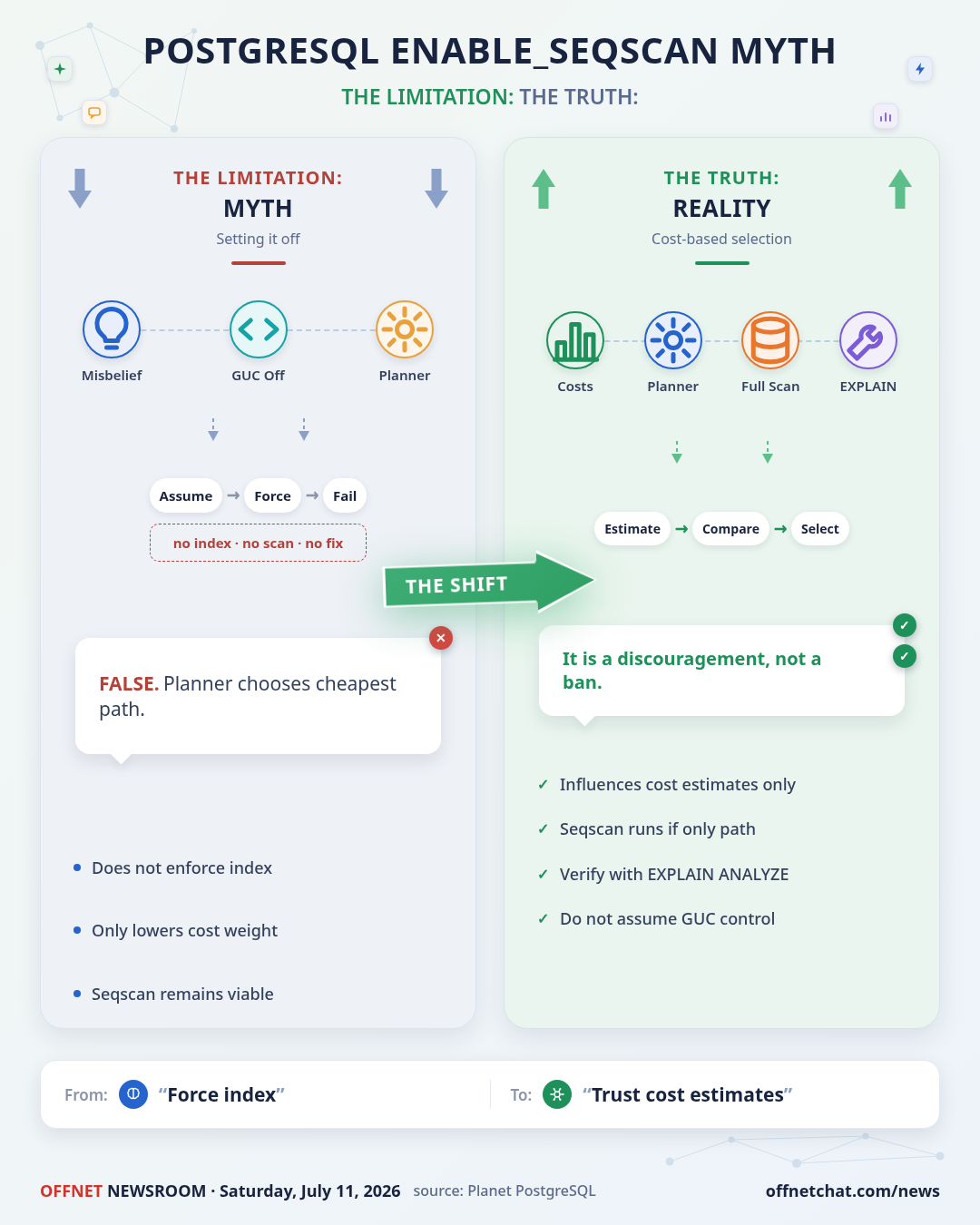
The enable_seqscan GUC does not strictly prevent sequential scans; it merely lowers their cost weight to discourage the planner from choosing them. Developers often mistakenly believe setting this to off will force index usage, but the planner may still select a sequential scan if it is the only viable execution path. This behavior is by design, as full table scans are sometimes the only way to satisfy a query.

  • enable_seqscan only influences planner cost estimates, it does not enforce index-only scans
  • Setting off will not prevent sequential scans when no other execution plan exists
  • Relying on this GUC to force index usage is a common misconception that leads to performance issues
  • Use EXPLAIN ANALYZE to verify actual execution plans rather than assuming GUCs dictate behavior
AWS What's New awsdatabase

AWS DMS Schema Conversion adds offline SQL Server support

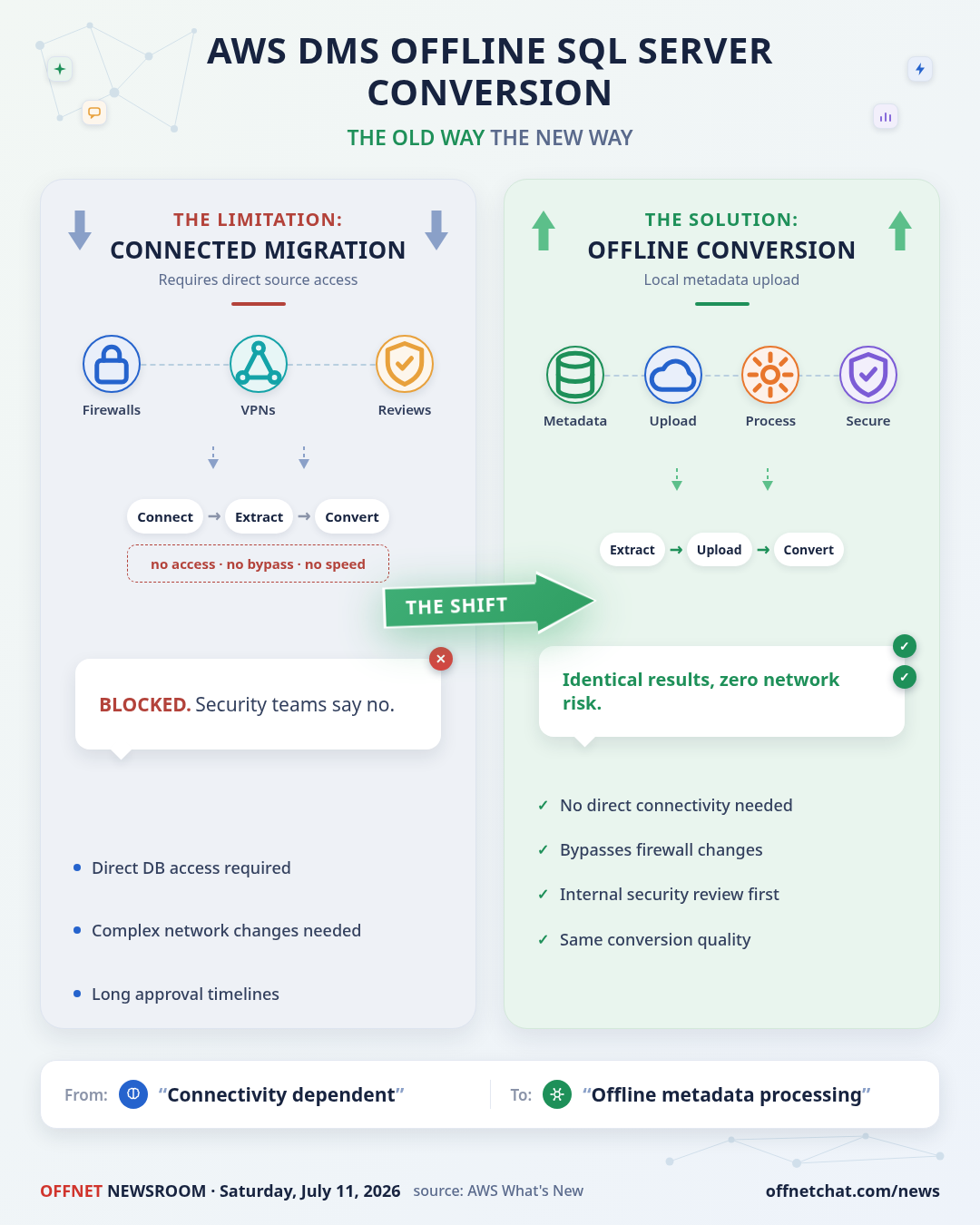
AWS Database Migration Service now allows offline schema conversion for Microsoft SQL Server, removing the need for direct connectivity to source databases. Users extract metadata using standard commands locally and upload it to DMS for processing, achieving the same results as the connected approach. This capability bypasses security reviews, firewall changes, and VPN setups that typically delay migration projects.

  • Eliminates need for direct DB connectivity, bypassing firewall and VPN setup delays.
  • Ideal for strict security policies restricting external tool access to production SQL Server.
  • Delivers identical conversion results to the online connected approach.
  • Allows internal security teams to review human-readable metadata files before upload.
HOW IT WORKSOffline SQL Server Migration Steps1Extract metadata locally2Review files internally3Upload to DMS4Convert schema offline
Planet PostgreSQL database

PostgreSQL 14 Throwing Errors Impossible for Its Version

A PostgreSQL 14 instance is generating an error message that the software version cannot logically produce. This indicates a mismatch between the binary code and the error catalog or internal state. The anomaly suggests potential corruption or a build artifact issue rather than standard query behavior.

  • Verify the exact binary build and patch level against the error definition.
  • Check for corrupted system catalogs or shared memory state.
  • Reproduce in a non-production environment to isolate the trigger.
  • Consider binary replacement if build artifacts are suspect.

An examination of governance challenges in financial services reveals that while individual teams like data engineering and AI development make sound, responsible decisions in isolation, significant risks emerge when viewing their interactions holistically. The C.A.L.M. platform test is introduced to identify these cross-functional misalignments, specifically where data movement for AI experimentation creates visibility gaps between engineering, AI, and compliance groups. This approach highlights how decentralized mandates can inadvertently lead to governance blind spots despite local adherence to best practices.

  • Siloed team decisions often mask cross-functional governance risks in AI data pipelines.
  • The C.A.L.M. framework exposes misalignments between data engineering and AI teams.
  • Compliance visibility gaps arise when data moves to isolated experimental environments.
  • Holistic reviews are necessary to catch issues invisible in individual team conversations.
AWS What's New awsdatabase ↺ since 07-09

Amazon Aurora DSQL CDC Generally Available for Real-Time Event Streaming

AWS has made change data capture for Amazon Aurora DSQL generally available, allowing real-time streaming of insert, update, and delete operations to Amazon Kinesis Data Streams. This managed feature captures database changes without requiring infrastructure management and is designed to have zero impact on database workload performance. Users can integrate these events into microservices, trigger Lambda functions, or deliver data to S3, Redshift, and OpenSearch via Firehose.

  • Stream real-time DSQL changes to Kinesis for event-driven architectures without managing infrastructure.
  • CDC captures inserts, updates, and deletes with zero impact on database performance.
  • Integrate with Lambda, S3, Redshift, and OpenSearch via Amazon Data Firehose.
  • Available in all regions supporting Aurora DSQL; no additional setup required.
HOW IT WORKSDSQL Change Data Flow1Aurora DSQL captures changes2Stream to Kinesis Data Streams3Trigger Lambda functions4Deliver to S3 or Redshift
AWS Database Blog awsdatabase ↺ since 07-08

RDS PostgreSQL 18 Boosts Logical Replication with Auto-Cleanup and Conflict Stats

Amazon RDS for PostgreSQL 18 introduces key logical replication enhancements, including default parallel streaming and automatic replication slot cleanup via idle_replication_slot_timeout. Users can now publish stored generated columns, toggle two-phase commit on active subscriptions, and monitor conflicts using new pg_stat_subscription_stats counters. These features are available for RDS for PostgreSQL 18.0+ and Aurora PostgreSQL.

  • Parallel streaming is enabled by default, likely improving replication throughput for large datasets.
  • Use idle_replication_slot_timeout to automatically clean up unused replication slots and prevent disk exhaustion.
  • Monitor subscription health with new conflict counters in pg_stat_subscription_stats for faster troubleshooting.
  • Publish stored generated columns using the new publish_generated_columns parameter for complex schemas.
  • Toggle two-phase commit on running subscriptions without restarting them, reducing operational downtime.

Fleet impact: For RDS PostgreSQL and Aurora fleets, enable idle_replication_slot_timeout immediately to prevent storage bloat from orphaned slots. Review pg_stat_subscription_stats to detect replication lag or conflicts early, and verify parallel streaming is active to optimize WAN-bound replication performance.

LLMs 8

roundup ↗
Hacker News (100+ points) general

GPT-5.6 Sol Ultra claims proof of Cycle Double Cover Conjecture

A model identified as GPT-5.6 Sol Ultra has generated a PDF purportedly containing a proof for the Cycle Double Cover Conjecture. The document was shared via social media links and is available as a standalone PDF. The release has garnered significant attention on Hacker News, indicating high interest in this potential mathematical breakthrough.

  • AI models are now attempting to solve open problems in pure mathematics.
  • Verify the proof's validity independently; AI hallucinations in formal logic are a known risk.
  • The Cycle Double Cover Conjecture remains a significant unsolved problem in graph theory.
  • Community scrutiny on platforms like Hacker News is critical for validating AI-generated math.
  • Treat AI-claimed proofs as hypotheses requiring rigorous peer review, not established facts.
CHECKLISTVerify AI Math ClaimsTreat AI proofs as hypothesesVerify validity independentlyExpect community scrutinyDemand rigorous peer review
Hacker News (100+ points) general

GLM 5.2 runs on 32GB RAM via int4 quantization and MTP optimization

A developer successfully deployed GLM 5.2 on consumer hardware with 32GB of RAM by converting the model to int4 quantization and leveraging MTP. The approach also explored DSA for long-context handling, maintaining quality comparable to Claude or GPT while avoiding out-of-memory errors. The project highlights viable inference strategies for large models on limited local resources.

  • Int4 quantization enables GLM 5.2 execution on 32GB RAM systems without OOM crashes.
  • MTP optimization is key to fitting and running large models on constrained consumer hardware.
  • Quality remains comparable to top-tier cloud models like Claude or GPT despite local constraints.
  • DSA implementation supports long-context windows, expanding utility for complex tasks.
Hacker News (100+ points) general

AI 2040: Plan A published on Hacker News with 259 points

A piece titled AI 2040: Plan A has surfaced on Hacker News, generating significant engagement with 259 points and 264 comments as of July 9, 2026. The source indicates an external publication at ai-2040.com, but provides no specific technical details or excerpts regarding the content. The high comment count suggests active community discussion around the topic.

  • Article is trending on Hacker News with high engagement metrics
  • No technical details provided in the source excerpt
  • External link points to ai-2040.com for full content
  • Community interest is high based on comment volume
LangChain Releases agentsreleases

langchain-openai 1.3.5 adds explicit prompt caching support

LangChain has released version 1.3.5 of its OpenAI integration library. The primary update introduces support for explicit prompt caching, allowing developers to control caching behavior directly. This release also includes a routine refresh of internal model profile data to ensure accuracy.

  • Explicit prompt caching is now supported in the OpenAI integration
  • Developers can leverage this to reduce latency and token costs
  • Model profile data has been updated for current availability
  • Upgrade to v1.3.5 to access the new caching feature
OpenAI News llmaiagents ↺ since 07-10

OpenAI launches GPT-Live voice models for ChatGPT Voice

OpenAI has introduced GPT-Live, a new generation of voice models designed to enable more natural human-AI interaction. These models are currently powering the ChatGPT Voice feature, marking a shift in how users engage with the assistant through audio. The release focuses on improving the fluidity and realism of spoken responses.

  • GPT-Live represents a new generation of voice models for human-AI interaction.
  • The technology is now live and powering ChatGPT Voice.
  • Focus is on natural, fluid conversational capabilities.
Hugging Face Blog llmaiml ↺ since 07-09

Hugging Face adds native vLLM backend to Transformers for speed

Hugging Face introduces a native vLLM integration within the Transformers library, allowing users to leverage vLLM's high-performance serving capabilities directly. This update brings optimized inference speeds and better resource utilization to standard Hugging Face workflows without requiring separate infrastructure setups.

  • Integrates vLLM engine directly into Hugging Face Transformers library.
  • Enables high-throughput inference with minimal code changes.
  • Simplifies deployment by removing need for separate vLLM servers.
  • Leverages vLLM's PagedAttention for improved memory efficiency.
OpenAI News llmaiagents ↺ since 07-10

Microsoft 365 Copilot defaults to GPT-5.6 for enhanced performance

Microsoft has updated Microsoft 365 Copilot to use OpenAI's GPT-5.6 as its preferred model. This shift targets improved AI capabilities across Word, Excel, PowerPoint, Chat, and Cowork. The change aims to deliver faster and higher-quality work assistance to users.

  • GPT-5.6 is now the default model for Microsoft 365 Copilot.
  • Updates apply to Word, Excel, PowerPoint, Chat, and Cowork.
  • Aims to improve speed and quality of AI-assisted tasks.
  • No immediate infrastructure changes required for end users.
OpenAI News llmaiagents ↺ since 07-10

OpenAI flags reliability issues in SWE-Bench Pro coding benchmark

OpenAI published an analysis identifying problems within SWE-Bench Pro, a widely used benchmark for measuring AI coding capabilities. The findings suggest that current evaluation methods may suffer from reliability and accuracy concerns, potentially skewing model performance metrics. This highlights the difficulty of distinguishing genuine engineering skill from benchmark-specific artifacts in automated coding tests.

  • SWE-Bench Pro results may be less reliable than assumed for model comparison
  • OpenAI's analysis suggests accuracy issues in current coding benchmark design
  • Practitioners should treat benchmark scores with caution when evaluating models
  • Signal-to-noise ratio in coding evaluations remains a critical challenge
  • Benchmarks may not fully reflect real-world software engineering reliability

AI / ML 4

roundup ↗

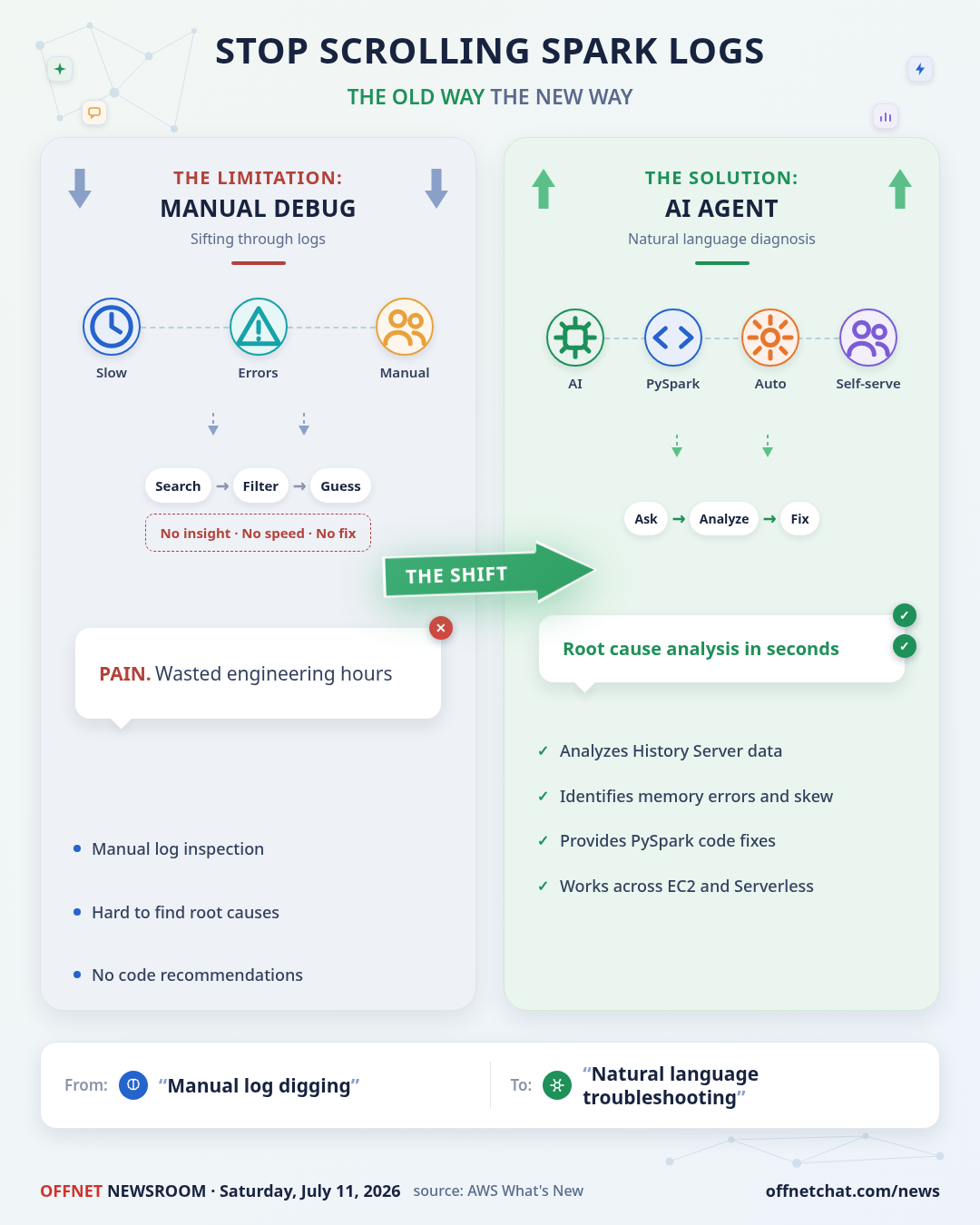
AWS has introduced an Apache Spark troubleshooting agent for Amazon EMR on EKS, enabling data engineers to diagnose job failures using natural language queries. The agent automatically analyzes Spark History Server data, distributed executor logs, and cluster configurations to identify root causes like memory errors, data skew, and resource contention. It provides automated root cause analysis and PySpark code recommendations, eliminating the need to manually sift through logs. This feature extends the troubleshooting agent's coverage to include EMR on EC2 and EMR Serverless, accessible via the console or CLI.

  • Diagnose EMR on EKS Spark failures via natural language instead of manual log inspection.
  • Agent analyzes History Server data, executor logs, and cluster configs for root cause analysis.
  • Receives automated code recommendations to fix issues like memory errors and data skew.
  • Now available across all EMR deployment options: EC2, Serverless, and EKS.
  • Access directly from the EMR on EKS console or via the AWS CLI.
TRADE-OFFEMR Troubleshooting EvolutionOld WayManual log inspectionSifting through executor logsTime-consuming diagnosisNew AgentNatural language queriesAutomated root cause analysisCode recommendations providedvs

Amazon SageMaker Feature Store now supports high-throughput batch ingestion via BatchWriteRecord, allowing multiple records across feature groups in a single request. Users can also discover stored records using ListRecords without pre-known identifiers. Additionally, the offline store now allows creating tables and databases with custom names for better cataloging.

  • Use BatchWriteRecord for lower latency and fewer API calls during high-volume feature ingestion.
  • ListRecords enables record discovery in feature groups without needing specific record IDs.
  • Custom naming for offline store tables and databases improves data organization and cataloging.
  • Batch writes target the online store to accelerate real-time feature availability for models.
CHECKLISTNew SageMaker Feature Store CapabilitiesUse BatchWriteRecord for high-throughput feature ingestionDiscover records with ListRecords without known IDsCreate custom named offline store tablesAccelerate real-time feature availability for models
AWS What's New awsdatabase ↺ since 07-10

SageMaker Unified Studio adds operators for Bedrock, S3 Tables, and Glue Catalog

Amazon SageMaker Unified Studio Workflows now includes 19 new operators for services like Amazon Bedrock, S3 Tables, S3 Vectors, and AWS Glue Data Catalog. These additions enable users to orchestrate tasks such as managing Bedrock guardrails and provisioning S3 resources directly within the visual workflow creator. By integrating these capabilities, the update reduces the need for custom integration code or switching between different AWS consoles. This expansion allows data workers to build more comprehensive workflows that include triggering MWAA Serverless runs and managing catalog metadata.

  • No custom code needed for Bedrock guardrails, S3 Tables/Vectors, and Glue Catalog tasks.
  • Visual workflow creator now supports 19 new operators across four major AWS services.
  • Centralize orchestration by triggering MWAA Serverless runs directly from SageMaker.
  • Reduced context switching between consoles for data engineering workflows.
BY THE NUMBERS19 New SageMaker Operators19New workflow operators addedFor Bedrock, S3, and Glue services
Hugging Face Blog llmaiml ↺ since 07-10

Hugging Face PyTorch Profiling: Focusing on Attention Mechanisms

This third installment in Hugging Face's PyTorch profiling series zooms in on attention layers as the primary bottleneck for transformer performance. It provides targeted strategies for identifying and optimizing attention-related overheads within the PyTorch framework. The guide helps engineers pinpoint inefficiencies specific to self-attention and cross-attention operations during model execution.

  • Targets attention layers as the critical path for transformer profiling
  • Offers PyTorch-specific techniques to isolate attention overhead
  • Helps DBA/ML engineers optimize model inference and training speed
  • Part of a structured series on advanced PyTorch performance tuning
  • Focuses on practical bottlenecks rather than generic metrics

Agentic AI 8

roundup ↗

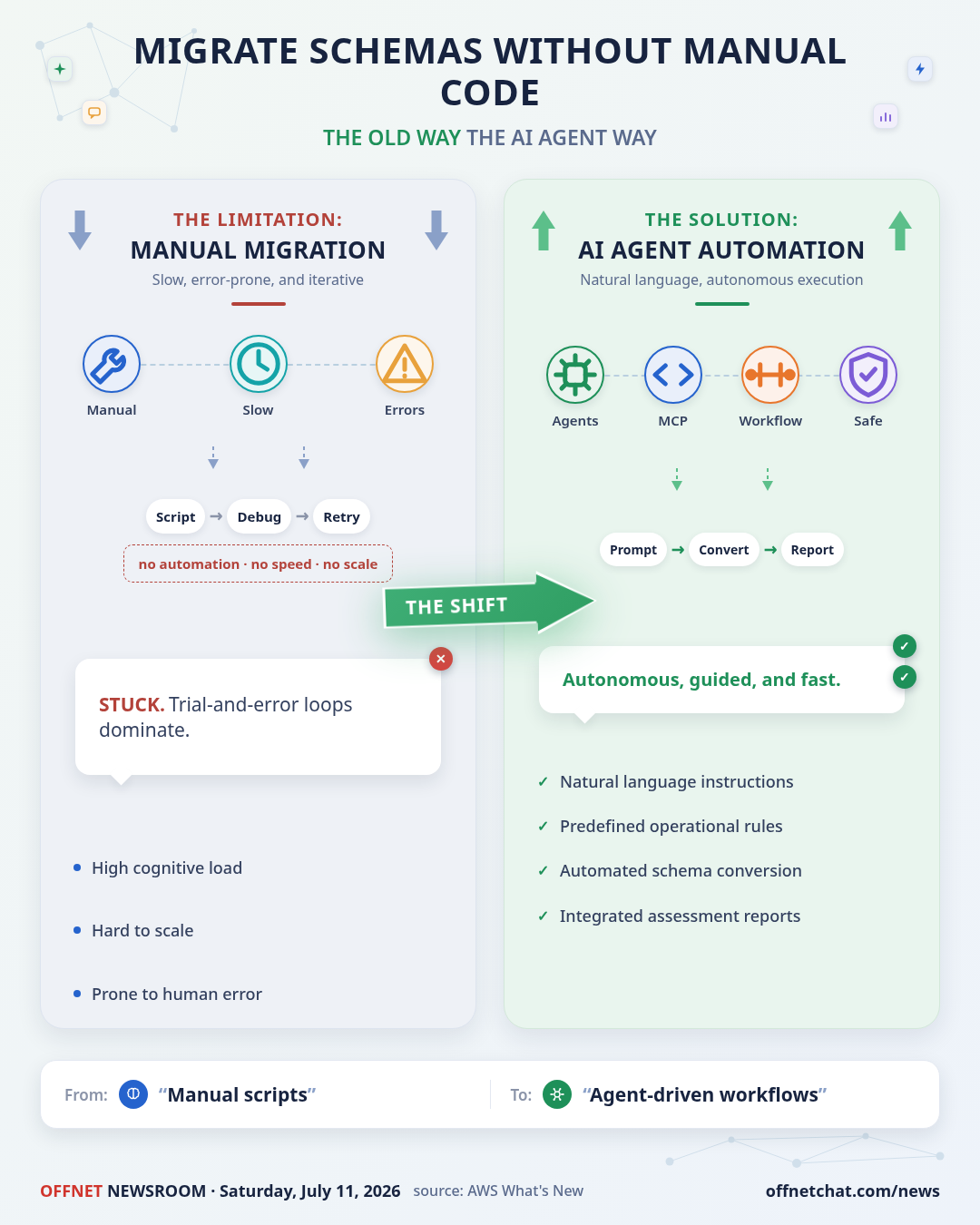
AWS Database Migration Service Schema Conversion now supports AI agent automation through the AWS MCP Server, enabling integration with coding agents like Kiro, Claude Code, and Cursor. These agents can execute complete migration workflows using natural language, autonomously creating projects, browsing metadata, converting schemas, and generating assessment reports. A dedicated skill, dms-schema-conversion, provides agents with predefined procedures and operational rules to reduce trial-and-error loops during migration tasks.

  • Integrate DMS Schema Conversion with IDE-based AI agents via the AWS MCP Server.
  • Agents can autonomously run full migration workflows using natural language instructions.
  • The dms-schema-conversion skill enforces best practices and reduces trial-and-error.
  • Supports automated schema conversion, metadata browsing, and report generation.
  • Extends automation to code objects like stored procedures with agent assistance.
HOW IT WORKSAI-Automated Migration Workflow1Connect via AWS MCP Server2Agents execute natural language commands3Convert schemas and browse metadata4Generate assessment reports automatically
GitHub Trending (daily) githubrepos ⚠ unverified date/source

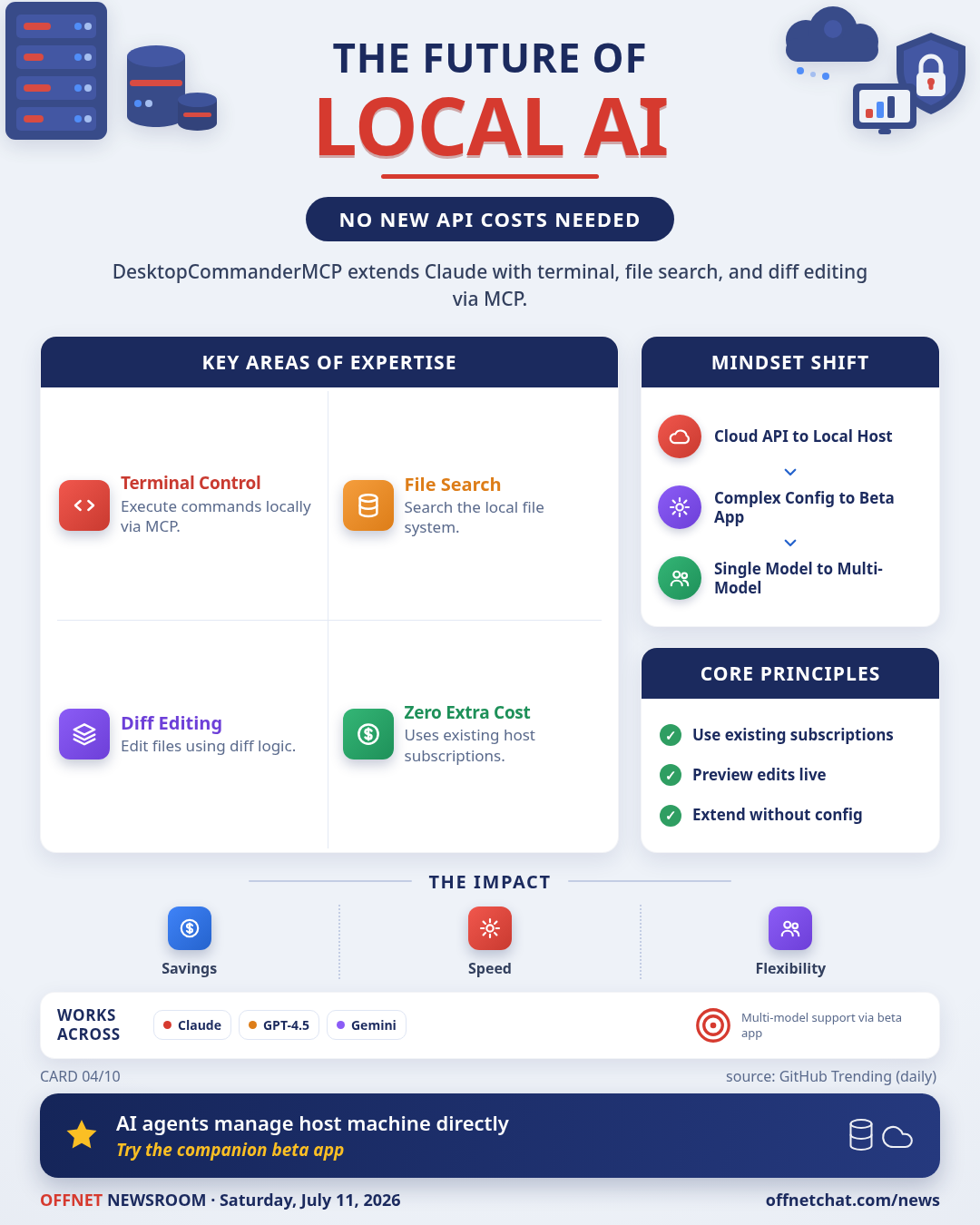
DesktopCommanderMCP extends Claude with terminal, file search, and diff editing via MCP

This GitHub repository hosts an MCP server that integrates Claude with local desktop capabilities, including terminal execution, file system search, and diff-based editing. It allows AI agents to manage files and run processes directly on the host machine, leveraging existing client subscriptions rather than incurring new API token costs. A companion beta app is available to support multiple AI models, provide live visual previews of edits, and allow custom MCP extensions without config files.

  • Enables Claude to execute terminal commands and search local file systems via MCP
  • Uses host client subscriptions, avoiding additional API token expenses for AI access
  • Beta app supports multi-model usage (Claude, GPT-4.5, Gemini) with live edit previews
  • Allows custom MCP tooling and context extension without complex configuration files

This research paper introduces the Context Graph, a live relational data structure that models enterprise entities and their state transitions over time. It proposes a Delta Detection Engine to monitor changes and a Proactivity Scorer to rank insights by urgency and relevance. An LLM-powered Surfacing Layer then delivers these proactive recommendations to workers before they explicitly ask for them.

  • Moves enterprise AI from reactive query-response to proactive insight delivery.
  • Uses a Context Graph to track entity relationships and state changes over time.
  • Delta Detection Engine continuously monitors for meaningful state shifts.
  • Proactivity Scorer ranks insights by urgency, relevance, and user persona.
  • Aims to boost productivity by surfacing actionable info before human requests.
HOW IT WORKSContext Graph Proactive Pipeline1Monitor entity state shifts2Detect meaningful delta changes3Score insight urgency4Surface proactive recommendations

Cloudflare now allows AI agents to deploy Workers via temporary accounts that require no permanent authentication. These ephemeral environments automatically expire and are deleted if unclaimed within 60 minutes. This feature streamlines autonomous deployment workflows by removing the friction of credential management.

  • AI agents can deploy Workers without creating or logging into permanent Cloudflare accounts.
  • Temporary accounts and their deployments self-destruct after 60 minutes if unclaimed.
  • Reduces friction for automated, unauthenticated deployment pipelines.
  • No database impact; this is an edge compute deployment feature.
GitHub Trending (daily) githubrepos ⚠ unverified date/source

Google Launches Stitch Skills for Coding Agents via MCP

Google has released a library of Agent Skills compatible with the Stitch MCP server, designed to integrate with major coding agents like Claude Code, Cursor, and Codex. These skills adhere to the Agent Skills open standard, enabling consistent interaction across different AI development environments. The release includes a quick start guide for installing the plugin suite globally or per repository via CLI.

  • Enables cross-agent compatibility for Stitch design tasks using the open Agent Skills standard.
  • Supports popular coding agents including Claude Code, Cursor, Gemini CLI, and Codex.
  • Provides CLI-based installation methods for global or sparse repository plugin management.
WORTH QUOTINGThe gistGoogle has released a library of Agent Skills compatiblewith the Stitch MCP server, designed to integrate with majorcoding— GitHub Trending (daily)

This paper addresses the transition of enterprise LLM applications from prompt-driven prototypes to production-grade systems by introducing a harness-engineering approach. It shifts deterministic behavior into code, manifests, and validation artifacts, establishing a replaceable composition boundary while keeping source-backed claims as the authority for runtime answers. The authors validate this architecture using a public dataset of five Korean corporate groups to demonstrate improved traceability and auditability.

  • Shifts deterministic logic from fragile prompts to structured code and schemas for reliability.
  • Establishes a replaceable composition boundary to decouple orchestration from model logic.
  • Ensures runtime answers remain grounded in source data rather than model hallucination.
  • Validates the pattern on real-world corporate data to prove enterprise-grade auditability.
CHECKLISTEnterprise LLM Audit StrategyShift logic to structured code for reliabilityDecouple orchestration with replaceable composition boundariesGround answers in source data to prevent hallucinationValidate patterns on real-world corporate data
GitHub Trending (daily) githubrepos ⚠ unverified date/source

TencentDB Agent Memory: Local 4-Tier Memory Pipeline Cuts Tokens 61%

TencentCloud’s new open-source project implements a fully local, four-tier memory architecture for AI agents, eliminating external API dependencies. It combines symbolic short-term memory to condense tool logs with layered long-term memory that structures conversations into personas and scenes rather than flat vectors. Integrating this system with OpenClaw reportedly reduces token consumption by over 61% and boosts task pass rates significantly.

  • Uses symbolic short-term memory to compress tool logs into Mermaid diagrams, reducing token overhead.
  • Implements layered long-term memory to structure conversations into personas instead of flat vector piles.
  • Fully local execution ensures zero external API dependencies for enhanced privacy and control.
  • Integration with OpenClaw yields 61.38% token reduction and 51.52% relative pass rate improvement.
  • PersonaMem accuracy increases from 48% to 76% through structured memory distillation.
HOW IT WORKS4-Tier Memory Pipeline1Capture tool logs2Condense to diagrams3Structure into personas4Distill long-term memory

CausalDS addresses the gap between symbolic causal reasoning benchmarks and standard data analysis evaluations by testing LLMs within realistic agentic workflows. The benchmark utilizes systematically generated synthetic causal structures rather than limited templatized variations, ensuring greater diversity in evaluation scenarios. This approach allows for a principled assessment of how agents handle data generation and causal inference simultaneously.

  • Existing benchmarks lack realistic data analysis combined with principled causal structures
  • CausalDS uses systematic generation of novel synthetic causal structures for diversity
  • Evaluates LLMs as integrated agents performing both reasoning and tool use
  • Fills the gap between symbolic reasoning and practical data science workflows
TRADE-OFFCausalDS vs Traditional BenchmarksTraditional BenchmarksLimited templatized variationsSymbolic causal reasoning onlyLacks realistic workflowsCausalDS BenchmarkSystematically generated…Integrated agent reasoningPractical data science workflowsvs

Automation / DevOps / IaC 8

roundup ↗

Bryan Oliver outlines chaos engineering strategies specifically designed for large-scale GPU clusters, addressing complex topologies and hardware inefficiencies. The presentation details seven practical fault-injection techniques to expose issues related to RDMA network protocols and NUMA misalignments. These methods aim to maximize the efficiency of expensive hardware while establishing robust observability loops for AI infrastructure.

  • Target RDMA network protocol failures to prevent silent data corruption in distributed AI workloads.
  • Inject NUMA misalignment faults to identify performance bottlenecks in multi-socket GPU servers.
  • Implement seven specific fault-injection strategies tailored for large-scale cluster topologies.
  • Build observability loops that correlate injected chaos with hardware efficiency metrics.
  • Use chaos engineering to validate robustness of multi-million dollar GPU infrastructure.

Amazon SageMaker HyperPod now allows AMI-based node lifecycle configuration for Slurm clusters using continuous provisioning. This update enables clusters to provision nodes with pre-configured software like Docker and Enroot without manual S3 script uploads. It simplifies the setup of production-ready AI/ML training environments by handling configuration automatically as capacity becomes available.

  • Eliminates need to upload lifecycle scripts to S3 for continuous provisioning clusters
  • Automates node setup with required tools like Docker, Enroot, and Pyxis
  • Handles Slurm accounting, SSH keys, and log rotation via AMI-based config
  • Streamlines scaling of Slurm clusters as capacity becomes available
HOW IT WORKSSimplified HyperPod Setup1Define AMI with tools2Continuous provisioning starts3Node auto-configures4Ready for training

Slack engineering has introduced an agentic testing framework that leverages AI agents to execute workflows based on user intent rather than rigid scripts. This approach allows tests to adapt dynamically to UI and system changes at runtime, addressing the fragility common in distributed systems. The strategy is designed to complement existing deterministic unit and integration testing layers rather than replace them.

  • AI agents interpret intent to drive test execution, reducing reliance on brittle, hardcoded selectors.
  • Tests adapt to runtime UI changes, improving resilience in distributed Slack environments.
  • This approach supplements, rather than replaces, traditional deterministic unit and integration tests.
  • Aims to lower maintenance overhead for end-to-end automation suites in complex systems.
TRADE-OFFSlack's Agentic Testing ShiftTraditional ScriptsRigid hardcoded selectorsFails on UI changesHigh maintenance overheadAgentic AIInterprets user intentAdapts to runtimeLowers maintenance costsvs

GitHub Copilot CLI has reached general availability with a redesigned terminal interface featuring a tabbed layout for managing sessions, gists, issues, and pull requests. The update introduces an in-session, form-driven setup process for MCP servers, skills, and plugins, eliminating the need to manually edit configuration files. The new interface also offers a cleaner, theme-aware design with improved accessibility and screen reader support.

  • Tabbed layout consolidates sessions, gists, issues, and PRs into a single terminal view.
  • Form-driven setup removes manual config file editing for MCP servers and plugins.
  • Enhanced accessibility includes screen reader support and theme-aware UI.
  • Redesigned terminal interface is now generally available for all users.

Datadog engineer Arnold Wakim details a production system migration where AI tools Claude and Cursor were leveraged to address storage backend constraints. The team applied a test-driven approach to overcome hard limits and achieve significant performance improvements. The shared lessons highlight practical successes and pitfalls encountered during this AI-assisted evolution.

  • AI tools like Claude and Cursor can effectively assist in complex production migrations.
  • Test-driven methodology helps manage risk when evolving critical storage backends.
  • Practical lessons from Datadog cover both successful strategies and common pitfalls.
  • AI assistance enabled overcoming hard performance limits in legacy storage systems.

Microsoft reports that GigaWiper is a newly identified modular backdoor targeting Windows systems. The tool integrates code from at least three distinct malware families, combining multiple wipers with ransomware capabilities into a single package. This consolidation allows attackers to execute varied destructive payloads using one unified framework.

  • GigaWiper merges at least three malware families into one modular Windows backdoor.
  • The tool combines multiple wiper capabilities with ransomware code in a single payload.
  • Modular design enables attackers to switch between destructive tactics flexibly.
  • Microsoft has issued alerts regarding this consolidated threat vector.

The Linux Foundation has introduced Akrites, an industry-wide initiative designed to protect critical open source software from emerging AI-enabled cyber threats. This program addresses the rapidly evolving nature of attacks that leverage artificial intelligence to compromise foundational codebases. The effort aims to establish a coordinated defense mechanism for the most vital components of the global software supply chain.

  • Akrites targets AI-driven attacks specifically aimed at critical open source infrastructure.
  • The initiative represents a coordinated industry response to escalating cyber risks.
  • Focus is placed on defending foundational codebases rather than individual applications.
  • Markets a shift toward proactive, AI-aware defense strategies in open source security.

The article argues that the best engineering tools disappear into the background, allowing developers to focus on logic rather than the mechanism. It contrasts this with tools that demand constant attention or introduce cognitive load through poor design. The core thesis is that tooling should facilitate flow state by removing unnecessary abstraction layers and decision points.

  • Prioritize tooling that requires zero configuration for standard use cases.
  • Reduce cognitive load by hiding complex features behind simple defaults.
  • Measure tool success by how quickly engineers forget they are using it.
  • Avoid tools that interrupt workflow with excessive alerts or verbose output.
CHECKLISTDesign Frictionless WorkflowsPrioritize zero-configuration standard use casesHide complex features behind simple defaultsMeasure success by user forgetfulnessAvoid excessive alerts and verbose output

AWS 8

roundup ↗

Amazon DocumentDB now supports R8g.24xlarge and R8g.48xlarge instances powered by AWS Graviton4 processors and DDR5 memory. The 24xlarge offers 96 vCPUs with 768 GiB memory, while the 48xlarge provides 192 vCPUs and 1,536 GiB memory. These configurations are designed to handle high-concurrency transactional applications and memory-intensive operational workloads with higher throughput and larger in-memory working sets.

  • Graviton4-based R8g instances enable higher throughput for DocumentDB workloads.
  • R8g.48xlarge supports 192 vCPUs and 1.5 TiB RAM for massive in-memory datasets.
  • Deploy via Console, CLI, or SDK by modifying existing clusters or creating new ones.
  • Ideal for high-concurrency transactions and large-scale document processing.
TRADE-OFFGraviton4 Instance Specs24xlarge Config96 vCPUs768 GiB memory48xlarge Config192 vCPUs1,536 GiB memoryvs

AWS Config has expanded its library with 191 new managed rules, significantly broadening governance capabilities for AI and core infrastructure services. The update covers Amazon Bedrock, SageMaker, ECS, EKS, RDS, Redshift, S3, and CloudTrail, enabling automated checks for encryption, logging, and network security. These rules can be deployed individually or bundled into conformance packs to streamline compliance across supported AWS Regions.

  • Covers critical AI services like Bedrock and SageMaker alongside core infra like EKS and RDS.
  • Automates checks for encryption, public access, logging, and data protection best practices.
  • Deploy via individual rules or conformance packs for scalable governance.
  • Availability depends on the underlying AWS service being active in the specific Region.
BY THE NUMBERS191 New AWS Config Rules191New managed rules addedCovers Bedrock, SageMaker, EKS, and RDS

AWS has extended availability of R8-series instances, powered by sixth-generation Intel Xeon Scalable processors and Nitro cards, to the Asia Pacific (Tokyo) and Europe (Frankfurt, Ireland) regions. These new instances offer up to 43% better compute performance per vCPU compared to the R6in and R6idn generations. The R8in and R8idn variants provide 600 Gbps of network bandwidth, marking the highest enhanced networking speed available among EC2 instances.

  • R8-series instances are now live in Tokyo, Frankfurt, and Ireland regions.
  • Expect up to 43% compute performance gain per vCPU over R6in/R6idn.
  • R8in and R8idn deliver 600 Gbps network bandwidth for high-throughput workloads.
  • Ideal for real-time big data, in-memory caches, and 5G Telco applications.
BY THE NUMBERSR8 Series Network Speed600 GbpsHighest EC2 network bandwidthAvailable in R8in and R8idn variants

AWS Organizations now automatically attaches Service Control Policies (SCPs) that prevent member accounts from leaving or closing themselves when a new organization is created via the console. This default behavior eliminates the need for manual initial configuration, ensuring immediate protection against unintended account departures. The change targets enterprises migrating to AWS or establishing new multi-account structures, providing central security teams with enforced governance from day one.

  • New orgs created via console get departure-blocking SCPs automatically.
  • Prevents member accounts from self-terminating or leaving the org.
  • Simplifies initial security posture for new multi-account environments.
  • Central teams get immediate governance without manual SCP setup.
CHECKLISTAutomatic Org GovernanceSCPs block account departure by defaultPrevents self-termination of member accountsEnsures immediate central team governanceEliminates manual SCP configuration needs
InfoQ generaldevops ↺ since 07-09

AWS details how ProGlove scaled to one million Lambda functions

AWS published a case study on ProGlove, an industrial-wearables manufacturer, which scaled its SaaS platform to support over one million AWS Lambda functions. This massive scale is distributed across thousands of dedicated customer accounts, highlighting the platform's capacity for multi-tenant isolation and high concurrency. The report outlines the architectural decisions required to manage this volume without performance degradation.

  • AWS confirms Lambda can support million-function scales across multi-tenant environments.
  • ProGlove uses dedicated customer accounts to isolate workloads at scale.
  • Industrial SaaS platforms can leverage AWS serverless for massive concurrency.
  • Architectural patterns for multi-account Lambda management are now public.
  • High-volume function invocation requires careful resource planning.
AWS What's New awsdatabase ↺ since 07-08

Amazon S3 Vectors now available in AWS GovCloud (US-East and US-West)

AWS has extended Amazon S3 Vectors support to its US GovCloud regions. This service provides purpose-built vector storage for AI agents, RAG, and semantic search at billion-vector scale. It leverages S3’s elasticity and durability while offering dedicated APIs for vector operations without infrastructure provisioning.

  • S3 Vectors is now live in US GovCloud (US-East and US-West) regions.
  • Designed for billion-vector scale AI, RAG, and semantic search workloads.
  • Uses dedicated APIs to store, access, and query vectors without provisioning.
  • Retains core S3 guarantees: elasticity, durability, and availability.
BY THE NUMBERSNew GovCloud Regions3GovCloud regions now supportedUS-East and US-West added for S3 Vectors
AWS What's New awsdatabase ↺ since 07-10

Amazon MSK Replicator now supports external Kafka to MSK Standard brokers

AWS has expanded Amazon MSK Replicator to handle data replication from external Apache Kafka clusters—including on-premises, self-managed, or other cloud environments—into MSK Standard brokers. This update complements existing support for MSK Express brokers, enabling seamless workload migrations and disaster recovery strategies. The service automates replication, removing the need for custom infrastructure or open-source tool configuration.

  • Replicate from external Kafka (on-prem, self-managed, other clouds) to MSK Standard brokers.
  • Simplifies migration of workloads to MSK Standard without custom replication code.
  • Enables hybrid and multi-cloud data distribution using managed replication.
  • Supports disaster recovery by using MSK clusters as failover or backup targets.
  • Eliminates need to manage custom replication infrastructure or open-source tools.
HOW IT WORKSExternal Kafka to MSK Replication1Source external Kafka cluster2AWS MSK Replicator service3Destination MSK Standard broker4Automated data synchronization
AWS What's New awsdatabase ↺ since 07-09

AWS Security Hub launches active network scanning for public reachability

AWS Security Hub now includes an active Network Scanning feature that probes resources directly from the internet to verify actual public reachability. Unlike previous configuration-based checks, this capability discovers live IP addresses, VMs, and load balancers across AWS and Azure environments. It identifies open ports and running services, generating specific findings for each reachable endpoint to confirm exposure.

  • Active probing confirms real internet exposure, not just theoretical risk from misconfigured rules.
  • Covers resources across both AWS and Azure environments in a unified view.
  • Discovers specific reachable ports and identifies services running behind them.
  • Generates Security Hub findings for each open port to aid in remediation prioritization.
TRADE-OFFNew Active Scanning vs Legacy ChecksLegacy Config ChecksTheoretical risk assessmentBased on settingsMay miss live exposureActive Network ScanningConfirms real internet exposureProbes resources directlyIdentifies open portsvs

Oracle Ecosystem 1

roundup ↗
AWS What's New awsdatabase ↺ since 07-08

RDS for Oracle now supports Database 26ai with Bedrock and AI Vector Search

Amazon RDS for Oracle has added support for Oracle Database 26ai, the latest Long Term Support Release. This update integrates Amazon Bedrock, enabling Select AI to generate SQL from natural language and offering access to models like Claude and Llama. It also introduces native AI Vector Search for storing embeddings and performing semantic queries directly within the database, eliminating the need for separate vector stores.

  • Oracle 26ai LTS is now available on RDS for Oracle with Bedrock integration.
  • Select AI allows natural language to SQL generation for developers and business users.
  • Native AI Vector Search enables semantic and hybrid searches without external tools.
  • RAG implementations can run directly in SQL, keeping data within the database.

Fleet impact: For Oracle ExaCC/RAC and RDS Oracle fleets, this release enables native vector search and RAG capabilities, reducing latency and data egress costs by eliminating the need for separate vector databases. Upgrade planning should prioritize testing Select AI prompts and validating vector index performance against existing workloads to leverage the new AI features effectively.

CHECKLISTKey Oracle 26ai RDS FeaturesIntegrates Amazon Bedrock for Select AIEnables natural language to SQL generationProvides native AI Vector SearchRuns RAG directly within SQL

Trending on GitHub 3

roundup ↗
GitHub Trending (daily) githubrepos ⚠ unverified date/source

GitHub Trending: davila7/claude-code-templates offers CLI-driven Claude Code customization

This repository provides a CLI tool to install pre-built configurations for Anthropic's Claude Code, including agents, custom commands, hooks, and MCP integrations. It features a beta web dashboard at aitmpl.com for browsing and managing these components. The tool allows developers to quickly deploy development stacks and specific AI agent personas via npx.

  • Streamlines Claude Code setup by installing agents, commands, and MCPs in bulk via CLI.
  • Beta web dashboard enables browsing and managing 100+ templates for easier discovery.
  • Supports modular installation of frontend, testing, and other development team personas.
  • Integrates external tools through MCPs and custom hooks to extend local workflows.
PostgreSQL News database ↺ since 07-10

pglayers offers composable Docker layers for 53 PostgreSQL extensions

The pglayers project publishes minimal Docker images for 53 PostgreSQL extensions, built from scratch and containing only necessary binaries and scripts. Users can stack these layers onto the official postgres image using COPY --from directives, eliminating the need for compilation or apt-get in the final container. This approach results in smaller, immutable images where extensions are activated via standard CREATE EXTENSION commands.

  • Eliminates build tools and apt-get from final images, reducing attack surface and size.
  • Supports 53 extensions including pgvector, PostGIS, and pg_cron out of the box.
  • Simplifies deployment by allowing stackable, pre-built extension layers via Docker COPY.
  • No compilation required; extensions are ready to use after standard CREATE EXTENSION.
BY THE NUMBERSPostgreSQL Extensions in Pglayers53Supported extensions countMinimal Docker layers for pre-built extensions

PDU is an open-source tool that reconstructs metadata and exports tables from offline PostgreSQL data files and WAL archives without modifying the original directory. It supports exporting entire databases, specific schemas, or individual tables as CSV for inspection or migration to another instance. The tool also facilitates targeted recovery of rows affected by accidental DELETE or UPDATE operations by parsing WAL logs.

  • Recovers data from crashed PostgreSQL instances by reading data files directly.
  • Exports offline database structures and content as CSV without server restart.
  • Enables targeted row recovery from WAL archives for accidental DML errors.
  • Operates without modifying the original data directory, preserving evidence.
CHECKLISTPDU Recovery CapabilitiesRecover data from crashed instances directlyExport offline structures to CSVRestore rows via WAL archivesPreserve original data directory intact

Mobile friendly 6

all cards ↗

Today's top database + AI stories as save-and-share cards — built for your phone and your LinkedIn feed.