OffNet Newsroom

Archive snapshot

Friday, July 10, 2026

Daily signal on databases, AI, and the tech that matters.

42 new today 48 stories 7 sections 18 for the DBA desk

Database Technology 7

roundup ↗

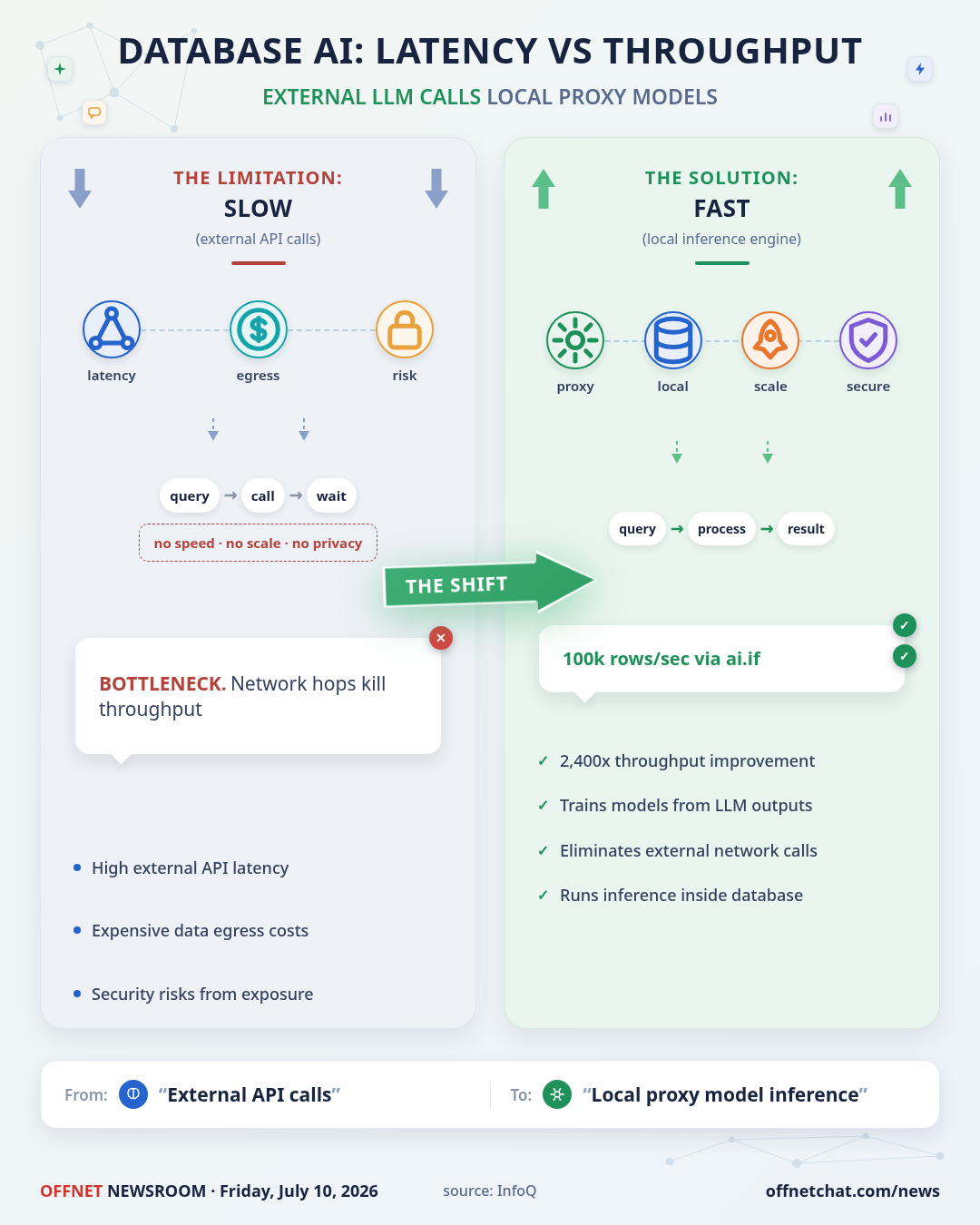
Google AlloyDB has generally available AI functions using a proxy model architecture that trains lightweight models directly from LLM outputs. This approach enables queries to run at database speed by eliminating external LLM calls, achieving up to 100,000 rows per second in preview. Internal benchmarks claim a 2,400x throughput improvement, though these metrics are specific to the ai.if function.

  • Eliminates external API latency by running inference locally within the database engine.
  • Trains lightweight proxy models from LLM outputs to handle high-volume query tasks.
  • Achieves massive throughput gains (2,400x) for specific AI functions like ai.if.
  • Reduces data egress costs and security risks by keeping inference inside the DB.
  • Benchmark figures are internal and apply only to the ai.if function.
Hacker News (100+ points) general

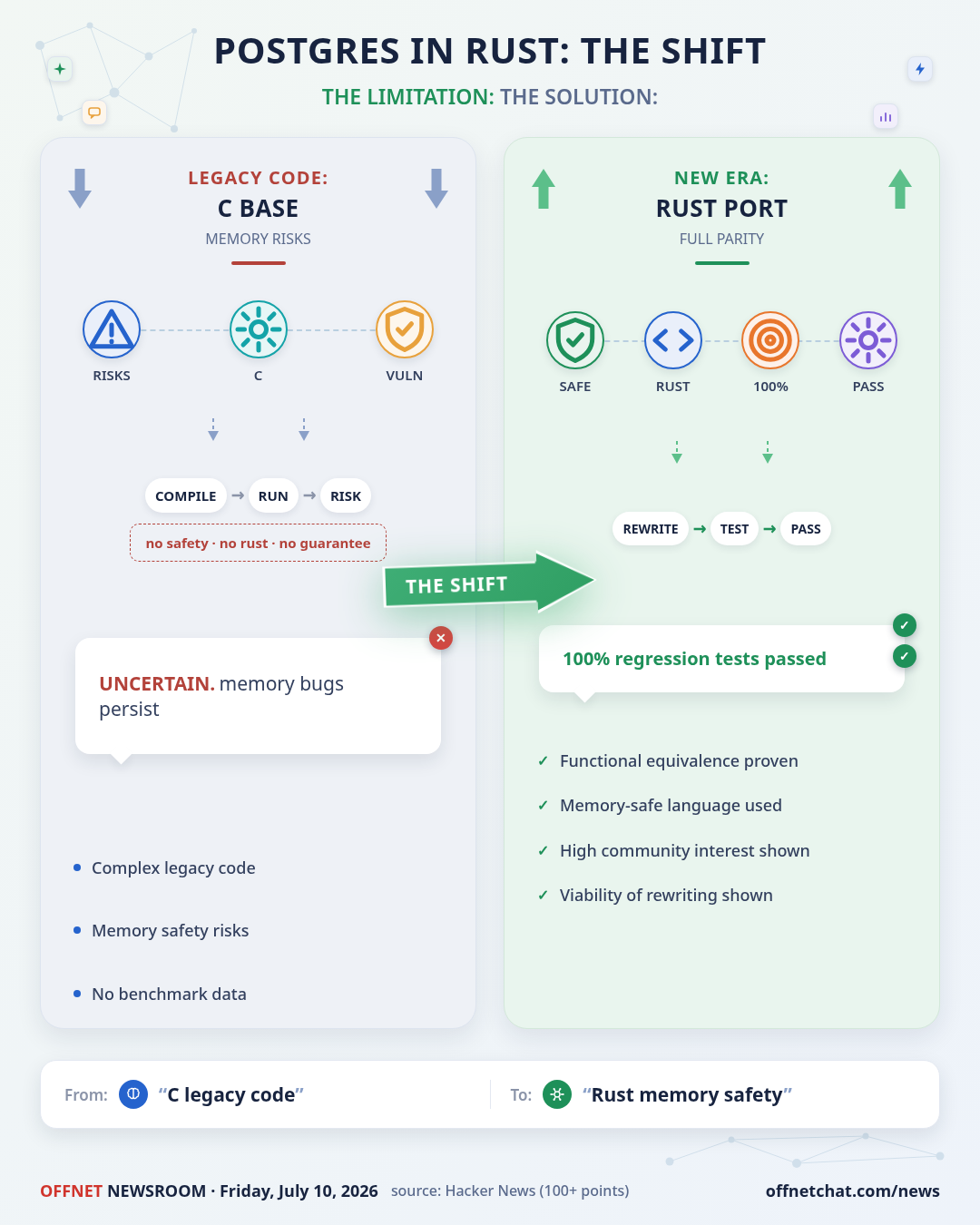
Postgres rewritten in Rust now passes 100% of regression tests

A new project called pgrust has rewritten the Postgres database engine in the Rust programming language. The implementation has successfully passed 100% of the standard Postgres regression test suite, demonstrating functional parity with the original C-based codebase. This milestone highlights significant progress in porting complex legacy database systems to memory-safe languages.

  • Rust port achieves full regression test compliance, proving functional equivalence to C Postgres.
  • Demonstrates viability of rewriting complex, legacy database engines in memory-safe languages.
  • No immediate production-ready features or performance benchmarks cited in the source.
  • Community interest is high, indicated by significant Hacker News engagement.
AWS Database Blog awsdatabase

Diagnose RDS Oracle Replica Lag with Wait Event Analysis

This second part of a series on Amazon RDS for Oracle read replicas details methods to monitor and resolve replication lag. It covers using CloudWatch metrics and database views to track lag, followed by wait event analysis to pinpoint root causes. The guidance focuses on troubleshooting specific performance bottlenecks to optimize replica throughput.

  • Use CloudWatch metrics and DB views to monitor replication lag in real time.
  • Analyze wait events to identify specific performance bottlenecks causing lag.
  • Troubleshoot common root causes to resolve read replica synchronization delays.

Fleet impact: For DBAs managing Oracle ExaCC or RDS for Oracle, leverage wait event analysis to distinguish between I/O saturation and CPU contention on replicas. Prioritize tuning redo transport and applying the configuration optimizations from Part 1 to prevent lag during peak write workloads.

AWS Database Blog awsdatabase

AWS RDS for Oracle: Optimize replica lag with redo compression

AWS Database Blog outlines how to leverage the redo compression feature in Amazon RDS for Oracle to reduce replication lag on standby replicas. This approach focuses on minimizing the bandwidth and processing overhead associated with transmitting redo data between primary and replica instances. The series notes that part two will address monitoring and troubleshooting strategies for lag resolution.

  • Enable redo compression on RDS for Oracle replicas to shrink network payload size.
  • Reduced redo volume directly lowers replication lag during high-write workloads.
  • Part 1 covers the optimization mechanism; part 2 details monitoring and troubleshooting.
  • Review current redo generation rates before enabling compression to gauge potential savings.

Fleet impact: For Oracle ExaCC/RAC fleets, this confirms that network bandwidth between nodes or availability zones is a key constraint for Data Guard lag; consider enabling similar compression or tuning network QoS if lag spikes occur. For AWS RDS for Oracle users, verify that the redo compression parameter is enabled and monitor replication lag metrics to ensure the feature is actively reducing the delta between primary and replica timestamps.

AWS Database Blog awsdatabase

Fail back from Amazon RDS for Db2 to on-premises AIX using DMS

AWS Database Migration Service now supports CDC-only reverse replication from Amazon RDS for Db2 back to on-premises AIX Db2 instances. This capability enables organizations to maintain a synchronized copy of their cloud database on local hardware for disaster recovery scenarios. The process allows for a controlled fail-back operation without requiring full schema or data reloads.

  • Enables reverse CDC replication from RDS for Db2 to on-premises AIX Db2.
  • Supports disaster recovery fail-back strategies for Db2 workloads.
  • Uses DMS to keep on-premises data in sync with the cloud source.
  • Avoids full data reloads by leveraging continuous change data capture.
Planet PostgreSQL database

PostgreSQL 20 Adds min/max Aggregates for UUIDs

Masahiko Sawada has committed a patch for PostgreSQL 20 that introduces min() and max() aggregate functions for the uuid data type. Since uuid already possesses a full set of comparison operators and a btree operator class, it is fully ordered. This update resolves the final gap by implementing the uuid_larger() and uuid_smaller() functions to support these aggregates.

  • UUIDs are now fully supported in min/max aggregations without custom casting.
  • Completes the aggregate coverage for uuid, matching other primitive types.
  • Enables direct ordering and selection of earliest/latest UUIDs in queries.
  • Requires PostgreSQL 20 to utilize the new uuid_larger/smaller functions.
CHECKLISTUUID Aggregation Updates in PG20Supports min and max aggregates for UUIDsLeverages existing btree operator classImplements uuid_larger and uuid_smaller functionsMatches coverage of other primitive typesRequires PostgreSQL 20 to function

LLMs 8

roundup ↗

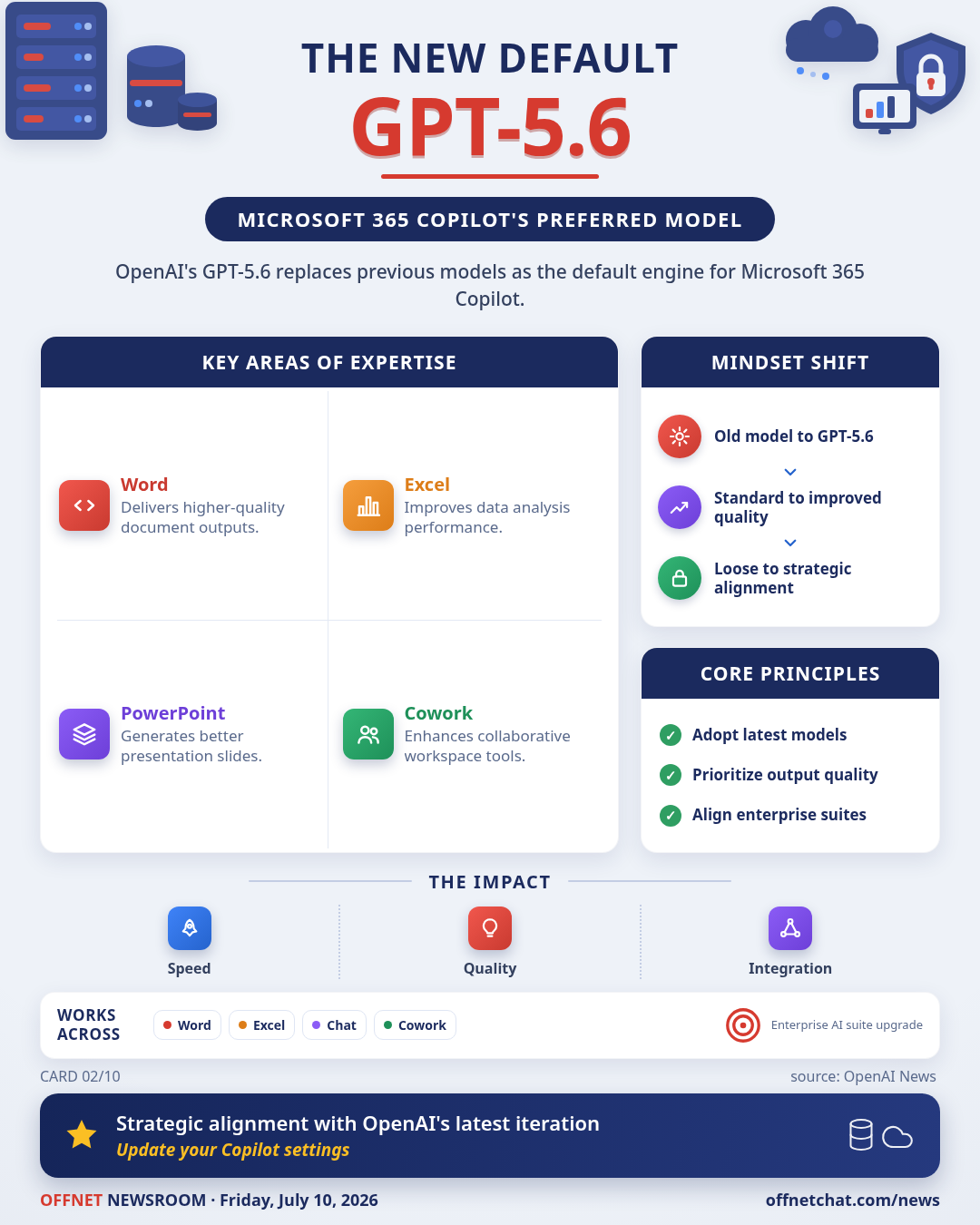
OpenAI announced that GPT-5.6 is now the default foundation model for Microsoft 365 Copilot. This update aims to deliver improved performance and higher-quality outputs across core productivity applications including Word, Excel, PowerPoint, Chat, and Cowork. The shift indicates a strategic alignment between OpenAI's latest iteration and Microsoft's enterprise AI suite.

  • GPT-5.6 is now the preferred model powering Microsoft 365 Copilot.
  • Updates target faster, higher-quality work in Word, Excel, and PowerPoint.
  • Enterprise AI integration deepens with OpenAI's latest model release.
  • No direct database or infrastructure changes required for this model swap.
Hacker News (100+ points) general

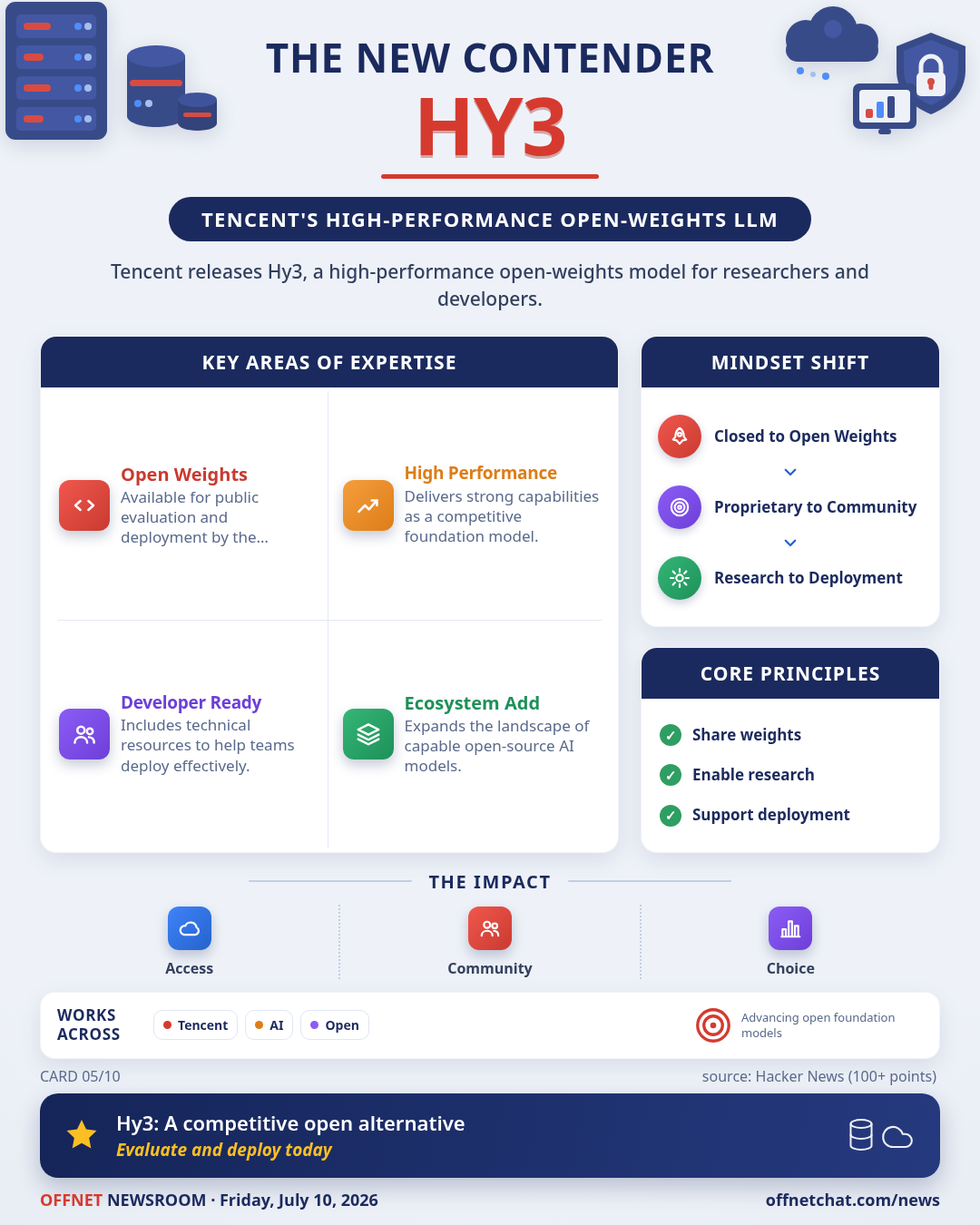
Tencent releases Hy3, a high-performance open-weights LLM

Tencent has published Hy3, a new large language model available as open weights. The release includes technical details and resources for researchers and developers to evaluate and deploy the model. This entry adds another capable open-source option to the current landscape of foundation models.

  • Tencent contributes Hy3 to the open-weights ecosystem
  • Provides technical resources for model evaluation
  • Adds competitive alternative to existing open LLMs
CHECKLISTKey Takeaways for Hy3 ReleaseTencent contributes Hy3 to open-weights ecosystemProvides technical resources for model evaluationAdds competitive alternative to existing open LLMs

OpenAI has introduced GPT-5.6, positioning it as a frontier intelligence model designed to deliver greater capability per token. The update emphasizes stronger performance relative to cost, allowing users to scale their workloads more efficiently. This release targets complex tasks by offering increased capability on demand while optimizing resource usage.

  • GPT-5.6 delivers higher intelligence output per token compared to previous versions.
  • Cost efficiency is improved, providing stronger performance per dollar spent.
  • The model scales capabilities on demand for complex, high-intensity workloads.
OpenAI News llmaiagents

OpenAI Introduces GPT-Live Voice Models for ChatGPT

OpenAI has released GPT-Live, a new generation of voice models designed to enable more natural human-AI interaction. These models are currently powering the ChatGPT Voice experience. The update focuses on improving the fluidity and realism of voice-based conversations.

  • GPT-Live powers the new ChatGPT Voice experience
  • Focus on natural, real-time human-AI interaction
  • No technical benchmarks or latency details provided
  • Consumer-facing voice capabilities are being updated

This paper identifies a failure mode in critic-free RL where uniform credit assignment reinforces erroneous low-probability tokens alongside plausible ones. The authors propose Tail-Aware Credit calibratiOn (TACO) to differentiate and suppress credit for these tail tokens. This calibration prevents the indiscriminate reinforcement of flawed reasoning patterns during model training.

  • Uniform credit assignment in critic-free RL reinforces bad tail tokens equally to good ones
  • TACO calibrates credit to suppress undesired low-probability token reinforcement
  • Mitigates positive-credit contamination that degrades reasoning capabilities
  • Addresses a critical gap in current LLM reinforcement learning methods
HOW IT WORKSTACO Training Pipeline1Identify erroneous tail tokens2Differentiate credit assignment3Suppress low-probability reinforcement4Refine reasoning patterns

SQuaD-SQL enables small language models to rival large language models on Text-to-SQL tasks by using LLM-guided knowledge distillation and synthetic data generation. This approach addresses the high computational costs of deploying LLMs in resource-constrained environments. The method combines structured knowledge extraction with synthetic data to boost small model efficiency without sacrificing accuracy.

  • SLMs can approach LLM performance on Text-to-SQL via distillation
  • Reduces computational footprint for resource-constrained deployments
  • Uses LLM-generated synthetic data to train smaller models
  • Enables efficient natural language interaction with databases
HOW IT WORKSSQuaD-SQL Distillation Pipeline1LLM generates synthetic data2Structured knowledge extraction3Distill to small model4Optimize for efficiency

This paper models in-context search as approximate inference where a base LLM provides a prior and self-reflection updates the posterior. The authors analyze the sampling complexity, defining the number of sequential attempts needed for high success probability. They prove that when reflections reliably pinpoint early mistakes, the process achieves exponential improvements over the base model's zero-shot pass rate.

  • In-context search acts as posterior updating over reasoning traces using base model priors.
  • Exponential performance gains occur when reflections accurately localize early reasoning errors.
  • Polynomial sequential attempts can solve problems with exponentially small zero-shot pass rates.
  • Theoretical framework quantifies the sampling complexity required for high success probability.
HOW IT WORKSIn-Context Search Pipeline1Base LLM generates prior trace2Self-reflection identifies errors3Posterior updates on trace4Sequential attempts refine result

Pyligent introduces a training and inference framework that treats reasoning as a validated search over partial solution chains rather than a simple linear progression. The system uses a task validator to label continuations and failures, converting these search trees into supervised targets for three specific actions: continue, finish, and backtrack. This approach allows models to recover from delayed failures by backtracking to the most recent viable prefix, with optional traces summarizing abandoned branches.

  • Shifts reasoning from linear chains to validated search trees with explicit backtracking.
  • Uses supervised targets for continue, finish, and backtrack actions based on validator feedback.
  • Evaluates performance on hidden directed graph tasks to isolate delayed-failure recovery.
  • Generates optional traces to summarize abandoned reasoning branches for transparency.
HOW IT WORKSPyligent Reasoning Pipeline1Generate partial solution chain2Validate continuation or failure3Action: continue, finish, or backtrack4Recover from delayed failures

AI / ML 8

roundup ↗

OpenAI has released an analysis highlighting significant reliability and accuracy concerns within SWE-Bench Pro, a widely used benchmark for evaluating AI coding capabilities. The findings suggest that current evaluation methods may be producing noisy or misleading results, potentially affecting how model performance is assessed across the industry.

  • SWE-Bench Pro may not provide reliable metrics for AI coding model performance.
  • Accuracy issues in benchmarks can lead to misleading model comparisons.
  • Practitioners should scrutinize benchmark results and consider alternative evaluations.
  • This analysis underscores the need for more robust coding evaluation standards.

Amazon SageMaker HyperPod now enables deep health checks for Slurm-orchestrated clusters using continuous provisioning. This feature allows proactive verification of GPU accelerator health on running instances before jobs commit resources. By targeting entire instance groups or specific nodes, users can run hardware stress and connectivity tests to prevent wasted compute time from single unhealthy nodes.

  • Deep health checks validate GPU health and connectivity on running instances before job allocation.
  • Continuous provisioning now pairs with hardware validation to prevent all-or-nothing scaling failures.
  • Proactive testing avoids wasting hours of compute time on single unhealthy nodes.
  • Users can target specific instances or entire groups for comprehensive stress testing.
CHECKLISTPrevent Compute WasteValidate GPU health before job allocationTarget specific nodes or entire groupsRun stress tests on running instancesVerify connectivity to prevent failures

AWS Neuron 2.31.0 introduces NKI 0.5.0 with MX FP8 scale dtype support, tensor indirection for optimized indexed access, and zero-cost NkiTensor view APIs. The release adds a public beta Neuron UltraServer Operator for Amazon EKS to automate Trainium UltraServer workload management. Additionally, the Neuron Compiler features a redesigned backend now default on Trn2 and Trn3, while the Runtime simplifies configuration with contiguous shared scratchpad support.

  • NKI 0.5.0 adds MX FP8 scale dtype support and tensor indirection for fewer instructions.
  • UltraServer Operator for EKS automates discovery and resource claims for Trainium workloads.
  • Redesigned Neuron Compiler backend is now default on Trn2 and Trn3 for better performance.
  • Neuron Runtime supports contiguous shared scratchpad, removing manual page size configuration.
  • NkiTensor view APIs enable zero-cost tensor layout transformations in custom kernels.
TRADE-OFFAWS Neuron 2.31.0 HighlightsNKI 0.5.0 KernelsMX FP8 scale dtype supportTensor indirection for accessZero-cost view APIsPlatform & CompilerUltraServer Operator for EKSRedesigned backend default on Trn2/3Contiguous shared scratchpad supportvs
Hacker News (100+ points) general

Meta releases Muse Spark 1.1 model API

Meta has introduced Muse Spark 1.1, an updated version of their AI model API. The release includes an evaluation PDF and developer resources for integration. This update builds on previous iterations to offer refined capabilities for developers.

  • Meta updated their Muse model to version 1.1
  • New API available for developer integration
  • Evaluation metrics published in PDF format
  • Developer guides released for building with the model
  • No specific database or fleet infrastructure impact noted

Amazon SageMaker Feature Store now supports BatchWriteRecord, allowing data scientists to ingest multiple records across feature groups in a single request for higher throughput. The update also introduces ListRecords to discover stored data without pre-known identifiers and enables the creation of databases and tables with custom names in the offline store. These changes target reduced API call volume and lower latency for high-volume feature ingestion.

  • Use BatchWriteRecord to reduce API calls and latency for high-throughput feature ingestion.
  • Discover stored features via ListRecords without needing specific record identifiers.
  • Create custom-named databases and tables in the offline store for better organization.
  • Optimize training pipelines by batching writes to the online store simultaneously.
CHECKLISTSageMaker Feature Store UpdatesUse BatchWriteRecord for high-throughput ingestionDiscover features with ListRecords APICreate custom-named offline databasesOptimize training pipelines via batching

Amazon SageMaker Unified Studio Workflows now includes 19 new operators covering Amazon Bedrock, S3 Tables, S3 Vectors, AWS Glue Data Catalog, and MWAA Serverless. These additions enable users to orchestrate tasks like managing Bedrock guardrails, provisioning S3 resources, and triggering MWAA runs directly through the visual workflow creator. This expansion reduces the need to write custom integration code or switch between different AWS consoles.

  • New operators allow visual orchestration of Bedrock guardrails without custom code.
  • S3 Tables and Vectors resources can be provisioned and deleted via workflow tasks.
  • Glue Data Catalog tables and databases are now manageable within SageMaker workflows.
  • MWAA Serverless workflow runs can be triggered directly from the visual editor.
  • Available in all AWS Regions, reducing context switching for data builders.
COMPARISONNew SageMaker Operator CategoriesBedrock19S3 Resources19Glue Catalog19MWAA Serverless19
Hugging Face Blog llmaiml

Hugging Face: Profiling PyTorch Attention Mechanisms

Hugging Face releases the third installment of its PyTorch profiling series, focusing specifically on attention layers. The guide details techniques to profile and optimize attention computation, a critical bottleneck in transformer architectures. It provides practical insights for engineers looking to improve model performance and reduce latency.

  • Focuses on profiling attention mechanisms, the core bottleneck in transformers
  • Part of a three-part series on PyTorch profiling best practices
  • Targeted at ML engineers optimizing inference and training performance
  • Published July 10, 2026 on the Hugging Face Blog

Prior research indicates that chain-of-thought reasoning is often unfaithful, meaning stated steps do not reflect the model's actual process. Since detecting unfaithfulness requires controlled interventions impossible to apply to existing transcripts, this work focuses on logical consistency instead. The authors introduce a reusable framework to assess whether stated reasoning aligns with the final answer using only transcript data.

  • Detects unfaithful CoT by checking logical consistency between reasoning and answer
  • Requires no experimental interventions, enabling post-hoc analysis of evaluation transcripts
  • Provides a reusable method for auditing AI safety evaluation data
  • Addresses the gap where faithfulness detection is impractical for static logs
HOW IT WORKSAuditing Reasoning Consistency1Collect static CoT transcripts2Check logical alignment with answers3Identify unfaithful reasoning steps4Audit AI safety evaluation data

Agentic AI 8

roundup ↗

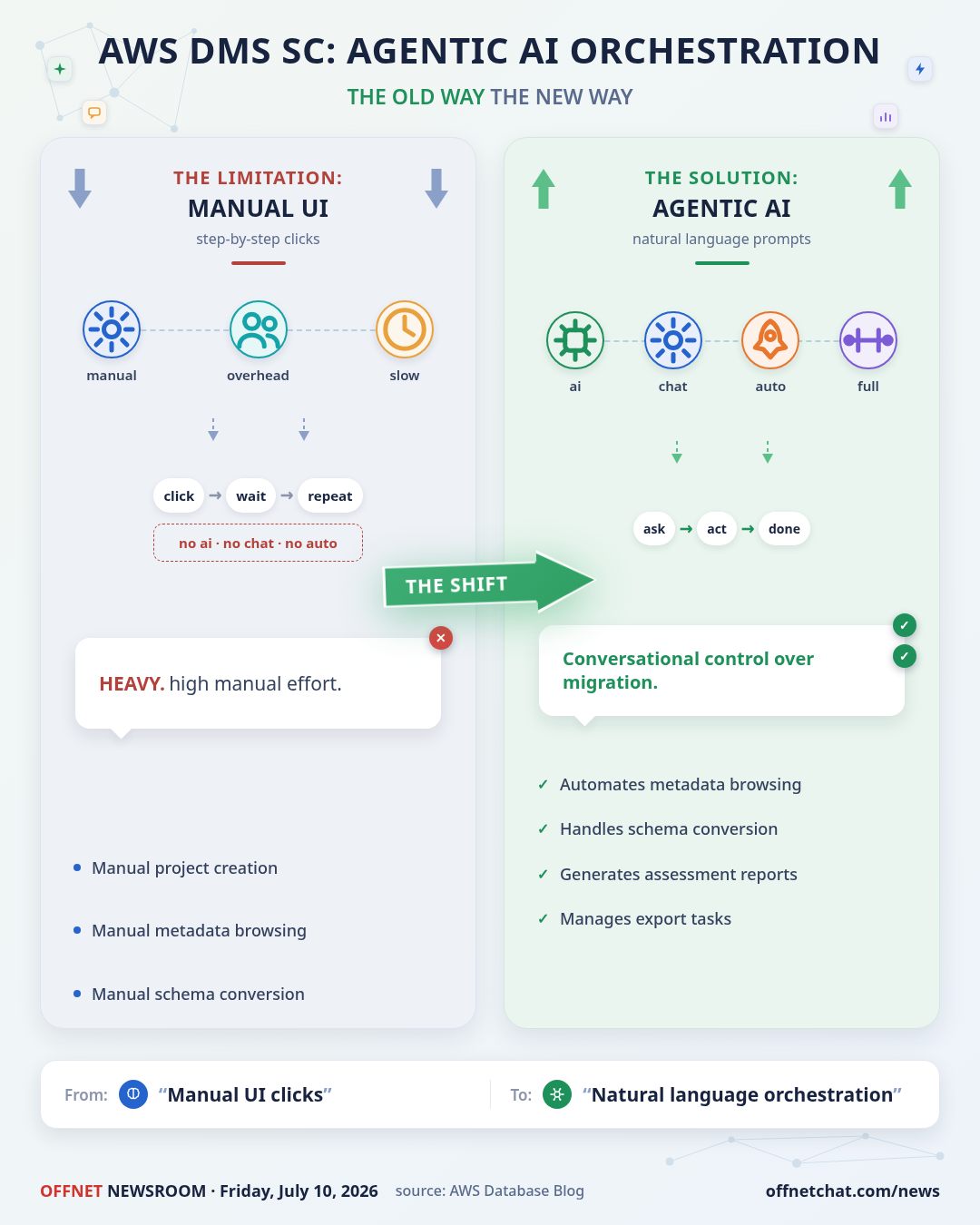
AWS has integrated AI agents into the DMS Schema Conversion tool to automate migration workflows via natural language prompts. The agent handles the full lifecycle, including project creation, source metadata browsing, schema conversion, and assessment report generation. This shift allows engineers to manage complex modernization tasks conversationally rather than through manual UI interactions.

  • Orchestrate full DMS SC workflows using natural language prompts instead of manual steps
  • Agent automates metadata browsing, schema conversion, and assessment report generation
  • Reduces manual overhead in database modernization projects by handling project creation
  • Enables conversational control over export and result management in migration tasks
arXiv cs.CL researchllm

Compile LLM SOPs into Versioned Tools to Cut Latency

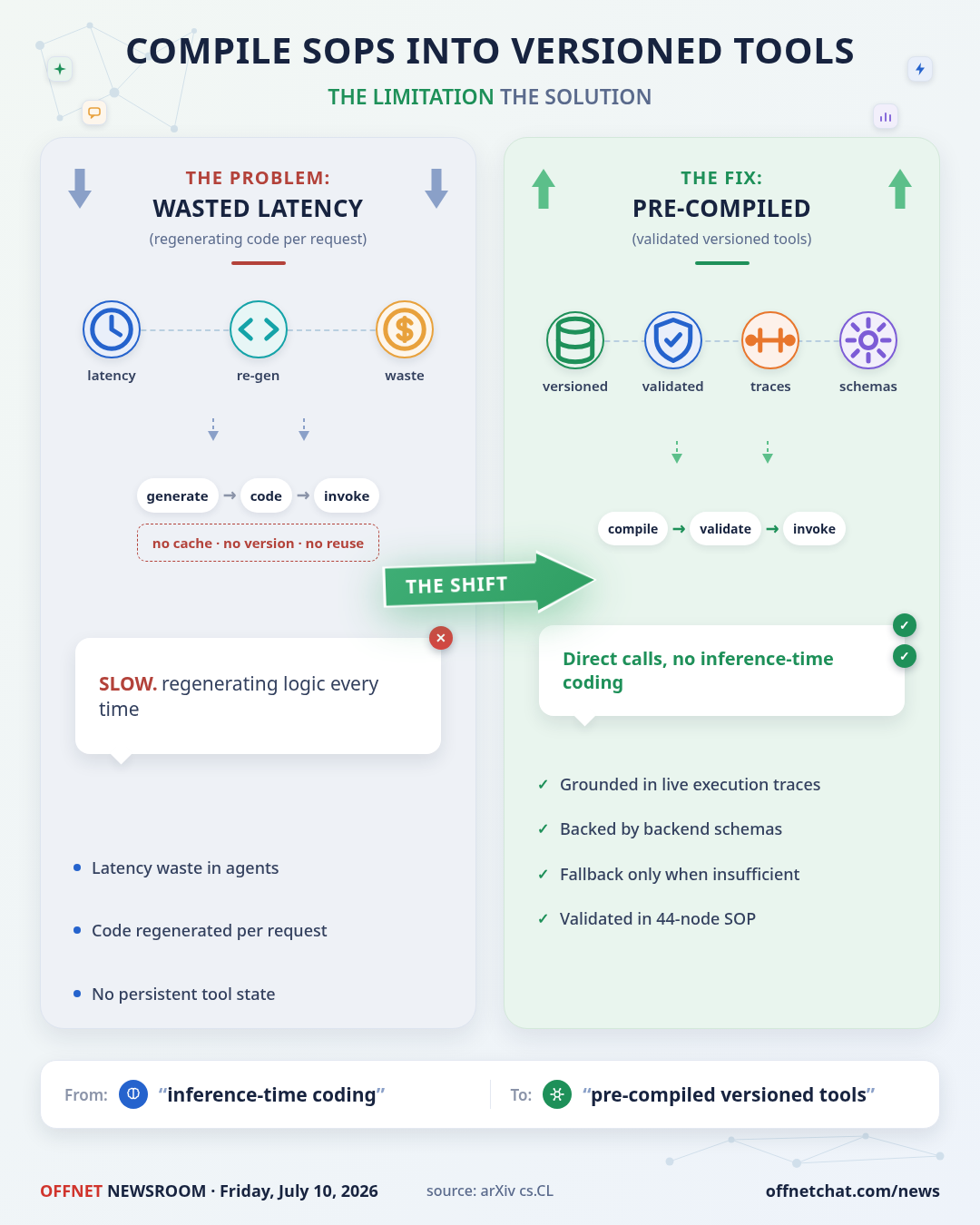
This paper addresses latency waste in production LLM agents caused by regenerating procedural code on every request. It introduces an agentic tool-making pipeline that compiles repeated standard operating procedure steps into validated, versioned tools before deployment. By grounding synthesis in live execution traces and backend schemas, the system generates and repairs candidate tools, allowing runtime agents to call them directly instead of relying on inference-time coding.

  • Replaces inference-time code regeneration with pre-compiled, versioned tools for repeated tasks.
  • Tool synthesis uses live execution traces and backend schemas to ensure accuracy.
  • Agents fallback to code generation only when pre-built tools are insufficient.
  • Validated in a Fulfillment Center alarm-triage system with a 44-node SOP.
HOW IT WORKSVersioned Tool Pipeline1Capture live execution traces2Match backend schemas3Compile and repair tools4Version and deploy5Agent calls pre-built tools

The AWS MCP Server now supports direct AI agent connections via AWS Sign-In and standard OAuth protocols, eliminating the need for custom authentication middleware. This update allows agents to leverage existing IAM permissions and governance controls while supporting both interactive browser-based and programmatic headless authorization flows. Administrators gain enhanced control through new IAM condition keys, token introspection APIs, and CloudTrail audit logging.

  • Agents connect via standard OAuth without extra auth software
  • Leverages existing IAM policies and AWS identities
  • Supports interactive and headless authorization modes
  • New IAM condition keys and token revocation APIs
  • Full CloudTrail audit coverage for OAuth access
HOW IT WORKSAWS MCP Server OAuth Flow1Agent initiates OAuth connection2User authenticates via browser3AWS issues access token4Agent uses token for IAM5CloudTrail logs the access

OpenAI has introduced ChatGPT Work, an agent designed to execute actions across multiple applications and files. Unlike standard chat interfaces, this tool can sustain operations for hours to transform high-level goals into completed work. The release signals a shift toward persistent, autonomous agents for complex workflows.

  • Agents can now operate across disparate apps and file systems autonomously.
  • Support for multi-hour sessions enables completion of complex, multi-step projects.
  • Shifts focus from simple Q&A to executing tangible business outcomes.

Researchers introduce DeepSearch-Evolve, a self-distillation framework designed to train tool-use agents that improve through their own experience. The system relies on DeepSearch-World, a deterministic environment featuring reproducible search and page-reading tools alongside 420K multi-hop QA tasks. This setup addresses the limitations of fixed teacher-distilled trajectories and sparse-reward reinforcement learning by enabling progress verification, grounded reflection, and failure recovery.

  • DeepSearch-World provides a deterministic, verifiable sandbox for training web agents with reproducible tools.
  • The dataset includes 420K multi-hop QA tasks generated via entity-level random walks.
  • Framework supports self-evolution behaviors like progress verification and failure recovery.
  • Bypasses weak supervision from sparse rewards by using iterative trajectory generation.
  • Addresses long-horizon interaction challenges in agentic AI training pipelines.
BY THE NUMBERS420K Verifiable Tasks420KMulti-hop QA tasks in datasetGenerated via entity-level random walks

Itamar Friedman outlines a strategy for engineering leaders to overcome AI productivity limits by implementing adaptive multi-agent systems. The approach moves beyond basic code completion to establish resilient workflows featuring autonomous testing, intelligent code review, and robust arbitration mechanisms. Key focus areas include governing agent communication and creating context-driven software development lifecycles that scale effectively.

  • Move past simple autocomplete to resilient, multi-agent SDLC workflows.
  • Integrate autonomous testing and intelligent code review for reliability.
  • Implement robust arbitration to control agent interactions and outputs.
  • Govern agent communication to build scalable, context-driven development.

This paper argues that aggregate safety metrics for planner-executor LLM pipelines conflate harmful intent reframing, planner refusal, and executor delegation. The authors introduce a five-condition controlled contrast design to isolate these mechanisms. Evaluated on synthetic and benchmark scenarios, the study reveals that overall pipeline safety is not a stable architectural property.

  • Aggregate 'pipeline effect' metrics mask distinct failure modes in multi-agent systems.
  • New five-condition design separates reframing, refusal, and delegation factors.
  • Results show pipeline safety is unstable, not a fixed architectural trait.
  • LLM-judged compliance used for evaluation across synthetic and benchmark sets.
HOW IT WORKSIsolating Safety Failure Modes1Intent Reframing by Planner2Planner Refusal Decision3Executor Task Delegation4Final Harmful Output5Aggregate Safety Metric

This research demonstrates that biased LLM judges can effectively turn off the skill retirement mechanism in self-evolving agents. While retirement relies on accurate failure signals to prune poor skills, reference-free tasks force the use of judges that introduce systematic bias rather than random noise. The study proves this bias prevents the agent from correctly identifying and discarding bad skills, leading to uncontrolled drift in the skill library.

  • Biased judges do not just add noise; they structurally disable the skill retirement mechanism.
  • Reference-free task evaluation often forces the use of biased LLM judges.
  • Skill drift occurs because agents fail to recognize and prune failing skills.
  • Symmetric noise preserves retirement, but systematic bias breaks it.
TRADE-OFFNoise vs Bias ImpactSymmetric NoisePreserves skill retirement mechanismSystem behaves as expectedNo structural disabling occursSystematic BiasDisables skill retirement entirelyPrevents identification of…Causes uncontrolled library driftvs

Automation / DevOps / IaC 8

roundup ↗

OpenAI resolved a complex issue in ChatGPT's data infrastructure by identifying two distinct problems: silent hardware corruption on an Azure host and a race condition in GNU libunwind's setcontext function. The race condition presented a one-instruction vulnerability window that had existed for 18 years. The team achieved this breakthrough by shifting focus from individual core dumps to population-level crash analysis across the fleet.

  • OpenAI treated crash debugging like epidemiology, analyzing population-level data instead of isolated core dumps.
  • An 18-year-old race condition in GNU libunwind's setcontext function was exposed by a one-instruction vulnerability window.
  • The incident involved two unrelated bugs: hardware corruption on Azure and the libunwind race condition.
  • Aggregating crash patterns can reveal subtle concurrency issues hidden in individual failure reports.
InfoQ generaldevops ↺ since 07-08

AWS DevOps Agent Adds AI Release Validation to Test Code Pre-Production

AWS has expanded its DevOps Agent to include autonomous release management features that assess code changes before they reach production. The new capabilities allow the agent to automatically test software modifications, aiming to validate integrity and reduce manual oversight. This update focuses on shifting validation responsibilities earlier in the deployment pipeline.

  • AWS DevOps Agent now autonomously tests code changes prior to production deployment.
  • Release management capabilities are integrated to assess code integrity automatically.
  • Shift-left validation reduces manual review overhead for engineering teams.
  • Updates align with broader AWS efforts to automate CI/CD pipelines.

Microsoft has cautioned that the rapid adoption of AI technologies is accelerating the discovery of security flaws, leading to a higher frequency of patches. This trend implies that traditional monthly update cycles may become more burdensome as new vulnerabilities emerge from complex AI integrations. The company is using this forecast to highlight the necessity of adopting automated patching solutions to manage the increasing workload.

  • AI integration is accelerating vulnerability discovery rates
  • Patch Tuesday volume and complexity are expected to rise
  • Manual patching workflows may become unsustainable
  • Microsoft is pushing auto-patching tools as the solution
  • Plan for increased maintenance windows and testing overhead
AWS Database Blog awsdatabase ↺ since 07-08

AWS automates PostgreSQL audit log extraction to S3 via CloudWatch Logs

AWS details a pipeline that captures PostgreSQL audit logs from CloudWatch Logs and converts them into structured CSV format for storage in Amazon S3. The solution processes log entries in near real time after generation to facilitate long-term analysis. This approach removes manual effort from the log extraction and formatting workflow.

  • Extracts PostgreSQL audit logs directly from CloudWatch Logs for automated processing.
  • Converts unstructured log entries into structured CSV format for easier analysis.
  • Stores processed logs in Amazon S3 for scalable, long-term retention.
  • Operates in near real-time, minimizing the window for audit data gaps.
HOW IT WORKSAutomated PostgreSQL Audit Pipeline1Capture logs from CloudWatch2Convert to structured CSV3Store in Amazon S34Enable near real-time analysis
PostgreSQL News database ↺ since 07-06

CloudNativePG 1.30.0 ships with GitOps role CRD and safer failover

CloudNativePG 1.30.0 introduces a DatabaseRole CRD to enable declarative, GitOps-friendly management of PostgreSQL roles within Kubernetes. The release also adds a lease-based primary election primitive to improve the safety of failover operations. Additionally, this update marks the End-of-Life for the 1.28.x series, urging operators to migrate to 1.29 or 1.30.

  • Use the new DatabaseRole CRD to manage PostgreSQL users declaratively via GitOps workflows.
  • Benefit from lease-based primary election logic to reduce split-brain risks during failover.
  • Plan immediate upgrades from 1.28.x, which reached EOL on June 30, 2026.
  • Maintenance releases 1.29.2 and 1.28.4 are available for current users.
  • CloudNativePG remains the leading operator for PostgreSQL on Kubernetes.
CHECKLISTWhat matters hereUse the new DatabaseRole CRD to manage PostgreSQL users declaratively…Benefit from lease-based primary election logic to reduce split-brain…Plan immediate upgrades from 1.28.x, which reached EOL on June 30…Maintenance releases 1.29.2 and 1.28.4 are available for current…CloudNativePG remains the leading operator for PostgreSQL on…

Airbnb engineers released details on Sitar-agent, a Kubernetes sidecar designed to handle dynamic configuration delivery across tens of thousands of pods. The system processes updates multiple times per minute, leveraging Java and Amazon S3 for snapshot bootstrapping. A key architectural shift involved migrating from Sparkey to SQLite to enhance startup performance and reliability.

  • Sitar-agent serves as a Kubernetes sidecar for real-time config delivery across massive pod fleets.
  • Updates are processed several times per minute to maintain consistent service state.
  • Migration from Sparkey to SQLite improves startup speed and configuration availability.
  • Amazon S3 snapshot bootstrapping ensures reliable initial state loading on pod start.
  • Java implementation supports the high-throughput requirements of dynamic config systems.
CHECKLISTWhat matters hereSitar-agent serves as a Kubernetes sidecar for real-time config…Updates are processed several times per minute to maintain consistent…Migration from Sparkey to SQLite improves startup speed and…Amazon S3 snapshot bootstrapping ensures reliable initial state…Java implementation supports the high-throughput requirements of…

Red Hat has introduced a support model allowing customers to maintain RHEL indefinitely, accommodating organizations that must stick to legacy technology stacks. This move addresses the needs of enterprises unable to migrate quickly due to regulatory, operational, or compatibility constraints. The offering serves as a long-term safety net for critical infrastructure that cannot be updated to newer releases.

  • Indefinite support enables legacy RHEL systems without forced migration pressure.
  • Targeted at enterprises with regulatory or compatibility migration blockers.
  • Provides stability for critical infrastructure requiring long-term consistency.
  • Red Hat balances innovation with legacy support via this new model.

TypeScript 7.0 introduces significantly faster type checking, reportedly accelerating build times by up to 10x, which may impact developer workflows and CI/CD pipelines. Simultaneously, Go has released its first stable version, marking a milestone for the language's maturity and production readiness. These updates signal major shifts in developer tooling performance and language stability.

  • TS 7.0's 10x faster builds could drastically reduce CI/CD feedback loops
  • Developers may need to adjust workflows to leverage new type-checking speed
  • Go's first stable release indicates increased enterprise confidence in the language
  • Monitor ecosystem compatibility before upgrading to TS 7.0 in production apps

AWS 8

roundup ↗

Simple arithmetic fails to capture the complex interplay between latency and cost in multi-region cloud deployments. The author proposes a framework that starts with decomposing the latency budget to inform infrastructure choices, selecting deployment patterns based on consistency and traffic profiles, and optimizing existing setups before adding regions. A phased strategy demonstrated that intelligent routing alone reduced latency by 35%, eventually bringing it under 60ms after introducing a new region.

  • Decompose your total latency budget to guide infrastructure decisions rather than relying on simple cost math.
  • Select deployment patterns based on strict consistency requirements and specific traffic profiles.
  • Optimize routing and existing topology before committing to the expense of new regions.
  • Phased approaches can yield significant latency gains (35%) through routing improvements alone.
AWS What's New awsdatabase ↺ since 07-08

Amazon S3 Vectors expands to AWS GovCloud regions

Amazon S3 Vectors is now live in AWS GovCloud (US-East) and (US-West), extending its vector storage capabilities to government and compliance-focused environments. The service provides purpose-built storage for AI agents, RAG, and semantic search, supporting billion-vector scales while maintaining S3's durability and elasticity. Users can store, access, and query vectors using dedicated APIs without provisioning underlying infrastructure.

  • S3 Vectors is available in both US-East and US-West GovCloud regions.
  • Supports AI agents, RAG, and semantic search at billion-vector scale.
  • Uses dedicated APIs for storage and querying without infrastructure provisioning.
  • Retains S3's core durability, availability, and elasticity guarantees.
HOW IT WORKSGovCloud Vector Integration Steps1Deploy AI agents in GovCloud2Store vectors via S3 APIs3Query using RAG or semantic search4Scale to billions without provisioning

Microsoft has released a fix for a critical zero-day vulnerability in Windows Defender that was actively exploited by the RoguePlanet campaign from group Nightmare Eclipse. The patch arrives weeks after exploit code became public, addressing the gap between disclosure and remediation. This update closes a significant security gap for organizations relying on Microsoft's endpoint protection.

  • Microsoft Defender zero-day patched weeks after exploit code leaked
  • RoguePlanet campaign by Nightmare Eclipse was actively exploiting this flaw
  • Organizations should verify patch deployment status immediately
  • Delay between exploit publication and fix highlights response time risks

Researchers argue that the UK's heavy reliance on cloud infrastructure creates a significant financial vulnerability. A single 24-hour outage in a critical AWS region could trigger massive economic losses for British firms. The report highlights the systemic risk inherent in this centralized digital habit.

  • UK economy faces billion-pound exposure from concentrated cloud dependency
  • Single 24-hour AWS outage could cause severe financial damage to firms
  • Research highlights systemic risk in current cloud adoption strategies

Amazon Timestream for InfluxDB now publishes lifecycle event notifications to Amazon EventBridge whenever database instances or clusters change state. These events cover creation, deletion, scaling, parameter updates, maintenance windows, and reboots, including both successes and failures. This capability allows automation systems to react programmatically to operations without relying on API polling.

  • Eliminates the need for polling APIs to track database lifecycle status changes.
  • Enables automated workflows triggered by scaling, maintenance, or reboot completions.
  • Supports immediate alerting for failed operations via EventBridge rules.
  • Facilitates audit trails by routing events to CloudWatch Logs or S3.
HOW IT WORKSTimestream Event Automation1Instance state changes2EventBridge receives event3Rule triggers action4Route to CloudWatch5Archive to S3
AWS What's New awsdatabase ↺ since 07-09

AWS launches 12TB U7i high-memory instances in Zurich for in-memory DBs

Amazon EC2 U7i instances with 12TiB of DDR5 memory are now available in the AWS Europe (Zurich) region. Powered by fourth-generation Intel Xeon Scalable processors, these 896 vCPU nodes deliver up to 100Gbps network and EBS bandwidth. They are designed to support mission-critical in-memory databases such as SAP HANA, Oracle, and SQL Server.

  • U7i-12tb.224xlarge instances provide 12TiB DDR5 memory for massive in-memory workloads.
  • Zurich region now hosts these high-memory nodes, expanding European availability.
  • Supports up to 100Gbps network and EBS for faster data loading and backups.
  • Targeted at SAP HANA, Oracle, and SQL Server in-memory database use cases.
BY THE NUMBERSAWS U7i Memory Capacity12TiBDDR5 memory per instanceFor SAP HANA and Oracle DBs

Amazon MSK Replicator extends its capabilities to allow data replication from external Apache Kafka clusters—including on-premises, self-managed, or third-party cloud environments—directly into Amazon MSK Standard brokers. This update complements existing support for MSK Express brokers, enabling broader migration paths, disaster recovery setups, and hybrid multi-cloud data distribution strategies. The feature automates replication tasks, removing the need for custom infrastructure or manual configuration of open-source tools.

  • Replicate from external Kafka sources to MSK Standard brokers, not just Express.
  • Simplifies migration of workloads to MSK Standard tier without custom tooling.
  • Enables MSK Standard clusters to serve as failover or backup targets.
  • Supports hybrid and multi-cloud data distribution via automated replication.
  • Eliminates need to manage custom replication infrastructure or open-source configs.
CHECKLISTAdopting MSK Replicator for Standard BrokersReplicate from external Kafka to MSK Standard brokersAutomate migration without custom open-source infrastructureEnable disaster recovery and hybrid multi-cloud strategiesEliminate manual configuration of replication tools

Netflix introduces CloudStream, a framework designed to accelerate data movement by pivoting key-value abstractions from stateless to stateful models. This architectural shift allows the platform to ingest terabytes of bulk data with improved safety and efficiency. The presentation highlights how leveraging specific data access patterns and using Pathfinder prototypes enabled a 99% faster rollout cycle.

  • Stateful key-value abstractions enable safer handling of terabyte-scale bulk data migrations.
  • CloudStream provides a repeatable capture, conversion, and deployment framework for cross-team use.
  • Pathfinder prototypes facilitate rapid validation and exploitation of specific data access patterns.
  • The approach achieved a 99% reduction in rollout time for data pipeline changes.

Trending on GitHub 1

roundup ↗

The pglayers project publishes 53 PostgreSQL extensions as minimal Docker images built from scratch. These layers contain only shared libraries, control files, SQL scripts, and correct filesystem paths, allowing them to be stacked onto the official postgres image via COPY --from. This approach eliminates the need for compilation, apt-get, or build tools in the final container, enabling a straightforward CREATE EXTENSION workflow.

  • Use COPY --from to stack extension layers onto official postgres images without bloat.
  • Avoids compilation and build tools, reducing attack surface and image size.
  • Supports 53 extensions including pgvector, PostGIS, and pg_cron.
  • Maintains standard CREATE EXTENSION syntax for immediate usability.
BY THE NUMBERS53 Extensions in Minimal Layers53PostgreSQL extensions availableStackable Docker layers reduce size and bloat

Mobile friendly 6

all cards ↗

Today's top database + AI stories as save-and-share cards — built for your phone and your LinkedIn feed.