OffNet Newsroom

Archive snapshot

Thursday, July 09, 2026

Daily signal on databases, AI, and the tech that matters.

35 new today 40 stories 7 sections 13 for the DBA desk

Database Technology 7

roundup ↗

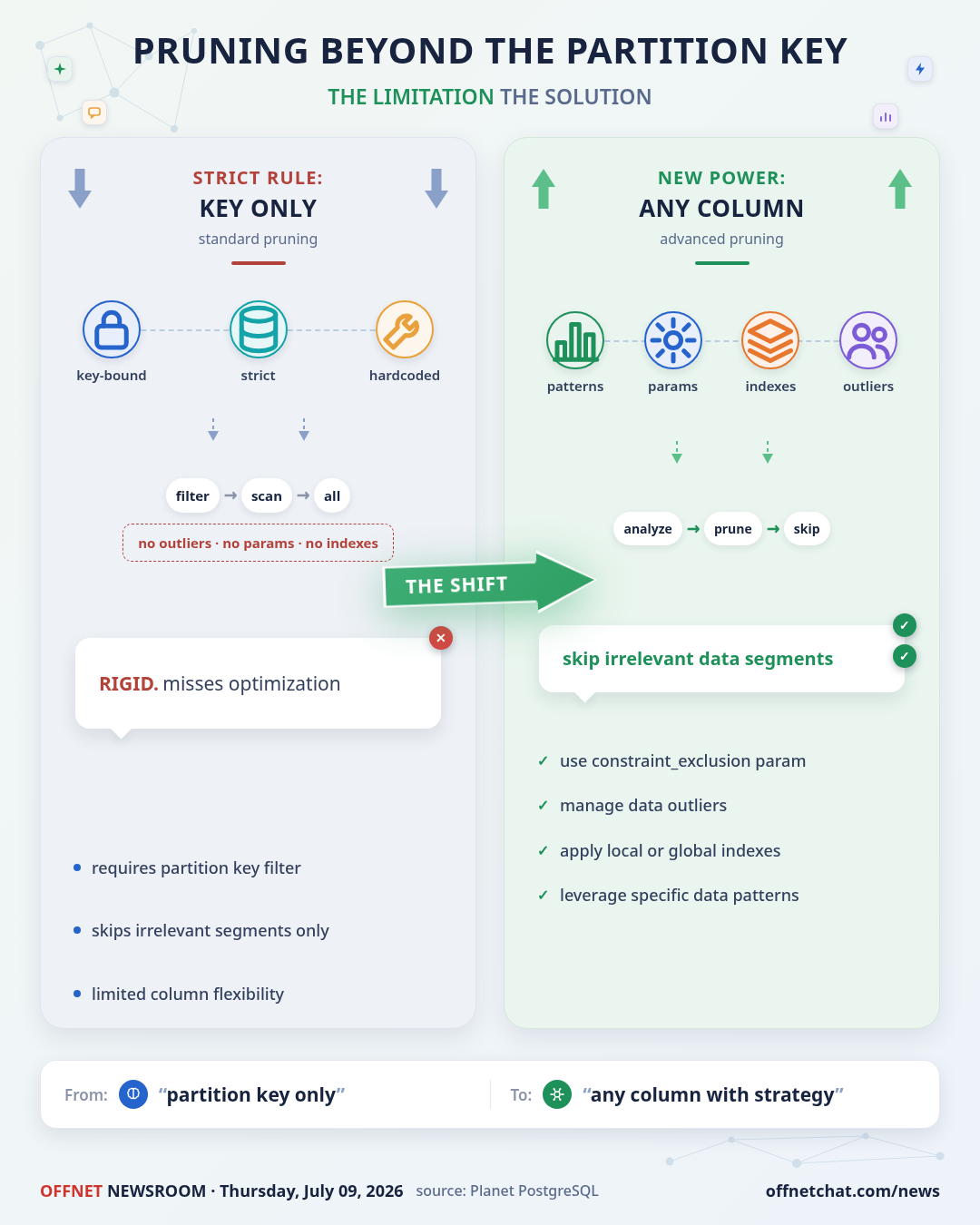
Partition pruning typically requires filtering on the partition key, but Haki Benita demonstrates techniques to enable this optimization for non-partition columns. By leveraging specific data patterns and optimizer parameters like constraint_exclusion, queries can eliminate entire partitions even when the predicate targets different attributes. The approach involves managing outliers and potentially using local or global indexes to facilitate the planner's ability to skip irrelevant data segments.

  • Partition pruning is not strictly limited to the partition key column.
  • Data patterns and outlier handling can enable pruning on other fields.
  • The constraint_exclusion parameter influences how the optimizer handles these predicates.
  • Local and global indexes may play a role in supporting non-key pruning strategies.

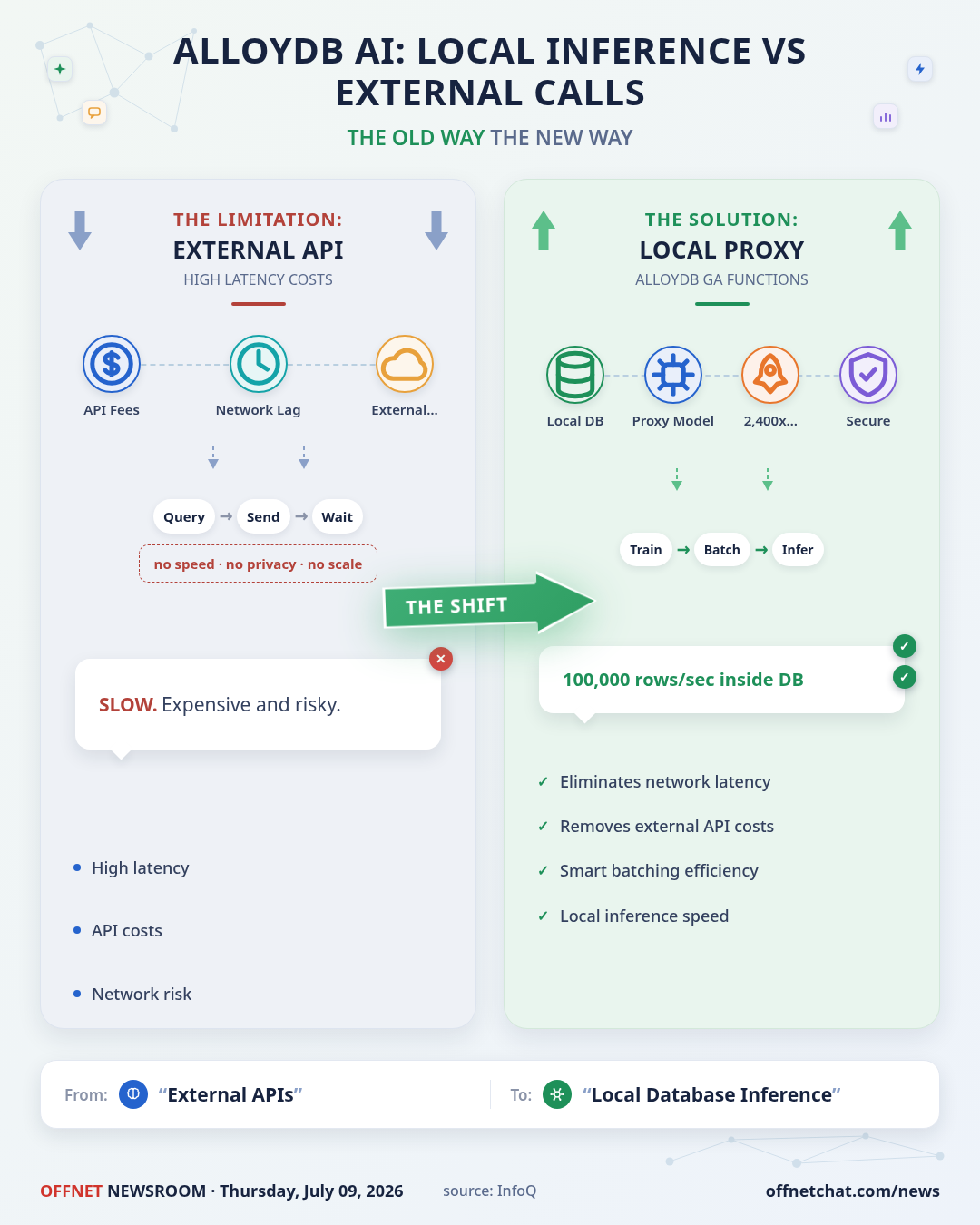
Google has released AlloyDB AI functions in general availability, introducing a proxy model architecture that trains lightweight local models from LLM outputs. This approach allows queries to be processed directly within the database, eliminating the need for external API calls. Internal testing reports a 2,400x throughput improvement, achieving speeds of 100,000 rows per second for the ai.if function.

  • Eliminates network latency and API costs by running inference locally inside the database engine.
  • Achieves reported 2,400x throughput gains via smart batching and local processing.
  • Benchmarks currently apply only to internal tests of the ai.if function.
  • New capability requires training a proxy model from existing LLM outputs.
Planet PostgreSQL database

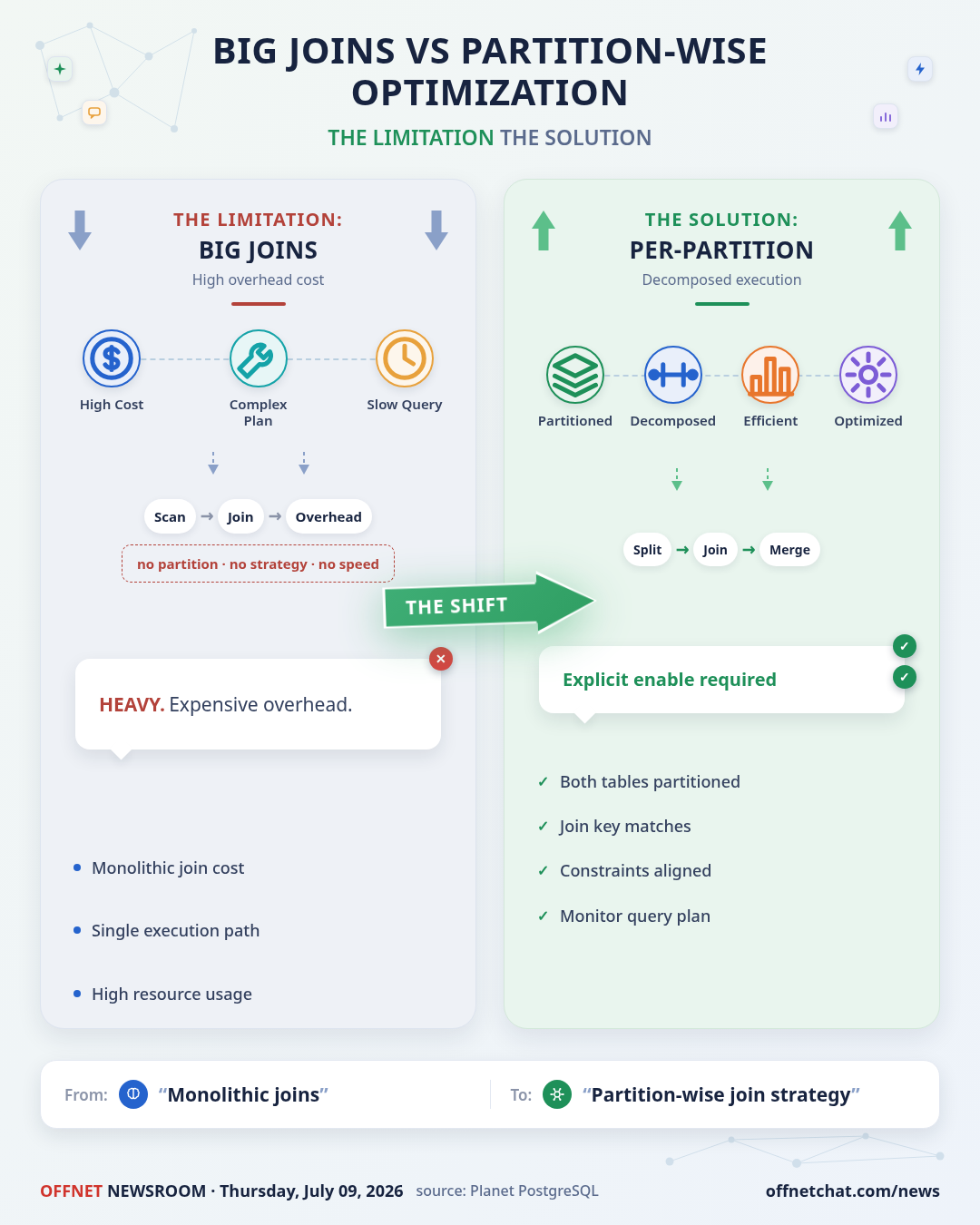
PostgreSQL enable_partitionwise_join: Decompose Big Joins

Christophe Pettus details the enable_partitionwise_join GUC, which allows PostgreSQL to break large joins into smaller per-partition operations when both tables share a partition key. This optimization is only active when explicitly enabled and requires strict adherence to partitioning constraints to function correctly. The feature aims to significantly reduce overhead for queries involving large, similarly partitioned datasets.

  • Enable partitionwise_join to let the planner decompose joins into per-partition pairs.
  • Both tables must be partitioned on the join key for this optimization to apply.
  • Strict partitioning constraints are required; misaligned schemas will not trigger the feature.
  • Explicitly enabling this GUC is necessary as it is not the default behavior.
  • Monitor query plans to verify the planner is using the partition-wise join strategy.

Momentic replaced its PostgreSQL caching layer with ClickHouse to manage over 2 million daily queries across 20 billion entries while keeping latency at 250 ms. The shift to a column-oriented architecture enabled the platform to handle its growing data volume and query load more efficiently. This rearchitecture supports the company's AI-driven software testing platform without compromising response times.

  • Columnar databases like ClickHouse excel at high-volume read workloads compared to row-oriented PostgreSQL.
  • Architectural shifts can sustain massive scale (20B entries) while maintaining sub-second latency.
  • Monitoring query volume and latency trends helps identify when to evaluate alternative storage engines.

Percona details practical strategies for moving production PostgreSQL workloads from the Crunchy Data operator to its own Kubernetes operator. The analysis focuses on evaluating trade-offs between downtime, operational complexity, rollback safety, and cost. The goal is to help engineers select the migration path that minimizes business risk during the transition.

  • Migration involves more than data movement; it requires balancing downtime against operational complexity.
  • Evaluate rollback safety and cost implications before selecting a specific migration path.
  • Percona provides comparative methods to reduce business risk when leaving Crunchy Data.
  • Kubernetes-native operators require careful planning to ensure zero-downtime or minimal impact.
TRADE-OFFMigration Trade-OffsSpeedAccept higher downtime riskSimpler initial executionLower immediate costSafetyMinimize business disruptionEnsure rollback capabilityHigher operational complexityvs

The pg_ivm 1.15 release introduces metadata restoration capabilities for Incrementally Maintained Materialized Views (IMMVs) during standard pg_dump and pg_upgrade operations. A new utility and function allow these views to resume incremental maintenance immediately after restore, eliminating the previous requirement to manually drop and recreate them. The update also corrects a bug where multiple trigger modifications on the same table caused inconsistent maintenance results.

  • IMMVs now survive pg_dump and pg_upgrade without manual recreation, simplifying backup and migration workflows.
  • New pg_ivm_dump_metadata utility and restore_immv() function automate metadata recovery for incremental maintenance.
  • Fixes inconsistency issues where multiple trigger updates on a single table broke incremental maintenance logic.
  • Reduces operational overhead for DBAs managing complex IMMV dependencies in PostgreSQL clusters.
CHECKLISTIMMV Maintenance FixesRestore IMMV metadata via pg_dump and pg_upgradeAutomate recovery with new pg_ivm_dump_metadata utilityFix inconsistent results from multiple trigger modificationsReduce DBA overhead for complex IMMV dependencies

LLMs 6

roundup ↗

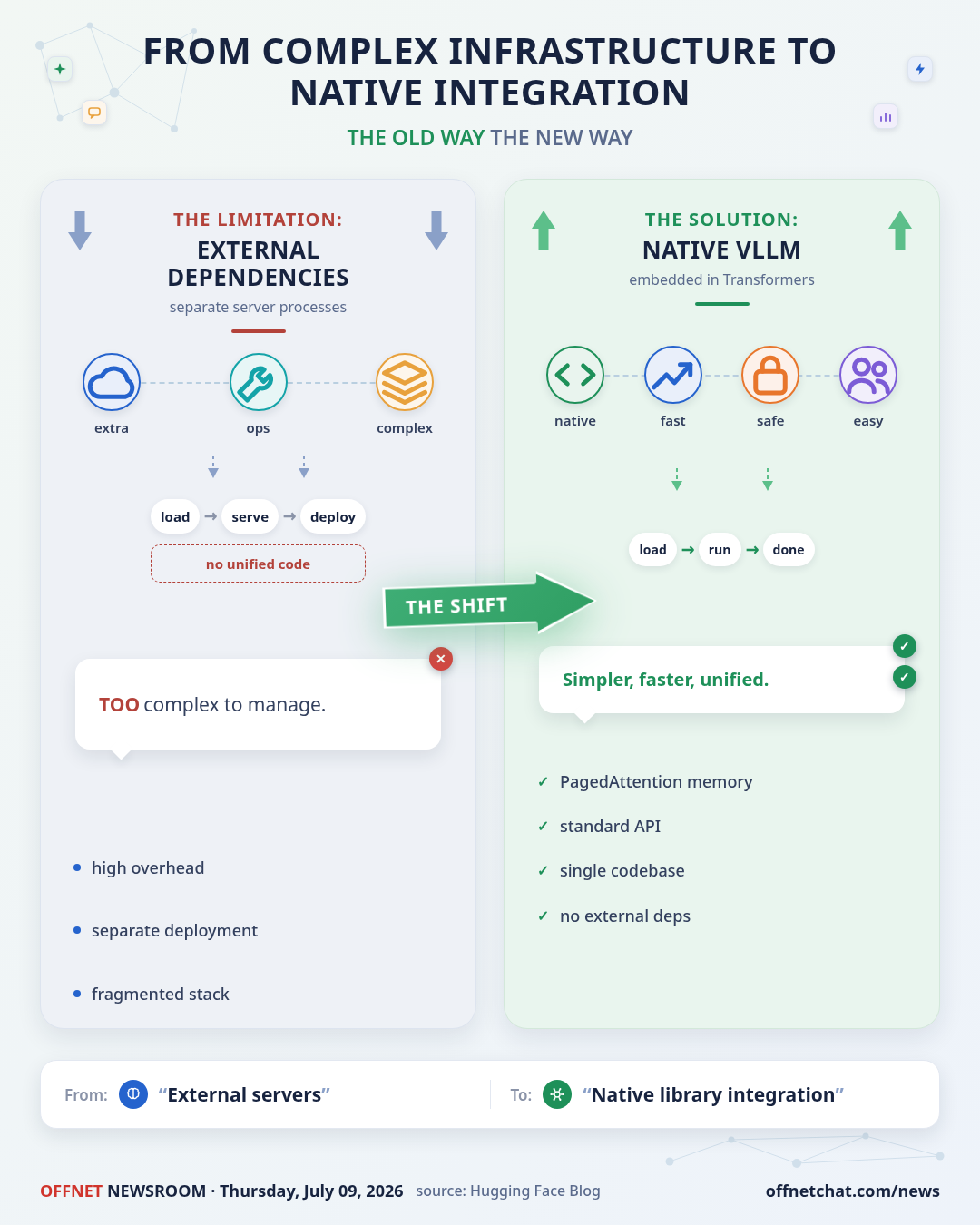
Hugging Face has introduced a native vLLM backend within the Transformers library, enabling high-throughput inference without external dependencies. This integration allows practitioners to leverage vLLM's optimized scheduling and memory management directly from standard Hugging Face APIs. The update simplifies deployment by unifying model loading and serving workflows into a single codebase.

  • Eliminates need for separate vLLM server processes by embedding backend directly in Transformers.
  • Leverages vLLM's PagedAttention for improved memory efficiency and throughput.
  • Maintains API compatibility with existing Hugging Face model loading logic.
  • Simplifies infrastructure by reducing component count in inference pipelines.

DeLS-Spec improves speculative decoding by pairing a fixed DFlash block-parallel drafter with a lightweight local head. This decoupled approach maintains intra-block causal conditioning without requiring the draft model to be trained from scratch, addressing limitations in methods like Domino and DSpark. The method treats the existing model as a long-context expert while the new head handles short-context specifics.

  • Avoids costly full retraining of draft models by keeping DFlash fixed as the long-context expert.
  • Introduces a lightweight local head to enforce intra-block causal conditioning in block-parallel drafting.
  • Reduces training costs while improving flexibility compared to scratch-trained methods like Domino.
  • Enables parallel verification of token blocks with better local context awareness.
CHECKLISTDeLS-Spec ImplementationKeep DFlash fixed as long-context expertAdd lightweight local head for causalityAvoid costly full model retrainingEnable parallel token block verification

PALS introduces percentile-aware layerwise sparsity for large language model pruning, deviating from uniform approaches by adjusting sparsity per layer based on the 99th percentile of activation magnitudes. The method bounds adjustments to ±5% around the target ratio, resulting in a 0.96 perplexity improvement on WikiText-2 for LLaMA-2-7B compared to Wanda. However, benefits are architecture-specific, with LLaMA-3-8B showing marginal gains and Mistral-7B showing none. The authors also note that gradient-based allocation strategies performed worse than random, challenging their assumed efficacy.

  • PALS uses 99th percentile activation magnitudes to set per-layer sparsity, improving LLaMA-2-7B perplexity by ~0.96 over uniform Wanda.
  • Gains are architecture-dependent: LLaMA-3-8B sees marginal improvement, while Mistral-7B shows no benefit.
  • Gradient-based sparsity allocation performed worse than random, suggesting magnitude may be a more reliable proxy than gradients.
  • Adjustments are tightly bounded (±5%), limiting deviation from the global target sparsity ratio.
TRADE-OFFPALS vs Wanda SparsityPALS MethodUses 99th percentile…Adjusts sparsity per layerBounded to ±5% deviationUniform WandaApplies uniform pruning ratiosLess adaptive to layersHigher perplexity on LLaMA-2vs

TF-Engram addresses the collision issues of GPU-resident engram memory by storing phrase-specific semantic tables across a GPU-DRAM-SSD hierarchy. The system operates without training, constructing offline memory from external corpora to avoid parameter-heavy updates. It employs Early-Exit Guided Predictive Prefetching to mitigate the latency penalties associated with accessing external storage.

  • Eliminates training costs by using offline corpus construction for semantic memory.
  • Prevents phrase collision by storing specific semantic memories rather than hashed slots.
  • Extends memory capacity beyond VRAM limits using SSD-backed hierarchical storage.
  • Hides I/O latency through Early-Exit Guided Predictive Prefetching mechanisms.
HOW IT WORKSTF-Engram Memory Pipeline1Offline Corpus Construction2Phrase-Specific Semantic Tables3GPU-DRAM-SSD Hierarchy4Predictive Prefetching5Latency-Hidden Inference

A new study compares pre-solution Feeling-of-Knowing (FOK) and post-solution Judgement-of-Learning (JOL) confidence metrics in large language models. The research finds that confidence estimates generated after the model completes its reasoning process are consistently better calibrated and more discriminative than those made beforehand. This temporal distinction highlights the limitations of treating confidence as a static property of the final output alone.

  • Post-solution JOL metrics outperform pre-solution FOK for reliability estimation.
  • Temporal evolution of confidence matters for accurate system decision-making.
  • Better calibration enables safer retrieval and tool-use triggers.
  • Frontier and open-source models both show this post-solution advantage.
WORTH QUOTINGConfidence Is Not StaticPost-solution confidence is consistently better calibratedand more discriminative than pre-solution estimates.— New LLM Study
LangChain Releases agentsreleases

langchain-openai 1.3.4 fixes Pydantic warnings and asyncio loop issues

LangChain released version 1.3.4 of the OpenAI integration, primarily addressing a Pydantic serializer warning that occurred when parsing structured output fields. The update also resolves an issue with using asyncio.get_running_loop() in async contexts to prevent runtime errors. Additional changes include dependency bumps for langgraph-checkpoint and test clarifications for API key failures.

  • Suppresses Pydantic serializer warnings on structured output parsed fields
  • Fixes asyncio.get_running_loop() usage in async contexts for stability
  • Bumps langgraph-checkpoint dependency to version 4.1.1
  • Clarifies trace output for async API key sync failures in tests

AI / ML 2

roundup ↗

Third-party benchmarks reveal that SambaNova's heterogeneous platform, which pairs Nvidia H200 GPUs with SN50 RDUs, achieves 763 tokens per second running the MiniMax M2.7 model. This performance metric suggests the architecture can effectively leverage existing Nvidia hardware while adding custom silicon to enhance inference speed. The results highlight a potential pathway for extending the useful life of current GPU fleets through specialized hybrid compute designs.

  • SambaNova's hybrid approach combines off-the-shelf Nvidia H200s with custom SN50 RDUs.
  • MiniMax M2.7 inference hits 763 tok/s in third-party heterogeneous testing.
  • Architecture demonstrates viable path to extend value of aging GPU inventory.
  • Intel-backed startup positions itself as alternative to pure Nvidia or custom silicon stacks.
InfoQ generaldevops ↺ since 07-07

HubSpot Scales Semantic Search to 20B Vectors for Agents and RAG

HubSpot transformed a semantic search proof of concept into an internal service managing over 20 billion vectors for more than 38 teams. The platform now underpins critical workflows including AI agents, retrieval-augmented generation, and contact deduplication. Rising agent usage has shifted the operational priority toward optimizing retrieval quality and minimizing latency.

  • HubSpot's semantic search handles 20B+ vectors across 38+ internal teams.
  • System supports AI agents, RAG pipelines, and automated contact deduplication.
  • Increasing agent traffic makes retrieval accuracy and low latency critical priorities.
  • Architecture evolved from small POC to large-scale enterprise internal service.

Agentic AI 8

roundup ↗

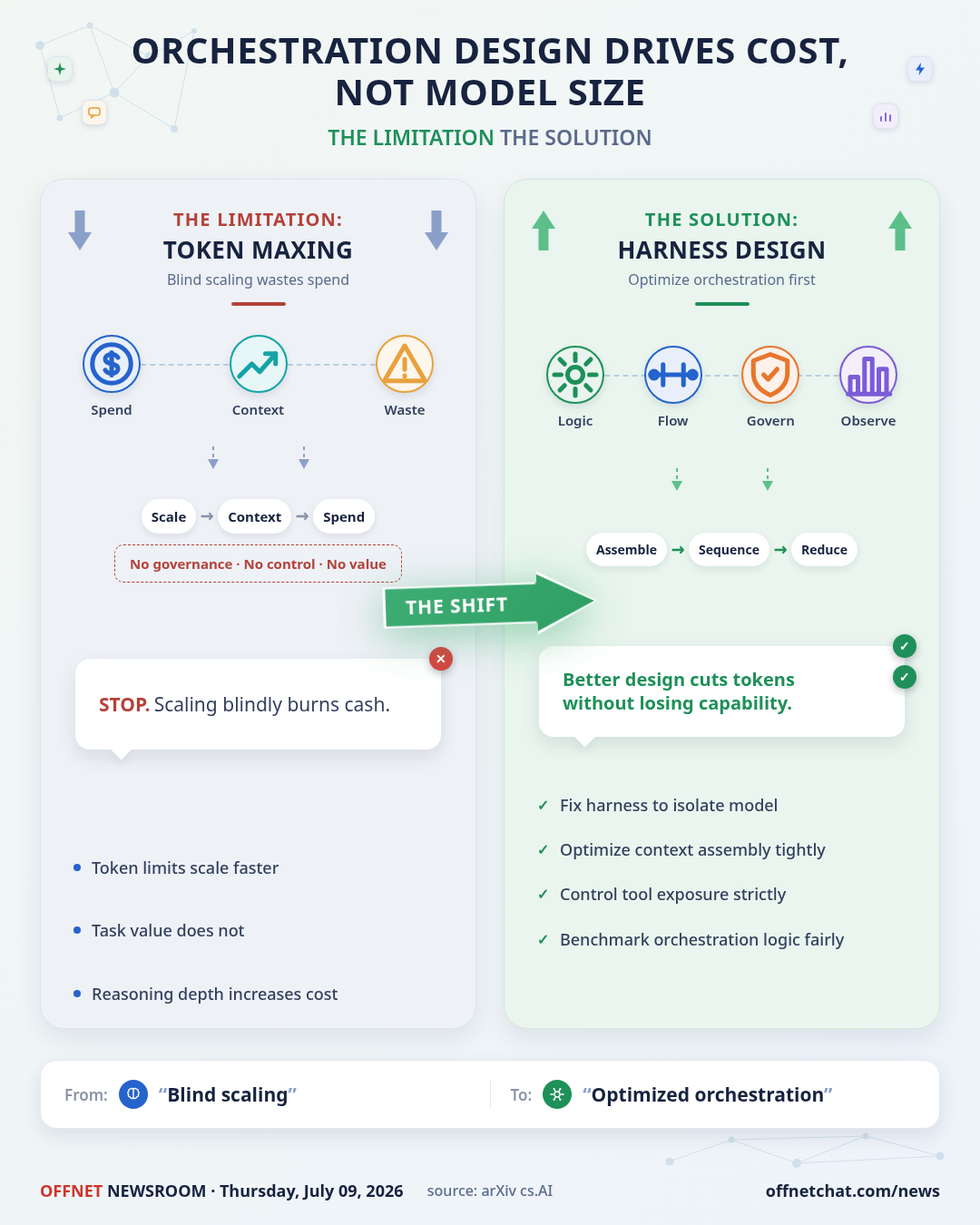
A new study identifies 'token maxing' as a key driver of rising AI spend, where organizations increase reasoning depth and context size faster than task value. The research isolates the orchestration layer as the decisive lever for control, testing six foundation models while swapping only the harness design. Results suggest that better context assembly, tool exposure, and turn sequencing can significantly reduce token consumption without compromising capability.

  • Token efficiency depends more on orchestration logic than the underlying foundation model chosen.
  • Stop scaling token limits blindly; optimize context assembly and tool delegation first.
  • Implementing stricter governance and observability in the harness curbs runaway token usage.
  • Benchmarking should fix the harness to isolate model performance from orchestration waste.
CHECKLISTOptimize Agentic OrchestrationOptimize context assembly and tool delegation firstImplement stricter governance and observability in the harnessBenchmark by fixing the harness to isolate model performance

This arXiv paper introduces Agentic Data Environments as an execution substrate designed to balance the efficiency gains of autonomous agents with strict safety guarantees. It argues that while databases are central, agents operate across a broader ecosystem of files, APIs, and system states. The proposed approach reframes data systems from passive storage into active components that enforce reliability and bound the consequences of agent failures.

  • Agents require execution substrates beyond traditional databases to manage files, APIs, and state.
  • New frameworks aim to amplify agent capabilities while strictly bounding failure costs.
  • Data systems are shifting from passive storage to active safety enforcement layers.
  • Focus is on preventing abrupt, irreversible costs in agentic automation workflows.
CHECKLISTWhat matters hereAgents require execution substrates beyond traditional databases to…New frameworks aim to amplify agent capabilities while strictly…Data systems are shifting from passive storage to active safety…Focus is on preventing abrupt, irreversible costs in agentic…

Training agentic models via multi-teacher on-policy distillation can induce subtle behavior shifts not visible in aggregate loss metrics. In tool-use scenarios, vanilla generalized knowledge distillation improves tool-call recall but simultaneously drives the model toward over-calling tools on direct-response examples. This imbalance occurs despite equal token exposure across sample types, indicating that standard aggregate explanations are insufficient for diagnosing these distributional changes.

  • Multi-teacher distillation improves recall but risks over-calling tools
  • Aggregate loss metrics fail to detect invisible behavior shifts
  • Token exposure balance does not prevent distributional drift
  • Direct-response examples may be negatively impacted by specialization
  • Monitor per-behavior metrics, not just overall loss, during training
TRADE-OFFAggregate Metrics vs RealityAggregate LossShows equal token exposureAppears balanced and stableFails to detect shiftsBehavioral RealityTool-call recall improvesOver-calling direct responsesDistributional drift occursvs

Hugging Face and NVIDIA have jointly published a new open dataset designed specifically for training and evaluating AI agents. The release aims to accelerate the development of autonomous systems by providing high-quality, standardized training material. This initiative addresses the growing need for robust data pipelines in agent-centric workflows.

  • New open dataset released for training autonomous AI agents
  • Collaboration between NVIDIA and Hugging Face
  • Aims to standardize evaluation metrics for agent performance
  • Supports development of more robust agent workflows

AgentLens introduces a benchmark for interactive code agents that assesses the entire execution trajectory rather than reducing results to a binary pass or fail. It combines formal verification with LLM-generated reviews to explain why a specific score was assigned. This approach allows engineers to diagnose model behavior and compare successive versions based on how agents handle instructions, tools, and error recovery.

  • Moves beyond binary metrics to evaluate the full agent interaction trajectory
  • Uses LLM-written reviews to provide readable explanations for scoring decisions
  • Enables diagnosis of specific model behaviors like tool usage and error recovery
  • Facilitates comparison of successive model versions through side-by-side analysis
TRADE-OFFAgentLens: Trajectory vs BinaryTraditional BenchmarksBinary pass or fail onlyHides intermediate agent errorsMisses tool usage contextAgentLens ApproachEvaluates full…LLM explains scoring decisionsDiagnoses specific model behaviorsvs

Current LLM agents rely on static, granular toolsets, forcing them to reinvent low-level logic for recurring workflows and increasing failure rates. This paper introduces EvoSOP, a framework where agents analyze execution trajectories to extract and synthesize atomic actions into reusable Standard Operating Procedures (SOPs). These SOPs act as higher-order tools that encapsulate multi-step logic, enabling agents to self-evolve and reduce reasoning overhead.

  • Shifts agent design from static atomic tools to dynamic, self-evolving SOPs.
  • Reduces reasoning overhead by encapsulating recurring multi-step logic.
  • Lowers failure rates by eliminating redundant low-level logic reinvention.
  • EvoSOP extracts SOPs directly from agent execution trajectories.
CHECKLISTWhat matters hereShifts agent design from static atomic tools to dynamic…Reduces reasoning overhead by encapsulating recurring multi-step…Lowers failure rates by eliminating redundant low-level logic…EvoSOP extracts SOPs directly from agent execution trajectories.

Tool-using LLM agents can violate operational policies while appearing to succeed, resulting in silent wrong-state updates like unauthorized cancellations. Research on the tau2-bench airline domain shows 78% of failures are this type, with no tool errors or self-reporting flags to alert the system. The study evaluates lightweight inter-process deterministic gates as a mechanism to catch these violations before they persist.

  • Agents may execute forbidden state transitions without raising errors, creating silent data corruption.
  • 78% of observed failures in the tau2-bench airline domain are silent wrong-state events.
  • Failure rates are reproducible across seeds, indicating a systematic policy-enforcement gap.
  • Standard tool outputs and agent self-reports do not expose these specific policy violations.
  • Deterministic gates offer a lightweight verification layer to prevent silent policy breaches.
BY THE NUMBERSSilent Policy Violations in LLM Agents78%Failures are silent wrong-state updatesNo tool errors or self-reporting flags

This study evaluates whether reusable, LLM-generated skill files improve performance over direct prompting for common data science tasks. Testing across data preparation, extraction, statistical analysis, and reporting stages, the findings show no reliable performance gain from using these generated skills. The results suggest that manually curating expert-written skills may still be necessary to avoid bottlenecks while ensuring quality.

  • LLM-generated skills do not reliably beat raw prompts in data science tasks.
  • No performance gain found across four key lifecycle stages.
  • Manual curation remains critical for high-quality, reusable guidance.
  • Avoid assuming auto-generated skills simplify workflow maintenance.
CHECKLISTNavigating LLM Skill LimitsDo not assume auto-generated skills outperform raw promptsExpect no reliable performance gain across key stagesManually curate expert skills for high-quality guidanceAvoid assuming automation simplifies workflow maintenance

Automation / DevOps / IaC 6

roundup ↗

Airbnb introduced Sitar-agent, a Kubernetes sidecar designed to deliver dynamic configuration updates to tens of thousands of pods with high frequency. The architecture leverages Java for the agent logic, Amazon S3 for snapshot-based bootstrapping, and SQLite as the local storage backend. This redesign replaced the previous Sparkey implementation to enhance startup performance, reliability, and overall configuration availability at scale.

  • Sitar-agent handles updates several times per minute across massive pod fleets.
  • Migration from Sparkey to SQLite improves local storage reliability and speed.
  • Amazon S3 snapshot bootstrapping accelerates initial configuration delivery.
  • Java-based sidecar ensures consistent runtime performance for config management.
  • System prioritizes availability and rapid startup in large-scale Kubernetes environments.
THE SHIFTStorage Migration Impact8SPARKEY PODS3SQLITE PODSMigration improved reliability and speed
AWS What's New awsdatabase

AWS SSM now manages Azure VMs with simplified hybrid pricing

AWS Systems Manager extends support to Azure Virtual Machines, allowing administrators to connect and manage them alongside EC2 instances without manual agent installation. Users can leverage Session Manager, Automation, and Patch Manager across both clouds from a single unified workflow. The update also removes the Advanced Instances Tier, shifting to a pay-as-you-go model for sessions and commands starting September 30, 2026.

  • Connect Azure VMs to SSM automatically via Cloud Connector without manual agent setup.
  • Manage AWS and Azure nodes using Session Manager, Run Command, and Patch Manager in one workflow.
  • Advanced Instances Tier is eliminated, removing upfront per-node fees for hybrid setups.
  • New pay-as-you-go pricing for Session Manager and Run Command begins September 30, 2026.
HOW IT WORKSUnified Hybrid Management Workflow1Connect Azure VMs via Cloud Connector2Manage AWS EC2 instances natively3Execute Session Manager commands4Run Automation and Patch Manager5Pay-as-you-go starting 2026

China's national vulnerability database has flagged Claude Code for containing monitoring mechanisms that forward Chinese users' data to remote servers. The advisory urges developers to discontinue use of the tool to mitigate data exfiltration risks. This action reflects heightened scrutiny of AI coding assistants regarding data sovereignty and supply chain security.

  • Chinese devs must remove Claude Code to avoid data exfiltration to remote servers.
  • National vulnerability database cites monitoring mechanisms as the primary risk factor.
  • AI coding tools face increased regulatory pressure in regions enforcing data sovereignty.
  • Review internal AI agent deployments for similar data forwarding behaviors.
PostgreSQL News database ↺ since 07-06

CloudNativePG 1.30.0 adds declarative roles, safer failover; 1.28 series EOL

CloudNativePG 1.30.0 introduces a DatabaseRole CRD for GitOps-friendly PostgreSQL role management and a Lease-based primary election primitive to improve failover safety. The release also includes security and operational enhancements, while maintenance versions 1.29.2 and 1.28.4 are now available. The 1.28.x series reaches End-of-Life on June 30, 2026.

  • Adopt DatabaseRole CRD for declarative, GitOps-friendly PostgreSQL role management.
  • Leverage Lease-based primary election for safer failover behavior in Kubernetes.
  • Plan upgrade from 1.28.x to 1.29 or 1.30 before EOL on June 30, 2026.
  • Update to 1.30.0 for latest security and operational improvements.
  • Maintenance releases 1.29.2 and 1.28.4 are immediately available.
CHECKLISTCloudNativePG 1.30 Upgrade GuideAdopt DatabaseRole CRD for GitOps role managementUse Lease-based election for safer failoverPlan upgrade before June 2026 EOLUpdate to latest security patches

AWS has expanded its DevOps Agent to include autonomous release management features that assess code changes before deployment. The new capabilities automatically test software updates to validate stability and correctness prior to reaching production environments. This update aims to reduce manual validation overhead by integrating AI-driven checks directly into the release workflow.

  • AWS DevOps Agent now autonomously tests code changes before production deployment
  • AI-powered release management assesses code quality and stability automatically
  • Reduces manual validation steps by integrating pre-production checks into the agent
  • Aims to accelerate release cycles while maintaining software reliability standards
AWS What's New awsdatabase ↺ since 07-07

AWS ACM adds ACME v2 support for automated public TLS cert management

AWS Certificate Manager now exposes a fully managed ACME server endpoint, enabling integration with standard clients like Certbot and cert-manager. This feature allows developers to automate the issuance and renewal of 45-day public TLS certificates from Amazon Trust Services. The move supports centralized governance by letting PKI admins restrict domain scopes and wildcard policies while delegating requests to application teams.

  • Deploy ACMEv2-compatible clients (Certbot, cert-manager) to automate public cert lifecycle in AWS
  • Leverage centralized governance controls to define domain scopes and enforce wildcard policies
  • Align with CA/Browser Forum mandates by automating renewal for 45-day certificate validity
  • Delegate certificate requests to app teams without distributing sensitive private keys
HOW IT WORKSAutomating Public TLS Certs1Deploy ACMEv2 Client2Request 45-Day Cert3Enforce Domain Scope4Auto-Renew Securely

AWS 8

roundup ↗
AWS What's New awsdatabase

AWS EC2 U7i high-memory instances now in Europe Zurich

Amazon EC2 U7i instances featuring 12TiB of DDR5 memory are now available in the AWS Europe (Zurich) region. Powered by fourth-generation Intel Xeon Scalable processors, these instances provide 896 vCPUs and support up to 100Gbps for both network and EBS bandwidth. This expansion targets mission-critical in-memory database workloads such as SAP HANA, Oracle, and SQL Server.

  • 12TiB DDR5 memory supports massive in-memory datasets for SAP HANA and Oracle.
  • 896 vCPUs on Sapphire Rapids deliver high transaction processing throughput.
  • 100Gbps EBS and network bandwidth accelerate data loading and backups.
  • ENA Express support ensures low-latency communication for critical apps.
BY THE NUMBERSMassive Memory for SAP HANA12TiBDDR5 RAM per instanceSupports mission-critical in-memory databases

AWS Security Hub now features Network Scanning to detect resources actually reachable from the internet by probing them directly. This active verification complements existing findings that only assess configuration risks like security group rules. The tool discovers public IPs, VMs, and load balancers across AWS and Azure environments, identifying open ports and running services.

  • Active scanning confirms real internet reachability, not just theoretical risk from config analysis.
  • Supports multi-cloud coverage, scanning both AWS and Azure resources for public exposure.
  • Generates specific Security Hub findings for each detected reachable port and service.
  • Reduces false positives by validating if resources are truly accessible from the public internet.
TRADE-OFFConfig Analysis vs Active ScanningConfig AnalysisTheoretical risk assessmentBased on security rulesHigh false positive rateActive ScanningReal internet reachabilityDirect probing verificationValidates actual exposurevs
AWS What's New awsdatabase

AWS Security Hub now monitors Microsoft Azure resources

AWS Security Hub has extended its unified security management capabilities to include Microsoft Azure environments. The service automatically discovers key Azure assets such as VMs, container images, Function Apps, and identities to evaluate them for misconfigurations and internet exposure. This update allows organizations to consolidate risk analytics, posture management, and vulnerability assessments into a single interface across both clouds.

  • Eliminates tool fragmentation by unifying AWS and Azure security monitoring in one console.
  • Auto-discovers Azure VMs, ACR images, Function Apps, and identities for continuous evaluation.
  • Enables holistic risk prioritization and consistent response actions across hybrid cloud workloads.
  • Centralizes cloud security posture management and vulnerability detection for multi-cloud fleets.
TRADE-OFFUnified Cloud SecurityBefore Security HubFragmented tool sprawl across cloudsManual asset discovery effortsInconsistent risk visibilityWith Multi-Cloud HubSingle console for AWS and AzureAuto-discovers VMs and identitiesHolistic risk prioritizationvs

AWS detailed how industrial-wearables maker ProGlove scaled its SaaS platform to operate over one million Lambda functions. The architecture spans thousands of dedicated customer accounts, leveraging AWS’s isolation models. This case study highlights strategies for managing massive concurrency and resource fragmentation in multi-tenant serverless environments.

  • ProGlove runs 1M+ Lambda functions across thousands of dedicated customer accounts.
  • AWS highlighted architectural patterns for handling extreme scale in multi-tenant SaaS.
  • Dedicated accounts provide isolation but require careful resource management strategies.
  • Serverless concurrency limits and cold starts are critical factors at this scale.
AWS What's New awsdatabase

AWS Redshift Graviton RG instances now on trailing track

Amazon Redshift has extended support for Graviton-based rg.4xlarge and rg.xlarge instances to the trailing track (P201). This update allows customers prioritizing stability to leverage AWS Graviton performance, which offers up to 2.4x faster query speeds than RA3 instances at a 30% lower price per vCPU. Deployment is supported via the console, CLI, and SDKs for both new clusters and existing resize operations.

  • Graviton RG instances are now available on the stable P201 trailing track.
  • Expect up to 2.4x faster query performance compared to RA3 instances.
  • Cost reduction of 30% per vCPU makes Graviton attractive for production.
  • Resize existing clusters or provision new ones using rg.xlarge/rg.4xlarge.
  • Provisioning supported via Console, AWS CLI, and SDKs.
BY THE NUMBERS30% Lower Cost Per vCPU30%Savings per vCPU vs RA3Faster queries and lower prices on P201 track

Amazon EMR Serverless now supports worker configurations up to 32 vCPUs and 244 GB of memory, doubling the previous maximum of 16 vCPUs and 120 GB. These larger instances are designed to improve runtime performance and cost efficiency for compute and memory-intensive Spark jobs. The update specifically addresses challenges like shuffle-heavy operations, data skew, and caching requirements by reducing data transfer overhead and lowering out-of-memory failure risks.

  • Max worker size doubled to 32 vCPUs and 244 GB RAM for heavier workloads
  • Shuffle-heavy jobs benefit from reduced inefficient data transfers between executors
  • Data skew scenarios see fewer out-of-memory failures due to increased memory headroom
  • Data caching performance improves as larger workers can hold more data in memory
  • Recommended for compute and memory-intensive Spark and Trino jobs
THE SHIFTEMR Serverless Worker Limits Doubled16 vCPUPREVIOUS MAX VCPU32 vCPUNEW MAX VCPUMemory also increased from 120GB to 244GB

Microsoft has integrated Hugging Face models into its Foundry Managed Compute service. This update allows users to deploy and run pre-trained models directly within the Foundry environment. The integration simplifies access to a wide range of AI capabilities for enterprise workloads.

  • Hugging Face models are now natively available on Microsoft Foundry Managed Compute
  • Simplifies deployment of pre-trained AI models within the Foundry ecosystem
  • Enables enterprise users to leverage community models without external infrastructure
  • Reduces friction for integrating open-source AI into existing data workflows

Hugging Face has partnered with SkyPilot to enable running AI workloads on any cloud provider while storing data in Hugging Face storage. This integration aims to eliminate egress fees by keeping data within the Hugging Face ecosystem regardless of the compute destination. The solution allows engineers to leverage multi-cloud flexibility without incurring data transfer costs.

  • Enables multi-cloud AI compute without data egress penalties.
  • Keeps datasets in Hugging Face storage during model training/inference.
  • Simplifies cross-cloud workflows via SkyPilot integration.
  • Reduces operational costs for large-scale model operations.

Trending on GitHub 3

roundup ↗

Barman versions 3.19.0 and 3.19.1 introduce the ability to restore backups directly from cloud object storage, supporting both local-to-cloud and postgres backup methods. These releases also include a new barman cloud-wal-restore command to streamline disaster recovery workflows. The updates allow DBAs to manage recovery for multiple remote servers from a single location without requiring intermediate local storage steps.

  • Direct restore from cloud object storage reduces recovery time and local storage requirements.
  • New barman cloud-wal-restore command simplifies continuous archiving recovery processes.
  • Supports both local-to-cloud and postgres backup methods for flexible DR strategies.
  • Quick succession of 3.19.0 and 3.19.1 suggests immediate bug fixes or refinements.
HOW IT WORKSBarman 3.19 Direct Cloud Restore1Backup PostgreSQL locally2Transfer to cloud storage3Restore directly from cloud4Recover remote servers

The former CEO of GitHub has launched a new competitor platform specifically built for the emerging wave of vibe coding. This move comes as GitHub faces growing difficulties in managing the increasing load from AI-driven development tools. The new venture aims to capture market share by offering infrastructure tailored to modern, AI-centric workflows rather than traditional repository management.

  • Former GitHub leadership is directly challenging incumbent with AI-native infrastructure.
  • GitHub is struggling to scale for current AI coding tool loads, creating opening for rivals.
  • New platform targets 'vibe coding' workflows, indicating a shift in developer tooling priorities.
  • Market fragmentation expected as specialized AI coding platforms emerge alongside legacy hosts.
GitHub Trending (daily) githubrepos ↺ since 07-07 ⚠ unverified date/source

addyosmani/agent-skills packages senior engineering workflows for AI coding agents

This GitHub repository provides production-grade engineering skills designed to guide AI coding agents through standard development lifecycles. It encodes workflows, quality gates, and best practices into structured packages that ensure consistency across phases like planning, building, and reviewing. The project utilizes eight slash commands to automatically activate specific skills corresponding to stages from idea definition to shipping code.

  • Standardizes AI agent behavior by encoding senior engineer best practices into reusable skills
  • Covers full lifecycle with slash commands for spec, plan, build, test, review, and ship
  • Ensures consistent quality gates and workflows across every phase of software development
  • Packaged for easy integration into AI coding tools to reduce manual oversight
WORTH QUOTINGThe gistThis GitHub repository provides production-grade engineeringskills designed to guide AI coding agents through standarddevelopmen…— GitHub Trending (daily)

Mobile friendly 6

all cards ↗

Today's top database + AI stories as save-and-share cards — built for your phone and your LinkedIn feed.