OffNet Newsroom

Archive snapshot

Tuesday, July 07, 2026

Daily signal on databases, AI, and the tech that matters.

41 new today 48 stories 8 sections 16 for the DBA desk

Database Technology 8

roundup ↗

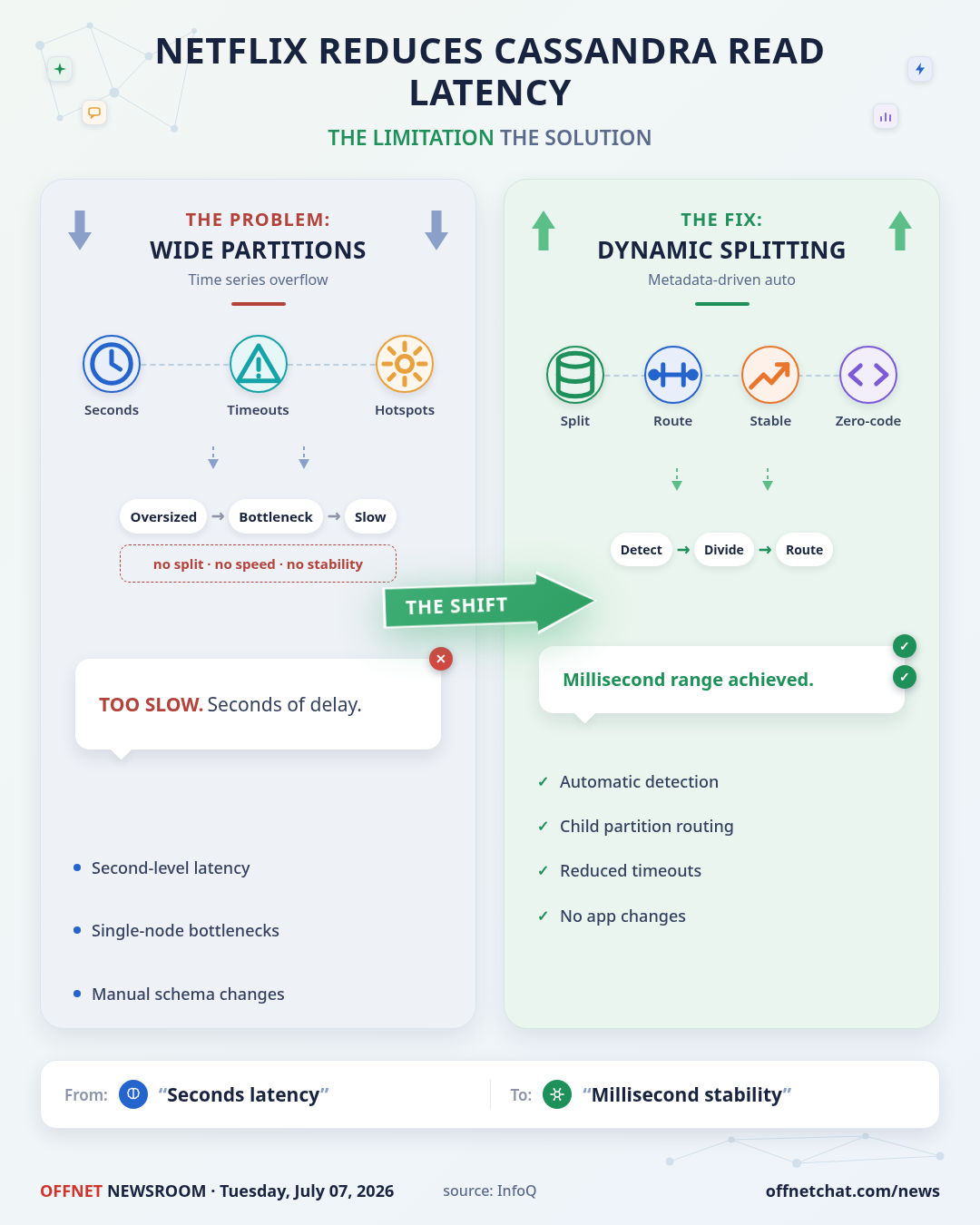
Netflix engineers deployed a metadata-driven dynamic partition splitting mechanism to resolve wide partition issues in time series workloads. The system automatically detects oversized partitions, divides them into smaller units, and routes read requests across these child partitions. This approach successfully lowered read latency to the millisecond range, reduced timeouts, and enhanced cluster stability without requiring application-level changes.

  • Dynamic splitting addresses wide partition hotspots that cause second-level read latencies in time series data.
  • Metadata-driven detection allows automatic partitioning without manual schema changes or application code updates.
  • Read routing across child partitions ensures load distribution and improved cluster stability under heavy load.
  • Timeouts are significantly reduced as the system prevents single-node bottlenecks from oversized partitions.
HOW IT WORKSDynamic Partition Splitting Pipeline1Detect oversized partitions via metadata2Automatically divide into smaller units3Route reads across child partitions4Maintain cluster stability under load

Christophe Pettus examines the enable_partitionwise_aggregate GUC, which defaults to off in PostgreSQL. Enabling this setting allows the planner to perform aggregation directly on partitioned tables, potentially improving query performance. The trade-off involves increased memory usage during execution, requiring careful evaluation of whether the speed gain justifies the resource cost for specific workloads.

  • The parameter defaults off, requiring explicit enablement for partitioned aggregation.
  • Enabling it trades higher memory consumption for faster query execution times.
  • DBAs must evaluate if the speed benefit outweighs memory costs for their queries.
  • This optimization specifically targets partitioned table aggregation strategies.
Planet PostgreSQL database

PostgreSQL 20 adds per-backend lock stats via pg_stat_lock

Michael Paquier committed a patch for PostgreSQL 20 that introduces per-backend lock statistics. This feature exposes lock wait counts, wait times, and fast-path exceeded counts for individual backends. The data mirrors existing information available through pg_stat_lock but allows for more granular monitoring at the session level.

  • PostgreSQL 20 gains per-backend visibility into lock contention metrics.
  • Monitor lock wait counts and durations to pinpoint specific blocked sessions.
  • Track fast-path lock acquisition failures to identify performance bottlenecks.
  • No immediate action required for current releases; plan for PG 20 upgrade.
CHECKLISTPer-Backend Lock Monitoring StepsEnable per-backend lock statistics in PostgreSQL 20Monitor lock wait counts and durations per sessionTrack fast-path lock acquisition failures for bottlenecksPlan upgrade to PG 20 for granular visibility

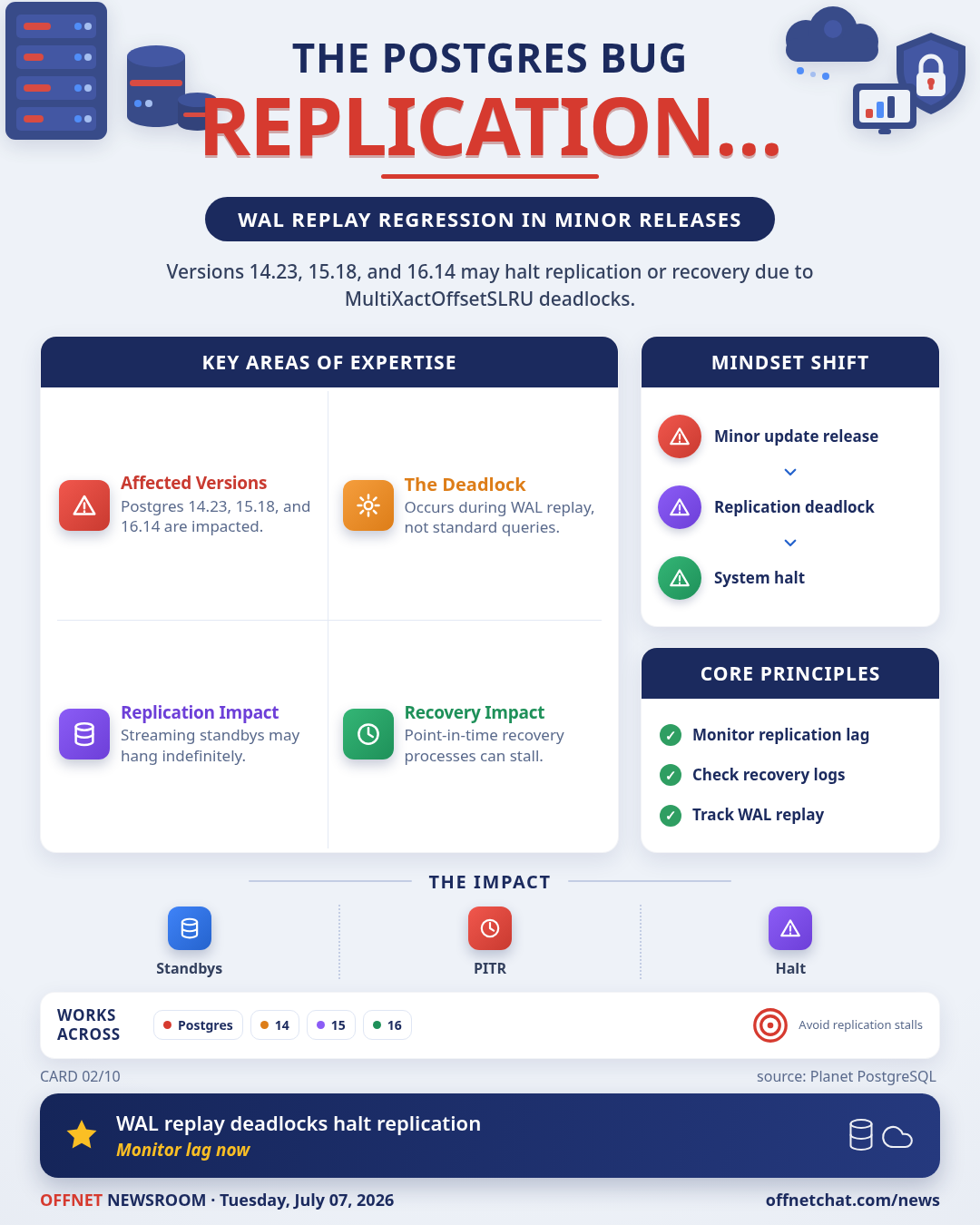
The presence of .ready files in pg_wal/archive_status indicates that WAL segments have been generated and are available for transport via streaming replication or archive_command. These files accumulate before being marked as .done once the receiving side confirms consumption. A growing pile of .ready files is a strong signal of stalled WAL delivery rather than a broken replica, often pointing to network or consumer latency issues.

  • .ready files mean WAL is generated and waiting for transport, not necessarily that replication is broken.
  • Consumption by streaming replicas or archive_command moves files to .done status.
  • Accumulating .ready files usually indicate slow transport or a stalled consumer.
  • Check network latency and replica replay speed when disk usage climbs due to .ready files.
HOW IT WORKSWAL Replication Lifecycle1WAL segment generated2.ready file created3Transported to replica4Consumer confirms receipt5Marked as .done

pg_hardstorage deliberately omits the incremental chain found in formats like pgBackRest or Barman to eliminate a critical single point of failure. In traditional chained models, corruption or deletion of any single backup in the sequence renders all subsequent backups invalid. This design choice prioritizes resilience against storage-level issues such as bit flips or lifecycle policy errors over the space efficiency of chaining.

  • Avoids the 'chain footgun' where one corrupted backup invalidates the entire recovery path.
  • Resilient to S3 lifecycle deletions or bit flips that would break traditional incremental chains.
  • Recovery does not depend on the sequential integrity of previous backup artifacts.
  • Design prioritizes fault isolation over the storage savings of strict incremental dependencies.
GitHub Trending (daily) githubrepos ⚠ unverified date/source

Alibaba releases zvec, an in-process vector DB with native FTS and hybrid search

Alibaba Group has open-sourced zvec, a lightweight vector database designed to run in-process within applications. The latest v0.5.0 release introduces native full-text search and hybrid retrieval capabilities, allowing combined queries across dense vectors, sparse vectors, and scalar filters without external search engines. It utilizes a DiskANN index for production-grade similarity search.

  • Embeds directly into apps, eliminating external vector DB infrastructure overhead.
  • Native full-text search removes dependency on separate search engines like Elasticsearch.
  • Supports hybrid retrieval combining vector, sparse, and scalar filters in one query.
  • Uses DiskANN indexing for low-latency, scalable similarity search.
TRADE-OFFzvec vs Traditional StackTraditional StackSeparate vector DBExternal search engineHigh infrastructure overheadzvec ApproachIn-process integrationNative full-text searchUnified hybrid queriesvs
Planet PostgreSQL database

PostgreSQL VACUUM: Byte-Level Page Analysis

This article moves beyond standard autovacuum tuning to examine VACUUM operation byte by byte. It contrasts page-level HOT pruning shortcuts with full VACUUM processes required for cold updates, deletes, and index cleanup. The author provides detailed snapshots of pages before and after each phase to illustrate internal mechanics.

  • HOT pruning is limited to single pages and HOT tuples only.
  • Full VACUUM handles cold updates, deletes, and index entry cleanup.
  • Byte-level analysis reveals exact state changes during vacuum phases.
  • Visibility map and free space map updates require dedicated vacuum work.

LLMs 8

roundup ↗

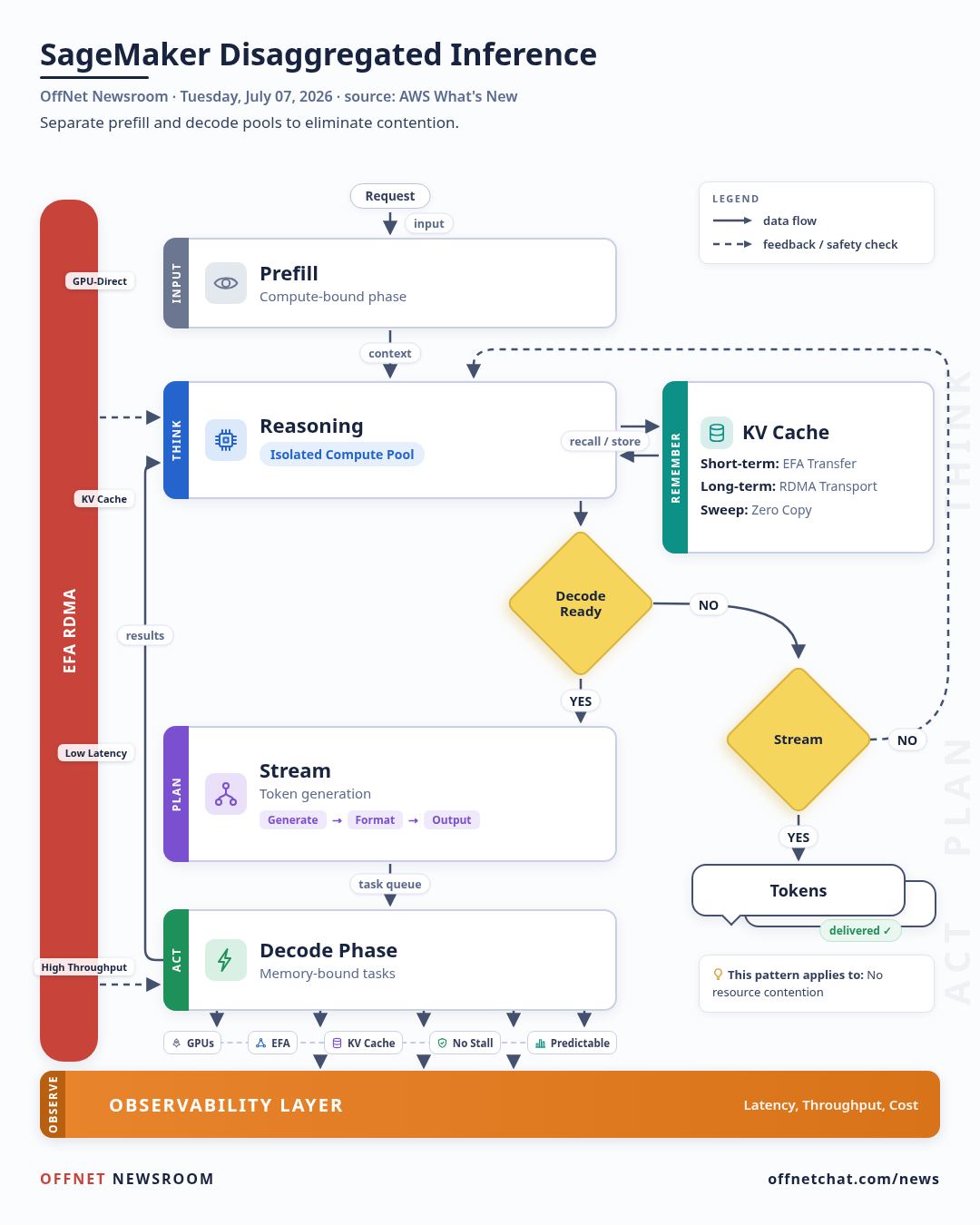
Amazon SageMaker HyperPod now supports Disaggregated Prefill and Decode (DPD), separating LLM inference phases onto dedicated GPU pools. The system transfers key-value caches between these pools via Elastic Fabric Adapter using GPU-Direct RDMA. This architecture prevents long-context prefill requests from stalling token generation for concurrent decode tasks, improving latency consistency and throughput under mixed workloads.

  • DPD isolates compute-bound prefill from memory-bound decode onto separate GPU resources.
  • KV cache transfer uses EFA with GPU-Direct RDMA for low-latency inter-pool communication.
  • Eliminates resource contention where long contexts stall concurrent request processing.
  • Enables predictable per-token latency for chat, agentic, and RAG pipelines.
  • Reduces need to over-provision infrastructure to handle peak prefill demands.
HOW IT WORKSDisaggregated LLM Inference Pipeline1Separate prefill and decode phases2Dedicate GPU pools per phase3Transfer KV cache via EFA4Use GPU-Direct RDMA for speed
Hacker News (100+ points) general

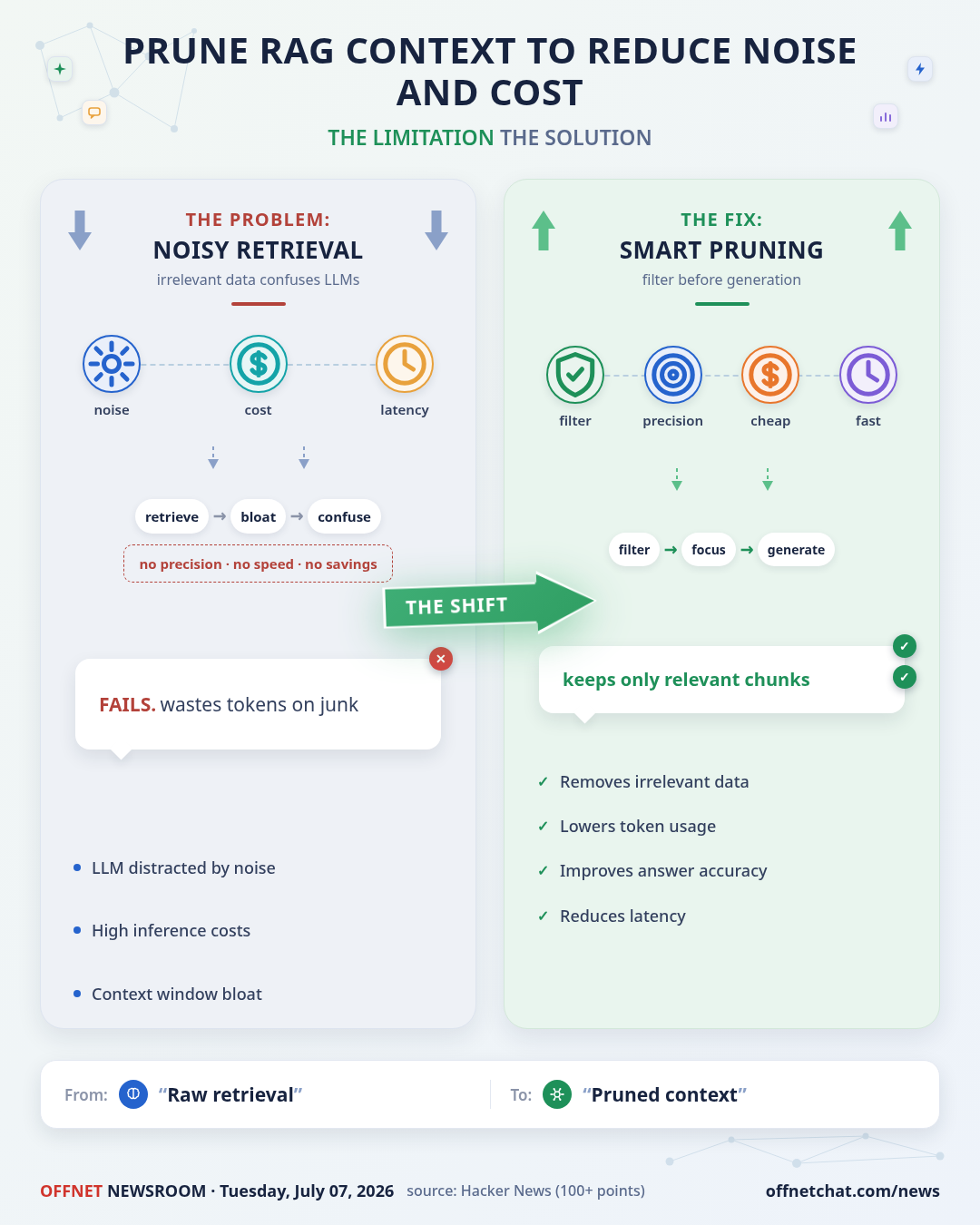
Kapa.ai details how to prune RAG context to reduce noise and cost

Kapa.ai shares its approach to filtering retrieved documents in RAG pipelines, focusing on removing irrelevant chunks before generation. The method aims to improve answer accuracy by ensuring the LLM only processes information directly related to the query. This reduces token usage and mitigates context window bloat caused by noisy retrieval results.

  • Filtering retrieved chunks prevents LLM distraction from irrelevant data
  • Reducing context size lowers inference costs and latency
  • Pruning strategies can significantly improve answer precision
  • Essential optimization for production RAG systems with large corpora

Gemma 4 is a new generation of open-weight multimodal models ranging from 2.3B to 31B parameters, featuring both dense and Mixture-of-Experts architectures. It includes improved vision and audio encoders, with a novel encoder-free 12B variant that ingests raw audio and image patches directly. The suite also integrates a 'thinking mode' for pre-response reasoning traces and targets gains in inference speed, memory efficiency, and long-context handling.

  • Native multimodal support with dense and MoE architectures across 2.3B-31B sizes.
  • 12B variant uses encoder-free architecture for raw audio/image patch ingestion.
  • Integrated 'thinking mode' enables explicit reasoning traces before final output.
  • Optimized for inference speed, memory usage, and long-context capabilities.
COMPARISONGemma 4 Model SizesSmallest2.3BMid-range12BLargest31B
Hacker News (100+ points) general

GLM 5.2 signals incoming AI margin collapse

The release of GLM 5.2 is triggering concerns about a structural collapse in AI profitability margins. Industry analysis suggests that competitive pressures and efficiency gains are compressing the economic advantages previously held by major model providers. This shift indicates a potential transition from high-margin growth to a more commoditized market landscape.

  • GLM 5.2 release highlights intensifying competition in the LLM space.
  • AI provider margins are predicted to compress due to market dynamics.
  • The industry may be shifting from high-margin growth to commoditization.
  • Practitioners should monitor pricing and infrastructure cost efficiencies.
  • Economic sustainability of current AI business models is under review.
WORTH QUOTINGAI Margin Collapse SignalGLM 5.2 release highlights intensifying competition in theLLM space— Industry Analysis
Hacker News (100+ points) general

Anthropic proposes global workspace architecture for language models

Anthropic has published research outlining a global workspace architecture designed to enhance the reasoning capabilities of large language models. The approach aims to improve how models integrate information and perform complex tasks by structuring internal processing more effectively. This work represents a significant step in refining model internals for better performance and reliability.

  • Anthropic introduces a new architectural pattern for LLMs focused on global workspace mechanisms.
  • The design targets improved reasoning and information integration across complex tasks.
  • Research suggests structural changes to model internals can yield measurable performance gains.
  • This work highlights ongoing industry efforts to move beyond standard transformer scaling.
  • Potential implications for future model training strategies and architectural choices.

Oyster-II improves upon the Oyster-I model by replacing Supervised Fine-Tuning with Reinforcement Learning to address poor safety generalization. The approach shifts away from blanket refusals toward constructive responses that safely address sensitive user intents. This method aims to balance helpfulness and trustworthiness without sacrificing capability on legitimate queries.

  • Moves beyond simple refusal strategies to constructive, response-oriented safety alignment.
  • Upgrades Oyster-I's SFT base with Reinforcement Learning for better generalization.
  • Targets the trade-off between safety compliance and helpfulness in sensitive contexts.
  • Addresses insufficient safety generalization found in previous supervised schemes.
TRADE-OFFSafety Alignment ShiftOld SFT ApproachRelies on supervised fine-tuningProduces blanket refusalsPoor safety generalizationNew RL ApproachUses reinforcement learningGenerates constructive responsesBalances safety and helpfulnessvs

Researchers address the generator-validator gap where LLMs generate responses they later reject as invalid. The study introduces a consistency formulation that corrects for utterance frequency, acknowledging that valid strings are often a priori unlikely. This adjustment prevents naive consistency metrics from failing due to low likelihood scores on common outputs.

  • LLMs suffer from inconsistency between generation and self-validation steps.
  • Valid outputs are often rejected because they are a priori unlikely.
  • New consistency metric corrects for utterance frequency bias.
  • Aligning validator logic with generator behavior improves reliability.
HOW IT WORKSFixing LLM Consistency Gaps1Generate initial response2Validate against rules3Reject valid outputs4Adjust for frequency5Align validator logic

This paper introduces Hierarchical Landmark Sparse (HiLS) Attention to address the quadratic cost and poor length extrapolation of dense attention in long-context LLMs. HiLS learns chunk selection end-to-end via language-modeling loss, factorizing attention so each query independently attends to retrieved chunks. The outputs are then fused based on chunk retrieval scores, offering a more accurate sparse alternative to existing methods.

  • HiLS uses end-to-end learning of chunk selection under LM loss for better accuracy.
  • Factorized attention allows independent query-chunk processing before score-based fusion.
  • Addresses quadratic cost and length extrapolation issues inherent in dense attention.
  • Outperforms existing chunk-wise sparse methods by avoiding inaccurate chunk selection.
HOW IT WORKSHiLS Attention Pipeline1Learn chunk selection via LM loss2Factorize attention for independent queries3Retrieve relevant chunks per query4Fuse outputs using retrieval scores

AI / ML 4

roundup ↗

HubSpot evolved its semantic search platform from a proof of concept into a core service handling over 20 billion vectors for more than 38 teams. The infrastructure now underpins key capabilities including agent retrieval, RAG workflows, and contact deduplication. Rising agent adoption has shifted the primary engineering focus toward optimizing retrieval quality and reducing latency at massive scale.

  • HubSpot manages 20B+ vectors internally, supporting 38+ teams.
  • Semantic search now powers agents, RAG, and contact deduplication.
  • Agent growth makes retrieval quality and latency critical priorities.
  • Platform scaled from PoC to enterprise-grade internal service.

The REDI framework addresses the gap in unifying data transformation, readiness assessment, and provenance tracking for large-scale scientific datasets. It operates via a five-stage pipeline that instruments each step for reproducibility and deploys as an agent-callable skill. A companion tool, SetGo, further automates FAIR compliance and catalog publication, enabling raw data to become AI-ready across domains like climate and fusion.

  • REDI unifies ingestion, preprocessing, transformation, structuring, and output into one reproducible pipeline.
  • Agent-callable deployment allows AI agents to trigger data readiness workflows directly.
  • SetGo companion tool handles FAIR compliance automation and metadata cataloging.
  • Validated across climate, proteomics, materials science, and nuclear fusion datasets.
HOW IT WORKSREDI Five-Stage Pipeline1Ingest raw data2Preprocess inputs3Transform structures4Structure datasets5Output AI-ready data

This paper examines the limitations of using local pairwise comparisons to learn human preferences for automated decision rules. It introduces a formal model for internal pluralism, where individuals hold multiple competing priorities regarding how a system should behave. The authors demonstrate that forced local comparisons fail when users cannot decisively choose between options due to these conflicting internal values.

  • Pairwise comparisons assume users have a single, consistent preference for decision rules.
  • Internal pluralism means people weigh multiple, potentially conflicting priorities simultaneously.
  • Forced choices in alignment tasks may produce misleading data when pluralism is present.
  • New evaluation methods are needed to capture complex, multi-priority human feedback.
  • Designers should account for indecision as a signal of conflicting values, not noise.
TRADE-OFFPairwise vs Pluralistic ViewsStandard PairwiseAssumes single consistent preferenceForces decisive binary choicesTreats indecision as noiseInternal PluralismHolds multiple competing prioritiesCaptures simultaneous…Uses indecision as signalvs
GitHub Trending (daily) githubrepos ↺ since 07-06 ⚠ unverified date/source

Meetily: Local AI Meeting Assistant with Rust-based Whisper Transcription

Meetily is an open-source, self-hosted meeting assistant that prioritizes data sovereignty by processing everything locally. It leverages Rust for performance, offering four times faster live transcription via Parakeet or Whisper models. The tool also includes speaker diarization and Ollama-based summarization without requiring cloud services.

  • 100% local processing ensures no data leaves your infrastructure, ideal for strict compliance.
  • Rust implementation drives 4x faster live transcription compared to standard Whisper setups.
  • Integrates Ollama for on-device summarization and speaker diarization capabilities.
  • Supports macOS and Windows with a self-hosted architecture for enterprise readiness.
BY THE NUMBERSMeetily Delivers 4x Faster Transcription4xPerformance boost over standard WhisperRust-based local processing ensures speed and privacy

Agentic AI 8

roundup ↗

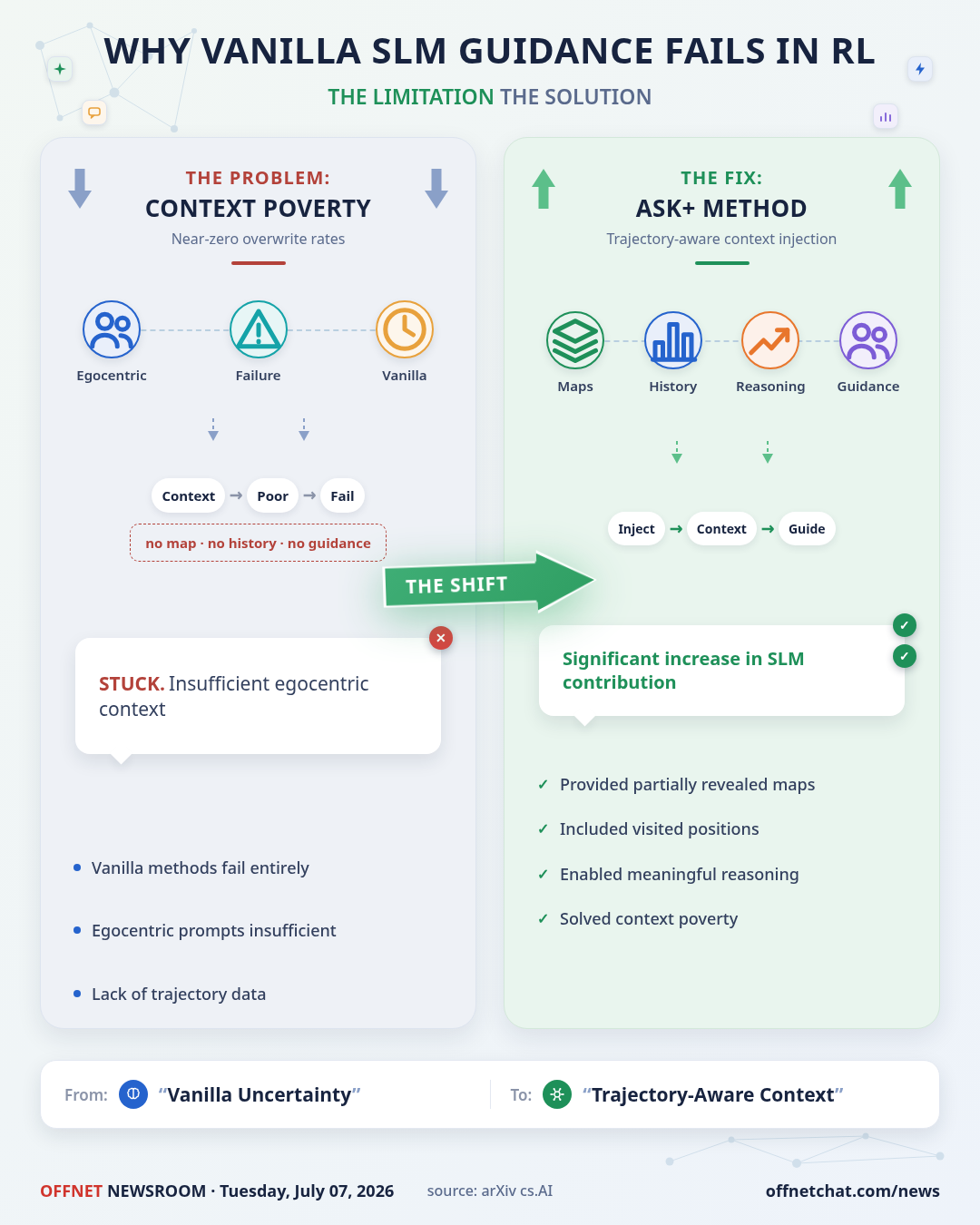
Reinforcement learning agents often fail to utilize small language models (SLMs) for assistance because vanilla uncertainty-gated approaches result in near-zero overwrite rates. This failure stems from insufficient egocentric context rather than a lack of model capacity. The proposed ASK+ method resolves this by providing SLMs with trajectory-aware context, such as partially revealed maps and visited positions, enabling meaningful reasoning and action guidance.

  • Vanilla SLM guidance in RL fails due to context poverty, not model capacity.
  • Egocentric prompts alone are insufficient for SLMs to reason effectively.
  • ASK+ injects trajectory-aware context like maps and visit history.
  • This approach significantly increases the SLM's contribution to agent actions.
CHECKLISTSolving Context Poverty in RLIdentify insufficient egocentric context as the root causeDiscard vanilla uncertainty-gated approaches for SLM guidanceInject trajectory-aware context like maps and visit historyEnable meaningful reasoning to boost SLM contribution

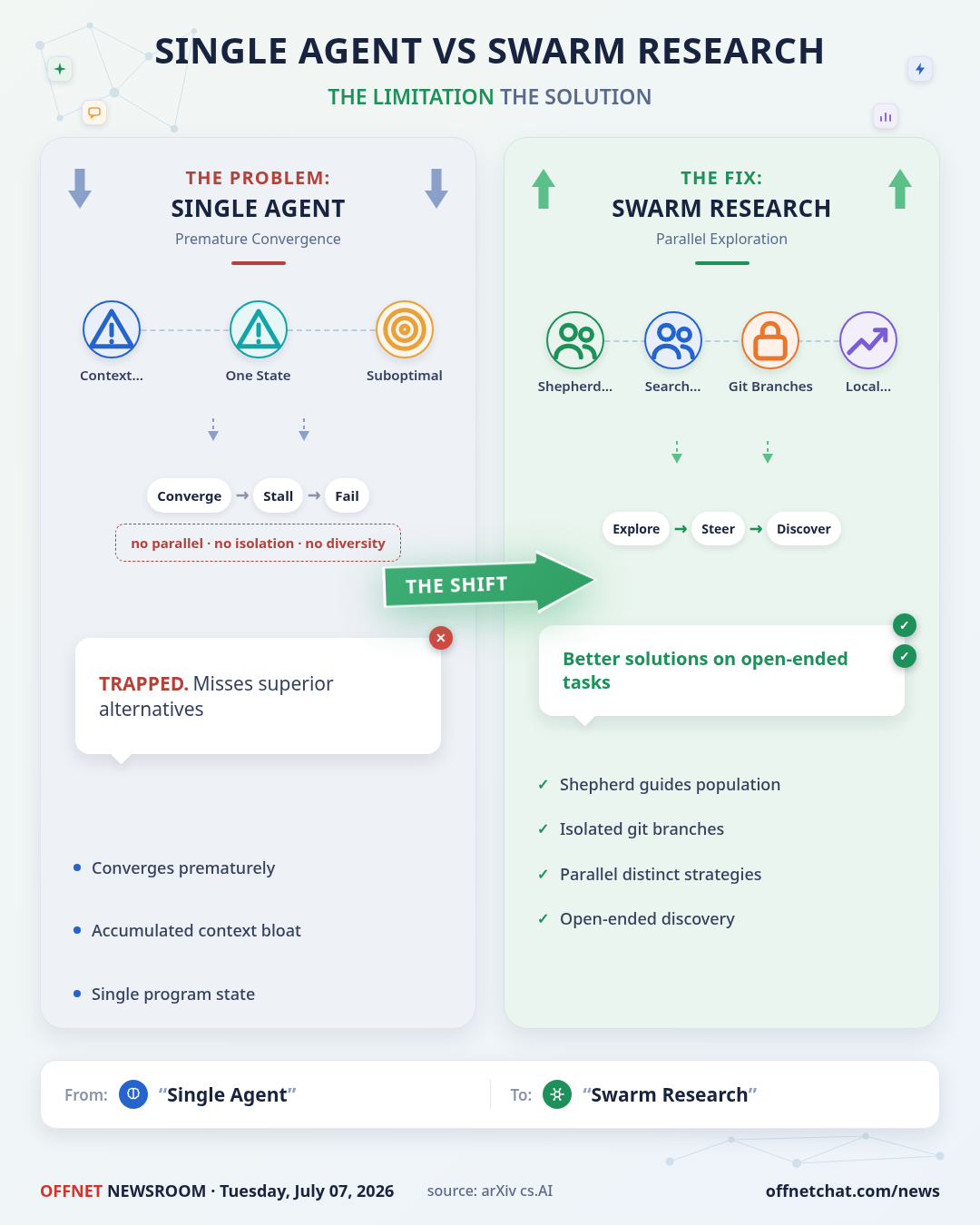
Long-running single agents often converge prematurely on one approach, missing superior alternatives due to accumulated context and a single program state. SwarmResearch addresses this by using a Shepherd Agent to guide a population of Search Agents, each maintaining local context within separate git branches. This harness enables parallel exploration of diverse optimization strategies for open-ended problems.

  • Single-agent systems risk premature convergence on suboptimal solutions due to context bloat.
  • SwarmResearch uses a Shepherd Agent to steer multiple Search Agents with isolated git branches.
  • Local context per agent allows parallel exploration of distinct optimization strategies.
  • The approach discovers better or comparable solutions on open-ended optimization tasks.
HOW IT WORKSSwarmResearch Orchestration Pipeline1Shepherd Agent guides strategy2Search Agents explore locally3Isolated git branches keep context4Best solutions converge

iFLYTEK-Embodied-Omni is a unified multimodal foundation model that jointly processes vision, language, and action within a single framework. It addresses the interface bottlenecks and error compounding found in traditional cascaded pipelines that separate world modeling from action generation. The model shares multimodal representations across its visual-language, video-generation, and action-generation components to enable more precise control over extended horizons.

  • Eliminates cascaded pipeline bottlenecks by unifying vision, language, and action prediction
  • Reduces compound prediction errors through shared multimodal representations
  • Enables precise control actions over extended horizons for general-purpose embodied agents
  • Replaces specialized modules with a single Omni framework for end-to-end reasoning
TRADE-OFFCascaded vs Unified AITraditional PipelinesSeparate vision and action modulesInterface bottlenecks…Compound error propagationiFLYTEK OmniSingle unified frameworkShared multimodal representationsPrecise extended controlvs

This paper proposes Object-Centric Environment Modeling (OCM) to solve the scalability issues of free-form textual memory in LLM agents. The approach structures experience into two linked Python codebases: object knowledge defining entities, and procedure knowledge recording interaction patterns. This allows for executable, reusable world models that improve through online, episodic learning.

  • Replaces unstructured text memory with structured, executable Python classes for better validation.
  • Separates entity definitions from interaction patterns to enhance modularity and reuse.
  • Supports online learning by updating models after each interaction episode.
  • Addresses limitations of symbolic approaches that assume simplified or local dynamics.
HOW IT WORKSOCM Learning Pipeline1Define entity objects2Record interaction patterns3Update via episodes4Reuse executable models

Researchers introduce VERITAS, a domain-agnostic framework designed to automate the replication of scientific studies using CLI coding agents. Unlike existing benchmark-specific tools, VERITAS operates as a general-purpose utility that extracts claims from papers or repositories and executes the methodology to verify results. The system dynamically resolves execution issues during the run and judges each claim against the original evidence.

  • VERITAS generalizes replication beyond narrow benchmarks by using CLI coding agents.
  • It handles both paper text and code repositories as input sources.
  • The framework autonomously resolves execution errors during methodology runs.
  • Automates claim verification to address the bottleneck of manual replication.
HOW IT WORKSVERITAS Replication Pipeline1Extract claims from papers2Execute methodology via CLI3Resolve execution errors4Judge claims against evidence

Aaron Erickson details NVIDIA’s architecture for purpose-built AI agent hierarchies, emphasizing the balance between deterministic tools and agentic discovery. The presentation highlights strategies for leveraging rare context and implementing LLM-as-a-judge test pyramids to ensure reliability. These methods aim to mitigate the paradox of choice while enabling production-grade AI systems at scale.

  • Balance deterministic tools with agentic discovery for production reliability.
  • Use LLM-as-a-judge test pyramids to validate agent behavior rigorously.
  • Leverage rare context to improve agent decision-making accuracy.
  • Design agent hierarchies to avoid the paradox of choice.
  • Focus on purpose-built architectures rather than generic AI models.
GitHub Trending (daily) githubrepos ⚠ unverified date/source

addyosmani/agent-skills: Production-grade workflows for AI coding agents

This GitHub repository packages senior engineering best practices into reusable skills for AI coding agents. It covers the full lifecycle from idea to ship, including spec, plan, build, test, review, and ship phases. The project provides eight slash commands to automatically activate the appropriate skills for each development stage.

  • Encodes senior engineer workflows and quality gates for consistent AI agent behavior.
  • Covers the complete SDLC: spec, plan, build, test, review, and ship.
  • Uses eight slash commands to trigger specific skill sets automatically.
  • Aims to standardize AI-assisted development with production-grade engineering practices.
GitHub Trending (daily) githubrepos ⚠ unverified date/source

GitHub Trending: last30days-skill aggregates multi-source AI summaries via CLI agents

The last30days-skill is an AI agent tool that researches topics across Reddit, X, YouTube, Hacker News, and Polymarket to produce grounded summaries. It functions as a search engine alternative scored by community engagement and market data rather than editorial curation. The tool supports installation via Claude Code plugins or standard npx commands for compatibility with over 50 agent hosts including Codex and Cursor.

  • Aggregates real-time sentiment from Reddit, X, HN, and Polymarket for holistic topic research.
  • Supports Claude Code, Cursor, Copilot, and Gemini CLI via standard npx or plugin install.
  • Scores information relevance by upvotes, likes, and real-money market data instead of editors.
  • Install globally with -g flag or scope per-project for flexible integration into workflows.

Automation / DevOps / IaC 8

roundup ↗
AWS What's New awsdatabase ↺ since 07-03

SageMaker Unified Studio adds Terraform IaC support for domain provisioning

Amazon SageMaker Unified Studio now allows provisioning via Terraform using the open-source terraform-aws-sagemaker-unified-studio module. This enables platform teams to integrate SageMaker domains into existing infrastructure-as-code pipelines with version-controlled templates. The update supports consistent deployment across development, staging, and production accounts for shared AI and data workflows.

  • Use the open-source terraform-aws-sagemaker-unified-studio module for provisioning
  • Integrate SageMaker Unified Studio domains into existing IaC pipelines
  • Maintain environment consistency across dev, staging, and prod accounts
  • Provision managed workspaces with version-controlled templates
  • No direct database engine changes; focus is on platform provisioning
HOW IT WORKSSageMaker IaC Provisioning Flow1Select…2Configure version-controlled templates3Deploy to dev environment4Promote to staging accounts5Launch in production accounts

AWS Certificate Manager now exposes a fully managed ACME server endpoint, allowing standard clients like Certbot and cert-manager to issue 45-day public TLS certificates from Amazon Trust Services. This feature addresses the upcoming CA/Browser Forum mandate for shorter certificate lifetimes by enabling standardized, automated issuance and renewal workflows. Administrators can enforce governance through domain scoping and wildcard policies while delegating requests to application teams.

  • Provision public TLS certs using any ACMEv2 client like Certbot or cert-manager directly from ACM.
  • Certificates issued via ACM have a 45-day validity to align with industry security trends.
  • Governance controls allow restricting domain scopes and wildcard usage per client.
  • Automates renewal processes, reducing manual overhead as 47-day limits approach in 2029.
  • Enables delegation of certificate requests to app teams without distributing private CA keys.
THE SHIFTTLS Certificate Lifespan Shrinking47-day2029 LIMIT45-dayCURRENT ACMACM aligns with industry trends early
Planet PostgreSQL database ↺ since 07-06

CloudNativePG 1.30 adds declarative roles and passwordless TLS

CloudNativePG version 1.30 introduces the DatabaseRole CRD, allowing application teams to manage PostgreSQL credentials declaratively. The release also includes built-in TLS client certificate issuance, enabling passwordless authentication. This shift reduces manual credential management and enhances security posture for cloud-native deployments.

  • DatabaseRole CRD lets apps own their credentials via Kubernetes manifests
  • Built-in TLS client certificates enable passwordless database connections
  • Reduces operational overhead by automating credential lifecycle management
  • Improves security by eliminating shared passwords in application configs

Node.js 26 is now available, bringing the Temporal API to the global scope by default and upgrading the underlying V8 engine to version 14.6. The release also includes Undici 8.0 for HTTP handling and removes several deprecated legacy APIs. Developers must account for NODE_MODULE_VERSION changes when maintaining native addons. This version will remain current for six months before transitioning to long-term support.

  • Temporal API is now enabled by default, simplifying modern date/time handling in Node.js.
  • V8 engine is updated to 14.6, potentially offering performance and feature improvements.
  • Undici HTTP client has been upgraded to version 8.0 in this release.
  • Native addons need rebuilds due to NODE_MODULE_VERSION changes.
  • This is a current release for six months before entering LTS status.
GitHub Trending (daily) githubrepos ⚠ unverified date/source

Firecrawl: Open-Source Web Scraping API for LLM Agents

Firecrawl is an open-source API designed for large-scale web search and scraping, specifically optimized for AI agents. It extracts content from JS-heavy pages and converts it into clean Markdown or structured JSON, handling infrastructure challenges like rotating proxies and rate limiting. The service claims industry-leading reliability across 96% of the web with a P95 latency of 3.4 seconds.

  • Provides LLM-ready output formats including clean Markdown and structured JSON.
  • Handles complex scraping infrastructure like rotating proxies and orchestration automatically.
  • Optimized for real-time agents with P95 latency of 3.4s across millions of pages.
  • Covers 96% of the web, including JavaScript-heavy dynamic content pages.
  • Available as both open-source software and a hosted service.
BY THE NUMBERSFirecrawl's Web Coverage96%Web coverage reliabilityCovers 96% of the web including JS-heavy pages

AWS has introduced Service Events for CloudWatch Application Signals, enabling automatic capture of exception and latency snapshots, function-level metrics, and deployment events. This feature requires no additional code changes, relying instead on existing instrumentation via ADOT SDKs or the CloudWatch Observability EKS add-on. Engineers can now rapidly diagnose whether recent deployments introduced new exceptions by navigating directly to the Errors section in the console.

  • Service Events automatically captures error and latency snapshots without code changes.
  • Deployment events are tracked alongside performance data for faster root cause analysis.
  • Requires existing instrumentation via ADOT SDKs or CloudWatch Observability EKS add-on.
  • Access captured data directly in the CloudWatch console under Service > Errors.
CHECKLISTDeploying Service EventsEnsure ADOT SDKs or EKS add-on is installedLeverage existing instrumentation without code changesMonitor error and latency snapshots automaticallyTrack deployments for faster root cause analysisAccess data in CloudWatch console under Service > Errors
AWS What's New awsdatabase ↺ since 07-03

SageMaker HyperPod adds AMI versioning and auto-patching for foundation models

Amazon SageMaker HyperPod now tracks AMI versions across clusters to detect drift and automatically applies security patches without interrupting long-running training jobs. This update removes the manual burden of patching and reduces the risk of breaking bundled software like NVIDIA drivers or CUDA during updates. The feature provides cluster administrators with clear visibility into the specific AMI versions currently in use.

  • Eliminates manual security patching for long multi-day training workloads.
  • Provides visibility into AMI versions to detect cluster drift quickly.
  • Prevents accidental breaks to bundled software like CUDA drivers during updates.
  • Reduces operational overhead for cluster administrators managing foundation models.
CHECKLISTHyperPod Patching BenefitsEliminate manual security patching for long workloadsDetect cluster drift with AMI version visibilityPrevent CUDA driver breaks during updatesReduce operational overhead for admins

The June 29, 2026 Java news cycle highlights a new JEP candidate for Strict Field Initialization, aiming to enforce initialization guarantees. Key updates include point releases for GraalVM, JReleaser, RefactorFirst, and the Java Operator SDK, alongside maintenance patches for GlassFish and Micronaut. Additionally, Grails 8.0 reached its second milestone, and Open Liberty 26.0.0.7 entered beta.

  • Strict Field Initialization JEP candidate targets safer object state management.
  • GraalVM, JReleaser, and RefactorFirst received point releases.
  • Grails 8.0 Milestone 2 is available for testing.
  • Open Liberty 26.0.0.7 beta is now live.
  • GlassFish and Micronaut got maintenance updates.

AWS 8

roundup ↗
InfoQ generaldevops ↺ since 07-06

AWS S3 Annotations enable searchable metadata without separate systems

AWS has launched S3 Annotations, allowing teams to attach rich, searchable context like summaries, classifications, and AI insights directly to objects. These annotations update independently of the underlying data and can be queried across datasets, eliminating the need for external metadata management. This feature consolidates metadata handling and improves discoverability for compliance and AI workflows.

  • Attach searchable context like summaries and AI insights directly to S3 objects
  • Annotations update independently of the object, decoupling metadata from data
  • Query annotations across datasets to replace separate metadata systems
  • Streamlines compliance tracking and AI-driven data discovery workflows
AWS Database Blog awsdatabase

Dynata cuts DB ops overhead 70% with AWS Savings Plans

Dynata shifted from managing fragmented Reserved Instances to AWS Database Savings Plans to streamline cost optimization. This consolidation reduced operational overhead by 70% and extended coverage to Amazon Aurora Serverless. The move accelerated their migration to Graviton processors while lowering overall TCO.

  • Consolidate fragmented Reserved Instances into Database Savings Plans for flexibility
  • Achieved 70% reduction in operational overhead for cost management
  • Extended cost commitments to cover Amazon Aurora Serverless workloads
  • Enabled faster infrastructure modernization to Graviton processors

Oracle shares have fallen more than 40% this month, signaling growing investor skepticism. Major financial institutions and hyperscalers are increasingly vocal about potential risks in the AI sector. The Bank for International Settlements has even suggested AI could pose broader economic threats.

  • Oracle's sharp decline reflects mounting doubts about AI valuation sustainability
  • BIS warning highlights systemic economic risks associated with current AI spending
  • Hyperscalers joining the critique suggests internal caution on ROI timelines
  • Market correction may impact cloud infrastructure procurement cycles
AWS Database Blog awsdatabase ↺ since 07-03

CRED automates Amazon RDS Blue/Green deployments at scale

CRED engineered a custom orchestration framework to manage Amazon RDS blue/green deployments across their entire database fleet. The system automates critical operations including engine upgrades, instance scaling, storage optimization, and Change Data Capture pipeline migrations. This approach has successfully maintained zero data loss and zero production incidents during these large-scale transitions.

  • Automated blue/green deployments can handle complex multi-step fleet-wide changes safely.
  • CDC pipeline migration is integrated into the deployment workflow for seamless continuity.
  • Zero data loss and zero production incidents achieved at scale using this methodology.
  • Engine upgrades and storage optimization are automated alongside instance scaling.

Cycle has introduced a dedicated control plane hosted within the European Union to address growing sovereignty concerns. This infrastructure change ensures that platform management data and telemetry remain strictly within European borders. The move aims to provide European organizations with improved compliance posture, operational isolation, and faster local responsiveness.

  • EU customers can now keep platform management data and telemetry within Europe
  • New control plane addresses data sovereignty and regulatory compliance requirements
  • Operational isolation is improved for European-based organizations
  • Local hosting aims to enhance responsiveness for EU users
Hacker News (100+ points) general

Januscape: KVM/x86 Guest-to-Host Escape via CVE-2026-53359

A new vulnerability named Januscape allows a guest VM to escape to the host system on KVM/x86 architectures. The issue is tracked as CVE-2026-53359 and has been highlighted on Hacker News with significant community attention. Details regarding the specific exploitation mechanism are available in the associated GitHub repository.

  • KVM/x86 environments face guest-to-host escape risks via CVE-2026-53359.
  • Review KVM patches and host configurations for mitigation strategies.
  • Monitor official KVM and Linux kernel updates for security fixes.
  • Assess isolation boundaries for multi-tenant cloud workloads immediately.

The UK government is overhauling planning regulations to accelerate datacenter construction by limiting the window for local objections. This change effectively reduces the time NIMBY groups have to complain by one year. The move aims to streamline approval processes and reduce delays for infrastructure projects.

  • Planning appeals window for datacenters reduced by one year
  • Regulatory overhaul targets faster infrastructure deployment
  • Local opposition timeframes tightened to speed up approvals
  • Aims to reduce bureaucratic delays in tech buildouts

Anthropic, an AI model developer that has not yet achieved profitability, has executed a 20-year lease agreement with energy company TeraWulf. The deal, valued at $19 billion, signals a long-term commitment to infrastructure capacity despite the company's current financial standing. This move underscores the intense demand for power and compute resources in the AGI development race.

  • Anthropic commits to a 20-year lease, betting on long-term infrastructure stability.
  • The $19B valuation highlights the massive capital intensity of modern AI training.
  • Unprofitable status does not deter major AI players from securing critical resources.
  • Energy partnerships like TeraWulf are becoming strategic assets for AI developers.

Oracle Ecosystem 1

roundup ↗
AWS Database Blog awsdatabase ↺ since 07-03

AWS RDS for Oracle now supports data masking via OEM

Amazon RDS for Oracle now allows the use of the Oracle Data Masking and Subsetting Pack to protect sensitive information. Users can configure and manage masking policies directly within Oracle Enterprise Manager. The update also introduces automation capabilities to streamline the masking workflow.

  • Use Oracle Data Masking and Subsetting Pack on RDS for Oracle instances.
  • Manage masking policies through Oracle Enterprise Manager (OEM).
  • Leverage new automation options to streamline data protection workflows.
HOW IT WORKSOracle Data Masking Workflow1Deploy Oracle Data Masking Pack2Configure policies in OEM3Automate protection workflows

Trending on GitHub 3

roundup ↗

GitHub initially offered to burn source code repositories onto CDs as a humorous response to Sony's physical media phase-out. The promotion was quickly retracted following widespread ridicule from the developer community. The brief campaign highlighted ongoing tensions regarding digital preservation and platform dependency.

  • GitHub withdrew the CD burning promotion after it sparked significant community backlash.
  • The move was a direct, albeit short-lived, reaction to Sony's discontinuation of physical media.
  • Developers mocked the idea, highlighting concerns about digital obsolescence and vendor lock-in.
  • No database infrastructure or cloud engineering implications identified.
GitHub Trending (daily) githubrepos ⚠ unverified date/source

Gas Town: Multi-agent orchestration with git-backed persistence

Gas Town is a workspace manager designed to coordinate multiple AI coding agents like Claude Code and GitHub Copilot. It solves context loss on restart by persisting work state via git-backed hooks. The system includes built-in mailboxes and identities to manage handoffs and scale workflows to dozens of agents.

  • Persists agent work state in git to prevent context loss on restart
  • Scales multi-agent coordination from 4 to 30+ agents reliably
  • Provides built-in mailboxes and identities for agent handoffs
  • Supports major agents including Claude Code, Copilot, and Gemini
GitHub Trending (daily) githubrepos ⚠ unverified date/source

Karakeep self-hosted bookmark app adds LLM tagging, OCR, and agent support

Karakeep, formerly Hoarder, is a self-hosted application for storing links, notes, images, and PDFs. It leverages LLMs for automatic tagging and summarization, supporting local inference via Ollama. The platform includes full-text search, OCR for image text extraction, and a rule-based engine for content management.

  • Supports local LLM inference via Ollama for private, on-prem tagging and summarization.
  • Offers OCR to extract text from stored images and PDFs for full-text searchability.
  • Provides CLI and agent-friendly interfaces for automation with tools like OpenClaw.
  • Enables collaboration through shared lists and rule-based content management workflows.
CHECKLISTKarakeep's Core CapabilitiesLocal LLM tagging via OllamaOCR for image and PDF textCLI and agent automation supportShared lists and rule workflows

Mobile friendly 6

all cards ↗

Today's top database + AI stories as save-and-share cards — built for your phone and your LinkedIn feed.