OffNet Newsroom

Archive snapshot

Monday, July 06, 2026

Daily signal on databases, AI, and the tech that matters.

14 new today 37 stories 8 sections 13 for the DBA desk

Database Technology 5

roundup ↗

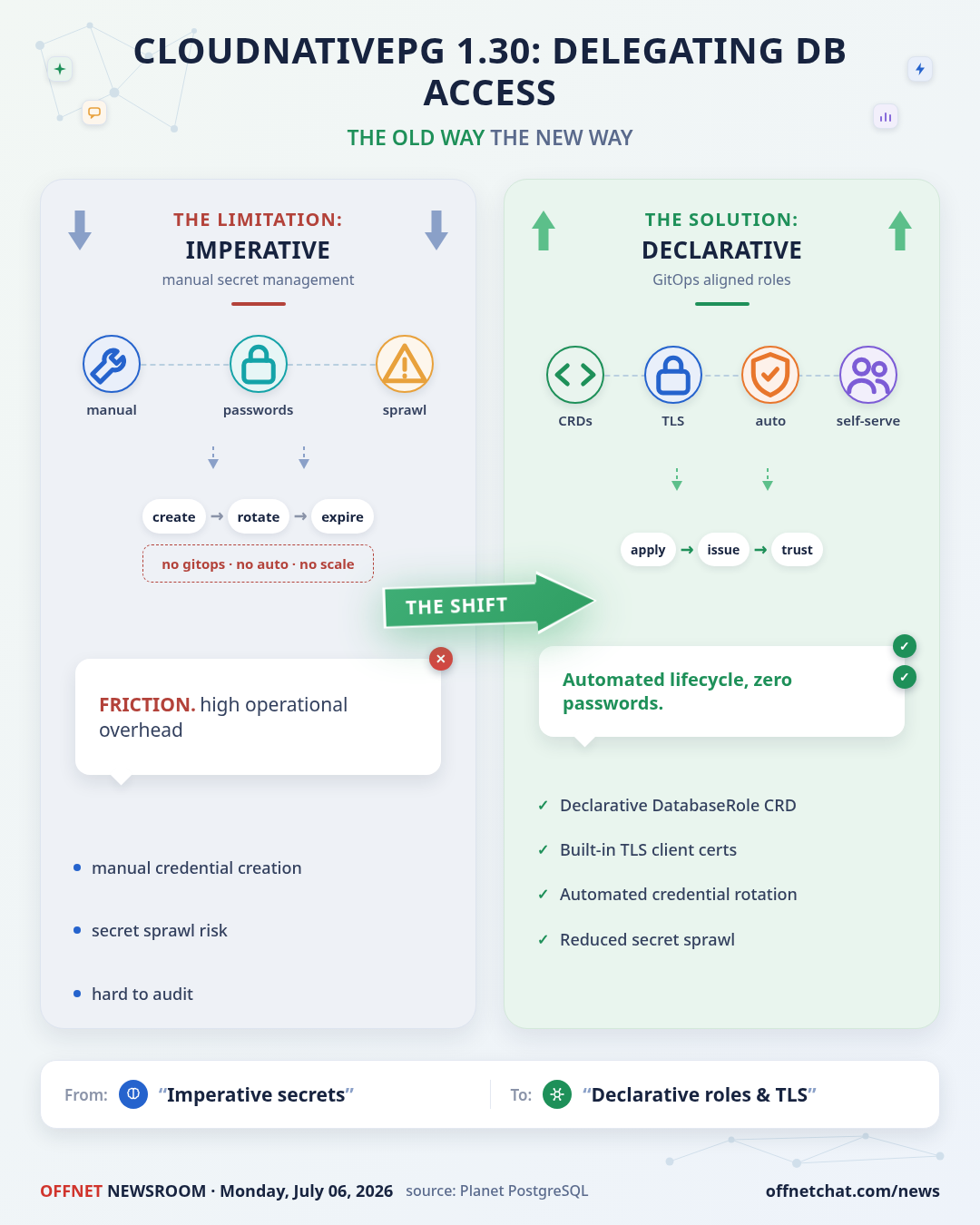
CloudNativePG 1.30 introduces the DatabaseRole CRD, enabling application teams to manage PostgreSQL credentials declaratively rather than imperatively. The release also includes built-in TLS client certificate issuance, allowing connections without password handling. This shift reduces operational friction by automating credential lifecycle management within the Kubernetes-native PostgreSQL operator.

  • Application teams can now manage DB roles via Kubernetes CRDs for better GitOps alignment.
  • Built-in TLS client certs enable passwordless authentication, reducing secret sprawl.
  • Declarative credential management simplifies onboarding and rotation for app services.
  • Operators should upgrade to 1.30 to leverage automated TLS and role provisioning.

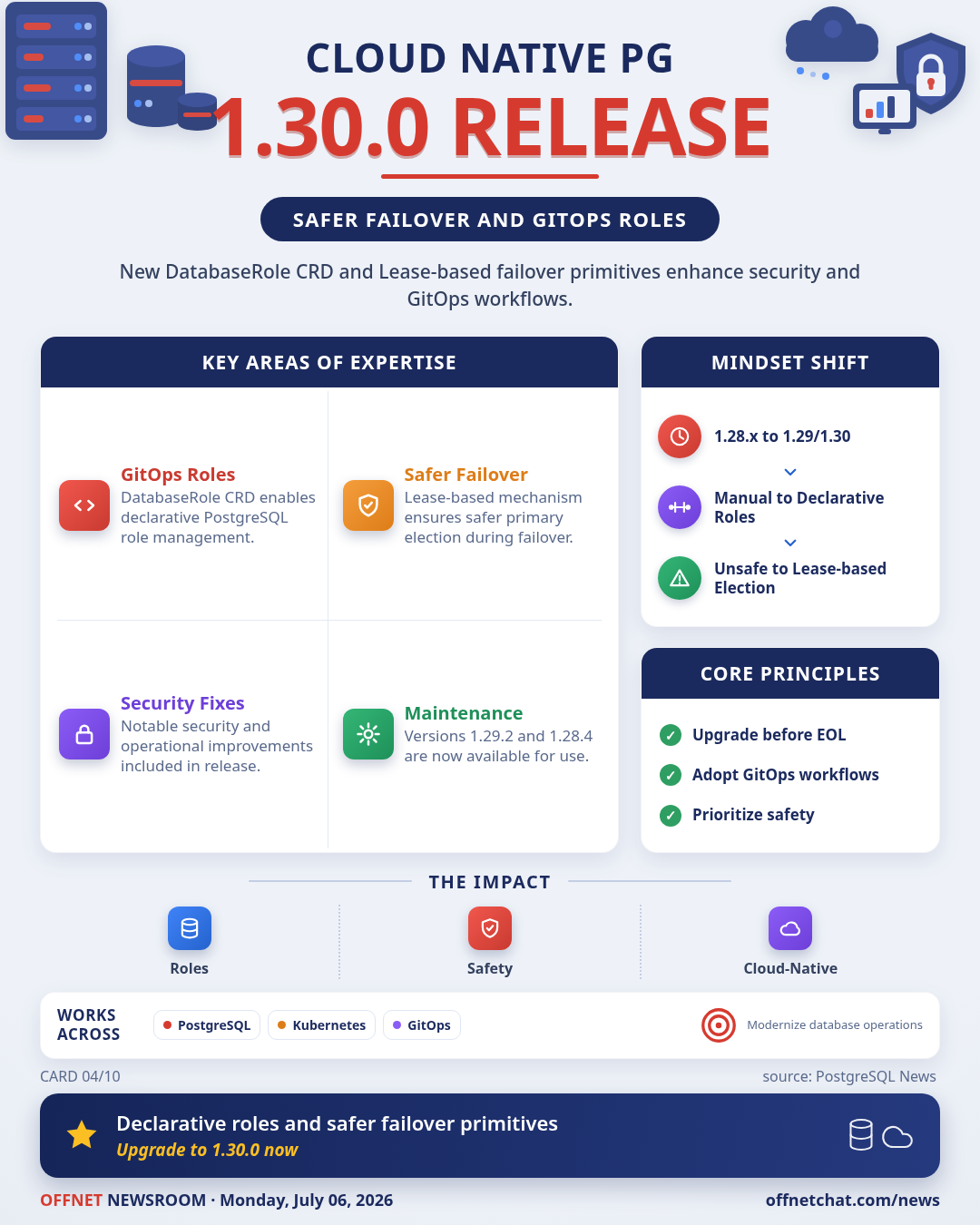
CloudNativePG 1.30.0 introduces a new DatabaseRole CRD for declarative, GitOps-style PostgreSQL role management and a Lease-based mechanism for safer primary election during failover. The release also includes notable security and operational improvements. Additionally, maintenance versions 1.29.2 and 1.28.4 are available, with 1.28.x reaching end-of-life on June 30, 2026.

  • Use DatabaseRole CRD for declarative, GitOps-friendly role management
  • Leverage Lease-based primitive for safer primary election failover
  • Upgrade from 1.28.x before EOL on June 30, 2026
  • Consider moving to 1.29 or 1.30 for latest security fixes
CHECKLISTCloudNativePG 1.30 Upgrade ActionsUse DatabaseRole CRD for GitOps role managementLeverage Lease-based mechanism for safer failoverUpgrade before 1.28.x EOL on June 30, 2026Move to 1.29 or 1.30 for security fixes

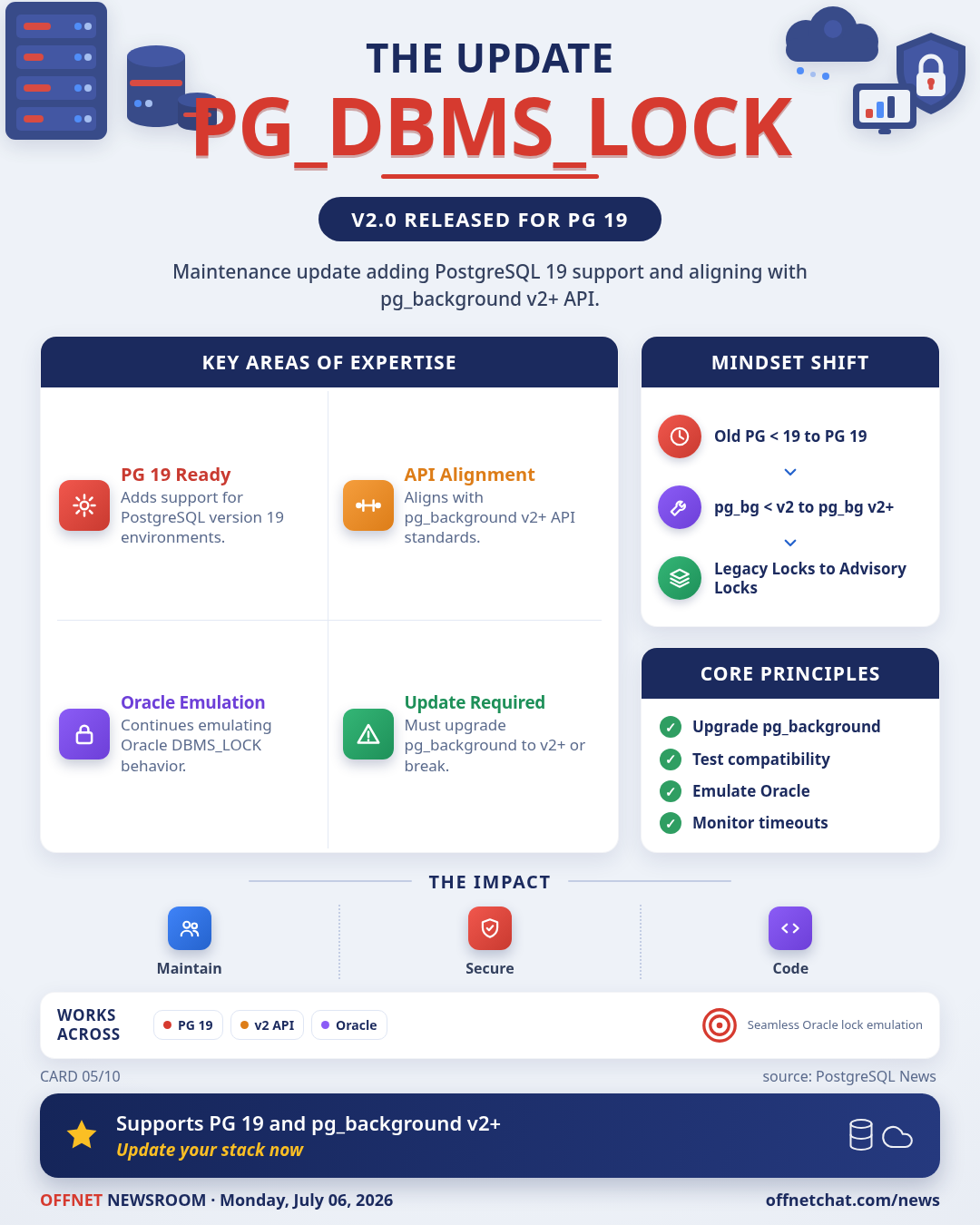
The pg_dbms_lock extension has reached version 2.0, a maintenance update that adds support for PostgreSQL 19. This release also aligns with the pg_background v2+ API, dropping support for older pg_background versions. The extension continues to emulate Oracle DBMS_LOCK behavior using PostgreSQL advisory locks, including lock modes, timeouts, and on-commit release settings.

  • Update required for PostgreSQL 19 environments using pg_dbms_lock.
  • Must upgrade pg_background to v2+ or break extension compatibility.
  • Retains Oracle DBMS_LOCK emulation for exclusive/shared locks and timeouts.
  • DBMS_LOCK.CONVERT() remains unsupported in this compatibility layer.
CHECKLISTPg_dbms_lock v2.0 Upgrade GuideUpdate for PostgreSQL 19 compatibilityUpgrade pg_background to v2 or laterRetain Oracle DBMS_LOCK emulation featuresNote: DBMS_LOCK.CONVERT() remains unsupported

The credcheck extension for PostgreSQL has reached version 5.0, offering a comprehensive suite of credential checks triggered during user creation, password changes, and renames. This release allows administrators to define strict rules such as password expiration, reuse policies, brute-force protection via failure limits, and mandatory password changes upon first login. By integrating these checks directly into the authentication lifecycle, organizations can enforce stronger security postures without relying on external tools.

  • Enforce password expiration, reuse policies, and minimum age requirements natively during user lifecycle events.
  • Mitigate brute-force attacks by defining authentication failure limits and mandatory delays before banning users.
  • Ensure compliance by forcing password changes on first login and issuing warnings before expiration.
  • Integrate credential validation directly into PostgreSQL via the extension for centralized policy management.
CHECKLISTPostgreSQL Credcheck v5.0 EnforcementEnforce password expiration and reuse policies nativelyMitigate brute-force attacks with failure limitsForce password changes on first loginIntegrate validation directly into PostgreSQL extension

LLMs 5

roundup ↗
InfoQ generaldevops ↺ since 07-03

OpenAI Agent RFT: RL for Reasoning Models via Tool Interactions

OpenAI has released Agent RFT, a platform that fine-tunes reasoning models using real-time tool interactions and custom reward signals. The approach leverages reinforcement learning to resolve complex credit assignment issues that typically arise within large context windows. Early enterprise implementations report the elimination of long-tail token loops and significant gains in operational efficiency.

  • Agent RFT enables fine-tuning of reasoning models through live tool usage rather than static datasets.
  • Custom reward signals help the model learn optimal paths by solving credit assignment problems in-context.
  • Adoption in enterprise settings has successfully reduced inefficient token loops and boosted performance.

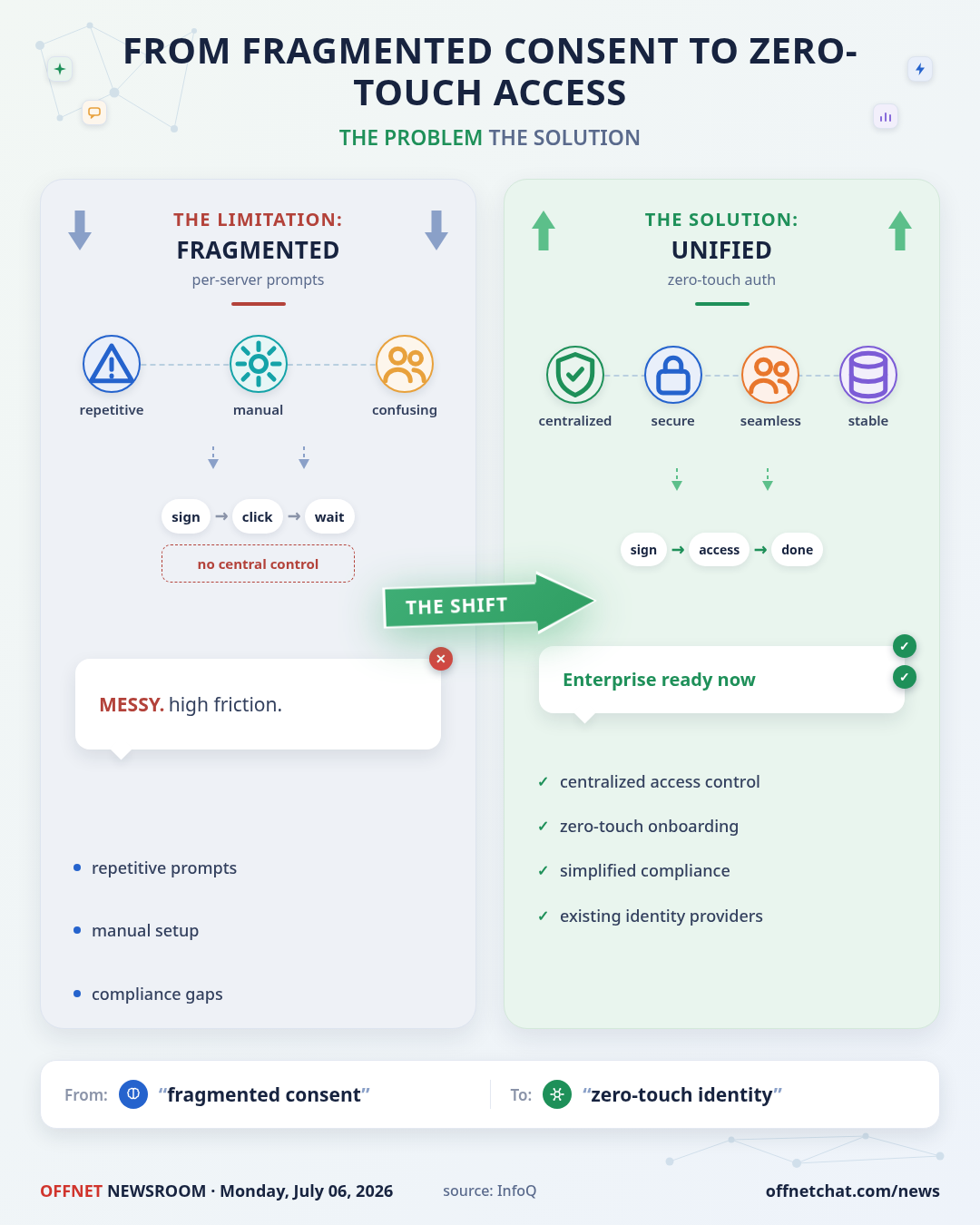
The Model Context Protocol team has stabilized the Enterprise-Managed Authorisation extension, allowing organizations to centralize access control for MCP servers via their existing identity providers. This update replaces fragmented per-server consent prompts with a unified, zero-touch authentication flow. Users sign in once and gain immediate access to approved servers without additional configuration steps.

  • MCP Enterprise Auth is now stable for production use.
  • Centralizes access control through existing identity providers.
  • Eliminates repetitive per-server consent prompts.
  • Enables zero-touch user onboarding for approved servers.
  • Simplifies enterprise compliance and access management.
AWS Database Blog awsdatabase ↺ since 07-02

AWS RDS log analysis: Natural language queries with Kiro and MCP

AWS demonstrates using Kiro, an AI conversational assistant, alongside the Model Context Protocol (MCP) server to analyze Amazon RDS logs. This approach shifts log review from manual SQL or CLI queries to natural language interactions, enabling instant retrieval of actionable insights. The integration leverages awslabs.cloudwatch-mcp-server to bridge the AI model with cloud log data.

  • Use Kiro for natural language RDS log analysis instead of manual queries.
  • Integrate awslabs.cloudwatch-mcp-server to enable MCP protocol support.
  • Transform technical log review into conversational, actionable insights.
  • Leverage AWS Database Blog case study for implementation patterns.
Planet PostgreSQL database ↺ since 07-03

Building pgEdge RAG Servers via API for Automation

Antony Pegg demonstrates provisioning a Retrieval-Augmented Generation (RAG) server on pgEdge Cloud using the API rather than the simplified UI. The guide provides concrete API calls to configure the service, emphasizing the need to manage API keys securely and avoid shell history exposure. The author uses a GURPS tabletop RPG dataset as the primary example for this setup.

  • Use the Cloud API instead of the UI for reproducible, scriptable RAG server provisioning.
  • Keep API keys out of shell history to prevent credential leakage during automated workflows.
  • Ensure your dataset is ready and accessible before initiating the API configuration calls.
  • Adapt the provided API structure to replace placeholder values with your specific environment configs.
CHECKLISTProvisioning RAG Servers SecurelyUse Cloud API for reproducible provisioningKeep API keys out of shell historyEnsure dataset is ready and accessibleAdapt API structure to your environment
The Register general ↺ since 07-04

Usage-based AI pricing baffles execs as KPMG reveals cost visibility gaps

A KPMG study shows nearly one-third of executives struggle to comprehend AI costs following an industry shift toward usage-based pricing models. Organizations are rethinking their deployment strategies as financial predictability becomes harder to maintain. The report highlights a growing disconnect between technical implementation and executive financial oversight.

  • Usage-based pricing creates cost opacity for C-suite leaders managing AI budgets.
  • 1 in 3 executives cannot accurately track or explain their AI spend.
  • Companies must overhaul financial governance to match technical deployment speed.
  • Shift from fixed contracts to variable usage demands new monitoring tools.

AI / ML 1

roundup ↗
GitHub Trending (daily) githubrepos ↺ since 07-03 ⚠ unverified date/source

Harvard CS249r Book: A Textbook for AI Engineering and MLSys

The Harvard CS249r repository serves as a comprehensive textbook for Machine Learning Systems, emphasizing the engineering aspects of building AI rather than just developing models. It covers principles for creating efficient, reliable, and robust intelligent systems that function in real-world environments. The material includes multiple volumes, labs, and a custom framework called TinyTorch, with a hardcopy edition scheduled for 2026.

  • Focuses on AI engineering as a distinct discipline alongside software and computer engineering.
  • Provides end-to-end guidance on designing, building, and evaluating intelligent systems.
  • Includes practical resources like labs and the TinyTorch framework for hands-on learning.
  • Aims to bridge the gap between isolated ML models and production-ready AI systems.

Agentic AI 8

roundup ↗
AWS What's New awsdatabase ↺ since 07-02

Amazon Bedrock AgentCore raises default runtime quotas for high-throughput AI agents

AWS has increased the default runtime quota limits for Amazon Bedrock AgentCore to support larger-scale agent workloads. The update allows up to 5,000 active concurrent sessions in US East (N. Virginia) and US West (Oregon), while other regions support 2,500. Across all available regions, the service now handles 200 agent interactions per second and 25 new session creations per second by default.

  • US East and West regions now support 5,000 active concurrent sessions by default.
  • All other supported regions support 2,500 active concurrent sessions by default.
  • Global throughput limit is 200 agent interactions per second across all regions.
  • New session creation rate is capped at 25 per second in all regions.
  • Higher default limits reduce the need to request quota increases for high-scale agents.
COMPARISONBedrock AgentCore Default LimitsUS East/West Sessions5000Other Regions Sessions2500Interactions Per Second200New Sessions Per Second25
InfoQ generaldevops ↺ since 07-03

Google Releases A2UI v0.9 for Framework-Agnostic Generative UI

Google has launched A2UI v0.9, a specification allowing AI agents to declare UI intent without executing arbitrary code. The release introduces a Python SDK, enhanced error handling, and multiple transport methods to support cross-platform deployment. It emphasizes alignment with existing design systems and provides migration guidance for developers.

  • A2UI v0.9 enables AI agents to define UI intent across platforms safely.
  • New Python SDK and improved error handling simplify integration.
  • Multiple transport methods support flexible deployment strategies.
  • Specs align with existing design systems to reduce friction.
GitHub Trending (daily) githubrepos ↺ since 07-04 ⚠ unverified date/source

OpenAI releases Codex plugin for Claude Code integration

OpenAI has published a plugin enabling Claude Code users to invoke Codex directly within their existing workflow. The integration supports commands for standard reviews, adversarial challenges, and task delegation with background job management. Users with a ChatGPT subscription or OpenAI API key can install it via the marketplace to leverage Codex capabilities without leaving the Claude Code environment.

  • Enables direct Codex invocation from within Claude Code workflows.
  • Supports /codex:review and /codex:adversarial-review commands.
  • Allows task delegation via /codex:transfer and /codex:rescue.
  • Requires ChatGPT subscription or OpenAI API key for access.
  • Consumes Codex usage limits associated with the user's account.
HOW IT WORKSCodex Integration Workflow1Install plugin in Claude Code2Invoke /codex:review command3Delegate via /codex:transfer4Manage background jobs5Rescue tasks with /codex:rescue
GitHub Trending (daily) githubrepos ↺ since 07-02 ⚠ unverified date/source

herdr: Rust-based terminal multiplexer for concurrent AI coding agents

herdr is a local Rust binary that acts as an agent multiplexer, allowing engineers to run multiple coding agents within a single terminal session. It provides real, native terminal instances for each agent, ensuring full compatibility with TUIs and screen rendering. The tool supports remote execution via SSH, enabling persistent agent workspaces that survive local disconnects and can be reattached from mobile or other devices.

  • Run multiple AI agents concurrently in one terminal without GUI wrappers or Electron overhead.
  • Native terminal emulation ensures full-screen TUIs render correctly for each agent instance.
  • SSH-based reattachment allows agents to persist on remote servers when the local laptop closes.
  • Single Rust binary dependency with no telemetry, accounts, or platform-specific restrictions.
AWS What's New awsdatabase ↺ since 07-03

Amazon Bedrock AgentCore expands to Bangkok, Malaysia, Milan, and Spain

AWS has expanded Amazon Bedrock AgentCore availability to four new regions: Asia Pacific (Bangkok), Asia Pacific (Malaysia), Europe (Milan), and Europe (Spain). This platform enables engineers to build, connect, and optimize AI agents using any framework or model while enforcing security at the infrastructure layer. The expansion allows customers to run agents closer to end users, reducing latency while maintaining capabilities like identity management, tool connectivity, and observability.

  • New regions support lower-latency agent deployment for users in Southeast Asia and Southern Europe.
  • All core capabilities including runtime, policy management, and observability are available at launch.
  • Security is enforced at the infrastructure layer, preventing agents from bypassing access controls.
  • Engineers can connect agents to enterprise systems and optimize them continuously across these regions.
TRADE-OFFAgentCore Regional BenefitsPre-Expansion LatencyHigher response timesDistant server accessUser experience delaysNew RegionsBangkok and MalaysiaMilan and SpainLower latency globallyvs

InfoQ publishes a new eMag positioning agentic AI as a distinct software architecture set to dominate the industry. The collection features expert contributions detailing the specific elements and aspects that define this emerging paradigm. It aims to capture the latest trends and developments as agentic systems move into the mainstream.

  • Agentic AI is framed as a new, dominant software architecture type, not just a library or tool
  • The eMag consolidates expert views on the structural components of agentic systems
  • Focus is on mainstream adoption trends and the evolution of architectural patterns
  • Provides a high-level overview rather than deep implementation code for engineers
GitHub Trending (daily) githubrepos ⚠ unverified date/source

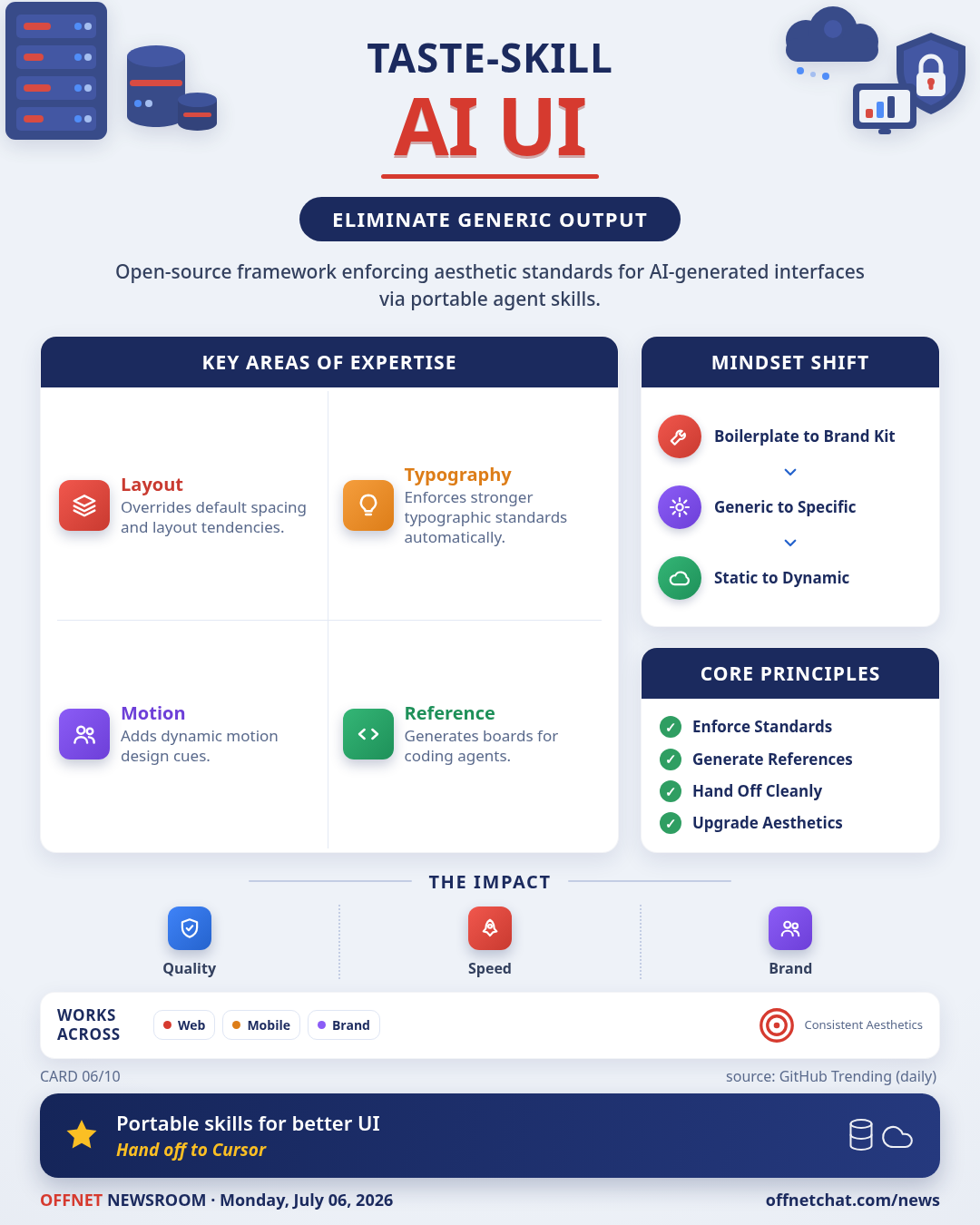
Taste-Skill: AI Agent Framework to Eliminate Generic UI Output

Taste-Skill is an open-source framework designed to improve the aesthetic quality of AI-generated user interfaces. It provides portable agent skills that enforce stronger layout, typography, motion, and spacing standards to prevent boilerplate-looking designs. The tool supports generating reference boards for web, mobile, and brand kits, which can then be handed off to coding agents like Cursor or Claude Code for implementation.

  • Provides specific agent skills to override default AI tendencies toward generic, boring UI designs.
  • Integrates with existing coding agents like Cursor, Claude Code, and Codex via reference frames.
  • Includes image-generation capabilities for creating web, mobile, and brand kit reference boards.
  • Focuses on non-functional aesthetics like spacing and typography to upgrade interface quality.
GitHub Trending (daily) githubrepos ⚠ unverified date/source

Planning-with-files v3 adds crash-proof MD plans and completion gates for AI agents

This GitHub project implements persistent file-based planning for AI coding agents using markdown files on disk. Version 3.0 introduces opt-in autonomous modes and a deterministic completion gate that prevents premature termination. It aims to solve context loss issues by maintaining task, findings, and progress state across agent resets.

  • Skips context window limits by persisting planning state to disk files.
  • New v3.0 completion gate ensures agents finish plans before stopping.
  • Compatible with 60+ agents via the SKILL.md standard interface.
  • Reduces hallucination risk by grounding decisions in explicit markdown plans.
BY THE NUMBERSPlanning with Files v360+Compatible AI coding agentsUses SKILL.md standard interface

Automation / DevOps / IaC 5

roundup ↗
AWS What's New awsdatabase ↺ since 07-03

SageMaker Unified Studio adds Terraform provisioning support

Amazon SageMaker Unified Studio now supports infrastructure-as-code via Terraform, allowing teams to deploy domains using the terraform-aws-sagemaker-unified-studio module. This enables platform teams to integrate the unified AI development environment into existing CI/CD pipelines with version-controlled templates. The update ensures consistent workspace governance across development, staging, and production accounts.

  • Deploy SageMaker Unified Studio domains using open-source Terraform modules for IaC consistency.
  • Integrate AI workspace provisioning into existing infrastructure-as-code pipelines seamlessly.
  • Maintain uniform access governance and catalog controls across multiple AWS accounts.
CHECKLISTSteps for IaC IntegrationUse open-source Terraform modules for consistencyIntegrate provisioning into existing CI/CD pipelinesMaintain uniform governance across AWS accounts
GitHub Trending (daily) githubrepos ↺ since 07-03 ⚠ unverified date/source

Strix: Autonomous AI Agent for Dynamic App Penetration Testing

Strix is an open-source AI penetration testing tool that deploys autonomous agents to dynamically execute code and identify vulnerabilities. Unlike static analysis, it validates findings through actual proofs-of-concept to reduce false positives. The tool integrates directly into GitHub Actions and CI/CD pipelines to block insecure code before production deployment.

  • Autonomous AI agents mimic real hackers by running code dynamically to find and validate vulnerabilities.
  • Reduces false positives compared to traditional static analysis tools through proof-of-concept validation.
  • Seamless CI/CD integration allows automatic scanning on every pull request without extra setup.
  • Designed to help developers and security teams perform fast, accurate security testing.
  • Blocks insecure code before it reaches production by integrating directly into GitHub Actions.
AWS What's New awsdatabase ↺ since 07-03

SageMaker HyperPod adds AMI versioning and auto-patching

Amazon SageMaker HyperPod now provides visibility into the AMI versions deployed across training clusters and automates security patching. This eliminates the previous manual, reactive process that risked disrupting long-running foundation model jobs or altering critical bundled software like NVIDIA drivers. The update ensures cluster consistency and security without requiring operator intervention during sensitive workloads.

  • Gain visibility into AMI versions across HyperPod clusters to detect drift quickly.
  • Auto-patching applies security updates without disrupting multi-day training jobs.
  • Reduces operational burden by removing manual patching workflows.
  • Protects bundled software integrity, such as CUDA and NVIDIA drivers.
CHECKLISTHyperPod Security TakeawaysGain visibility into AMI versions across clustersAuto-patch without disrupting multi-day training jobsReduce operational burden by removing manual workflowsProtect bundled software integrity like NVIDIA drivers
InfoQ generaldevops ↺ since 07-04

OpenTelemetry Graduates to CNCF Highest Maturity Level

The CNCF has elevated OpenTelemetry to its highest maturity tier, formally certifying the project as production-ready for enterprise deployment. This graduation marks a significant milestone in the observability landscape, signaling broad industry acceptance and stability. The move simplifies adoption decisions for organizations evaluating telemetry standards.

  • OpenTelemetry is now CNCF's highest maturity project, confirming enterprise readiness.
  • Graduation reduces vendor lock-in risk by standardizing signals across providers.
  • Organizations can now treat OTel as the default standard for observability stacks.
  • Adoption barriers lower as the project gains formal CNCF stability assurance.

Amazon ECS now allows customization of deployment circuit breaker settings to control when a service deployment fails and triggers an automatic rollback. Users can define failure thresholds using either a fixed task count or a percentage of the desired task count. The feature also supports choosing between consecutive failure models to better align with specific application startup behaviors and failure tolerances.

  • Customize rollback triggers using fixed task failure counts or percentages of desired tasks.
  • Select consecutive failure counting models to match specific application startup patterns.
  • Reduce manual intervention by automating rollbacks based on tailored failure thresholds.
  • Improve deployment reliability by aligning circuit breaker logic with environment tolerance.
CHECKLISTECS Circuit Breaker SetupDefine rollback triggers via task counts or percentagesSelect consecutive failure models for startup patternsAutomate rollbacks to reduce manual interventionAlign thresholds with environment failure tolerance

AWS 6

roundup ↗
AWS Database Blog awsdatabase ↺ since 07-03

CRED automates Amazon RDS Blue/Green Deployments at scale

CRED constructed an automated orchestration layer around Amazon RDS Blue/Green Deployments to manage engine upgrades, instance scaling, and storage optimization across its entire database fleet. The system also handles the migration of Change Data Capture (CDC) pipelines during these transitions. This approach has resulted in zero data loss and zero production incidents since implementation.

  • Automated orchestration reduces risk for engine upgrades and scaling events
  • Blue/Green Deployments enable seamless CDC pipeline migration without downtime
  • Storage optimization is integrated into the deployment workflow
  • Zero data loss and zero production incidents achieved at scale
InfoQ generaldevops ↺ since 07-05

Claude GA on Foundry Blocked in Europe Due to Missing Data Zone

Anthropic’s Claude models have reached general availability on Microsoft Foundry with native Azure billing and governance features. However, the service lacks a dedicated European data zone, meaning data residency guarantees do not apply here unlike in Bedrock or Vertex AI. Consequently, European enterprises in regulated sectors like banking and healthcare cannot currently deploy it in production.

  • Claude is GA on Foundry but lacks EU data residency support.
  • Azure-native billing and governance are available globally.
  • EU banking and healthcare sectors cannot use it in production.
  • Data guarantees apply to Bedrock/Vertex, not Foundry in EU.
AWS Database Blog awsdatabase ↺ since 07-02

AWS Centralizes RDS and Aurora Monitoring Across Accounts and Regions

AWS introduced cross-account and cross-Region monitoring capabilities for Amazon RDS and Aurora using CloudWatch Database Insights. This feature allows organizations to configure a single centralized monitoring account that aggregates visibility from databases distributed across multiple AWS accounts and geographic Regions. The update simplifies fleet-wide observability for complex, multi-account infrastructure deployments.

  • Enable centralized visibility for RDS and Aurora across multiple AWS accounts and Regions.
  • Use CloudWatch Database Insights to aggregate metrics into a single monitoring account.
  • Simplify fleet-wide observability for distributed database infrastructure.
  • Reduce operational overhead by consolidating monitoring into one central location.
AWS What's New awsdatabase ↺ since 07-03

Amazon EKS adds 7-day Kubernetes minor version rollback

Amazon EKS now allows operators to revert to the previous Kubernetes minor version within seven days of an upgrade. The service performs automated readiness checks covering API compatibility, add-ons, and cluster health before executing the rollback. For EKS Auto Mode clusters, the system automatically manages worker node downgrades prior to reverting the control plane. Rollbacks can be triggered via the console, AWS CLI, or SDKs.

  • Provides a 7-day safety window to revert Kubernetes minor version upgrades in EKS.
  • Automated readiness checks validate API compatibility, version skew, and add-on status before rollback.
  • EKS Auto Mode handles worker node downgrades automatically before control plane reversion.
  • Initiate rollbacks using the EKS console, AWS CLI, or AWS SDKs.
BY THE NUMBERSSeven Day Safety Window7Days to rollback EKS upgradesRevert minor versions within one week

AWS has launched Amazon S3 Annotations, allowing teams to attach rich, searchable metadata like summaries, compliance tags, and AI insights directly to objects. These annotations are managed independently of the underlying S3 object data, enabling updates without modifying the object itself. This capability allows for cross-dataset querying of context, potentially eliminating the need for external metadata management platforms.

  • Annotations decouple searchable context from the S3 object data itself.
  • Supports summaries, classifications, compliance data, and AI-generated insights.
  • Enables querying context across multiple datasets without external systems.
  • May reduce operational overhead by removing separate metadata infrastructure.
AWS What's New awsdatabase ↺ since 07-03

Amazon ECS Express Mode now accepts custom task definitions

AWS has extended ECS Express Mode to support custom task definitions, allowing users to apply the service's automated infrastructure management to existing application configurations. This update enables the reuse of task definitions from current CI/CD pipelines and IaC workflows without sacrificing the simplified deployment features like auto-scaling and load balancing. The change bridges the gap between rapid Express Mode deployments and complex operational requirements for containerized workloads.

  • Custom task definitions are now valid inputs for ECS Express Mode deployments
  • Retain existing CI/CD and IaC task definitions while using Express automation
  • Gain automatic load balancing, networking, and scaling for custom apps
  • Simplifies deployment of containerized web apps and APIs with advanced configs
CHECKLISTMigrate to Express ModeReuse existing custom task definitionsMaintain current CI/CD and IaC workflowsEnable automatic load balancingActivate auto-scaling for containersSimplify complex web app deployment

Oracle Ecosystem 2

roundup ↗
AWS Database Blog awsdatabase ↺ since 07-03

AWS RDS for Oracle now supports Data Masking and Subsetting Pack via OEM

Amazon RDS for Oracle now integrates with the Oracle Data Masking and Subsetting Pack, enabling secure data handling for non-production environments. The update allows users to configure masking policies directly through Oracle Enterprise Manager (OEM) and provides automation capabilities for routine data sanitization tasks. This feature helps organizations reduce compliance risks by ensuring sensitive information is obscured in lower-tier instances.

  • Masking is managed via Oracle Enterprise Manager (OEM) interface for RDS instances.
  • Supports both masking and subsetting to optimize storage and performance.
  • Automation options available for scheduling regular data sanitization jobs.
  • Helps meet regulatory requirements for PII and sensitive data protection.
  • Simplifies setup compared to legacy manual masking scripts.
TRADE-OFFLegacy vs New Data HandlingLegacy ApproachManual scripting requiredHigh error riskTime consuming setupNew OEM IntegrationAutomated masking jobsCentralized managementReduced compliance riskvs
InfoQ generaldevops ↺ since 07-03

Oracle Cuts Always Free Ampere A1 Limits to 2 OCPUs, 12GB RAM

Oracle has silently reduced the Always Free Ampere A1 compute quota from 4 OCPUs and 24 GB RAM to 2 OCPUs and 12 GB RAM. The change was implemented without public announcement, leaving many users unaware of the downgrade. Documentation claims the new limits apply to all tenancies, while support staff have provided conflicting information regarding PAYG accounts.

  • Always Free Ampere A1 instances are now capped at 2 OCPUs and 12 GB RAM.
  • Oracle made this significant reduction without prior notice or public communication.
  • Documentation conflicts with support guidance on whether PAYG accounts are affected.
  • Review current free-tier workloads for immediate capacity constraints.

Trending on GitHub 5

roundup ↗

pg-cdc is a single-binary tool that reads Postgres Write Ahead Logs and writes typed, immutable Parquet files to AWS S3 in Iceberg format. It integrates with AWS Glue for metadata and enforces access control via Lake Formation tags, ensuring consumers never need database credentials. The architecture is strictly one-way, preventing any data from flowing back to the production database, which isolates analytics workloads from the source system.

  • Single binary implementation with no JVM dependency reduces deployment overhead.
  • One-way WAL stream guarantees analytics agents cannot modify production data.
  • Lake Formation tags govern access, removing the need for DB credentials.
  • Iceberg tables on S3 enable time-travel queries and immutable storage.
HOW IT WORKSOne-Way Data Pipeline1Read Postgres WAL2Convert to Parquet3Write Iceberg Tables4Store on S3
GitHub Trending (daily) githubrepos ⚠ unverified date/source

Meetily: Local Rust AI Meeting Assistant with Parakeet Transcription

Meetily is an open-source, self-hosted AI meeting assistant built in Rust that processes audio entirely on local infrastructure. It leverages a 4x faster Parakeet/Whisper model for live transcription and speaker diarization, while using Ollama for summarization. The tool is designed for enterprises requiring data sovereignty, offering macOS and Windows support without cloud dependencies.

  • Rust-based architecture ensures high performance for real-time audio processing tasks.
  • Parakeet/Whisper integration delivers significantly faster live transcription speeds.
  • Ollama handles summarization locally, maintaining strict data privacy and sovereignty.
  • Fully self-hosted solution suitable for enterprise compliance and secure environments.
BY THE NUMBERSLocal AI Meeting Assistant4xFaster local transcription speedParakeet model outperforms standard Whisper
GitHub Trending (daily) githubrepos ⚠ unverified date/source

Repo aggregates leaked system prompts for Claude, GPT, and Gemini models

The asgeirtj/system_prompts_leaks repository catalogs extracted system instructions for major AI models including Anthropic's Claude series, OpenAI's GPT variants, and Google's Gemini. It highlights specific version changes, such as the transition from Claude Opus 4.8 to Fable 5, and includes prompts for developer tools like Cursor and VS Code. The collection serves as a reference for understanding the hidden rules governing these AI interactions.

  • Provides raw system prompt text for top-tier models (Claude, GPT, Gemini).
  • Tracks version diffs to identify instruction changes between model releases.
  • Includes prompts for developer tools like Cursor and VS Code Copilot.
  • Useful for prompt engineering and understanding model constraints.
  • Aggregates data from multiple vendors into a single searchable repo.
THE SHIFTClaude Model Version Shift4.8CLAUDE OPUS VERSION5FABLE MODELTracking major instruction changes
GitHub Trending (daily) githubrepos ⚠ unverified date/source

Open-source library of 350+ skills for Claude Code and other AI agents

The alirezarezvani/claude-skills repository aggregates over 350 production-ready skills, plugins, and agent configurations for Claude Code, Codex, Gemini CLI, and Cursor. It covers diverse domains including engineering, DevOps, compliance, and business operations, offering reusable expertise packages. The project positions itself as a comprehensive open-source library designed to extend the capabilities of multiple coding agents beyond basic coding tasks.

  • Covers 13+ AI coding tools including Claude Code, Codex, and Cursor.
  • Includes skills for non-coding roles like marketing, finance, and compliance.
  • Features 30+ agents and 70+ custom commands for extended functionality.
  • Provides reusable expertise packages to standardize agent workflows.
GitHub Trending (daily) githubrepos ↺ since 07-05 ⚠ unverified date/source

dotnet/skills: Curated Agent Skills for .NET AI Coding

The .NET team has released a curated repository of agent skills designed to assist AI coding agents with C# and .NET development. It includes plugins for language server integration, data access via Entity Framework, performance diagnostics, and MSBuild tasks, following the agentskills.io standard. The project provides a dashboard to track accuracy and efficiency trends for these contained plugins.

  • Integrates LSP skills directly into AI coding agents for better C# context awareness.
  • Offers specialized plugins for EF data access, diagnostics, and MSBuild operations.
  • Follows the agentskills.io standard for interoperable AI agent capabilities.
  • Provides a public dashboard to monitor plugin accuracy and efficiency metrics.
CHECKLISTKey .NET Agent Skills FeaturesIntegrate LSP skills for C# contextUse plugins for EF data accessLeverage diagnostics and MSBuild tasksFollow agentskills.io interoperability standardMonitor metrics via public dashboard

Mobile friendly 6

all cards ↗

Today's top database + AI stories as save-and-share cards — built for your phone and your LinkedIn feed.