OffNet Newsroom

Archive snapshot

Sunday, July 05, 2026

Daily signal on databases, AI, and the tech that matters.

10 new today 37 stories 7 sections 10 for the DBA desk

Database Technology 6

roundup ↗

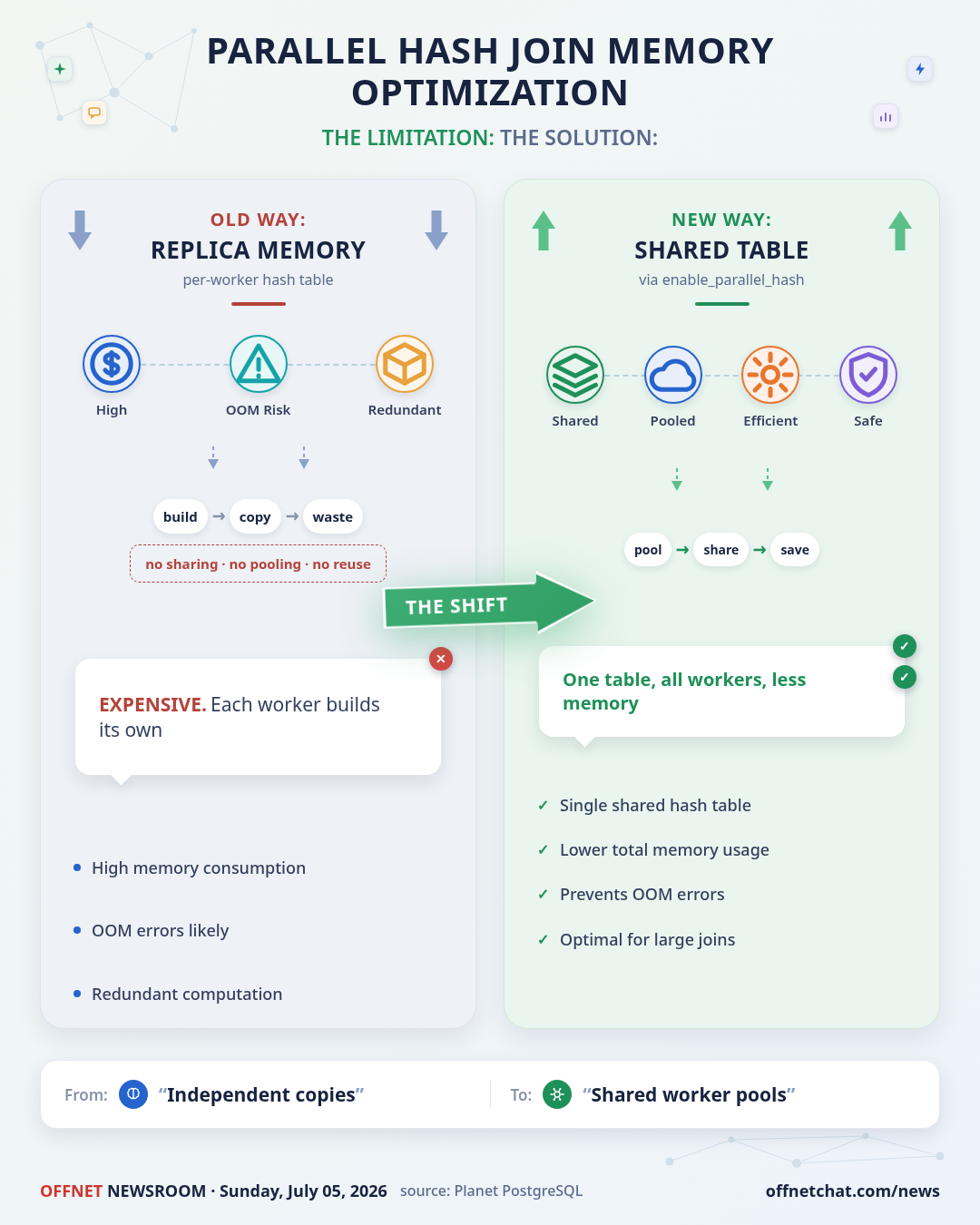
The enable_parallel_hash GUC allows parallel hash join workers to pool their memory to build a single shared hash table instead of each worker constructing its own independent copy. This architectural shift significantly lowers total memory consumption during parallel query execution. The optimization is particularly impactful for workloads that previously suffered from memory exhaustion due to redundant hash table creation across multiple workers.

  • Reduces total memory usage by sharing one hash table across all parallel workers
  • Prevents OOM errors in memory-constrained parallel hash join operations
  • Check enable_parallel_hash setting to ensure optimal memory utilization
  • Benefit is most pronounced in large-table joins with high parallelism degrees
Planet PostgreSQL database ↺ since 07-02

Recovering PostgreSQL Tables from Full Ransomware Attack Using PDU Dropscan

A field report details the recovery of core PostgreSQL tables after ransomware encrypted all database files and rendered system catalogs unusable. With only test-environment DDL available, the team adapted the PDU dropscan utility to match individual table files against known structures. This process allowed for the extraction of critical data directly from the raw file fragments.

  • System catalogs being unusable requires bypassing standard recovery tools.
  • PDU dropscan can be adapted to parse raw table files by structure.
  • Test-environment DDL is essential for mapping raw data to tables.
  • Full-file encryption necessitates low-level file scanning techniques.
The Register general ↺ since 07-04

Databricks Unifies OLTP and OLAP With Debatable Marketing Pitch

Databricks is pushing an LTAP architecture that attempts to merge online transactional and analytical processing workloads. The company relies on specific engineering choices to present this as a unified platform, though the definition of data consistency is under scrutiny. The approach suggests a shift in how data lakes can handle real-time updates alongside batch analytics.

  • Databricks claims to merge OLTP and OLAP via LTAP architecture
  • Engineering behind the scenes supports real-time data consistency
  • Marketing pitch questions the true definition of a single copy
  • Practitioners should evaluate if LTAP fits current hybrid workloads

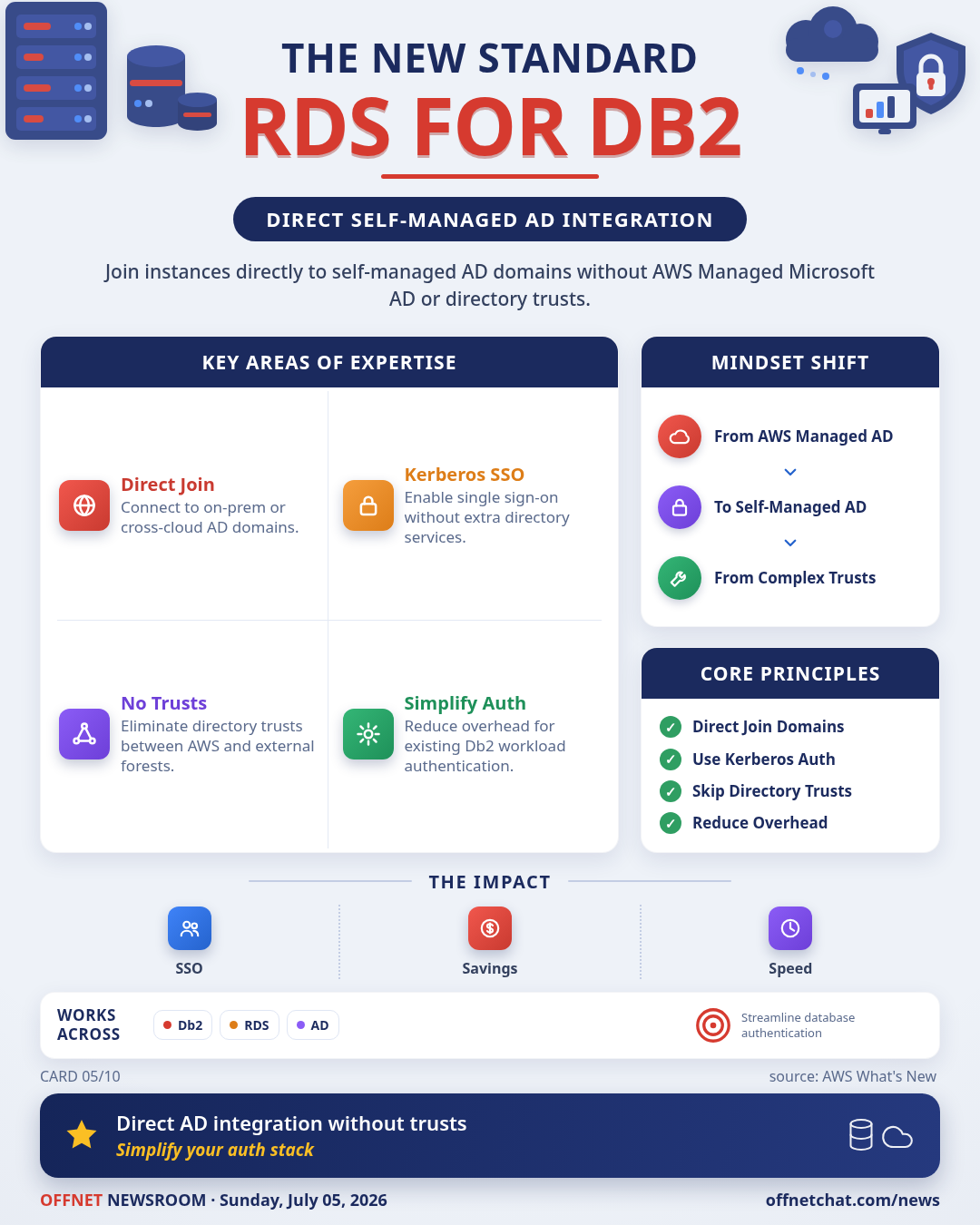
Amazon RDS for Db2 now allows direct joining of database instances to self-managed Microsoft Active Directory domains hosted on-premises or in other clouds. This update enables Kerberos-based single sign-on without requiring AWS Managed Microsoft AD or establishing directory trusts. The change eliminates the overhead of managing a separate managed directory service for authentication.

  • Join RDS for Db2 instances directly to on-prem or cross-cloud self-managed AD domains
  • Use Kerberos for SSO without deploying AWS Managed Microsoft AD
  • Remove the need for directory trusts between AWS and external AD forests
  • Simplify authentication architecture for existing Db2 workloads on RDS

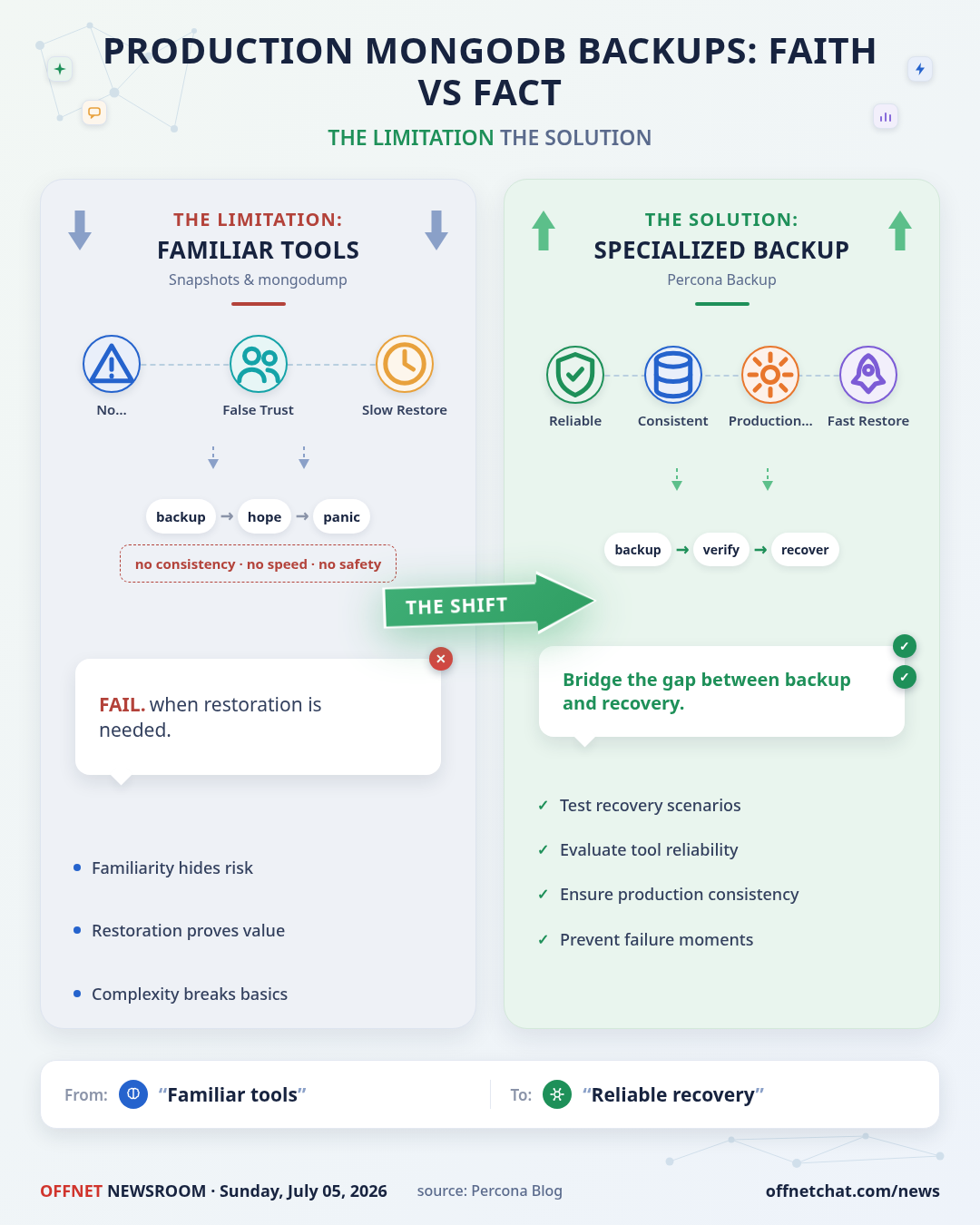
Percona argues that production MongoDB backups require more than familiar tools like volume snapshots or mongodump, which often fail when restoration is actually needed. The provider positions Percona Backup for MongoDB as a specialized solution designed to bridge the gap between basic backup strategies and reliable recovery. This approach aims to prevent the visibility of poor backup practices during critical failure moments.

  • Volume snapshots and mongodump lack reliability guarantees for complex production MongoDB environments.
  • Backup strategy effectiveness is only proven during actual restoration attempts.
  • Specialized tools like Percona Backup for MongoDB are positioned to handle production-grade consistency.
  • Teams should evaluate their current tools against actual recovery scenarios rather than familiarity.

LLMs 5

roundup ↗
AWS What's New awsdatabase ↺ since 07-02

AWS launches Claude Sonnet 5 for coding, agents, and knowledge work

AWS has made Anthropic's Claude Sonnet 5 available, positioning it as the most capable model in the Sonnet generation. The release maintains the Sonnet tier's balance of speed and cost while delivering top-tier intelligence for complex tasks. It is optimized for coding across large codebases, agentic tool use with state retention, and professional knowledge work. This update aims to reduce correction rounds and improve first-time success rates for automated workflows.

  • Sonnet 5 handles multi-file coding changes and refactoring with fewer correction iterations.
  • Agentic workflows benefit from precise tool calling and better error recovery across steps.
  • Performance scales for large codebases while keeping costs aligned with previous Sonnet models.
  • Ideal for production workloads requiring high reliability in autonomous agent runs.
InfoQ generaldevops ↺ since 07-03

OpenAI Agent RFT: Reinforcement Learning for Enterprise Reasoning Models

Speakers detail Agent RFT, a platform for fine-tuning reasoning models using real-time tool interactions and custom reward signals. The approach addresses complex credit assignment challenges within the context window through reinforcement learning. Enterprise cases demonstrate how this method eliminates long-tail token loops and significantly improves operational efficiency.

  • Agent RFT enables fine-tuning via real-time tool interactions rather than static datasets.
  • Custom reward signals help solve credit assignment issues in long context windows.
  • Real-world deployments show elimination of inefficient long-tail token loops.
  • The platform drives extreme efficiency gains in enterprise reasoning workloads.
Google AI Blog aillm ↺ since 07-03

Google AI June 2026 roundup: Pixel Drop and model updates

Google's June 2026 AI update centers on the Pixel Drop, introducing new on-device capabilities for Pixel smartphones. The blog post aggregates recent announcements from the month, highlighting shifts in how AI features are deployed directly to consumer hardware rather than relying solely on cloud inference.

  • Google is prioritizing on-device AI processing for Pixel devices in June 2026.
  • The Pixel Drop serves as the primary vehicle for these new AI feature releases.
  • Updates suggest a continued shift toward edge computing for latency-sensitive tasks.
  • Cloud-based model announcements were secondary to the hardware-integrated features this month.

Anthropic's Claude models have reached general availability on Microsoft Foundry, offering Azure-native billing and governance controls. However, the platform currently lacks a designated European data zone, creating a compliance gap for regulated industries. While Anthropic guarantees data residency on Bedrock and Vertex AI, these protections do not extend to Foundry, leaving European banking and healthcare practitioners unable to approve the service for production use.

  • Claude GA on Foundry lacks European data residency support, blocking production use in regulated sectors.
  • Azure-native billing and governance are active, but data location remains the primary blocker.
  • Anthropic's residency guarantees apply to Bedrock and Vertex AI, not Foundry.
  • European banking and healthcare teams report the offering is currently unapproved for deployment.

A KPMG study reveals that nearly a third of executives find it difficult to comprehend AI spending following the industry shift to usage-based pricing models. Companies are currently rethinking their deployment strategies as they face unexpected billing complexities. This confusion highlights a significant gap in financial visibility for leadership teams adopting new AI infrastructure.

  • Usage-based pricing is creating cost opacity for C-suite decision makers.
  • Nearly 33% of executives report struggling to understand AI expenses.
  • Organizations are actively reevaluating deployment strategies due to billing confusion.
  • Financial visibility remains a critical bottleneck in AI adoption.

AI / ML 3

roundup ↗
AWS What's New awsdatabase ↺ since 07-02

SageMaker AI halves generative AI scale-out time via container image caching

Amazon SageMaker Inference now supports automatic container image caching to accelerate scale-out events for generative AI models. By pre-caching large images (often 10 GB or more) from Amazon ECR, the service eliminates the cold-start latency previously caused by pulling full images for each new instance. This optimization allows new instances to start serving traffic significantly faster, reducing end-to-end scaling time by up to 50%.

  • Generative AI endpoints scale up to 2x faster during scale-out events due to reduced cold-start latency.
  • Large container images are pre-pulled from ECR, preventing new instances from waiting for full downloads.
  • End-to-end scaling time is cut by up to half, improving responsiveness for traffic spikes.
  • No code changes required; the caching feature is enabled automatically for supported SageMaker Inference endpoints.

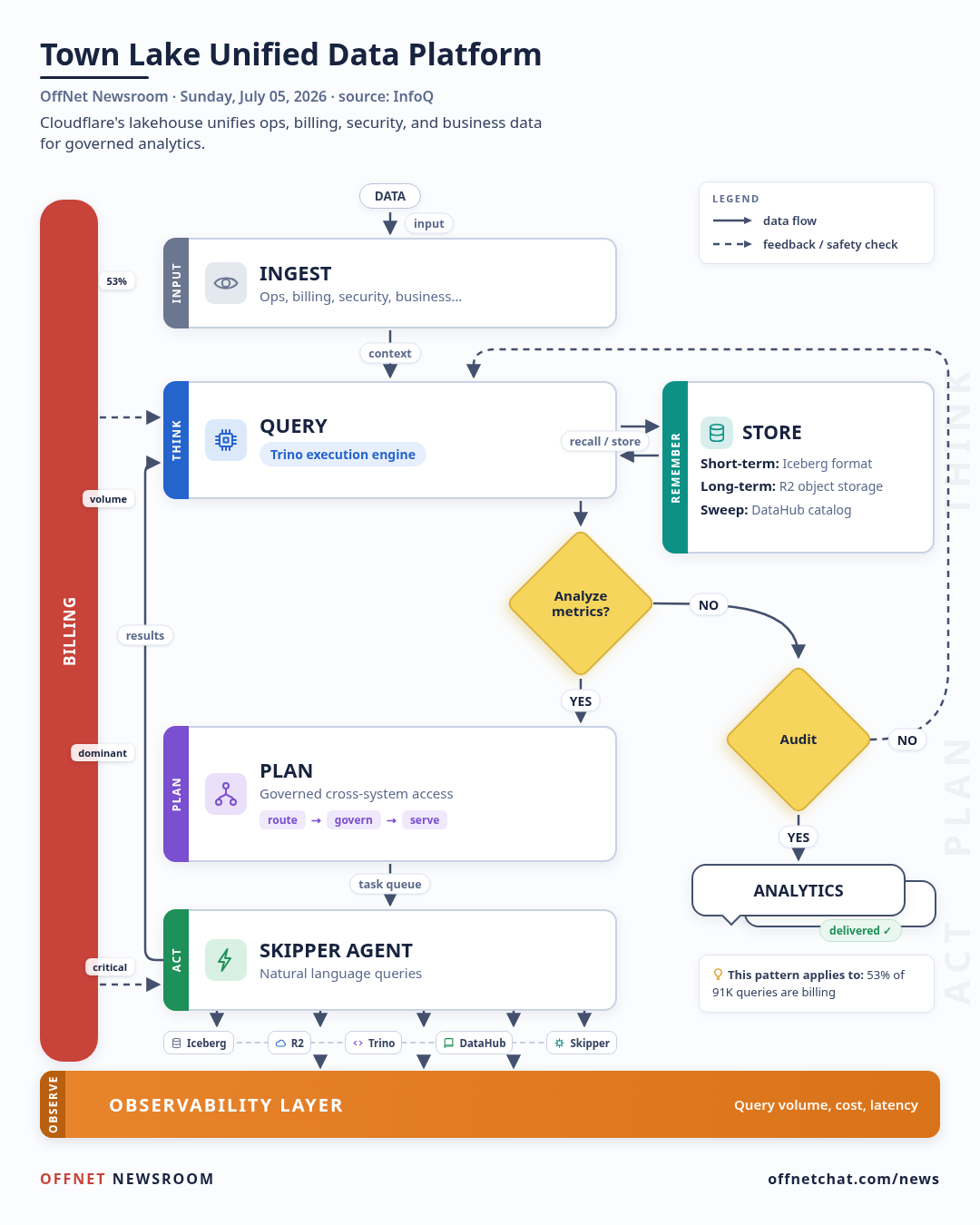
Cloudflare has introduced Town Lake, an internal unified data platform leveraging a lakehouse architecture built on Trino, Iceberg, R2, and DataHub. The system integrates operational, billing, security, and business data, enabling governed cross-system analytics. Notably, billing workloads dominate usage, accounting for approximately 53% of the ~91K queries processed.

  • Billing queries constitute 53% of total volume, highlighting their critical role in data infrastructure planning.
  • Town Lake unifies disparate data sources (ops, billing, security, business) into a single governed lakehouse.
  • The stack relies on open standards: Trino for query execution, Iceberg for table format, and R2 for storage.
  • Skipper acts as an AI analytics agent, providing natural language access to the unified data layer.
GitHub Trending (daily) githubrepos ↺ since 07-03 ⚠ unverified date/source

Harvard CS249r Book: Engineering End-to-End AI Systems

This GitHub repository hosts the textbook for Harvard's CS249r course, focusing on the principles of engineering machine learning systems. It addresses the gap between building isolated models and deploying efficient, reliable AI in production. The resource includes multiple volumes, labs, and a dedicated section on StaffML for engineering leadership.

  • Covers the full lifecycle of AI engineering, not just model training.
  • Emphasizes reliability, safety, and robustness in real-world deployments.
  • Includes companion resources like labs and StaffML guidance.
  • Hardcopy edition with MIT Press is scheduled for 2026.

Agentic AI 8

roundup ↗
AWS What's New awsdatabase ↺ since 07-02

Amazon Bedrock AgentCore raises default runtime quotas for higher concurrency

AWS has increased the default runtime quota limits for Amazon Bedrock AgentCore to support larger-scale agent deployments. Concurrent session caps now reach 5,000 in US East and West, while all regions support 200 interactions per second and 25 new sessions per second. These adjustments allow developers to handle high-throughput workloads without immediately requesting quota increases.

  • US East and West regions now support 5,000 active concurrent sessions by default.
  • All regions support 200 agent interactions per second and 25 new sessions per second.
  • Higher default limits reduce friction for scaling high-throughput AI agent workloads.
  • Monitor actual usage against these new caps to avoid unexpected throttling.
AWS What's New awsdatabase ↺ since 07-03

AWS GA Amazon WorkSpaces for AI Agents: Screen-Level Automation for Legacy Apps

Amazon WorkSpaces for AI agents is generally available, allowing agents to interact with desktop applications via screen-level automation. This enables enterprises to automate workflows on critical, hard-to-modernize systems like ERPs and mainframes without building custom integrations. The service leverages existing WorkSpaces infrastructure to provide a secure, managed environment for these automated operations.

  • Agents operate desktop apps via screen interaction, bypassing the need for API modernization.
  • Ideal for automating legacy ERPs, CRMs, and mainframes with strict compliance needs.
  • Uses established WorkSpaces infrastructure for secure, scalable agent deployment.
  • Eliminates costs associated with custom integrations for proprietary tools.
GitHub Trending (daily) githubrepos ⚠ unverified date/source

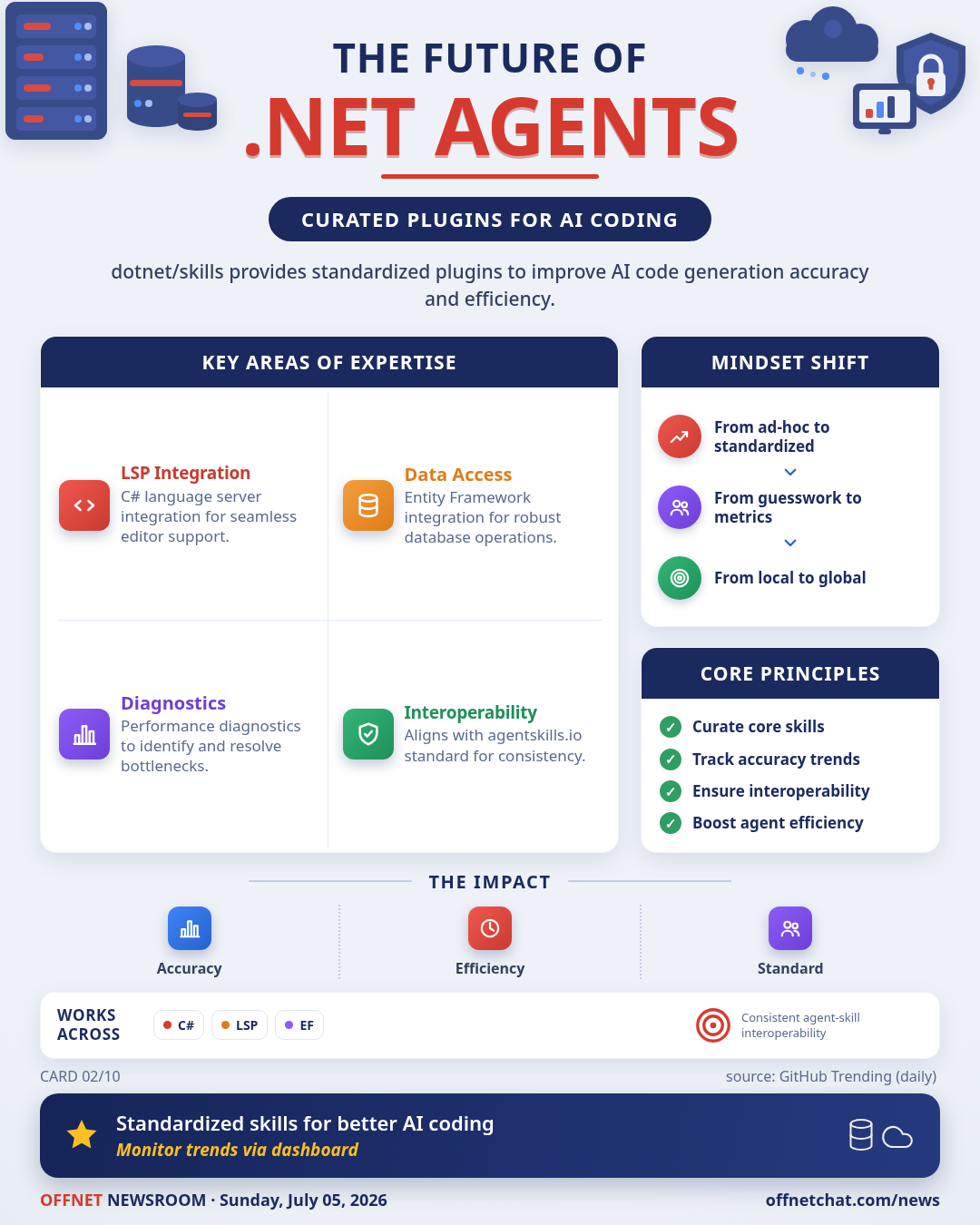
dotnet/skills curates core plugins for .NET AI coding agents

The .NET team has released dotnet/skills, a repository of curated plugins designed to assist AI coding agents. These skills cover C# language server integration, advanced scenarios, data access via Entity Framework, and performance diagnostics. The project includes a dashboard tracking accuracy and efficiency metrics for the contained plugins.

  • Provides standardized .NET skills for AI coding agents to improve code generation accuracy.
  • Covers critical areas including LSP integration, data access, and performance diagnostics.
  • Offers a public dashboard to monitor plugin accuracy and efficiency trends over time.
  • Aligns with the agentskills.io standard for consistent agent-skill interoperability.
GitHub Trending (daily) githubrepos ↺ since 07-04 ⚠ unverified date/source

Agent Skills proposes open standard for extending AI agent capabilities

The agentskills/agentskills repository introduces a lightweight, open format for standardizing how AI agents acquire new expertise. A skill is defined as a folder containing a SKILL.md file with metadata and instructions, alongside optional scripts and reference materials. This structure allows developers to bundle specialized knowledge and workflows that agents can execute directly.

  • Standardizes agent extensibility via a simple folder-based structure.
  • SKILL.md file serves as the core manifest for metadata and instructions.
  • Supports bundling scripts, references, and templates for complex tasks.
  • Enables portable, reusable capabilities without vendor lock-in.
  • Reduces friction in integrating specialized domain knowledge into agents.
AWS What's New awsdatabase ↺ since 07-03

Amazon Bedrock AgentCore expands to Bangkok, Malaysia, Milan, and Spain

AWS has extended Amazon Bedrock AgentCore availability to four new regions: Asia Pacific (Bangkok and Malaysia) and Europe (Milan and Spain). This service enables engineers to build, connect, and optimize AI agents using any framework or model while enforcing infrastructure-level security. The expansion allows customers to deploy agents closer to end users to reduce latency, with full capabilities including runtime, identity management, and observability available at launch.

  • Bedrock AgentCore is now live in Asia Pacific (Bangkok/Malaysia) and Europe (Milan/Spain).
  • Deploy agents closer to users in these regions to achieve lower latency.
  • Security policies are enforced at the infrastructure layer and cannot be bypassed by agents.
  • All core features like runtime, tool connectivity, and session persistence are available at launch.
InfoQ generaldevops ↺ since 07-03

InfoQ eMag defines Agentic AI as a dominant new software architecture

InfoQ releases a mini-book positioning agentic AI architecture as a primary software paradigm for the coming years. Industry experts contribute articles detailing the specific elements and aspects that constitute this new structural approach. The collection highlights current trends and developments as agentic systems transition into mainstream adoption.

  • Agentic AI architecture is framed as a distinct, future-dominant software design pattern.
  • Content is curated by industry experts covering key architectural components.
  • Focuses on mainstream trends shaping the evolution of agentic system design.
  • Serves as a foundational resource for understanding the new structural paradigm.
GitHub Trending (daily) githubrepos ↺ since 07-04 ⚠ unverified date/source

OpenAI releases Codex plugin for Claude Code

OpenAI has published a plugin enabling Claude Code users to invoke Codex for code reviews and task delegation. The integration supports read-only reviews, adversarial challenges, and background job management via slash commands. It requires a ChatGPT subscription or API key and runs on Node.js 18.18 or later.

  • Enables direct Codex invocation from within the Claude Code workflow
  • Supports read-only reviews and steerable adversarial challenge modes
  • Provides commands for delegating work, transferring sessions, and managing jobs
  • Requires ChatGPT subscription or OpenAI API key with usage limits
GitHub Trending (daily) githubrepos ⚠ unverified date/source

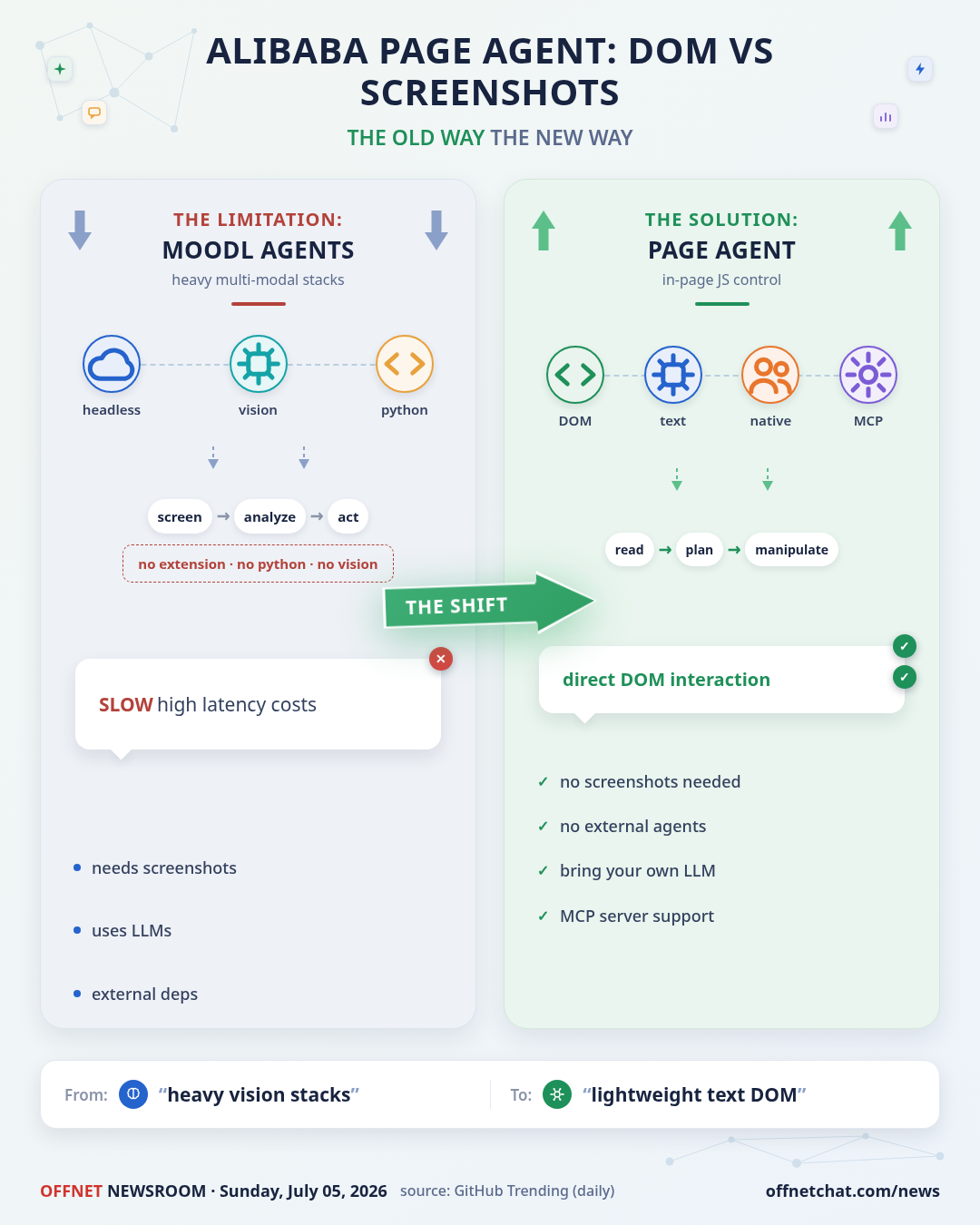
Alibaba Page Agent: In-page JS GUI control via natural language text DOM

Alibaba's Page Agent is a JavaScript-based GUI agent that operates directly within web pages, allowing users to control interfaces through natural language commands. It relies on text-based DOM manipulation rather than screenshots or multi-modal LLMs, eliminating the need for browser extensions, Python scripts, or headless browsers. The tool supports bringing your own LLMs and includes an optional Chrome extension and MCP Server for external control.

  • In-page JS integration avoids external dependencies like headless browsers or extensions.
  • Uses text-based DOM manipulation instead of screenshots or multi-modal AI models.
  • Enables rapid SaaS AI Copilot implementation with minimal code changes.
  • Optional MCP Server allows external systems to control the in-page agent.

Automation / DevOps / IaC 8

roundup ↗
AWS What's New awsdatabase ↺ since 07-03

SageMaker Unified Studio now supports Terraform provisioning

Amazon SageMaker Unified Studio now allows provisioning via the open-source terraform-aws-sagemaker-unified-studio module. Platform teams can integrate SageMaker domains into existing infrastructure-as-code pipelines for version-controlled deployments. This enables consistent state management across development, staging, and production accounts using familiar IaC workflows.

  • Use the official Terraform module to provision SageMaker Unified Studio domains.
  • Integrate SageMaker into existing IaC pipelines for consistent deployment.
  • Enforce version control for SageMaker domain configurations and access policies.
  • Maintain environment parity across dev, staging, and prod AWS accounts.
AWS What's New awsdatabase ↺ since 07-03

Amazon EKS adds safety net with automatic Kubernetes version rollback

Amazon EKS now allows users to revert to the previous minor Kubernetes version within seven days of an upgrade. The service performs automated readiness checks covering API compatibility, version skew, and add-on status before initiating the rollback. For EKS Auto Mode clusters, the system automatically rolls back worker nodes prior to reverting the control plane.

  • Revert to prior K8s minor version within 7 days of upgrade to mitigate production issues.
  • EKS validates rollback readiness via automated checks on API, skew, and add-ons.
  • EKS Auto Mode handles worker node rollback before control plane reversion automatically.
  • Rollbacks can be triggered via Console, AWS CLI, or AWS SDKs.

AWS CloudFormation now performs pre-deployment validation on Create Stack and Update Stack operations, catching common errors before resource provisioning begins. This feature, previously available only during change set creation, now runs automatically to detect property syntax errors, resource name conflicts, and S3 bucket constraints. The change eliminates the need to wait through full provision-and-rollback cycles for preventable failures, accelerating feedback loops in CI/CD pipelines and manual workflows.

  • Pre-deployment validation now runs automatically on Create and Update Stack operations.
  • Catches syntax errors, name conflicts, and S3 constraints before provisioning starts.
  • Eliminates wait time for full provision-and-rollback cycles on simple errors.
  • Accelerates feedback loops for manual, CI/CD, and AI agent infrastructure workflows.
AWS What's New awsdatabase ↺ since 07-02

AWS CloudFormation CDK Express Mode Cuts Deploy Time 4x

AWS has introduced Express Mode for CloudFormation and CDK, reducing infrastructure deployment times by up to 4x according to internal benchmarks. This new mode completes stack operations as soon as CloudFormation confirms resource configuration is applied, bypassing extended stabilization checks like traffic readiness and region propagation. The change targets faster iteration cycles for developers and AI agents building infrastructure incrementally in development environments.

  • Deployments skip full stabilization checks (traffic, propagation, cleanup) to complete faster.
  • Up to 4x speedup for CloudFormation and CDK stack operations based on internal data.
  • Enables rapid iteration for dev environments and AI agents building infrastructure.
  • Resource config confirmation is the new completion trigger instead of full stabilization.
InfoQ generaldevops ↺ since 07-04

OpenTelemetry graduates to CNCF highest maturity level

The CNCF has officially promoted OpenTelemetry to its highest maturity tier, confirming the project is production-ready for enterprise environments. This graduation formally recognizes the observability framework's stability and widespread adoption across cloud-native stacks. The move signals strong industry consensus on OpenTelemetry as the standard for telemetry data collection.

  • OpenTelemetry is now the definitive CNCF standard for observability telemetry.
  • Enterprise adoption is validated by the foundation's highest maturity rating.
  • Projects using OpenTelemetry can expect long-term stability and support.
  • Integration efforts should prioritize OTel for future-proofing observability pipelines.
GitHub Trending (daily) githubrepos ⚠ unverified date/source

Terax AI: 7MB Terminal-First Dev Workspace with Agentic AI Side-Panel

Terax is a lightweight, open-source terminal environment built on Tauri 2, Rust, and React 19. It combines a native PTY backend with a WebGL renderer to offer a full dev workspace including a code editor, file explorer, and git graph. The tool features an agentic AI side-panel that supports user-provided keys or fully local models, ensuring no telemetry or accounts are required.

  • Built on Tauri 2 + Rust/React 19 for a native, lightweight (~7MB) footprint.
  • Integrates an agentic AI side-panel for local models or user API keys.
  • Includes a WebGL-rendered terminal, git graph, and web preview pane.
  • Zero telemetry and no account requirements for privacy-conscious devs.
GitHub Trending (daily) githubrepos ⚠ unverified date/source

Caveman: Claude Code Skill Cuts Output Tokens by 65% via Concise Speech

Caveman is a plugin for major AI coding agents that forces the model to communicate in a terse, 'caveman-style' syntax. This approach eliminates conversational filler while preserving the exact byte-for-byte integrity of code, commands, and error outputs. The result is a significant reduction in output tokens, potentially lowering costs and speeding up interactions for heavy users.

  • Reduces output tokens by approximately 65% by stripping conversational filler.
  • Compatible with 30+ agents including Claude Code, Cursor, and Copilot.
  • Preserves code and command blocks with byte-for-byte accuracy.
  • Install as a skill or plugin to apply consistently across sessions.
  • Ideal for cost-sensitive workflows where token usage drives expenses.
GitHub Trending (daily) githubrepos ⚠ unverified date/source

mattpocock/skills offers composable AI agent skills for precise engineering control

This GitHub repository provides a collection of agent skills designed for practical software engineering rather than experimental coding. The author argues that existing frameworks often remove developer control and complicate bug resolution, whereas these skills are small, adaptable, and model-agnostic. Built on extensive engineering experience, they aim to give practitioners granular control over their AI-assisted workflows.

  • Avoids rigid process frameworks to maintain developer control over AI interactions
  • Skills are composable and work with any language model for flexibility
  • Designed for real application development, not just high-level vibe coding
  • Easy to install via npx and customize to fit specific engineering needs

AWS 6

roundup ↗
AWS Database Blog awsdatabase ↺ since 07-03

AWS details user auth and session management for Aurora DSQL

The AWS Database Blog outlines design patterns for implementing user authentication and session management on Amazon Aurora DSQL. It maps the full request flow from client to database, highlighting architectural considerations specific to the DSQL engine. The post shares practical lessons learned from building and testing these services against a live cluster.

  • Aurora DSQL requires specific design patterns for user authentication services.
  • Session management must account for the unique request flow in DSQL.
  • Live cluster testing reveals practical implementation lessons and edge cases.
  • Review DSQL-specific architectural constraints when designing auth flows.

CISA has added a SharePoint Remote Code Execution vulnerability to the Known Exploited Vulnerabilities catalog, overriding Microsoft's assessment that active exploitation was unlikely. The flaw allows attackers with valid SharePoint credentials to execute arbitrary code on vulnerable on-premises servers. This move signals urgent operational risk for organizations running affected SharePoint versions.

  • CISA mandates patching regardless of vendor exploitation likelihood assessments.
  • Valid SharePoint account credentials are sufficient to trigger the RCE.
  • On-prem SharePoint servers face immediate critical exposure.
  • Prioritize patching this vulnerability over other lower-severity issues.
  • Review access controls for SharePoint accounts to limit blast radius.
AWS What's New awsdatabase ↺ since 07-02

AWS RDS Cross-Region Automated Backups expand to 4 new regions

Amazon RDS now supports replicating automated backups across regions in Mexico Central, Asia Pacific Taipei, New Zealand, and Thailand. This feature enables point-in-time recovery for mission-critical databases by storing backup copies in geographically distant locations. Specific replication paths are enabled, such as Mexico Central to Europe (Ireland) or US West (N. California), and Asia Pacific Taipei to Singapore or Tokyo.

  • Mexico Central RDS backups can now replicate to Europe (Ireland) or US West (N. California)
  • Asia Pacific (Taipei) backups replicate to Singapore or Tokyo for improved disaster recovery
  • New Zealand and Thailand RDS instances can replicate backups to nearby APAC regions like Singapore
  • Enhanced geographic redundancy for mission-critical databases without manual backup management
  • Simplifies compliance with data residency and disaster recovery requirements in these regions
AWS What's New awsdatabase ↺ since 07-03

AWS Security Hub CSPM adds AI Security Best Practices standard with 31 controls

AWS Security Hub CSPM has introduced an AI Security Best Practices standard featuring 31 automated controls. This new standard enables continuous evaluation of Amazon Bedrock, Bedrock AgentCore, and SageMaker workloads against recommended security configurations. It eliminates the need for manual assessments or custom rule authoring by checking critical domains like network isolation, encryption, and VPC placement.

  • Covers 31 automated controls for AI workloads without custom rule authoring.
  • Validates configurations for Bedrock, Bedrock AgentCore, and SageMaker.
  • Enforces controls on network isolation, encryption, and KMS key usage.
  • Requires private container registries and strict authorization controls.
  • Provides continuous compliance evaluation for deployed AI resources.

Apple has partnered with Google Cloud to host its Private Cloud Compute service externally for the first time, leveraging NVIDIA Blackwell GPUs, Intel Trust Domain Extensions, and Google's Titan security chip. The architecture relies on an independent append-only hardware ledger and dual-vendor attestation roots to ensure integrity, while explicitly excluding AWS and Azure from this collaboration. This move marks a strategic shift in how Apple extends its confidential computing capabilities beyond its own data centers.

  • Apple utilizes NVIDIA Blackwell GPUs and Intel TDX for hardware-level security in this external deployment.
  • Dual-vendor attestation and an append-only ledger enforce integrity without relying on AWS or Azure.
  • This expands Private Cloud Compute beyond Apple's internal infrastructure to Google Cloud exclusively.
  • The solution integrates Google's Titan chip to bolster the trusted execution environment.
AWS What's New awsdatabase ↺ since 07-02

EC2 Auto Scaling adds reservations-then-balanced AZ strategy

Amazon EC2 Auto Scaling now supports a 'reservations-then-balanced' distribution strategy that prioritizes launching instances into capacity reservations before spreading remaining capacity across Availability Zones. This update targets On-Demand Capacity Reservations, Capacity Blocks, and Interruptible Capacity Reservations to maximize utilization of pre-purchased compute. Users configure this by setting the capacity distribution strategy in the Auto Scaling group’s AZ configuration and specifying target reservations via ARN or ID.

  • Prioritizes filling Capacity Reservations before falling back to balanced AZ distribution for better cost efficiency.
  • Supports ODCRs, Capacity Blocks, and Interruptible Capacity Reservations within the same strategy.
  • Configurable via Auto Scaling group AZ settings using Capacity Reservation Group ARNs or individual IDs.
  • Maintains operational resilience of Auto Scaling while optimizing pre-purchased capacity utilization.

Oracle Ecosystem 1

roundup ↗

Oracle has silently reduced the Always Free Ampere A1 compute allowance from 4 OCPUs and 24 GB RAM to 2 OCPUs and 12 GB RAM. The change was implemented without public notice, leading to confusion as documentation claims the new limits apply to all tenancies while support agents indicated only free-tier accounts are affected. Support staff provided conflicting information regarding whether PAYG accounts are impacted.

  • Always Free Ampere A1 limits are now 2 OCPUs and 12 GB RAM, a 50% reduction.
  • No public announcement was made; users discovered the change via support interactions.
  • Documentation conflicts with support statements on scope: all tenancies vs. free-tier only.
  • PAYG account impact remains unclear due to inconsistent support agent responses.
  • Review current free-tier usage immediately to avoid unexpected throttling or limits.

Mobile friendly 6

all cards ↗

Today's top database + AI stories as save-and-share cards — built for your phone and your LinkedIn feed.