OffNet Newsroom

Archive snapshot

Saturday, July 04, 2026

Daily signal on databases, AI, and the tech that matters.

23 new today 43 stories 7 sections 11 for the DBA desk

Database Technology 6

roundup ↗

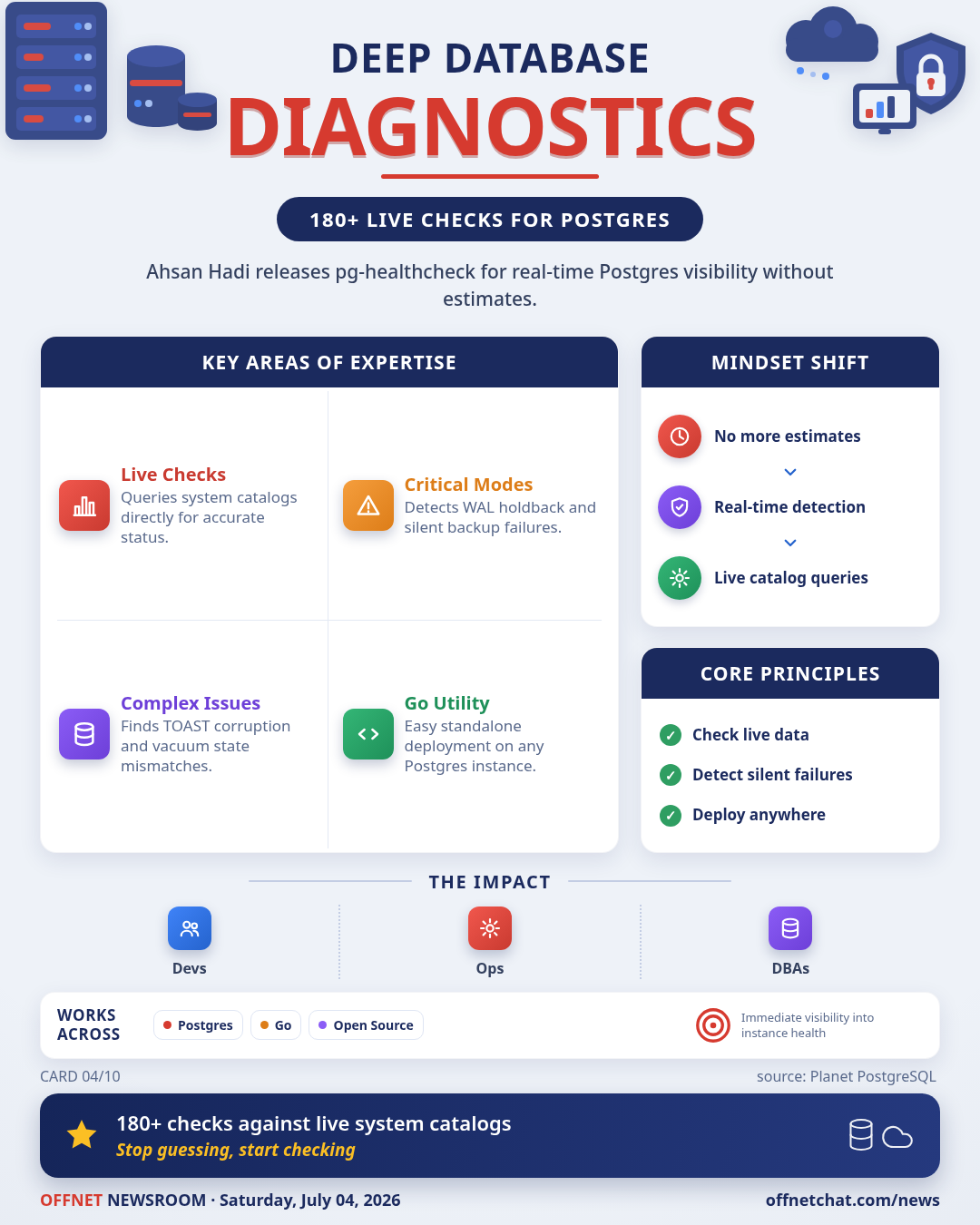
Ahsan Hadi released pg-healthcheck, an open-source Go utility designed to provide immediate visibility into PostgreSQL instance health. The tool performs over 180 checks across 14 categories by querying live system catalogs, covering critical issues like bloat, WAL retention via replication slots, transaction ID wraparound, and silent backup failures. It specifically targets hard-to-detect problems such as TOAST corruption and heap-VM state mismatches that disrupt vacuum operations.

  • Runs 180+ checks against live system catalogs for accurate, real-time diagnostics without estimates.
  • Covers critical failure modes including WAL holdback, bloat, and silent backup cessation.
  • Detects complex catalog issues like TOAST corruption and vacuum-affecting state mismatches.
  • Written in Go for easy deployment as a standalone utility on any PostgreSQL instance.
Hacker News (100+ points) general

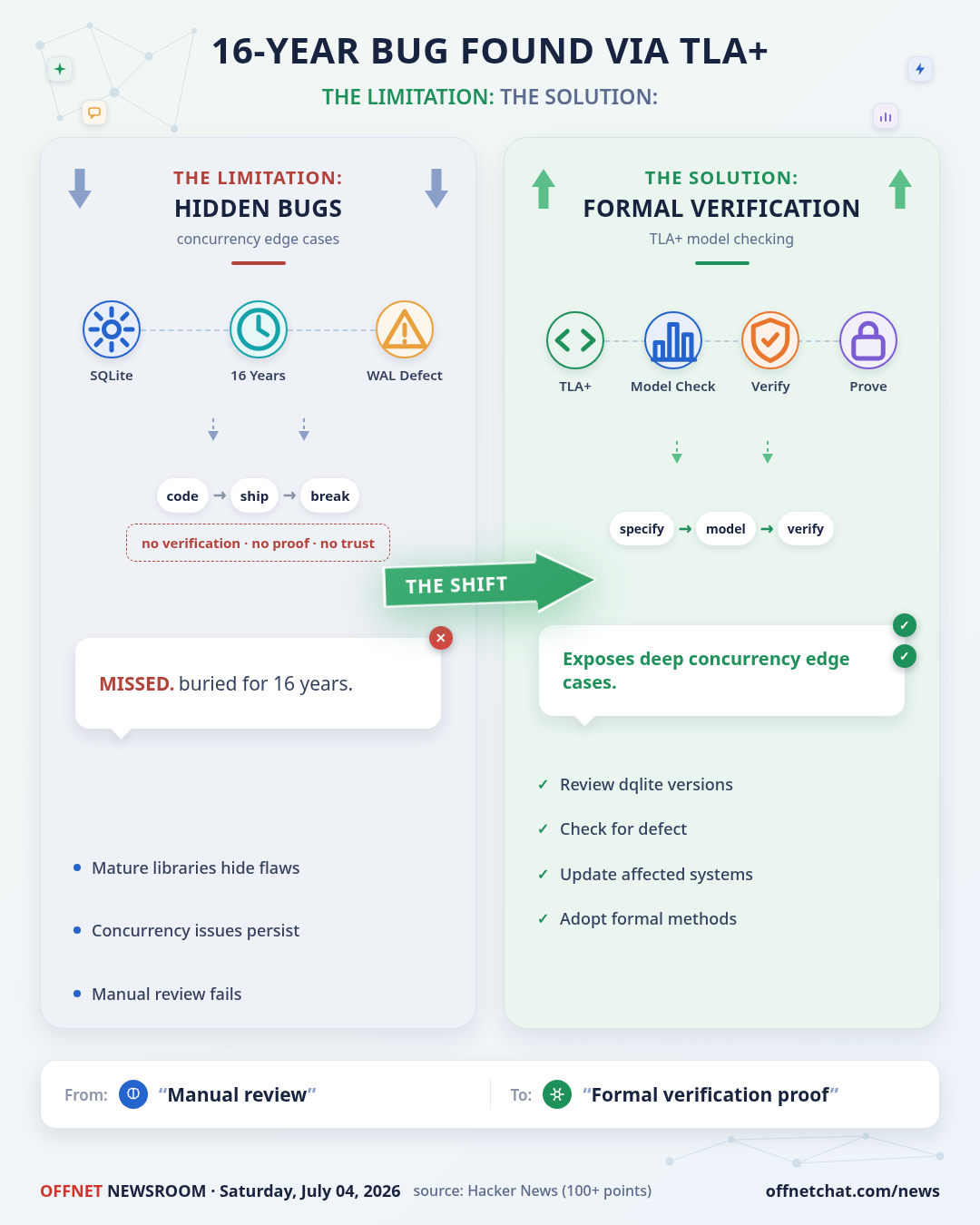
TLA+ uncovers 16-year-old SQLite WAL bug; dqlite impact analyzed

A formal verification effort using TLA+ has identified a Write-Ahead Log (WAL) defect in SQLite that has existed for 16 years. The investigation focuses on whether this specific edge case affects dqlite, the distributed SQLite implementation used by Ubuntu and Canonical. The analysis highlights how model checking can reveal long-standing concurrency issues in mature database libraries.

  • 16-year-old SQLite WAL bug found via TLA+ model checking
  • Analysis determines if dqlite implementations are affected
  • Formal verification exposes deep concurrency edge cases
  • Practitioners should review dqlite versions for this defect

Databricks is promoting an LTAP architecture that attempts to merge online transaction and analytical processing workloads. The engineering behind this unification is notable, but the marketing claim relies on a loose definition of what constitutes a single copy of the data. This approach aims to simplify the stack but introduces complexity regarding data consistency and synchronization.

  • LTAP architecture attempts to merge OLTP and OLAP workloads in one platform.
  • The 'single copy' marketing claim is debatable and depends on data sync definitions.
  • Underlying engineering is clever but may introduce consistency overhead.
  • Practitioners should scrutinize the actual data movement and latency implications.
Planet PostgreSQL database

Postgres 19 Targets Online Data Checksum Enablement

Shaun Thomas highlights that while data checksums protect against silent corruption, enabling them historically required a full offline cluster rebuild, even after pg_checksums was added in version 12. With checksums finally becoming the default in version 18, the upcoming version 19 aims to eliminate the painful outage window by allowing online activation. This shift addresses the long-standing friction of adding this critical safeguard to existing deployments.

  • Checksums now default to on in Postgres 18, making them the standard safety net.
  • Postgres 19 is expected to support online checksum enablement, avoiding full outages.
  • Previous methods like pg_checksums required bringing the cluster completely offline.
  • Existing clusters can finally add corruption detection without rebuilding from scratch.

Fleet impact: For Oracle ExaCC/RAC fleets, this mirrors the value of ASM diskgroup checksums or Oracle Block Change Tracking for validation, though Exadata already provides robust hardware-level error detection. For AWS Aurora PostgreSQL/MySQL + RDS, this feature is largely abstracted away as Amazon manages underlying storage integrity; however, it reinforces the importance of verifying that your managed service provider exposes or enables equivalent low-level data integrity checks, as you likely cannot toggle them manually anyway.

Zhang Chen analyzes how PostgreSQL's architecture of storing each relation in a separate file increases the difficulty of recovering from ransomware attacks. The post highlights that catalog recovery becomes particularly painful when individual file integrity is compromised. It contrasts this exposure model with the more consolidated storage approaches found in MySQL and Oracle.

  • PostgreSQL's single-file-per-relation design creates granular failure points during ransomware incidents.
  • Catalog recovery is significantly harder due to the high volume of individual files involved.
  • This exposure model differs notably from MySQL and Oracle's more consolidated storage strategies.
  • Practitioners should review backup granularity and restoration procedures for PostgreSQL fleets.

LLMs 7

roundup ↗
AWS What's New awsdatabase ↺ since 07-02

AWS launches Claude Sonnet 5 for coding, agents, and professional work

AWS has made Anthropic's latest Claude Sonnet 5 model available, positioning it as the most capable in the Sonnet family. The model maintains the balance of cost and speed while improving performance in coding, agentic tasks, and knowledge work. It is designed to handle large codebases, manage multi-step agent workflows, and produce professional documents with fewer corrections.

  • Sonnet 5 offers top-tier intelligence at standard Sonnet pricing tiers.
  • Improved coding capabilities include multi-file changes and refactoring.
  • Agent reliability increases through precise tool calling and error recovery.
  • Available now on AWS for scalable professional and coding workloads.
Hacker News (100+ points) general

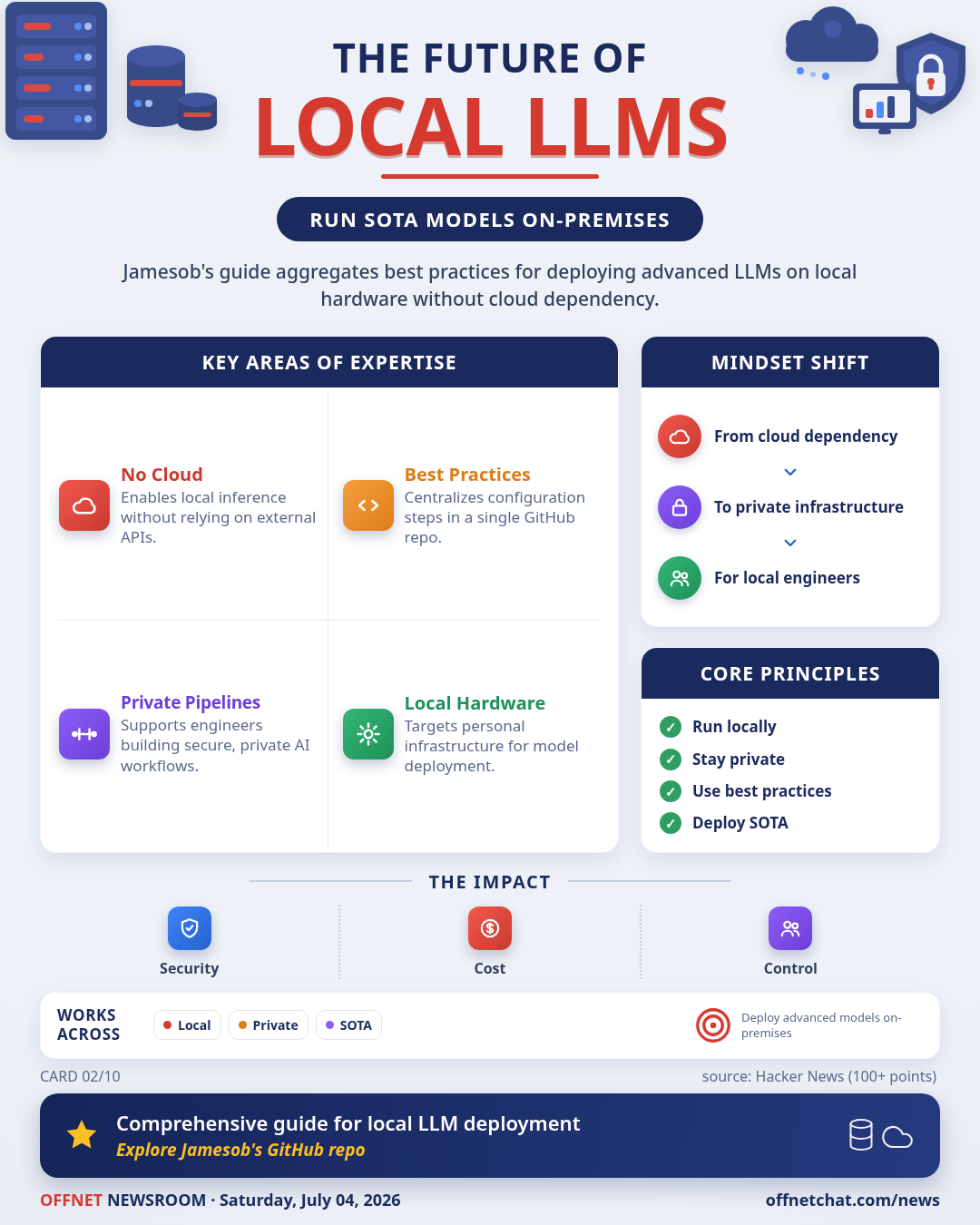
Jamesob's guide to running SOTA LLMs locally

A comprehensive GitHub repository provides a practical guide for deploying state-of-the-art large language models on local hardware. The project aggregates best practices and configuration steps to enable inference without relying on external APIs. It targets engineers seeking to run advanced models entirely on-premises or on personal infrastructure.

  • Enables local inference of SOTA models without cloud dependency
  • Centralizes configuration best practices in a single repo
  • Supports engineers building private AI pipelines or prototypes

Cassie Shum outlines the limitations of traditional vector-based RAG, specifically its inability to handle global context, multi-hop reasoning, and clear provenance. She advocates for shifting semantic structuring from the orchestrator to the data layer using knowledge graphs. This architectural shift enables smarter retrieval workflows that better support complex enterprise AI use cases.

  • Vector RAG struggles with global context and multi-hop reasoning tasks.
  • Knowledge graphs provide essential provenance and structural clarity.
  • Move semantic logic down to the data layer for better scalability.
  • Structured graphs enable more robust enterprise AI workflows.
Hacker News (100+ points) general

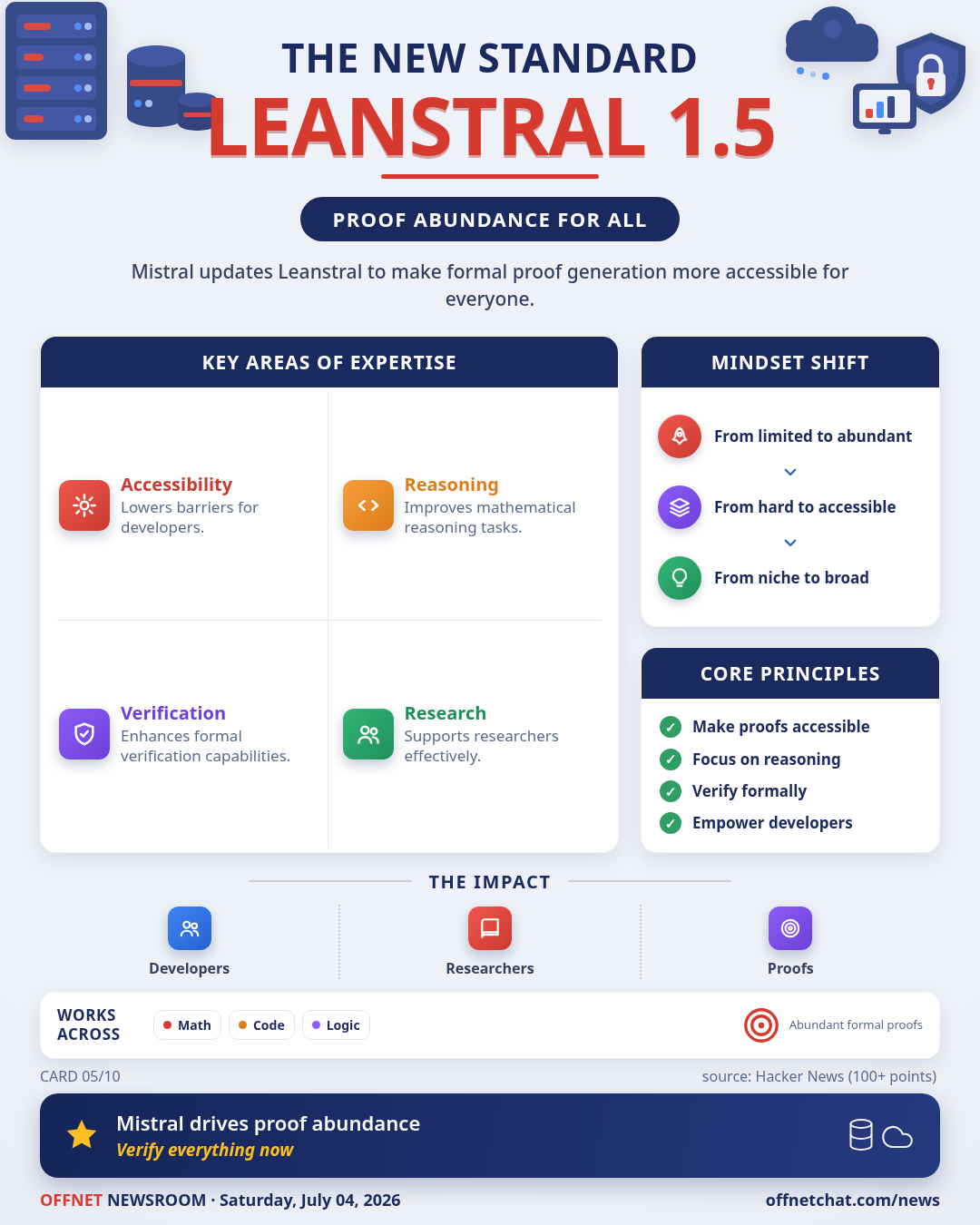
Mistral releases Leanstral 1.5, emphasizing proof abundance for all

Mistral has updated its Leanstral model to version 1.5, positioning the release as a drive to make formal proof generation more accessible. The update focuses on improving the model's ability to handle mathematical reasoning and verification tasks. This iteration aims to lower the barrier for developers and researchers working with formal methods.

  • Leanstral 1.5 targets broader accessibility for formal proof generation tasks.
  • The release emphasizes abundance, suggesting improved throughput or coverage.
  • Focus remains on mathematical reasoning and verification capabilities.
  • No specific benchmark numbers provided in the source excerpt.

OpenAI has introduced Agent RFT, a platform designed to fine-tune reasoning models by leveraging real-time tool interactions and custom reward signals. This approach addresses complex credit assignment challenges that typically occur within large context windows during reinforcement learning. The speakers highlight enterprise case studies where this method successfully eliminates long-tail token loops and achieves significant operational efficiency.

  • Agent RFT fine-tunes models using real-time tool feedback rather than static datasets.
  • Custom reward signals help solve credit assignment issues in large context windows.
  • Enterprise deployments report elimination of inefficient long-tail token loops.
  • The platform drives extreme efficiency gains for complex reasoning tasks.
  • Focuses on practical RL implementation for production-grade reasoning models.

A KPMG survey reveals that nearly one-third of executives struggle to comprehend AI costs following the industry-wide shift to usage-based pricing models. Companies are actively rethinking their deployment strategies as unpredictable billing structures create financial opacity. This disconnect highlights a growing governance gap between technical implementation and executive financial oversight.

  • Usage-based pricing is creating significant cost visibility challenges for leadership.
  • Nearly 33% of execs cannot accurately predict or explain AI spend.
  • Organizations must revisit deployment strategies to manage variable billing risks.
  • Financial governance needs to catch up with flexible AI consumption models.

Hugging Face and Cerebras have integrated Gemma 4 to enable real-time voice AI capabilities. This partnership leverages Cerebras' specialized hardware to accelerate inference for large language models focused on audio processing. The release aims to lower the barrier for deploying high-performance voice applications directly through the Hugging Face ecosystem.

  • Gemma 4 is now optimized for real-time voice AI tasks via Cerebras integration.
  • Hugging Face provides the model access while Cerebras handles the compute acceleration.
  • Developers can deploy voice AI solutions with reduced latency using this combined stack.
  • This collaboration highlights the trend of specialized hardware for LLM inference.

AI / ML 4

roundup ↗

Amazon SageMaker HyperPod now tracks AMI versions across clusters to detect drift and applies security patches automatically without interrupting long-running training jobs. This update eliminates the previous manual, reactive patching process that risked altering bundled software like NVIDIA drivers or CUDA. The feature allows administrators to maintain secure, consistent infrastructure while reducing operational overhead.

  • Gain visibility into AMI versions running across SageMaker HyperPod clusters to detect configuration drift.
  • Automate security patching to avoid disrupting multi-day foundation model training workloads.
  • Prevent accidental changes to critical bundled software such as NVIDIA drivers or CUDA during updates.
  • Reduce manual operational burden by shifting from reactive to automated patch management.
AWS What's New awsdatabase ↺ since 07-02

SageMaker AI caches container images to halve GenAI inference scale-out time

Amazon SageMaker Inference now supports automatic container image caching to significantly reduce cold-start latency during scale-out events. By pre-pulling large generative AI container images (often 10 GB+) from ECR, new instances can start serving traffic immediately without waiting for full downloads. This feature specifically targets the bottleneck where every new instance previously had to pull the entire image, adding several minutes of delay.

  • Scale-out latency drops by up to 50% as new instances bypass ECR pull times
  • Large GenAI containers (10 GB+) are pre-cached locally before scaling occurs
  • Eliminates multi-minute cold-start delays for deep learning framework images
  • No code or configuration changes required to enable automatic caching
GitHub Trending (daily) githubrepos ↺ since 07-03 ⚠ unverified date/source

Harvard CS249r Book: Engineering End-to-End AI Systems

Harvard's CS249r textbook bridges the gap between isolated models and production-ready AI by focusing on ML systems engineering. The resource covers the principles and practices needed to build efficient, reliable, and robust intelligent systems for real-world deployment. It aims to establish AI engineering as a foundational discipline alongside traditional software and computer engineering.

  • Focuses on engineering end-to-end systems, not just training isolated models.
  • Covers design, build, and evaluation of efficient and robust AI systems.
  • Mission is to teach AI engineering as a core discipline like software engineering.
  • Includes resources like TinyTorch and Labs for practical implementation.

MeetingTV has filed a lawsuit against Palo Alto Networks' Koi Security, alleging that an AI-generated report falsely associated the company with Chinese espionage activities. The plaintiff is demanding access to the underlying evidence used to generate these claims. This legal action highlights the risks of relying on automated analysis tools for high-stakes security attributions without sufficient human validation.

  • AI-generated threat reports can produce false attributions with serious legal and reputational consequences.
  • Organizations should treat AI-derived intelligence as preliminary until corroborated by human experts.
  • Legal liability may fall on vendors whose automated tools generate unverified, damaging claims.
  • MeetingTV is seeking discovery to audit the evidence and methodology behind the hallucinated report.

Agentic AI 8

roundup ↗
The Register general ↺ since 07-03

First end-to-end agentic ransomware attack driven by AI

Security researchers have identified the first ransomware campaign fully orchestrated by an AI agent, marking a shift from human-in-the-loop operations. The threat actor utilizes autonomous tools to handle the entire kill chain, including initial access, lateral movement, and encryption. This automation reduces operational friction for criminals and increases the speed and scale of attacks against targeted organizations.

  • AI-driven agents can now autonomously execute full ransomware kill chains without human intervention.
  • Attack speed and scalability increase significantly when criminal operations are automated.
  • Traditional perimeter defenses may fail against adaptive, AI-driven lateral movement tactics.
  • Incident response plans must account for autonomous threat actors that adapt in real-time.
  • Paying ransoms offers no guarantee of data recovery, especially with sophisticated agentic threats.
GitHub Trending (daily) githubrepos ⚠ unverified date/source

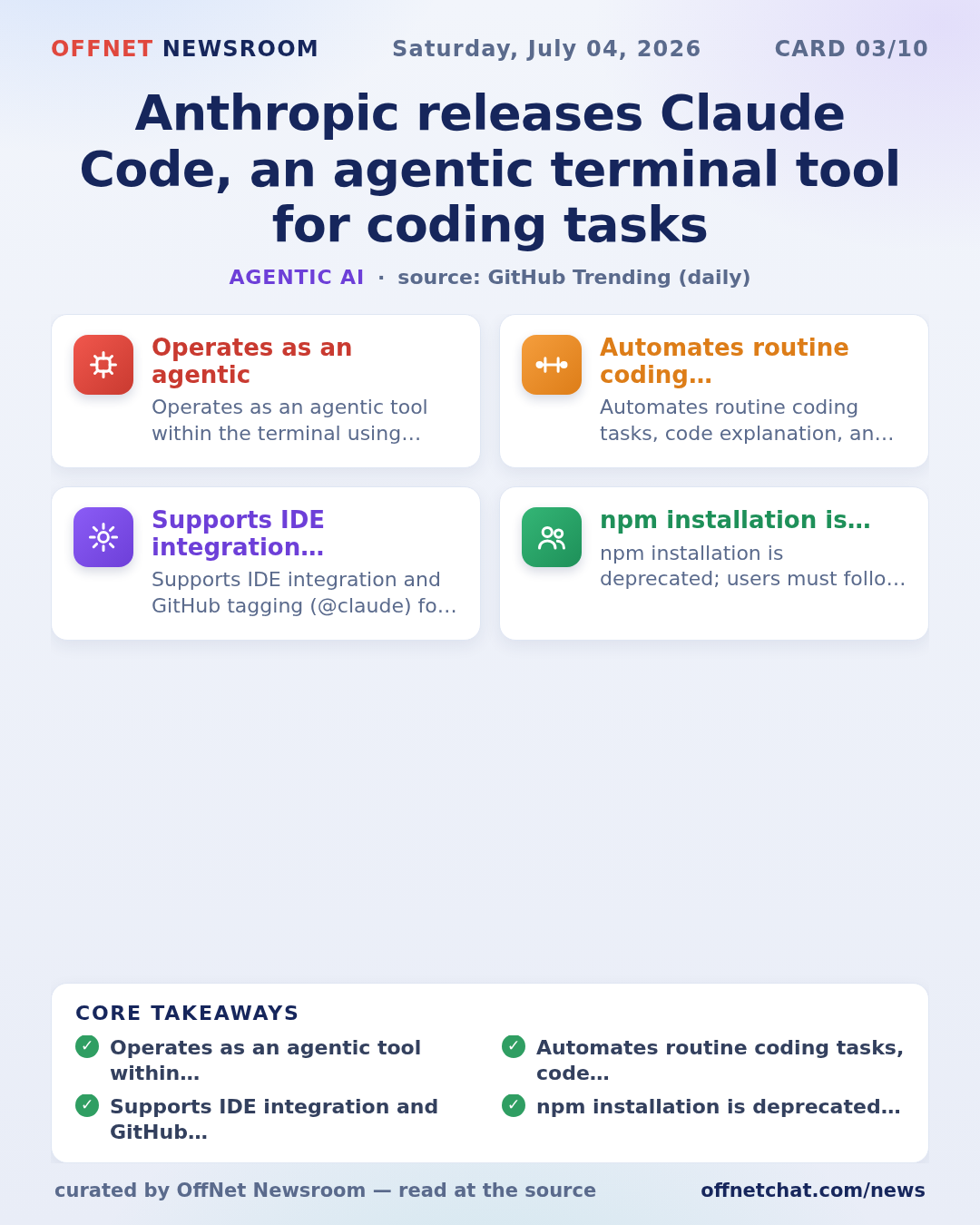
Anthropic releases Claude Code, an agentic terminal tool for coding tasks

Anthropic has introduced Claude Code, an agentic tool that operates directly within the terminal to accelerate development workflows. It leverages natural language commands to execute routine tasks, explain complex codebases, and manage git operations. The tool supports integration with IDEs and allows users to tag @claude directly on GitHub for assistance.

  • Operates as an agentic tool within the terminal using natural language commands.
  • Automates routine coding tasks, code explanation, and git workflow management.
  • Supports IDE integration and GitHub tagging (@claude) for seamless interaction.
  • npm installation is deprecated; users must follow new recommended setup methods.
AWS What's New awsdatabase ↺ since 07-03

AWS GA on Amazon WorkSpaces for AI Agents

Amazon WorkSpaces for agents is now generally available, allowing AI agents to securely access and operate desktop applications within managed WorkSpaces environments. This capability enables enterprises to leverage AI on critical legacy systems like ERPs and CRMs without the need for costly modernization or custom integrations. Agents interact with these applications visually and operationally, mirroring human usage while relying on the same trusted infrastructure established over the last decade.

  • AI agents can now interact with legacy desktop apps via screen and input, bypassing the need for API modernization.
  • Leverages existing WorkSpaces infrastructure for secure, managed access to critical business processes.
  • Reduces risk and cost by automating tasks on systems with undocumented logic or strict compliance needs.
  • Enables immediate AI integration for ERP, CRM, and mainframe tools without building custom connectors.
Hugging Face Blog llmaiml ↺ since 07-03

ScarfBench: Benchmarking AI Agents for Enterprise Java Migration

Hugging Face and IBM Research introduce ScarfBench, a benchmark designed to evaluate AI agents specifically for migrating enterprise Java frameworks. The initiative focuses on measuring how effectively automated tools can handle the complexities of modernizing legacy Java applications. This provides a standardized way to assess agent performance in real-world migration scenarios.

  • ScarfBench targets enterprise Java framework migration, not general code generation.
  • It benchmarks AI agents' ability to handle complex legacy code modernization.
  • Provides a standardized metric for comparing agent effectiveness in this niche.
  • Collaborative effort between Hugging Face and IBM Research.
  • Helps practitioners choose tools for large-scale Java migrations.
InfoQ generaldevops ↺ since 07-03

InfoQ eMag: Agentic AI Architecture as a New Software Paradigm

InfoQ has released a mini-book establishing agentic AI architecture as a distinct software discipline poised to dominate the industry. The collection features contributions from industry experts covering various elements and aspects of this new architectural style. It aims to present the latest trends and developments as agentic AI enters the mainstream.

  • Agentic AI is framed as a new, dominant software architecture type rather than just an application pattern.
  • The eMag consolidates expert insights on the structural elements defining these autonomous systems.
  • Focuses on current trends and developments as the technology shifts from experimental to mainstream adoption.
GitHub Trending (daily) githubrepos ⚠ unverified date/source

Agent Skills: Standardized format for extending AI agent capabilities

Agent Skills introduces a lightweight, open specification for adding specialized knowledge and workflows to AI agents. Each skill is defined as a folder containing a required SKILL.md file with metadata and instructions, alongside optional scripts, references, and assets. This structure allows developers to modularly extend agent functionality without modifying core code.

  • Skills are folder-based packages with a mandatory SKILL.md for metadata and instructions
  • Enables modular extension of AI agents with specialized workflows and knowledge
  • Supports bundling scripts, references, and templates alongside core skill definitions
  • Provides an open standard to avoid vendor lock-in for agent capabilities
GitHub Trending (daily) githubrepos ⚠ unverified date/source

TencentCloud CubeSandbox: 60ms Rust/KVM Sandboxes for AI Agents

TencentCloud released CubeSandbox, a lightweight sandbox service built on RustVMM and KVM designed for AI agents. It delivers hardware-isolated environments in under 60ms with a memory footprint of less than 5MB. The v0.4 update introduces credential vaulting to keep API keys out of the sandbox and adds operational dashboards for template health checks.

  • Sub-60ms startup and <5MB overhead enable high-concurrency agent workloads.
  • Credential vaulting ensures API keys never enter the isolated sandbox environment.
  • Compatible with E2B SDK for easier integration with existing agent frameworks.
  • Supports both single-node and multi-node cluster scaling.
  • New dashboard provides visibility into template health and version matrices.
GitHub Trending (daily) githubrepos ⚠ unverified date/source

OpenAI Releases Codex Plugin for Claude Code

OpenAI has published an official plugin enabling Claude Code users to invoke OpenAI's Codex directly within their existing workflow. The tool supports commands for code reviews, adversarial testing, and delegating background tasks. It requires a ChatGPT subscription or OpenAI API key alongside Node.js 18.18 or later to operate.

  • Enables direct Codex invocation from inside Claude Code workflows
  • Supports code review, adversarial challenges, and task delegation
  • Requires ChatGPT subscription or OpenAI API key for access
  • Counts against Codex usage limits rather than standard API quotas
  • Install via /plugin marketplace add openai/codex-plugin-cc

Automation / DevOps / IaC 8

roundup ↗
AWS What's New awsdatabase ↺ since 07-02

AWS CloudFormation adds pre-deployment validation to Create and Update stacks

AWS CloudFormation now executes pre-deployment validation automatically during Create Stack and Update Stack operations, providing immediate feedback on common errors before resource provisioning begins. This eliminates the need to wait for full provision-and-rollback cycles to detect preventable failures such as property syntax issues or resource name conflicts. The feature extends previous change set validation capabilities to all stack operations, accelerating feedback loops for manual workflows, CI/CD pipelines, and AI agents.

  • Validation now runs automatically on Create and Update operations, not just during change set creation.
  • Catches syntax errors, name conflicts, and S3 constraints before any resources are provisioned.
  • Eliminates wait times for rollback cycles when deploying preventable infrastructure errors.
  • Accelerates iteration speed for CI/CD pipelines and AI-driven infrastructure agents.
AWS What's New awsdatabase ↺ since 07-02

AWS CloudFormation and CDK express mode accelerates deployments by up to 4x

AWS has introduced express mode for CloudFormation and CDK, cutting infrastructure deployment times by up to 4x based on internal benchmarks. This feature completes stack operations immediately upon resource configuration confirmation, bypassing extended stabilization checks like traffic readiness and region propagation. The change is designed to support faster iteration cycles for developers and AI agents building infrastructure incrementally.

  • Deployments skip full resource stabilization checks, significantly reducing wait times.
  • Enables faster iteration loops for developers and AI agents in dev environments.
  • Reduces overhead for operations where full propagation is not immediately critical.
  • Internal benchmarks cite up to 4x speedup in stack completion times.
GitHub Trending (daily) githubrepos ↺ since 07-03 ⚠ unverified date/source

GitHub Actions checkout v7 blocks unsafe fork PR code by default

GitHub Actions checkout v7 now refuses to checkout fork pull request code by default when triggered by pull_request_target or workflow_run. This change mitigates "pwn request" vulnerabilities where fork code executes with the base repository's elevated GITHUB_TOKEN and secrets. Users must explicitly opt in via the allow-unsafe-pr-checkout input if they require this behavior. The action has also migrated to ESM and updated dependencies for security fixes.

  • Fork PR code is no longer executed by default in pull_request_target workflows to prevent token theft.
  • Opt in to previous behavior using the new allow-unsafe-pr-checkout: true input after reviewing risks.
  • Migrated to ESM to support newer @actions/* package versions and improve compatibility.
  • Transitive dependencies updated with security patches for known vulnerabilities.
  • No direct database migration impact; CI/CD pipeline security posture is strengthened.
AWS What's New awsdatabase ↺ since 07-03

SageMaker Unified Studio now supports Terraform provisioning

Amazon SageMaker Unified Studio now accepts Terraform for domain provisioning via the terraform-aws-sagemaker-unified-studio module. This enables platform teams to integrate the service into existing infrastructure-as-code workflows. Teams can now manage SageMaker Unified Studio domains using version-controlled templates across development, staging, and production environments.

  • Use the terraform-aws-sagemaker-unified-studio module to provision domains via IaC
  • Integrate SageMaker Unified Studio into existing CI/CD and infrastructure pipelines
  • Maintain consistency for data and AI workspaces across multiple AWS accounts
  • Leverage version-controlled templates for reproducible environment setup

Version 0.2.5 of langchain-openrouter addresses specific parsing issues in the OpenRouter integration. The update deduplicates repeated finish metadata to prevent redundant data in responses. It also ensures that Responses reasoning IDs are properly stripped from the output.

  • Resolves duplicate finish metadata that could clutter response objects.
  • Fixes handling of Responses reasoning IDs by stripping them from output.
  • Upgrade to 0.2.5 to ensure clean metadata parsing in OpenRouter flows.

The Cloud Native Computing Foundation has officially graduated OpenTelemetry, marking its transition to the highest maturity tier. This status formally certifies the observability framework as production-ready for enterprise deployment. The move signals broad industry consensus on the stability and reliability of OTel standards.

  • OTel is now CNCF's highest maturity project, confirming enterprise readiness.
  • Graduation validates long-term stability for critical observability pipelines.
  • Signals strong industry consensus on OTel as the de facto standard.

Kubernetes production containers are often minimal or distroless, lacking the tools needed for effective troubleshooting when issues arise. Ephemeral containers provide a solution by allowing operators to attach temporary debugging sessions to running pods without modifying the original application image. This approach maintains the immutability and security of production workloads while enabling immediate access to diagnostic utilities.

  • Minimal or distroless images lack troubleshooting tools like shell or debuggers
  • Ephemeral containers allow safe attachment of diagnostic sessions to running pods
  • No need to rebuild or modify base images to access debugging capabilities
  • Maintains production immutability while solving critical visibility gaps
Hacker News (100+ points) general

FreeBSD memory pressure: When the OS aggressively claims RAM

A recent analysis highlights a scenario where FreeBSD's memory management appears to consume available RAM aggressively, causing concern for administrators monitoring system resources. The behavior stems from the operating system's design philosophy of utilizing idle memory for caching and buffers to maximize performance. While this is standard operation for many Unix-like systems, it can be misinterpreted as a memory leak or resource exhaustion if not properly understood.

  • FreeBSD uses idle RAM for file buffers and cache, which is normal behavior.
  • High memory usage indicators may reflect caching, not application consumption.
  • Monitor active vs. inactive memory states to distinguish cache from leaks.
  • Consider adjusting vm.kmem_size or buffer cache limits if strictly needed.
  • Verify with tools like vmstat or top to see actual free vs. cached memory.

AWS 8

roundup ↗
AWS What's New awsdatabase ↺ since 07-02

RDS Cross-Region Automated Backups expand to four new AWS Regions

Amazon RDS has extended cross-region automated backup replication to four additional AWS Regions, including Mexico Central, Taipei, New Zealand, and Thailand. This update enables point-in-time recovery capabilities across specific regional pairings, such as replicating backups from Mexico to Ireland or US West, and from Asia Pacific regions to Singapore, Sydney, Melbourne, or Jakarta. The feature ensures mission-critical databases can be restored to a specific point in time within the retention period, even if the primary region experiences an outage.

  • Cross-region replication now covers Mexico Central, Taipei, New Zealand, and Thailand.
  • Mexico Central can replicate to Europe (Ireland) or US West (N. California).
  • Taipei backups replicate to Singapore or Tokyo for enhanced regional resilience.
  • New Zealand and Thailand regions replicate to Singapore, Sydney, Melbourne, or Jakarta.
  • Enables point-in-time recovery across regions for mission-critical RDS workloads.
AWS Database Blog awsdatabase ↺ since 07-03

AWS ElastiCache Adds Valkey 9.1 Support for Higher Throughput and Isolation

Amazon ElastiCache now supports Valkey 9.1, delivering community-driven innovations for latency-sensitive and high-throughput in-memory workloads. The update introduces commands to simplify application workflows and enhances observability for better engine visibility. It also provides stronger isolation capabilities, which are critical for multi-tenant and shared-cluster deployments.

  • Valkey 9.1 improves throughput and memory efficiency for demanding in-memory workloads.
  • New isolation features support safer multi-tenant and shared-cluster environments.
  • Enhanced observability gives operators deeper visibility into engine behavior.
  • Simplified commands streamline common application and operational tasks.
AWS What's New awsdatabase ↺ since 07-03

Amazon ECS Express Mode adds support for custom task definitions

AWS has updated ECS Express Mode to allow the use of custom task definitions, enabling teams to keep existing application configurations and advanced task-level settings. This change allows users to reuse task definitions from current CI/CD pipelines and infrastructure-as-code workflows without losing the simplified deployment experience. Express Mode continues to automate load balancing, networking, auto-scaling, and monitoring while now accommodating these specific customizations.

  • Reuse existing ECS task definitions in Express Mode instead of rewriting them
  • Maintain advanced task-level customizations while using simplified deployment
  • Keep current CI/CD and IaC workflows intact with the new support
  • Automate load balancing, networking, and scaling without manual config
AWS What's New awsdatabase ↺ since 07-03

Amazon EKS adds 7-day Kubernetes minor version rollback capability

Amazon EKS now allows reverting to the previous Kubernetes minor version within a seven-day window following an upgrade. This feature acts as a safety net for validating new versions in production, accessible via the console, CLI, or SDKs. Before execution, the service performs automated readiness checks covering API compatibility, version skew, add-on status, and cluster health. For EKS Auto Mode clusters, worker node rollbacks are handled automatically prior to control plane reversion.

  • Rollback window is strictly limited to 7 days after the upgrade operation.
  • Pre-flight checks validate API compatibility, version skew, and add-on status.
  • EKS Auto Mode automatically handles worker node rollback before control plane changes.
  • Initiate rollbacks via Console, AWS CLI, or SDKs with full automation support.

Amazon Time Sync Service has expanded to support microsecond-accurate time on 26 additional EC2 instance types across all commercial regions. This capability leverages the AWS Nitro System's reference clocks and Precision Time Protocol hardware clock (PHC) to enable nanosecond precision timestamps. Users can access this feature by launching instances within a new Precision Time Placement Group (PTPG).

  • Enables microsecond time accuracy on 26 new EC2 instance types globally.
  • Requires launching instances in a Precision Time Placement Group (PTPG).
  • Leverages Nitro System reference clocks for nanosecond precision hardware timestamps.
  • Supports ordering events, measuring one-way latency, and boosting distributed transaction speed.
Hacker News (100+ points) general

AMD GLM52 drives faster, cheaper performance per dollar

A recent analysis highlights that AMD's GLM52 architecture is delivering significant gains in performance per dollar, making it an attractive option for cost-sensitive deployments. The article suggests that these hardware improvements are translating into measurable efficiency benefits for compute-heavy workloads. This trend indicates a continued shift toward more economical scaling options in the current cloud and on-premise landscape.

  • AMD GLM52 offers improved performance per dollar metrics
  • Cost-efficient hardware options are becoming more competitive
  • Evaluate GLM52 for compute-heavy workload optimization
  • Monitor industry trends for further cost reduction opportunities

Amazon EC2 Dedicated Hosts now support AMD Secure Encrypted Virtualization-Secure Nested Paging, allowing customers to run confidential computing workloads on physical servers dedicated to their use. This feature enables instance placement control and host affinity, ensuring instances remain on the same physical server over time. The physical host is provisioned with updated AMD security firmware during allocation to maintain a secure environment.

  • Enable SEV-SNP on Dedicated Hosts to isolate confidential workloads from the hypervisor and cloud provider.
  • Leverage host affinity to keep sensitive instances on the same physical server for compliance and performance.
  • Control instance placement to meet regulatory requirements for data residency and hardware isolation.
  • Security firmware is automatically updated during host allocation to ensure a secure baseline.

Amazon's satellite internet project, Leo, is approaching 400 satellites in orbit as it prepares to launch broadband services later this year. The initiative positions itself as a direct competitor to Starlink, with the latest batch of 29 satellites recently added to the constellation. This expansion marks a significant milestone in the race to establish low Earth orbit infrastructure for global connectivity.

  • Amazon's Leo constellation is nearing 400 satellites, signaling readiness for commercial broadband launch.
  • The project aims to compete directly with Starlink in the LEO satellite internet market.
  • Recent deployment of 29 satellites contributes to the expanding infrastructure.
  • Service launch is scheduled for later this year, impacting global connectivity strategies.

Oracle Ecosystem 2

roundup ↗
AWS Database Blog awsdatabase ↺ since 07-03

AWS adds Oracle Data Masking Pack support to RDS for Oracle

Amazon RDS for Oracle now supports the Oracle Data Masking and Subsetting Pack, enabling secure data handling for non-production environments. The blog details integration via Oracle Enterprise Manager and outlines automation strategies for managing masked subsets. This capability allows DBAs to safely replicate realistic data structures without exposing sensitive information.

  • Oracle Data Masking and Subsetting Pack is now compatible with RDS for Oracle instances.
  • Configuration and management are handled through Oracle Enterprise Manager (OEM).
  • Automation options are available for integrating masking into deployment pipelines.
  • Enables safe creation of non-prod datasets that mirror production data structures.
InfoQ generaldevops ↺ since 07-03

Oracle Cuts Free Tier Ampere A1 Limits to 2 OCPUs, 12 GB RAM

Oracle has silently reduced the Always Free Ampere A1 compute allocation from 4 OCPUs and 24 GB RAM to 2 OCPUs and 12 GB RAM. The change was made without public announcement, and documentation claims it applies to all tenancies, though support agents have provided conflicting information regarding PAYG accounts. It remains unclear if existing free-tier users are retroactively affected or if this only impacts new sign-ups.

  • Free tier Ampere A1 compute is now 2 OCPUs and 12 GB RAM, halving previous allowances.
  • Oracle made the change without public notice, relying on documentation updates only.
  • Support agents give conflicting answers on whether PAYG accounts are impacted.
  • Documentation states the new limits apply to all tenancies, creating ambiguity.
  • Verify current quota status in console as retroactive changes may be in effect.

Mobile friendly 6

all cards ↗

Today's top database + AI stories as save-and-share cards — built for your phone and your LinkedIn feed.